Address
304 North Cardinal St.
Dorchester Center, MA 02124
Work Hours
Monday to Friday: 7AM - 7PM
Weekend: 10AM - 5PM
Address
304 North Cardinal St.
Dorchester Center, MA 02124
Work Hours
Monday to Friday: 7AM - 7PM
Weekend: 10AM - 5PM

If you search “what is feng shui” online, most results will show you a feng shui bagua map with 8 directions. North is Career. East is Family. Southeast is Wealth. You overlay the feng shui bagua map onto your floor plan, figure out which zone your bedroom falls in, and follow the advice. That’s the starting point for most people’s feng shui basics journey.
But classical feng shui, the system that practitioners in China have refined for over 3,000 years, doesn’t use 8 directions. It uses 24. And the gap between those two numbers changes everything about how the analysis works.
I ran both overlays on the same floor plan to show what that difference actually looks like.
The feng shui bagua divides the compass into 8 sectors of 45 degrees each. Each direction is assigned a Trigram, an element, and a life area:
That’s the feng shui bagua map. It’s clean, intuitive, and easy to apply. Every feng shui basics guide starts here.
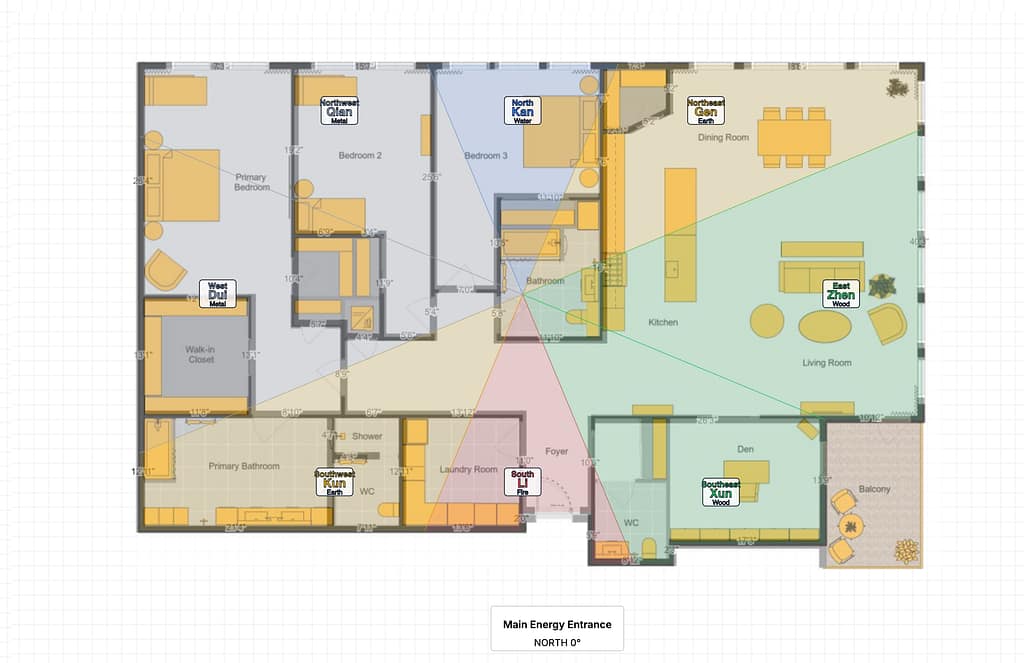
On this north-facing San Diego condo, the Ba Gua overlay maps the primary bedroom to “Northwest – Helpful People.” The living room and kitchen fall in “East – Family.” The den sits in “Southeast – Wealth.” Each room gets one label. One element. One life area.
For feng shui basics, this works. But if you want to run any classical formula, this is where it stops being enough.
The 24 Mountains system (二十四山向) divides the compass into 24 sectors of 15 degrees each. Not 8. Not 12. Twenty-four.
These 24 sectors aren’t arbitrary divisions. They combine three classification systems that are central to the principles of feng shui:
4 Trigram (Gua) sectors: Qian (乾), Kun (坤), Gen (艮), Xun (巽) 8 Heavenly Stem sectors: Jia (甲), Yi (乙), Bing (丙), Ding (丁), Geng (庚), Xin (辛), Ren (壬), Gui (癸) 12 Earthly Branch sectors: Zi (子), Chou (丑), Yin (寅), Mao (卯), Chen (辰), Si (巳), Wu (午), Wei (未), Shen (申), You (酉), Xu (戌), Hai (亥)
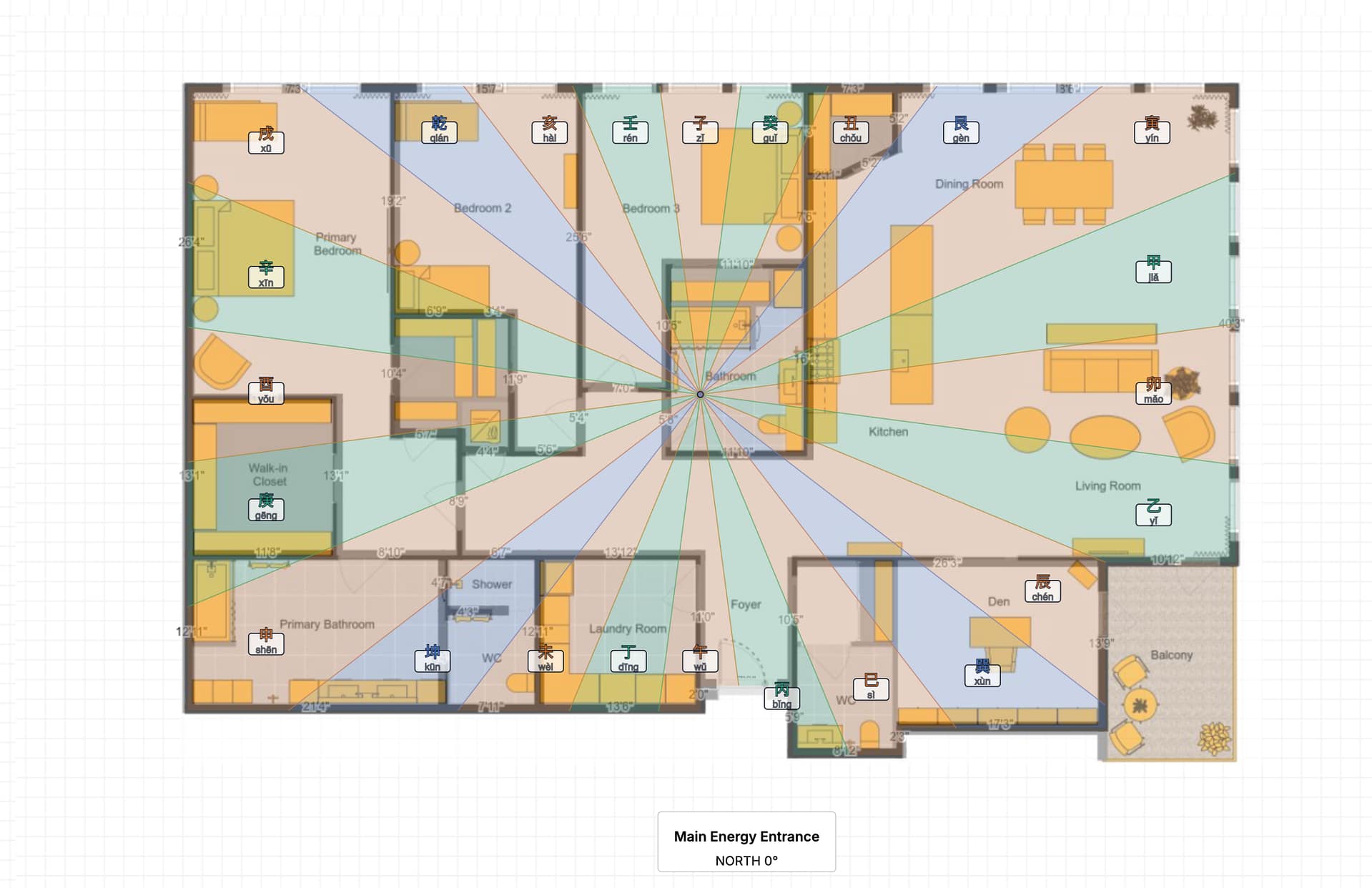
Each type carries different Five Elements properties. That’s why the feng shui compass overlay color-codes them differently: blue-tinted for Trigram sectors, green for Heavenly Stems, orange for Earthly Branches.
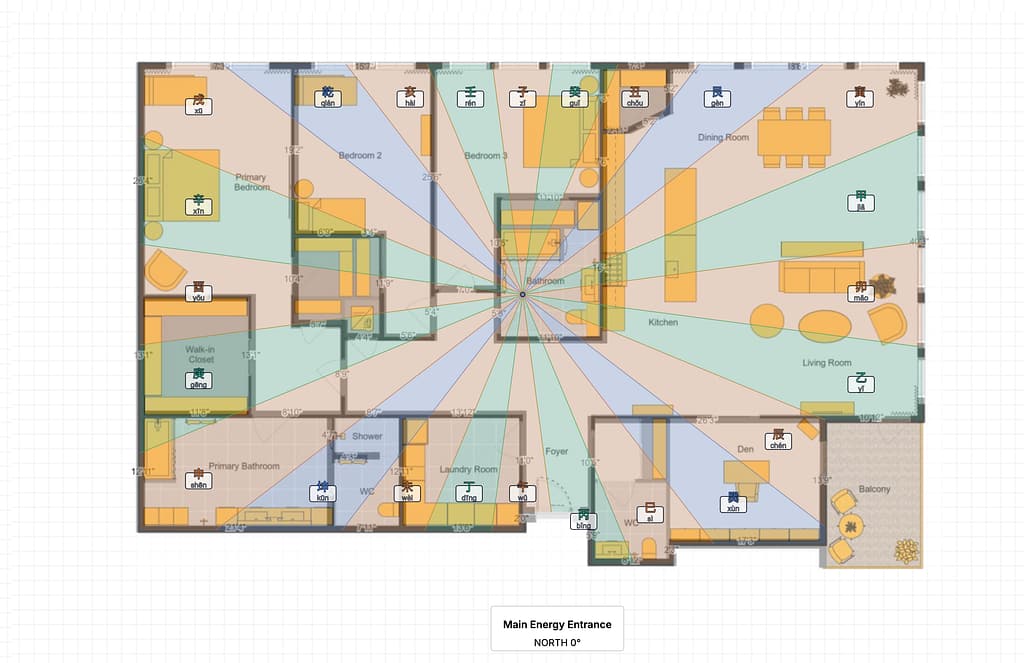
On the same San Diego condo, the 24 Mountains overlay tells a much more detailed story. The primary bedroom that the feng shui bagua lumps into “Northwest” now spans three distinct sub-sectors: 戌 Xu (an Earthly Branch), 乾 Qian (a Trigram), and 亥 Hai (another Earthly Branch). Each has a different classification, different Five Elements attributes, and different interactions with classical formulas.
The “East – Family” zone that contained the entire kitchen and living room? Under 24 Mountains, it separates into 甲 Jia (a Yang Wood Heavenly Stem), 卯 Mao (a Wood Earthly Branch), and 乙 Yi (a Yin Wood Heavenly Stem). Same element family, but different classification types that produce different formula results.
Want to see the difference between 8 directions and 24 mountains on a real floor plan?
Our sample report runs both systems on an actual property so you can see how 15-degree precision changes the analysis.
Here’s where it gets practical. Every advanced formula in classical feng shui was designed to operate at the 24 Mountains level. Using the 8-zone Ba Gua for these formulas is like using a map that rounds every address to the nearest zip code. You’re in the right neighborhood, but you might be at the wrong house.
Formulas that require 24 Mountains precision:
A bedroom at 75 degrees and a bedroom at 100 degrees are both “East” in the feng shui bagua. But in 24 Mountains, the first bedroom is in 甲 Jia (a Heavenly Stem at 67.5-82.5 degrees) and the second is in 乙 Yi (a different Heavenly Stem at 97.5-112.5 degrees). Different sub-sectors mean different formula outputs. A formula might flag one as favorable and the other as problematic. The Ba Gua gives them the same reading.
This isn’t a theoretical concern. The feng shui compass reading for a property needs to be precise to the degree. A 5-degree measurement error can shift the assessment from one 24 Mountains sub-sector to another, potentially changing the results of every formula that depends on it.
Understanding what is feng shui in a broader sense requires knowing that two fundamentally different systems both carry the name.
BTB (Black Sect Tantric Buddhist) feng shui was developed in the 1970s by Grand Master Thomas Lin Yun. It’s the system most Westerners learn first. Key characteristics:
Classical feng shui has been practiced and refined for 3,000+ years. Key characteristics:
These aren’t different levels of the same thing. They’re different approaches to the same question, with about 3,000 years of difference in field testing. Roughly 80% of Western feng shui practitioners use the BTB approach. Classical practitioners consider the 24 Mountains system the minimum viable resolution for serious assessment.
Whether you use the 8-zone Ba Gua or the 24 Mountains, the process starts the same way: stand at your main entrance, face outward, and take a compass reading. That reading is your facing direction. Your sitting direction is 180 degrees opposite.
For the feng shui bagua map (8 zones), that compass reading tells you which 45-degree sector your entrance faces. You rotate the bagua map to match, and every room in your home gets assigned to one of 8 zones.
For the 24 Mountains, you need that same compass reading but to a higher level of precision. Instead of “East” (a 45-degree range), you’re identifying the specific 15-degree sub-sector: is it 甲 Jia (67.5-82.5 degrees), 卯 Mao (82.5-97.5 degrees), or 乙 Yi (97.5-112.5 degrees)? That’s why classical feng shui practitioners use a luopan (a specialized feng shui compass) rather than a phone app. A phone compass can be off by 5-10 degrees, which is fine for Ba Gua but shifts the entire assessment in 24 Mountains.
Curious what classical feng shui analysis actually looks like?
Our sample report runs 15+ classical systems on a real property with color-coded overlays, scoring, and room-by-room breakdowns.
If you’ve used a feng shui bagua map to identify the “Wealth corner” or the “Career zone” of your home, you’ve done the Ba Gua analysis. That’s a valid starting point for feng shui basics. The principles of feng shui at the Ba Gua level are useful for understanding the general energy mapping of your space.
But if you want to apply classical feng shui rules – check for Yellow Spring taboos, identify robbery-star directions, map Nine Star energy, or calculate Flying Star patterns – you need the 24 Mountains resolution. The formulas don’t work at 8-zone precision. They weren’t designed for it.
The visual comparison on this San Diego condo makes the difference clear. The Ba Gua gives you 8 broad zones with one label each. The 24 Mountains gives you 24 precise sectors with specific classifications that interact with every formula differently. Same floor plan. Same compass reading. Completely different level of analysis.
Curious what 15+ classical feng shui systems reveal about a real home?
Our sample report shows every overlay on an actual floor plan so you can see the difference between classical analysis and generic advice.
Feng shui is a system for analyzing how the orientation, layout, and surroundings of a space affect the people who live or work there. The feng shui compass (luopan) measures the precise direction a building faces and sits. Classical feng shui uses 24 compass divisions called the 24 Mountains (二十四山向), each covering 15 degrees. The simplified version most people encounter online uses 8 feng shui bagua directions, each covering 45 degrees.
The feng shui bagua divides the compass into 8 zones of 45 degrees each, assigning life areas (Career, Wealth, Family, etc.) to each direction. The 24 Mountains system divides the compass into 24 sectors of 15 degrees each, combining three classification layers: Trigrams, Heavenly Stems, and Earthly Branches. Every classical feng shui formula was designed for 24 Mountains precision. The Ba Gua provides a general overview; the 24 Mountains provides the resolution needed for formula-based analysis.
Yellow Spring (Ba Sha Huang Quan) maps forbidden directional sectors. Jie Sha identifies robbery-star directions. Nine Star analysis sequences stars across compass positions. Twelve Longevity Cycles maps life stages. Flying Stars calculates time-based energy patterns. All these principles of feng shui require 24 Mountains precision because the formulas assign different properties to each 15-degree sub-sector.
BTB (Black Sect) feng shui is a separate approach developed in the 1970s. It uses 8 feng shui bagua directions aligned to the main entrance without a compass. Classical feng shui uses 24 compass-measured directions. Neither is “wrong” – they’re different systems. But they produce different results on the same property, and the classical system has roughly 3,000 more years of refinement and field testing.
Stand at your main entrance, face outward, and take a compass reading. That’s your facing direction. Subtract or add 180 degrees to get your sitting direction. For a feng shui bagua map (8 zones), this tells you which 45-degree sector your entrance faces. For 24 Mountains precision, you need the reading accurate to within 5 degrees, which is why classical practitioners use a luopan compass rather than a phone app.
The most common feng shui mistake is using 8-zone Ba Gua precision for formulas designed for 24 Mountains. A room at 75 degrees and a room at 100 degrees are both “East” in Ba Gua, but they fall in different 24 Mountains sub-sectors with different formula results. Other common mistakes: using a phone compass app instead of a calibrated feng shui compass (luopan), confusing the facing direction with the sitting direction, and not accounting for magnetic declination.