Address
304 North Cardinal St.
Dorchester Center, MA 02124
Work Hours
Monday to Friday: 7AM - 7PM
Weekend: 10AM - 5PM
Address
304 North Cardinal St.
Dorchester Center, MA 02124
Work Hours
Monday to Friday: 7AM - 7PM
Weekend: 10AM - 5PM

If you’ve ever searched “is feng shui real,” you’ve seen two types of answers. Feng shui practitioners say yes and offer personal anecdotes. Skeptics say no and point to a lack of controlled trials. Neither side tends to show actual evidence mapped onto a real property.
We took a different approach. We ran a classical feng shui analysis on a 2-bedroom apartment in La Jolla and compared the results, principle by principle, to peer-reviewed research in environmental psychology. Some of the principles of feng shui aligned with published science. Others didn’t have studies behind them yet. And a few landed in territory that researchers are only starting to test.
This isn’t a post arguing that feng shui is definitely real. It’s not a post calling it superstition, either. It’s what happens when you put a compass overlay on a floor plan and hold it up against the research.
Feng shui is an ancient Chinese practice of arranging living spaces to support the flow of energy through buildings and landscapes. The term translates to “wind and water,” referring to the natural forces that shape environments. The goal of feng shui has always been the same: align human life with the patterns of the built environment so that people feel better in the spaces where they live and work.
The reason people question whether feng shui is real comes down to how it’s been presented in the West. Most Western exposure to feng shui involves simplified rules: put a plant in the southeast corner for wealth, hang a mirror to bounce energy, declutter for good fortune. These come from a school called BTB (Black Tantric Buddhist) feng shui, which was adapted for Western audiences in the 1980s. BTB stripped out the compass measurements and classical formulas that traditional feng shui relies on.
Classical Chinese feng shui, the kind practiced for thousands of years, uses precise compass readings, mathematical formulas, and a framework built on yin and yang, the five elements (wood, fire, earth, metal, water), and directional energy mapped through systems like the bagua. When scientists study feng shui, they’re usually studying spatial principles from this older tradition, not the simplified BTB version.
The honest answer: more than most skeptics realize, but less than most practitioners claim.
A 2023 systematic review published in Heliyon (PMC) analyzed 36 empirical studies on feng shui using PRISMA methodology. The conclusion was that feng shui qualifies as a “quasi-science,” meaning it contains principles with measurable environmental validity alongside principles that haven’t been empirically tested. The review also found that only 0.43% of the total feng shui literature is empirical. That’s not because feng shui has been disproven. It’s because almost nobody has studied it with controlled methods.
Then in 2024, the first randomized controlled trial on feng shui was published in PLOS ONE. Zijlstra et al. studied 558 participants in hospital rooms. Rooms arranged according to feng shui principles produced lower anxiety scores compared to control rooms. The mechanism wasn’t mysterious: feng shui rooms scored higher on perceived pleasantness (B=-0.85), and that pleasantness mediated the anxiety reduction. Participants didn’t know which rooms were feng shui-compliant. The study design was rigorous enough to appear in a top-tier open-access journal.
A 2015 study by Kryžanowski found that 45% of Form School feng shui recommendations align fully or partially with environmental psychology. An IJASRE review pushed that number to 57% when including partial overlaps across multiple knowledge systems.
These aren’t fringe journals. These are peer-reviewed publications examining whether ancient spatial design principles hold up under modern testing.
Not all feng shui principles are equal when it comes to evidence. The ones with the strongest scientific support tend to be spatial and sensory, not symbolic.
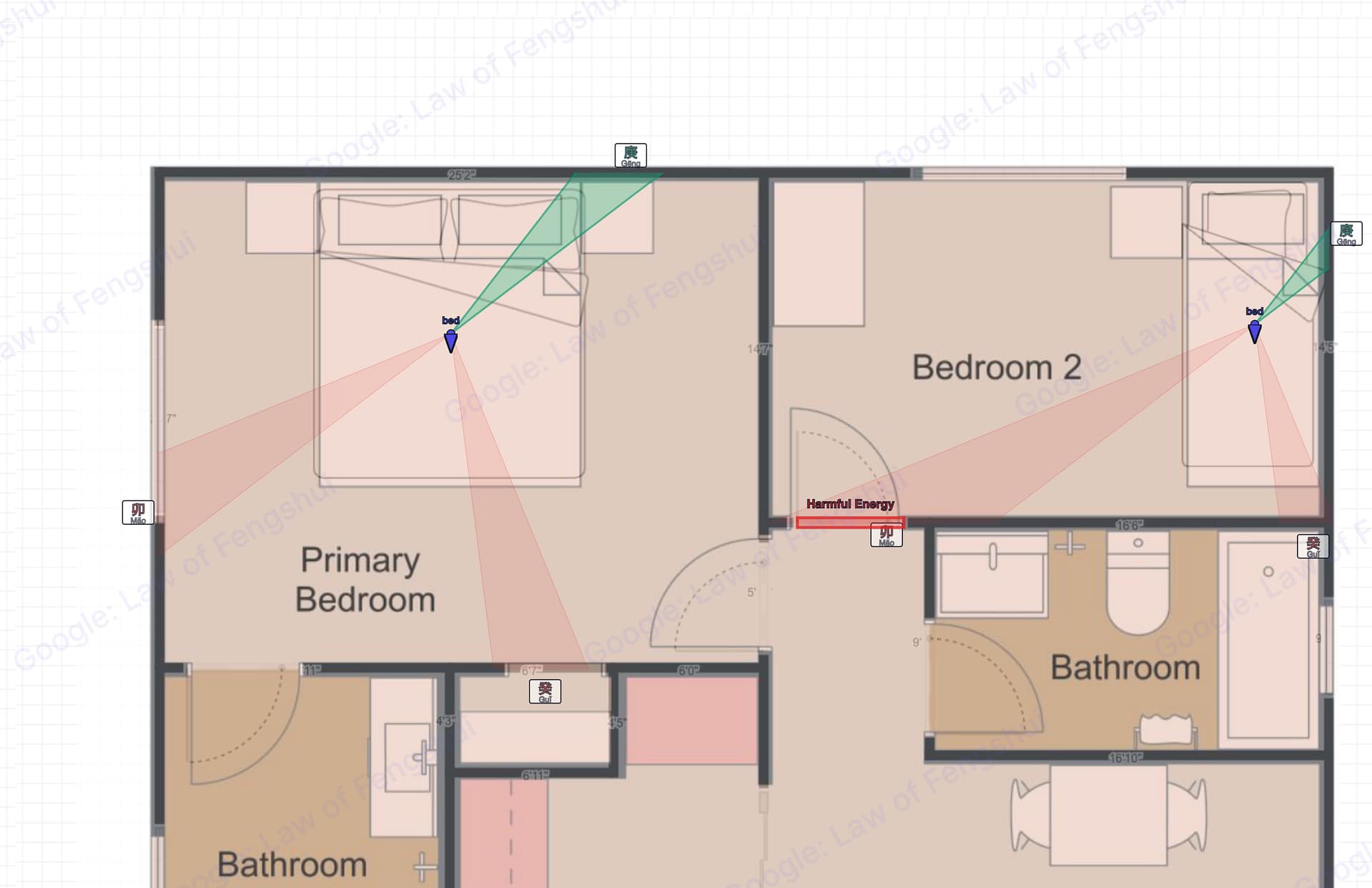
Commanding position. Classical feng shui says the bed or desk should sit farthest from the door but with a clear sightline to the entry, back against a solid wall. This is called the commanding position. Environmental psychologist Jay Appleton published prospect-refuge theory in 1975, which describes the same pattern: humans feel safer in positions with back protection and front visibility. A 2021 study in Building and Environment used heart rate variability (HRV) and POMS mood measures to show that feng shui-compliant rooms produce more positive physiological and emotional responses.
Decluttering and cortisol. Feng shui has always emphasized keeping spaces clear and organized. Saxbe and Repetti (2010) measured cortisol levels in 30 dual-income couples and found that people who described their homes as “cluttered” had flatter cortisol slopes throughout the day, a pattern linked to worse health outcomes. Clutter isn’t just a feng shui concern. It’s a measurable stressor.
Nature views and biophilic design. Feng shui emphasizes bringing natural elements into living spaces and orienting buildings toward natural features. Ulrich’s famous 1984 study in Science showed that hospital patients with nature views recovered 21% faster than those facing a brick wall. This aligns with the feng shui principle of integrating natural energy into the living environment.
Building orientation. South-facing buildings receive more daylight, which building science confirms improves circadian health, vitamin D synthesis, and mood. Classical feng shui has recommended south-facing orientation (坐北朝南) for thousands of years.
Want to see what a classical feng shui overlay looks like on a real floor plan?
Our sample report maps Ba Gua Sectors, commanding position, and 13 other classical systems onto an actual property so you can see the spatial analysis for yourself.
This is where honesty matters, and it’s where most articles on “is feng shui real” fall apart. They either ignore the untested parts or dismiss everything because of them.
The compass-based formula systems, including Flying Stars (Xuan Kong), Eight Mansions (Ba Zhai), and zodiac-based personal matching like He Chong, haven’t been tested in controlled studies. These systems assign specific energy qualities to compass sectors based on mathematical relationships between directions, elements, and time cycles. They form the backbone of what a feng shui practitioner uses in a full consultation.
That doesn’t mean they’re wrong. It means nobody has designed an experiment to test them. The Heliyon systematic review noted that the vast majority of feng shui’s theoretical framework remains unexamined by empirical research. There’s a difference between “disproven” and “not yet studied.”
The five elements framework (wood, fire, earth, metal, water) and yin and yang theory are foundational to traditional feng shui. Some researchers, like Yu Kongjian at Peking University, have reinterpreted these through the lens of landscape ecology. His framing: qi is a “measure of ecosystem function.” That’s a bridge between classical language and modern science, but it hasn’t generated controlled experiments yet.
The honest position: some aspects of feng shui have strong scientific parallels, some are internally consistent traditional wisdom awaiting study, and a few are likely cultural preferences rather than spatial science. A good feng shui expert will tell you which is which.
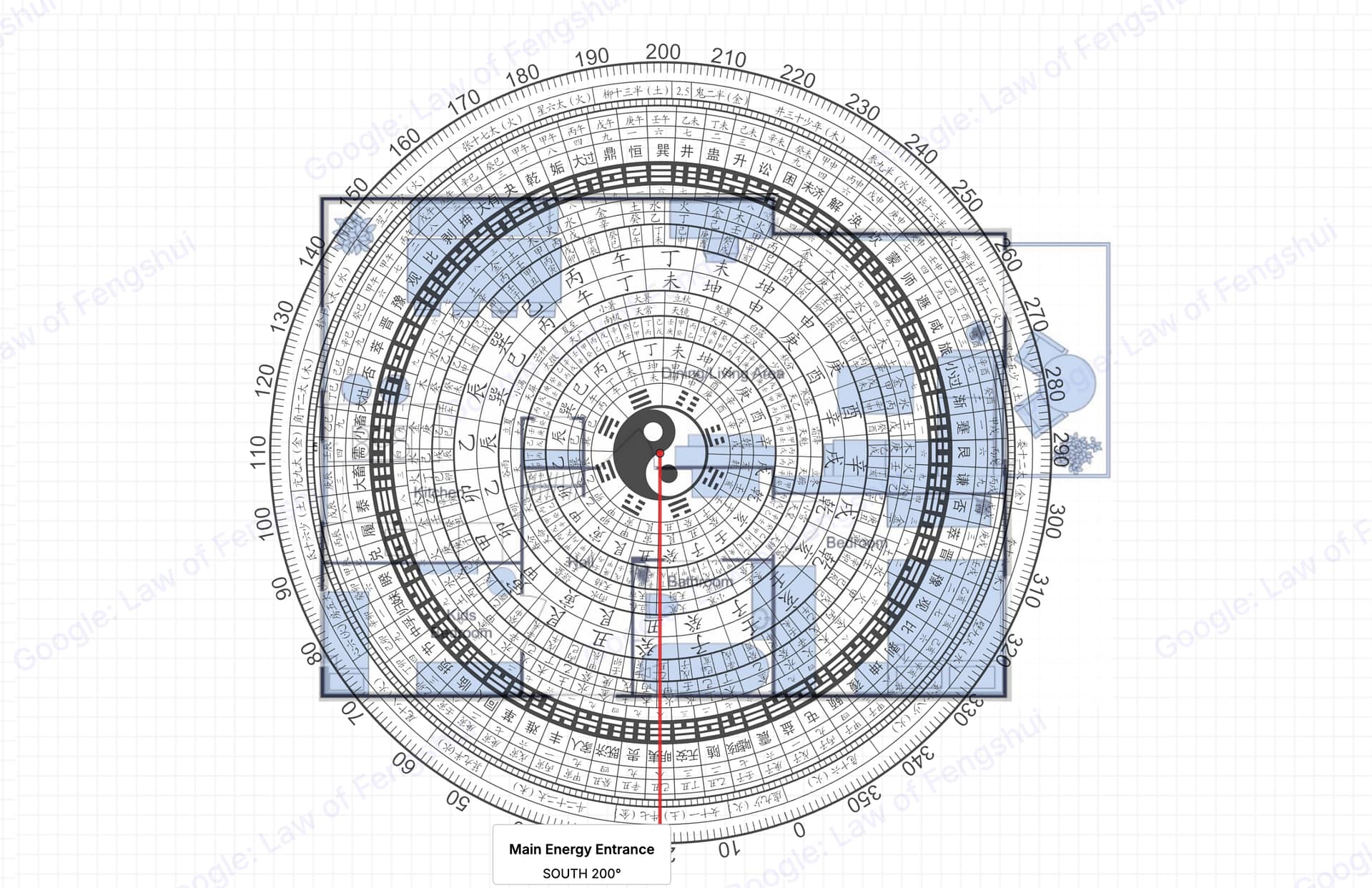
Instead of debating theory, we ran an actual analysis. The property is a 2-bedroom, 1-bathroom apartment in La Jolla, approximately 851 square feet. Main energy entrance faces South at 200 degrees. The building sits on the Gui (癸) mountain facing Ding (丁).
Nadia is a data scientist. She’s skeptical but curious. She wanted to see what classical feng shui actually produces when applied to a real floor plan, not a generic diagram.
We activated the Ba Gua Sectors overlay, which divides the apartment into eight energy zones based on compass direction. Each sector corresponds to a life area and an element.
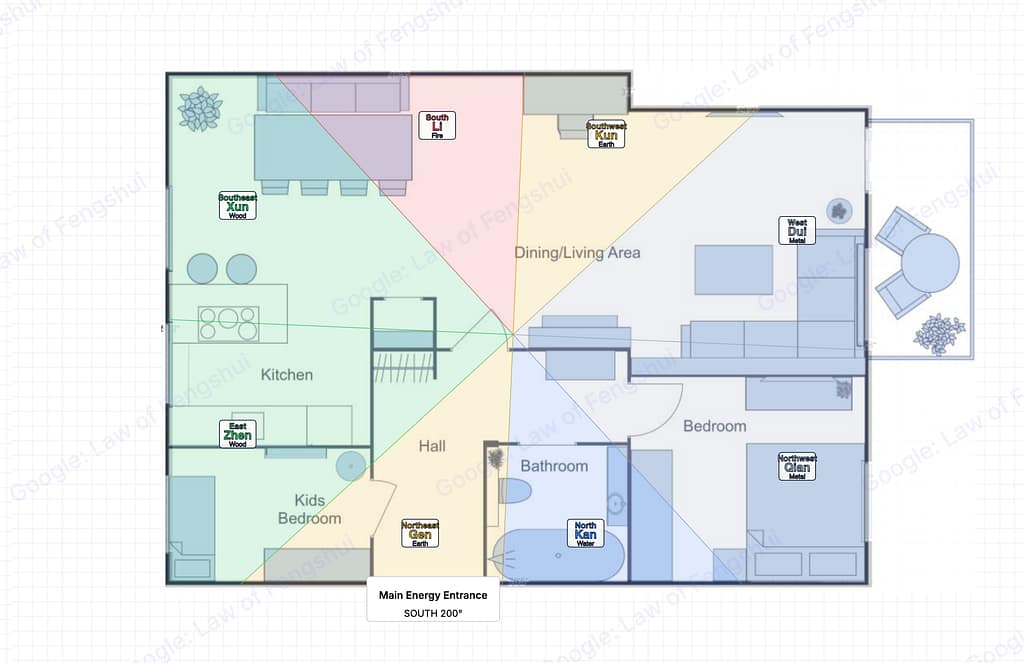
Here’s what the overlay mapped:
Kids Bedroom sits in the Zhen/Family sector (East, Wood element). Classical feng shui says this sector supports family bonds and health. The room houses Nadia’s child. That’s a natural fit: a family member in the family sector.
Kitchen spans the Xun/Wealth sector (Southeast, Wood element). In traditional feng shui, the wealth sector and fire (cooking) create an interesting dynamic. Wood feeds fire in the five elements cycle. A kitchen in the wealth sector isn’t inherently bad, but it needs the stove positioned carefully to avoid “burning away” wealth energy.
Primary Bedroom sits in the Qian/Helpful People sector (Northwest, Metal element). This sector is associated with mentorship, travel, and support from others. According to feng shui, sleeping in this sector can attract helpful connections.
Living and Dining Area spans three sectors: Li/Fame (South, Fire), Kun/Love (Southwest, Earth), and Dui/Children (West, Metal). Social gathering spaces covering the fame, love, and children sectors. The room where people connect sits in the sectors associated with relationships and public life.
Bathroom falls in the Kan/Career sector (North, Water element). A water-element room in the water sector. Classical feng shui flags this as potential career energy draining downward through plumbing. Environmental psychology doesn’t have a parallel for this specific claim, but the concept of functional room-sector alignment is what the Ba Gua system maps.
Hall and Entry sit near the Gen/Knowledge sector (Northeast, Earth element). The transition space near the knowledge sector. Not a functional match, but not a conflict either.
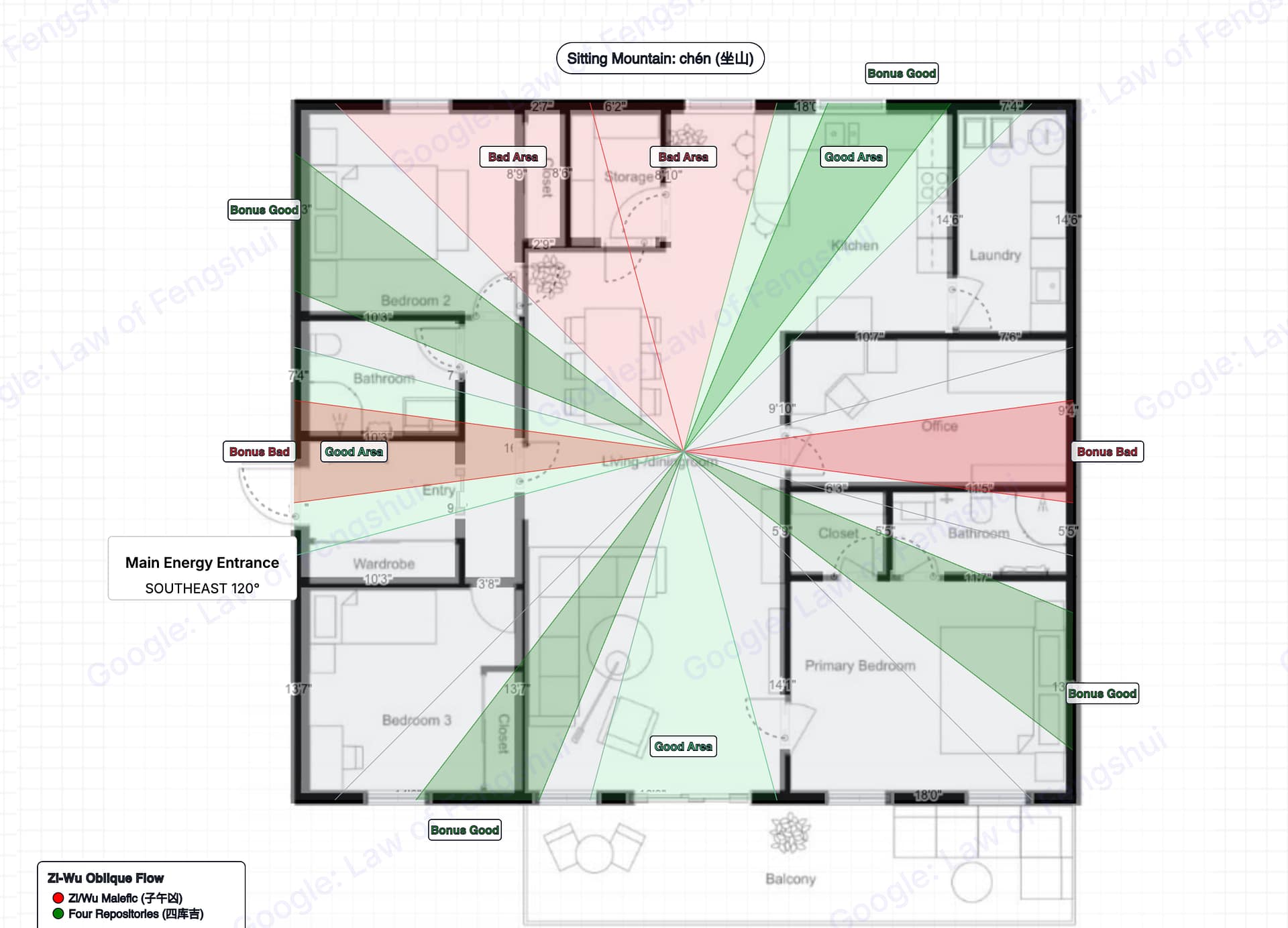
The second overlay shows the building’s sitting and facing direction.
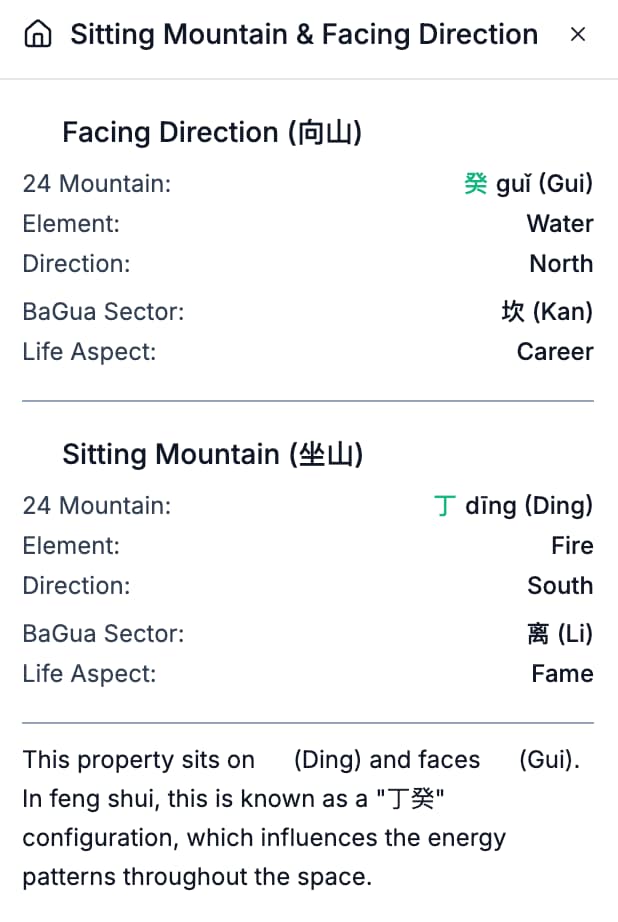
This south-facing building sits on Gui (癸, North) and faces Ding (丁, South). South-facing orientation means the primary living spaces receive afternoon sunlight through the south-facing windows. Building science confirms this orientation maximizes daylight exposure in the Northern Hemisphere, which supports circadian rhythm regulation and vitamin D production.
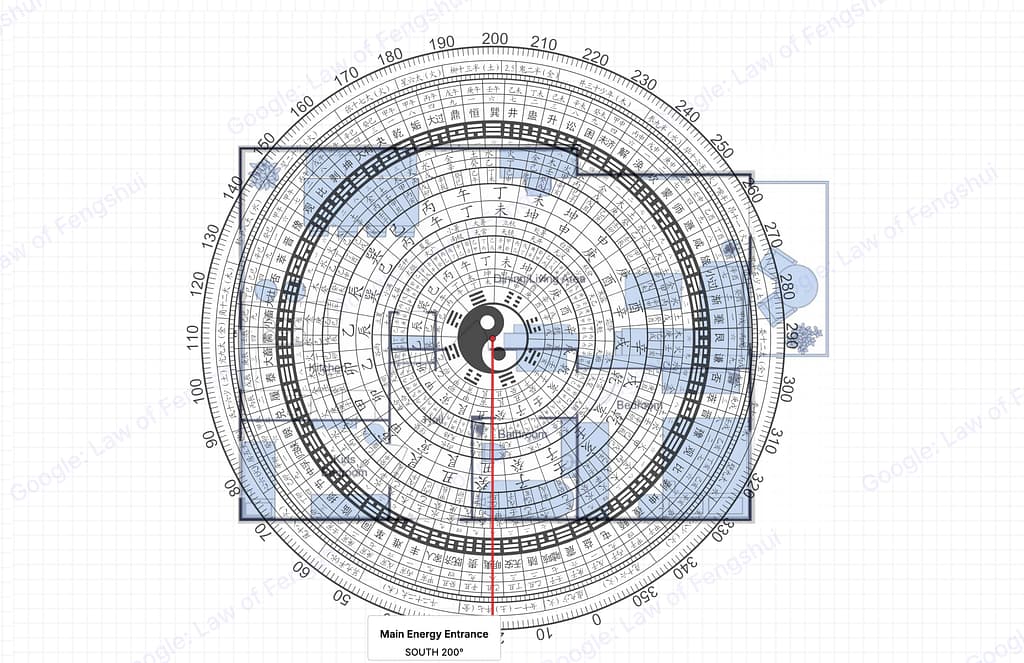
The luopan compass overlay shows every layer classical feng shui uses: the eight trigrams, 24 mountains, Heavenly Stems, and Earthly Branches. This is the tool a feng shui practitioner uses to analyze a property with precision, not the simplified eight-zone map that most Western feng shui tips rely on.
This is where skeptics often raise an eyebrow. But the data exists.
A 2025 SSRN paper using AI-assisted analysis of property transactions found a 22% price premium for properties with good feng shui characteristics. The study controlled for location, size, and condition. Properties that met classical feng shui criteria, including orientation, site positioning, and environmental features, sold for significantly more.
That doesn’t prove feng shui causes the premium. The properties may simply have better natural light, better views, and better spatial layouts, all of which feng shui principles happen to favor. But it suggests the principles of feng shui overlap with the spatial qualities buyers are willing to pay more for, whether they call it feng shui or not.
Curious how the Ba Gua compass divides your home into 8 energy zones?
Our sample report runs the full Ba Gua Sectors overlay on a real floor plan and shows which rooms fall in which life-area zones based on compass direction.
If you’re science-minded and curious about feng shui in your home, start with the principles that have the strongest evidence base.
Check your desk and bed position. Are you sitting or sleeping with your back to the door? The commanding position principle, supported by prospect-refuge theory, is the easiest feng shui change to test. Move your desk so you can see the door but not directly in line with it. Put a solid wall behind you. Notice whether you feel different after a week.
Declutter one room. The cortisol research is clear. A cluttered space is a measurable stressor. This is one aspect of feng shui where the science is strong enough that no debate is needed.
Check your building’s orientation. South-facing rooms get more daylight. That affects sleep, mood, and energy levels. If your feng shui bedroom gets no natural light, the orientation question matters more than which crystal to put on the nightstand.
Map the bagua onto your floor plan. Even without believing in qi as a life force, the exercise of checking whether room functions align with sector themes can reveal mismatches you hadn’t noticed. A home office in the relationship sector. A storage closet in the wealth sector. Whether these assignments carry “energy” or just highlight spatial incongruities, the mapping process is worth doing. We mapped the Ba Gua’s 8 energy zones onto Nadia’s apartment and found that most room functions aligned naturally.
Stay honest about what has evidence and what doesn’t. Incorporating feng shui doesn’t require believing everything. Start with the Form School spatial principles. Explore the compass-based systems with curiosity rather than conviction. The nature of feng shui is that it contains both evidence-based spatial analysis and traditional wisdom in the same framework.
The Heliyon systematic review called it a “quasi-science.” That’s probably the most accurate label available right now.
Feng shui contains design principles that overlap with environmental psychology, building science, and biophilic design. It also contains metaphysical frameworks, like the five elements cycle and the eight trigrams (bagua), that operate outside current scientific methodology. Dismissing the entire system because the metaphysical parts aren’t testable ignores the spatial parts that have been tested and confirmed.
A 2021 study in Building and Environment measured participants’ physiological responses in feng shui-compliant versus non-compliant rooms. The feng shui rooms produced better HRV readings and more positive mood scores. The researchers didn’t attribute this to qi. They attributed it to the spatial qualities that feng shui principles happen to optimize: orientation, proportion, view, and arrangement.
Many feng shui schools exist, from Form School (which analyzes landscape and spatial relationships) to Compass School (which uses precise directional formulas). The empirical studies have overwhelmingly focused on Form School principles. That doesn’t invalidate Compass School. It just means the scientific literature hasn’t caught up yet.
Astronomy, medicine, and chemistry all evolved from practices that mixed observation with philosophy. Feng shui may follow a similar path, where the spatial analysis principles get absorbed into evidence-based design while the traditional elements remain a cultural and philosophical framework.
Curious what 15+ classical feng shui systems reveal about a real home?
Our sample report shows every overlay on an actual floor plan so you can see the difference between classical analysis and generic advice.
Is feng shui real or just superstition? Some feng shui principles have strong scientific support. The commanding position aligns with prospect-refuge theory (Appleton 1975). Decluttering reduces cortisol (Saxbe & Repetti 2010). Nature views speed recovery (Ulrich 1984). A 2024 RCT in PLOS ONE (n=558) found feng shui rooms reduced anxiety through pleasantness. Other principles, particularly compass-based formula systems, haven’t been empirically tested yet. Calling the entire practice “superstition” ignores the 57% overlap between feng shui and environmental psychology found in academic reviews.
Is there scientific proof that feng shui works? There are peer-reviewed empirical studies, though the field is small. The 2024 Zijlstra et al. RCT is the most rigorous to date. A 2023 Heliyon systematic review analyzed 36 studies and classified feng shui as a “quasi-science” with environmental validity. A Building and Environment study used HRV and mood measures to show measurable benefits of feng shui-compliant rooms. Full proof would require hundreds more studies across different feng shui methods and applications.
What percentage of feng shui aligns with science? Kryžanowski (2015) found 45% of Form School feng shui recommendations align with environmental psychology. An IJASRE review found 57% alignment when including partial overlaps. These numbers apply specifically to spatial and sensory principles, not to all aspects of feng shui practice.
Is feng shui a pseudoscience? The Heliyon systematic review deliberately avoided the term “pseudoscience” and used “quasi-science” instead. The distinction: pseudoscience makes untestable claims, while a quasi-science contains both testable (and in some cases validated) principles and elements that haven’t been studied. Feng shui’s spatial principles have measurable effects. Its compass-based formula systems are theoretically testable but haven’t been tested.
Does feng shui affect property value? A 2025 SSRN study found a 22% price premium for properties meeting good feng shui criteria, controlling for size, location, and condition. Whether the premium comes from feng shui itself or from the spatial qualities feng shui principles optimize (better light, better orientation, better layout) is still debated. Either way, the properties feng shui favors tend to sell for more.
Can feng shui improve mental health? The Zijlstra 2024 RCT showed feng shui rooms reduced anxiety in 558 participants. The mechanism was room pleasantness, not belief in feng shui. Participants didn’t know which rooms were feng shui-compliant. Separately, Saxbe and Repetti’s cortisol research shows that decluttered, organized spaces, a core feng shui recommendation, correlate with healthier stress patterns.
What’s the difference between Form School and Compass School feng shui? Form School analyzes visible spatial relationships: landscape, building shape, room layout, furniture position. Compass School uses precise directional measurements and mathematical formulas. Most scientific validation applies to Form School principles. Compass School hasn’t been the focus of empirical research yet, though its principles are internally consistent and have been practiced for centuries. A full feng shui consultation typically uses both.
How can I practice feng shui if I’m not sure it’s real? Start with the evidence-based principles: commanding position for your bed and desk, decluttering, maximizing natural light, and checking your building’s orientation. These have scientific backing regardless of whether you subscribe to the broader feng shui framework. Map the Ba Gua energy zones onto your home and check whether room functions align with sector themes. Treat it as spatial analysis first, philosophy second.