Address
304 North Cardinal St.
Dorchester Center, MA 02124
Work Hours
Monday to Friday: 7AM - 7PM
Weekend: 10AM - 5PM
Address
304 North Cardinal St.
Dorchester Center, MA 02124
Work Hours
Monday to Friday: 7AM - 7PM
Weekend: 10AM - 5PM

Every home has a compass sector where prosperity energy reaches its peak. Classical feng shui calls it Emperor Prosperity, and it’s one of twelve life phases mapped onto your building’s floor plan. This article shows you how to find the wealth corner in your space using feng shui, what makes it different from the generic southeast rule, and how to activate it with the right items for money and abundance.
We’ll walk through a real case study on an Austin apartment to show exactly where the wealth corner landed and what that means for everyday living.
The feng shui wealth corner is the compass sector of your home or office where prosperity energy is strongest. In classical feng shui, this isn’t a fixed location that’s the same for every building. It’s calculated from your building’s sitting direction and the feng shui elements that govern that direction.
The system that identifies it is called the Twelve Longevity Cycles (十二长生). It maps twelve life phases onto twelve 30-degree compass sectors around your home. These phases mirror a complete cycle: birth, growth and vitality, peak prosperity, decline, and renewal. The fifth phase, Emperor Prosperity (帝旺), represents the absolute peak. That’s your primary wealth corner.
Think of it this way: your entire home has an energy flow pattern, and one sector sits at the highest point. That’s where wealth energy concentrates naturally.
This is the most common question, and the answer surprises most people.
The idea that the southeast corner of your home equals the wealth corner comes from the Western school of feng shui (sometimes called Black Hat or BTB). In that system, you stand at your front door, and the far left corner of your home becomes the wealth and abundance area. Standing at the entrance and looking in, this area of the bagua is known as the wealth and prosperity zone regardless of compass direction. Every home gets the same map.
Classical feng shui works differently. When you use the bagua in the classical tradition, compass directions matter. Your wealth area of your home depends on which of the twenty-four mountains your building sits on. Two apartments on the same street, facing different directions, will have their prosperity corner in completely different sectors.
For some homes, the wealth corner IS in the southeast. For many others, it’s in the north, west, east, or south. There’s no universal answer without a feng shui compass reading.
The Twelve Longevity Cycles determines your prosperity corner through a sequence. First, the building’s sitting direction maps to one of the twenty-four mountains. That mountain belongs to one of five elements (Wood, Fire, Earth, Metal, or Water). The element determines where the twelve phases start on the compass, and from there, each 30-degree sector gets assigned a phase.
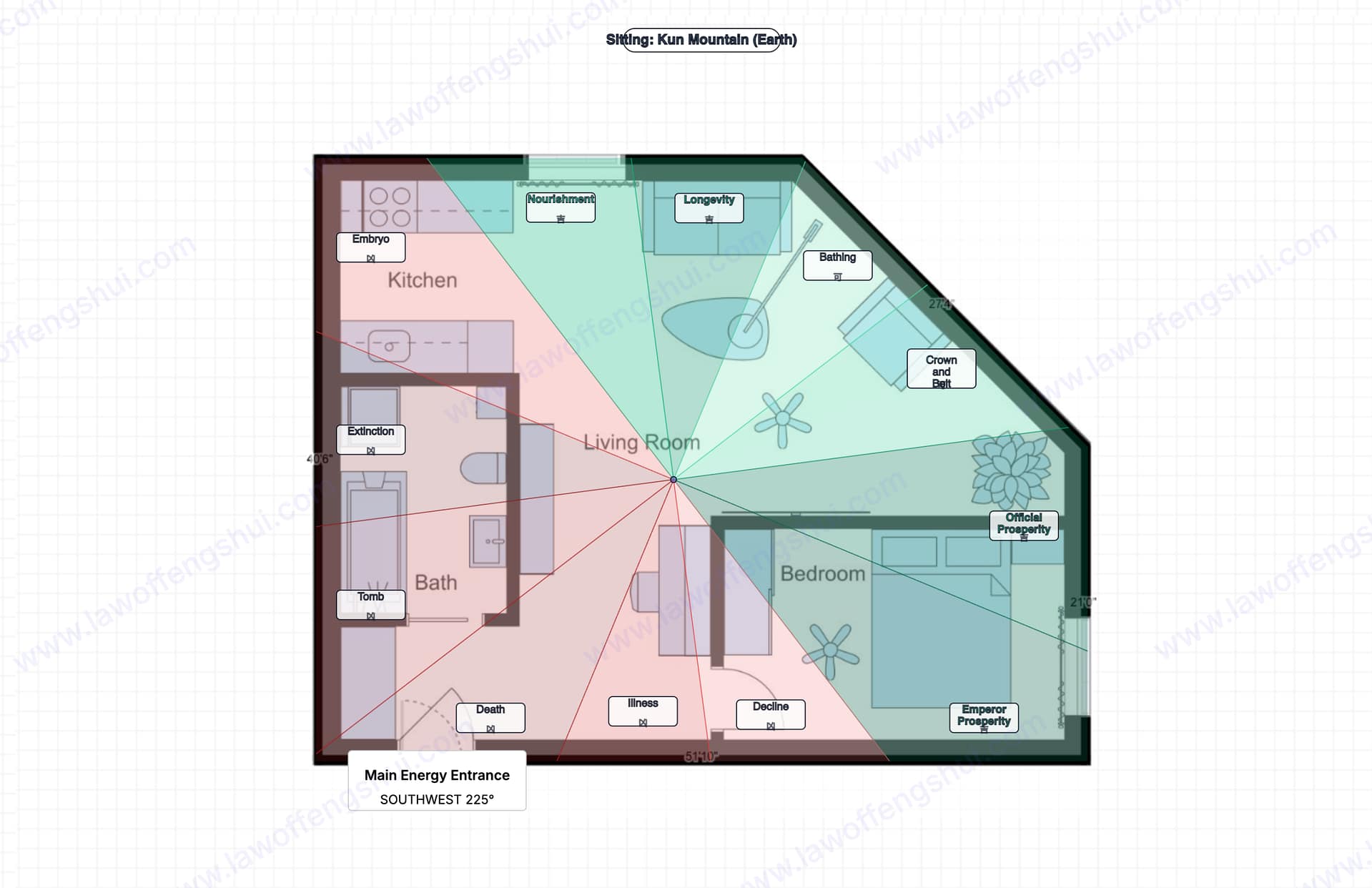
The six growth phases (Longevity, Bathing, Crown and Belt, Official Prosperity, Emperor Prosperity, and Nourishment) light up green on our analysis overlay. The six declining phases (Decline, Illness, Death, Tomb, Extinction, and Embryo) show red. Emperor Prosperity is the deepest green, the peak of the entire cycle.
Here’s where it gets practical: the system also tells you which rooms are suitable for each phase. Emperor Prosperity sectors are ideal for a living room or master’s office. Longevity sectors work well for a master bedroom or feng shui study room. The declining phases like Extinction? Those are best left as storage or utility areas, not active living space.
Understanding wealth in feng shui means recognizing that each building distributes these phases differently. Activating this corner of your home starts with knowing which phase it holds, not just placing items in a generic spot.
Want to see where the prosperity zones land on a real floor plan?
Our sample report maps Twelve Longevity Cycles on an actual property with color-coded overlays showing all twelve phases.
Want to see where the prosperity zones land on a real floor plan?
Our sample report maps Twelve Longevity Cycles on an actual property with color-coded overlays showing all twelve phases.
We ran the Twelve Longevity Cycles analysis on a 1-bedroom apartment in Austin, TX. The building sits on the Kun Mountain, which ties to the Earth element. Earth’s cycle starts with Longevity in the southwest, then progresses clockwise through all twelve phases.
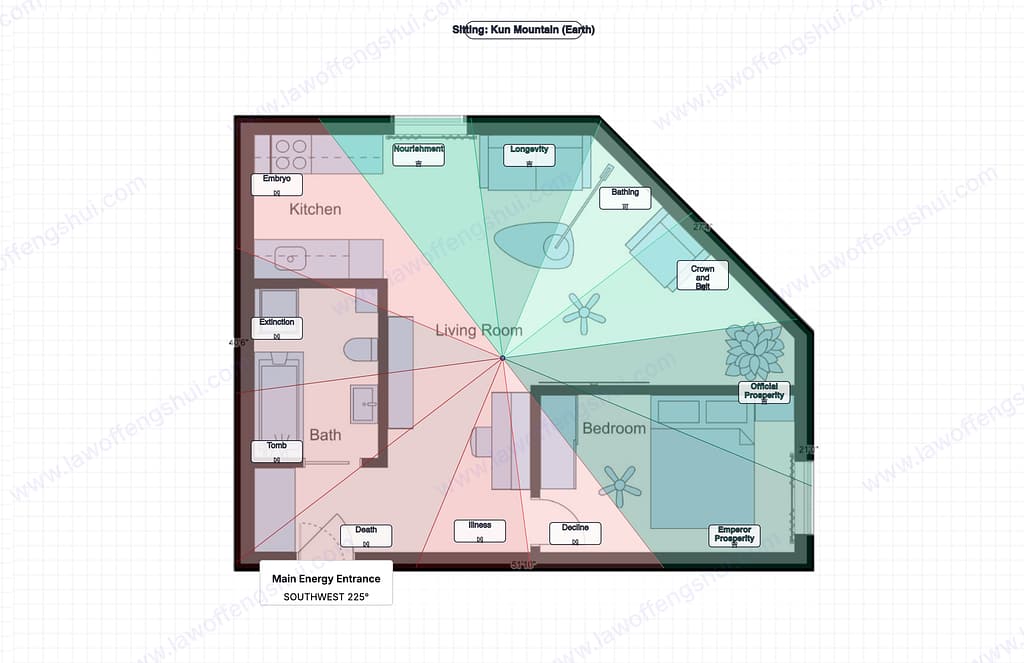
Here’s where things got interesting. The Emperor Prosperity sector, the building’s peak wealth corner, landed in the north. The living room area extends into that zone, making it the natural spot to place wealth-activating items like a crystal, a healthy plant, or a small fountain with flowing water. If you want to attract prosperity and invite good fortune into this space, this is the sector to focus on.
Meanwhile, the southeast sector, the one that generic guides would call the feng shui money corner, landed in Extinction. That’s the lowest phase in the entire cycle. The system’s recommendation for Extinction zones is blunt: suitable for external storage or a tool shed. Must not be used for any living or working space. If someone told you the money corner of your home is always in the southeast, this case study shows that classical compass analysis often points to a completely different sector.
The bedroom landed in Official Prosperity, the fourth phase, which is one of the strongest growth sectors. Classical feng shui rules say Official Prosperity is excellent for a master bedroom or feng shui office. The feng shui kitchen straddled the Embryo and Nourishment sectors, a mixed reading that suggests it’s functional but not optimal.
The bath ended up near the Tomb phase, which actually works. Low-activity rooms in low-energy sectors represent alignment rather than a problem.
Once you’ve identified the Emperor Prosperity sector in your home, activating the wealth corner is straightforward. The goal is to keep positive energy flowing and avoid letting it stagnate.
Items to add to the wealth corner:
Each of these items helps attract more wealth and channels abundance energy into the Emperor Prosperity sector. The more intentional the placement, the stronger the effect.
What to avoid:
Curious which sector holds your home’s peak prosperity zone?
Our sample report runs the Twelve Longevity Cycles on a real property so you can see how Emperor Prosperity maps onto an actual floor plan.
The Emperor Prosperity phase is best suited for high-activity rooms: a living room, a master’s office, or a family room. The classical recommendation specifically says it’s not ideal for long-term residence, meaning it’s better as a room where you work and socialize than where you sleep.
If the wealth corner of your home happens to fall in the bedroom, that’s not a problem. The bedroom serves double duty. You can still place a crystal or a small figurine on your nightstand to bring wealth into your life during the hours you’re awake in that room.
For a home office, the wealth corner is ideal. Setting up your desk in the Emperor Prosperity sector, especially in a commanding position, puts you at the peak of your building’s energy flow during working hours. Pair that with proper desk direction from a Na Jia Li analysis and you’re covering multiple layers.
If the wealth area lands in a bathroom or closet, that’s a tougher situation. You can still keep the area of your home clean and well-lit, and add a small plant or crystal to gently activate the wealth energy. But the room’s function limits how much activation is practical.
Different feng shui traditions recommend different items. Here are the ones with the strongest classical backing:
Curious which sector holds your home’s peak prosperity zone?
Our sample report runs the Twelve Longevity Cycles on a real property so you can see how Emperor Prosperity maps onto an actual floor plan.
Some guides tell you to find it by standing at the entrance: you stand at your front door and look in. The far left corner of your living space is supposedly the wealth and abundance area. This comes from the BTB (Black Hat) bagua method, which aligns the feng shui room layout relative to the entrance rather than compass direction.
This approach can be a starting point if you don’t have access to a feng shui tool or compass reading. But it’s worth knowing that the far-left corner method and the classical compass method often point to different parts of your home. In the Austin apartment we analyzed, the two methods disagreed entirely. The BTB wealth corner would have been in the back-left area of the apartment. The classical wealth corner was in the north.
Both methods have their practitioners. If you want to work with the bagua in a way that accounts for your specific building’s orientation and element cycle, the compass-based Twelve Longevity Cycles gives you more precision.
Here’s a practical path to find and activate your prosperity area:
A feng shui expert who practices classical feng shui can run this analysis using a specialized feng shui tool that maps all twelve phases onto your actual floor plan. The result shows you not just where the wealth corner is, but how every part of your home fits into the complete energy flow cycle.
Ready to find your home’s Emperor Prosperity zone?
Our sample report runs the Twelve Longevity Cycles, Ba Gua sectors, and 13 other classical overlays on a real property. See exactly where prosperity peaks in an actual floor plan.
Ready to find your home’s Emperor Prosperity zone?
Our sample report runs the Twelve Longevity Cycles, Ba Gua sectors, and 13 other classical overlays on a real property. See exactly where prosperity peaks in an actual floor plan.