Address
304 North Cardinal St.
Dorchester Center, MA 02124
Work Hours
Monday to Friday: 7AM - 7PM
Weekend: 10AM - 5PM
Address
304 North Cardinal St.
Dorchester Center, MA 02124
Work Hours
Monday to Friday: 7AM - 7PM
Weekend: 10AM - 5PM

Every guide on feng shui bedroom layout will tell you the same things: put the bed in the commanding position, keep clutter off the floor, avoid mirrors that reflect the bed. That advice is solid. It comes from form school feng shui, and it applies to every bedroom as a reasonable starting point.
Classical compass feng shui goes one layer further. Once you know the basics, the He Chong system maps 12 compass sectors onto your bedroom and identifies which corners align with your personal Earthly Branch. Sleep is the most sustained exposure you have to any compass sector: six to eight hours in a single position, night after night. The classical approach treats this seriously.
This post covers both layers: the feng shui bedroom dos and don’ts that apply universally, and the compass analysis that tells you which specific corner of your bedroom is best suited to you. We ran a full analysis on a north-facing Denver apartment using Law of Fengshui. The result challenged the most common headboard placement advice.
Most people who search “how to feng shui your bedroom” want the essential feng shui bedroom tips. Here they are, plainly:
Bed position: The bed should be visible from the bedroom door without sitting directly in line with it. This is the commanding position, and it is the single most important layout rule in feng shui. You want a clear view of the door from where you sleep.
Headboard: A solid headboard backed against a wall provides support. Avoid placing the headboard under a window, which leaves the energy at your back ungrounded. A solid wall behind the headboard is the ideal feng shui bed position for backing and stability.
Nightstands: Matching nightstands on either side of the bed create balanced energy. Asymmetry here is considered unsettled from a feng shui perspective. Two bedside tables, even simple ones, complete the bedroom layout.
Clutter: Clutter under the bed disrupts energy flow during sleep. Items under the bed are considered bad feng shui because they introduce stagnant or conflicting energy directly beneath the sleeping body. Clear the space under the bed completely when possible.
Electronics: Electronics out of the bedroom support restful sleep. Screens and devices introduce active, yang energy into what should be a yin, restorative space.
Relaxation: Color choices, natural materials, and soft lighting all contribute to the bedroom environment. Warm, muted tones promote relaxation. Bright, stimulating colors disrupt it.
These are the baseline feng shui bedroom rules. Every feng shui expert and certified feng shui consultant will cover these. They work. But they also apply the same recommendation to every person and every bedroom.
The feng shui commanding position is 3,000 years old and has been confirmed repeatedly by environmental psychologists. Seeing the entry point of a room from a position of rest reduces background vigilance, improves sleep quality, and reduces cortisol. It is considered bad feng shui to have the bed directly in line with the door, and for good reason: the position creates a line of energy running directly through the sleeping body.
The commanding position tells you: place your bed so you see the bedroom door without being directly in line with it, with a solid wall behind your headboard and space on both sides. This is the form school answer to feng shui bedroom layout.
What it leaves open is the compass question. The commanding position gives you a relationship to the door. It does not tell you which wall of the bedroom to back the headboard against. In a standard rectangular bedroom, that can mean four different walls and four different compass sectors, and each one has a different energy profile depending on who lives there.
This is where the classical system begins.
He Chong (合冲) is a classical Chinese system that maps 12 Earthly Branches to 12 compass sectors. Each person’s birth year determines their personal branch. The system identifies how each compass sector relates to that branch: San He (Three Harmony), Liu He (Six Harmony), Liu Chong (Six Clash), or neutral. In a bedroom, the goal is to place the bed in a harmony sector while avoiding the clash zone.
The reason feng shui prioritizes bedrooms for this analysis comes down to exposure time. A third of our lives sleeping means you spend more continuous hours in a single compass sector in your bedroom than anywhere else in your home. Getting the sector right matters more here than in any other room.
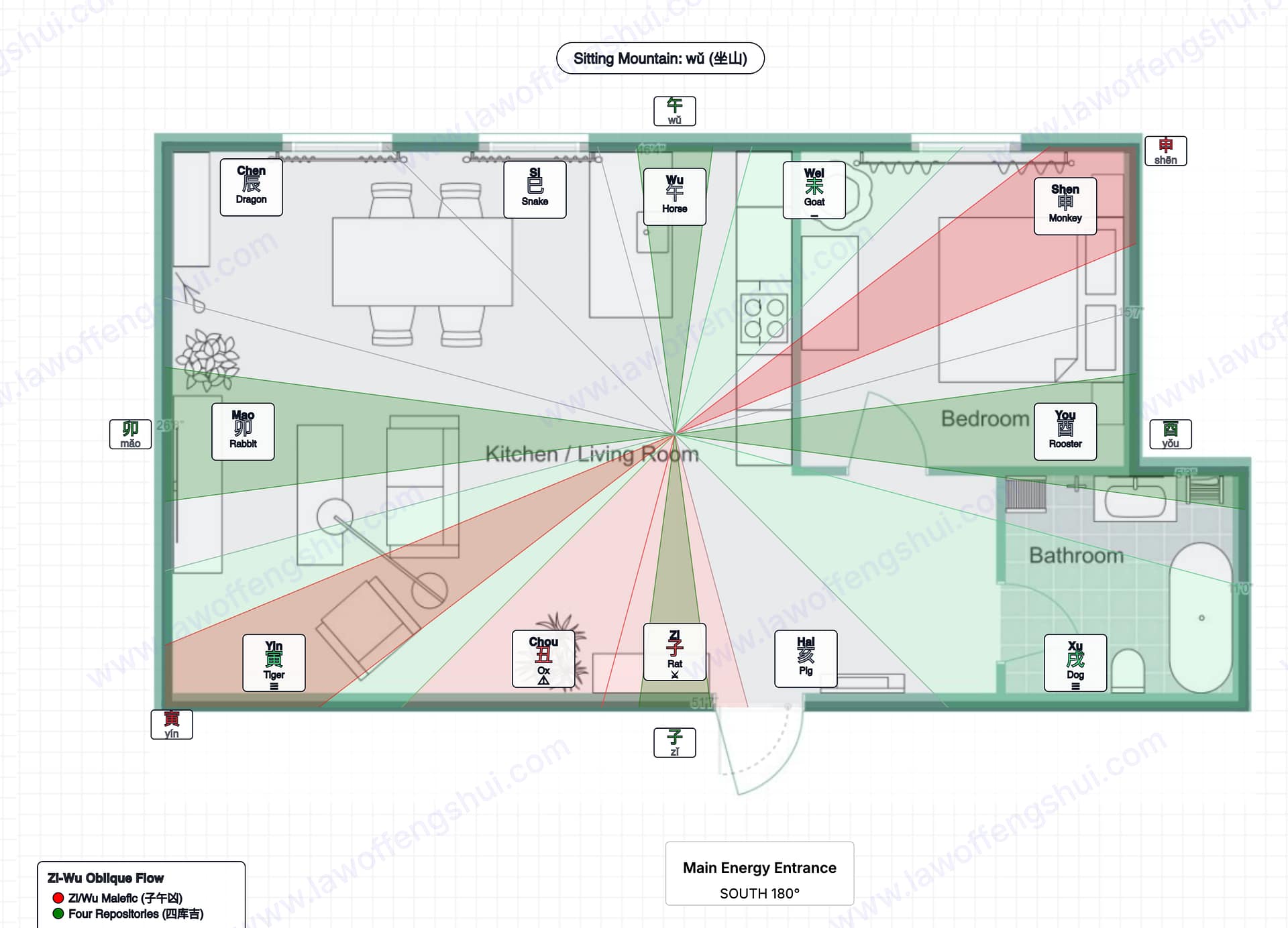
Zi-Wu Oblique Flow (子午斜流) is a structural system that works independently of who lives in the home. It identifies two fixed malefic positions at Zi (North, 0°) and Wu (South, 180°) and four auspicious positions called the Four Repositories at ESE, WNW, NNE, and SSW. These positions reflect structural energy flow within the building, not personal zodiac relationships.
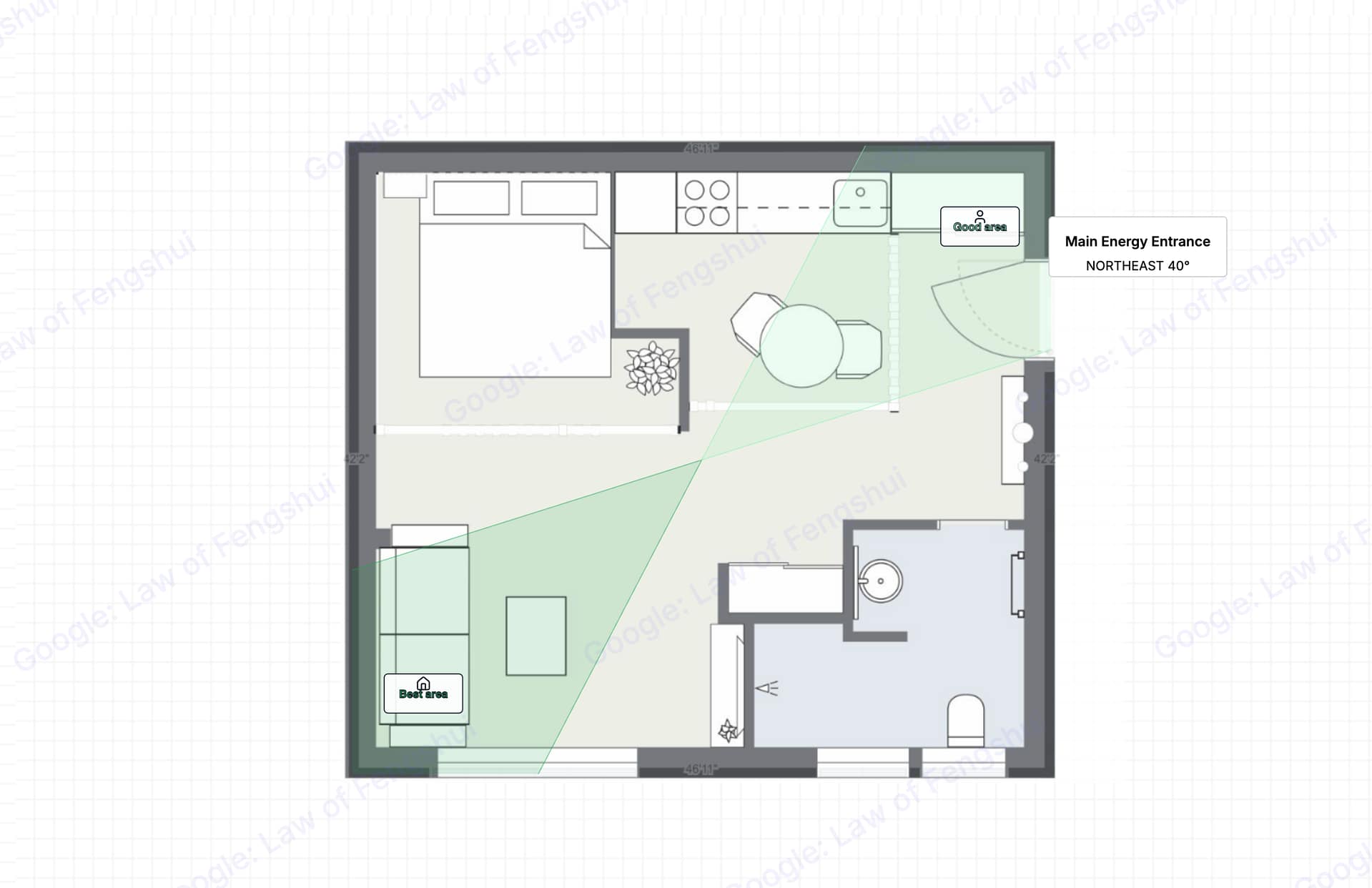
The “Find Best Bedroom Spot” feature at Law of Fengshui combines both systems simultaneously, generating four zone labels for every corner and wall of a selected bedroom: Bonus Bed (both systems agree this is ideal), Good Area (one system identifies harmony here), Bad Area (clash or malefic zone), and Bonus Good (structural overlay finds this auspicious).
Curious which bedroom corner aligns with your personal energy?
Our sample report runs He Chong and Zi-Wu Oblique Flow on a real floor plan, showing exactly which corner of the bedroom is Bonus Bed for your birth year.
The property is a 1-bedroom apartment in Denver, Colorado. It faces north. The resident is Maya, born June 15, 1990. Her Earthly Branch is Horse (午, wǔ).
For a Horse-branch resident, the He Chong relationships look like this: the north sector corresponds to the Rat (子) branch, which holds a direct Six Clash relationship with Horse. Six Clash is the strongest conflict in the He Chong system, a Water-Fire direct opposition. The north sector, for Maya, is her worst compass direction for sleep.
The apartment faces north. Its main energy entrance is on the facing side, in the Rat sector. This is already the wrong direction for extended exposure.
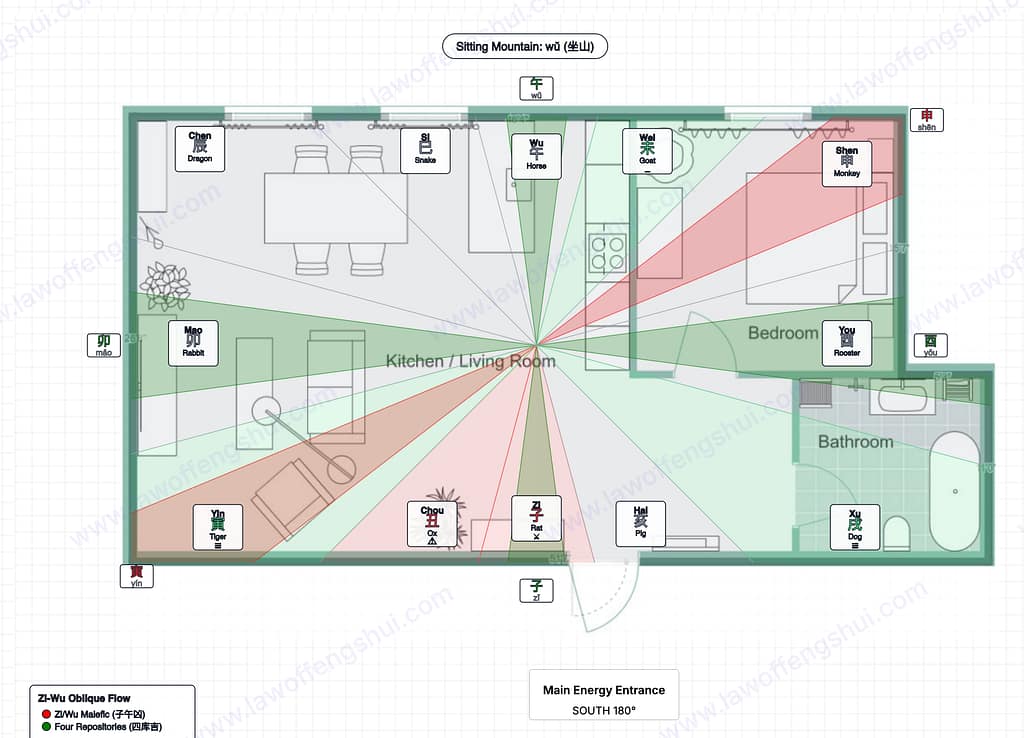
The bedroom sits on the west side of the apartment, away from the north entrance. At the apartment level, the bedroom area avoids the worst sector. The analysis then zooms into the bedroom itself.
Applying the “Find Best Bedroom Spot” overlay to Maya’s bedroom produces the combined He Chong and Zi-Wu analysis for that room specifically. The result clarifies which corner to prioritize and which to avoid.
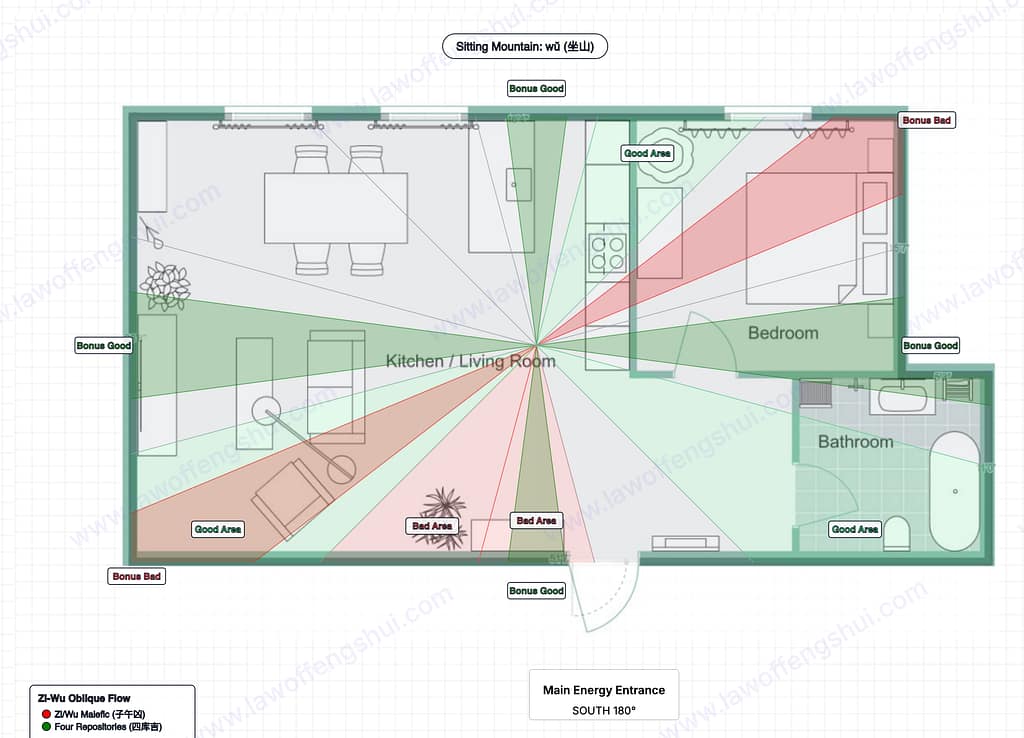
“Bonus Bed” lands in the far corner of the bedroom. In compass terms, this points into the SSW direction, which corresponds to the Goat (未) sector. For Maya’s Horse branch, Goat holds a Liu He (Six Harmony) relationship, a gentle, steady compatibility. Zi-Wu Oblique Flow independently marks SSW as one of the Four Repositories, an auspicious structural position. Both systems agree: this is the best corner for the bed.
“Good Area” covers most of the bedroom, which means the room itself is a reasonable zone for sleep. The bedroom placement at the apartment level was already sound. The overlay refines it.
“Bad Area” appears near the north section of the building, where the Rat sector and the Zi malefic position overlap. This is the double-conflict zone, flagged by both systems.
“Bonus Good” marks additional corners and zones where the Zi-Wu structural overlay finds auspicious alignment, independent of the personal branch analysis.
Form school points to the north wall as a common headboard position in a north-facing apartment: it sits opposite the door, provides a solid wall, and gives a clear sightline to the entrance. It looks like the commanding position choice.
For Maya, applying feng shui principles to the compass layer produces a different conclusion:
He Chong identifies north as the Rat sector: Six Clash with Horse. The clash direction warning flags this as unsuitable for a master bedroom. Avoid placing the bed in this direction, according to classical feng shui bedroom rules for this branch.
Zi-Wu Oblique Flow identifies north as the Zi direction: a structural malefic position. Avoid placing important functional areas in this direction.
Two independent systems, the same result. What form school reads as a strong headboard wall is, for Maya’s specific birth year, the worst available position in the bedroom. The commanding position logic is not wrong. It just does not account for compass sector at the personal level.
The Bonus Bed corner in the SSW, which a form school analysis would overlook entirely, is where He Chong and Zi-Wu both find alignment. Classical feng shui bed placement identifies this through compass analysis, not intuition about which wall looks solid.
This section consolidates the essential best feng shui bedroom practices, covering both the form school baseline and the classical compass layer.
Do’s:
Place the bed in the commanding position. See the bedroom door without being directly in line with it. A clear view of the door from the bed is considered essential feng shui in every school.
Use a solid headboard and back it against a wall. A solid headboard provides support and grounding. Avoid headboards with cutouts or gaps, and avoid positioning the bed under a window, which leaves the headboard without solid backing.
Keep matching nightstands on either side of the bed. Either side of the bed should have a surface for balance. Matching nightstands on both sides support symmetrical energy around the sleep space.
Clear clutter completely from under the bed. Even small amounts of clutter under the bed are also considered bad feng shui because they disrupt the energy around the bed during sleep. This is one of the most consistent rules across all feng shui schools.
Let natural light in during the day and keep electronics out of the bedroom for rest.
Check the compass sector before finalizing headboard position. The commanding position tells you which direction to face from the bed. The compass analysis tells you which wall to back the headboard against for your personal birth year.
Don’ts:
Don’t place the bed directly in line with the bedroom door. Foot of the bed facing the door is considered bad feng shui across every tradition. The direct energy flow from the door toward the sleeping body disrupts sleep and is associated with depleted energy over time.
Don’t reflect the bed in mirrors. Mirrors that reflect the bed are widely considered bad feng shui. They are associated with disturbed sleep and restless energy in the bedroom.
Don’t place the bed under a window without solid wall support for the headboard.
Don’t store items under the bed if you can avoid it.
Don’t skip the compass layer entirely. Applying feng shui principles without compass direction means applying the same advice to every bedroom and every person. The classical analysis adds the personal specificity that form school does not.
Want to see where the Bonus Bed lands on a real floor plan?
Our sample report maps He Chong personal harmony and Zi-Wu structural flow onto an actual bedroom with color-coded zone labels for every corner and wall.
Learning how to feng shui your bedroom with the classical layer starts with two pieces of information: your compass directions and your birth year branch.
Stand at the center of your bedroom with a compass app. Note which compass sector each wall of the room faces. Identify your Earthly Branch from your birth year. From there, a classical feng shui analysis identifies how each wall’s compass sector relates to your personal branch, and which corners fall into harmony, neutral, or clash territory.
For a full two-system analysis combining He Chong and Zi-Wu Oblique Flow, the best feng shui bedroom setup can only be determined with a floor plan mapped to compass north. The feng shui bedroom mirror analysis we ran on a different apartment used the same compass-sector approach at the Ba Zhai level. Each system adds a different layer. None of them replace each other.
Simple feng shui tips work for everyone as a starting point. The classical layer is where bedroom feng shui becomes specific to you.
Curious what 15+ classical feng shui systems reveal about a real home?
Our sample report shows every overlay on an actual floor plan so you can see the difference between classical analysis and generic advice.
The commanding position places the bed so you can see the bedroom door without being directly in line with it, with a solid wall behind the headboard. It is the foundation of feng shui bedroom layout from the form school tradition and applies to every bedroom regardless of compass direction or birth year.
Avoid placing the bed directly in line with the bedroom door, under a structural beam, or under a window without solid wall backing. In classical compass feng shui, also avoid the sector corresponding to a Six Clash or malefic direction for your personal branch. For a Horse-branch resident, the north wall is a Bad Area zone under both He Chong and Zi-Wu Oblique Flow.
Yes. He Chong maps your Earthly Branch (determined by birth year) to 12 compass sectors, identifying harmony and clash zones. A bedroom wall that is a Bonus Bed sector for one birth year can be a Bad Area for another. This personal layer is what distinguishes classical compass feng shui from generic bedroom advice. The same concept applies to broader room selection, as covered in our feng shui home office analysis.
The core feng shui bedroom rules for restful, restorative sleep: commanding position (see the door, solid wall behind the headboard), clutter-free under-bed space, no mirrors reflecting the bed, matching nightstands, minimal electronics, and natural light during the day. The classical layer adds compass-sector alignment based on your birth year for deeper optimization beyond these universal feng shui principles.
A solid headboard backed against a wall is standard feng shui bedroom practice. The question is which wall. Backing the headboard against a harmony-sector wall is ideal. Backing it against a clash-sector wall introduces ongoing conflict even if the form school logic of solid backing holds. Classical bedroom feng shui identifies which wall is which based on the resident’s personal branch.