Address
304 North Cardinal St.
Dorchester Center, MA 02124
Work Hours
Monday to Friday: 7AM - 7PM
Weekend: 10AM - 5PM
Address
304 North Cardinal St.
Dorchester Center, MA 02124
Work Hours
Monday to Friday: 7AM - 7PM
Weekend: 10AM - 5PM

Most feng shui content tells you what’s wrong with your home. Bad mirror placement, bed facing the wrong direction, clutter in the wealth corner. But classical feng shui also maps where prosperity energy naturally collects, and every home has these zones.
The system is called Zi-Wu Oblique Flow (子午斜流). It’s one of the oldest directional assessment methods in classical feng shui. Based on your building’s compass sitting direction, it identifies four specific sectors where wealth energy accumulates. Classical texts call these the Four Repositories (四庫: Chen 辰, Xu 戌, Chou 丑, Wei 未). They’re the storage branches of the Earthly Branch system – positions where energy doesn’t just pass through, it settles and collects.
I ran this analysis on a 2-bedroom family home in San Diego to see which rooms landed in the fortune spots and which ones didn’t.
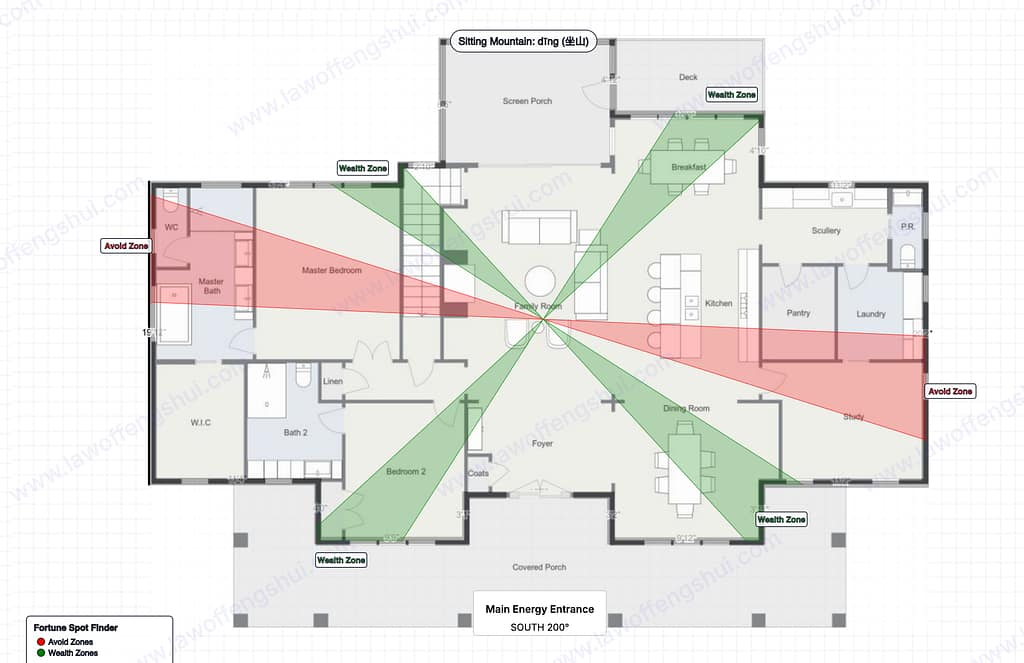
The Ba Gua compass that most people know divides your home into 8 equal sectors of 45 degrees each. The Zi-Wu system works differently. It maps the 12 Earthly Branches onto compass sectors based on the building’s sitting mountain and creates diagonal energy channels that cut across the standard grid.
Four of those branches – Chen (辰), Xu (戌), Chou (丑), Wei (未) – are classified as Repositories. In the Chinese metaphysical system, they function as natural storage points. When energy reaches a Repository sector, it accumulates rather than flowing through.
For this property, the sitting mountain is Ding (丁, south-southwest at approximately 200 degrees). The Ding sitting direction places the Four Repositories at four specific diagonal positions through the floor plan. A building sitting on a different mountain would have completely different wealth corner locations.
That’s the key point: the feng shui wealth corner isn’t in the same spot for every home. It’s calculated from the compass bearing. Two identical floor plans facing different directions would have different fortune spots.
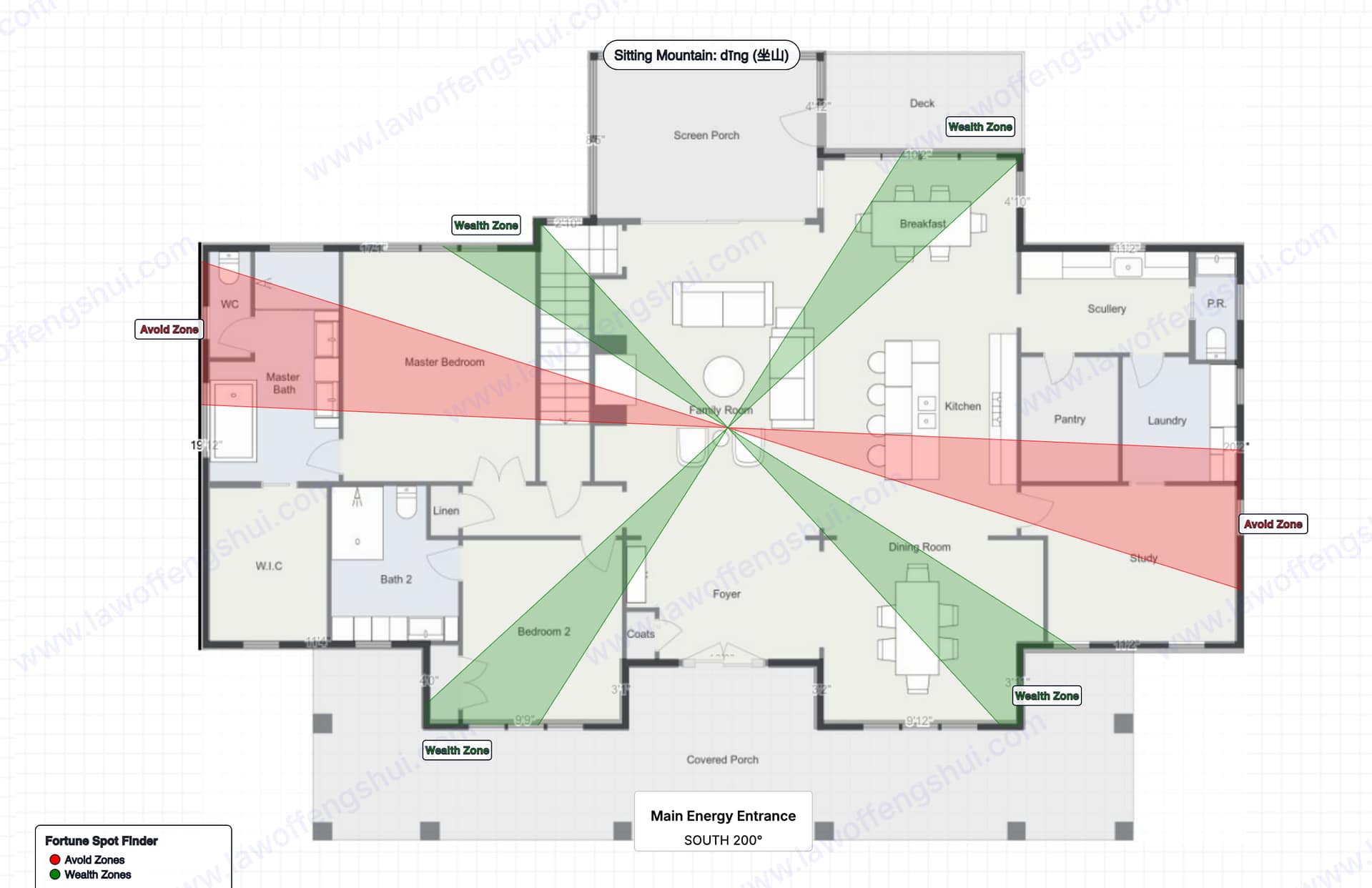
The Fortune Spot overlay identified four green Wealth Zones and two red Avoid Zones across the floor plan.
Dining Room – Wealth Zone. The formal dining table sits squarely in a prosperity sector. This is where the family gathers for meals, hosts guests, celebrates birthdays and holidays. Nobody consulted a feng shui practitioner when choosing this room for the dining table. The building’s compass orientation naturally placed it in a wealth corner.
In classical feng shui, shared meals in a wealth sector carry prosperity energy to everyone at the table. The Dining Room being in a fortune spot is genuinely one of the best possible outcomes for a family home.
Screen Porch and Deck – Both Wealth Zones. The two main outdoor gathering areas both landed in prosperity sectors. Morning coffee on the Screen Porch, dinner parties on the Deck – these activities happen in wealth zones. Outdoor spaces don’t always get attention in feng shui analysis, but the Zi-Wu system treats them equally.
Bedroom 2 – Wealth Zone. The secondary bedroom sits in a fortune spot. If someone in the household works from home and occasionally sets up a laptop in Bedroom 2, the Zi-Wu system would identify that as a naturally supportive location.
Master Bath and WC – Avoid Zones. The bathroom and toilet room on the far left ended up in the avoid zone. This is a non-issue. Nobody places a desk, safe, or financial documents in the bathroom. The system flags the zone, but the practical impact depends on what activities happen there. Service rooms in avoid zones are perfectly fine.
Want to see where the fortune spots land on a real floor plan?
Our sample report maps Zi Wu fortune zones and Ba Gua wealth sectors on an actual property with color-coded overlays.
Here’s where it gets practical. The Fortune Spot Placement Guide recommends specific items for the green wealth zones:
Desks and office furniture. If you work from home, placing your desk in a wealth corner supports career growth and productivity. The compass position of your workspace matters as much as the ergonomics.
Safes and financial storage. Important documents, family safe, investment records. Storing them in a fortune spot aligns with the energy of accumulation that the Four Repositories represent.
Money plants and prosperity symbols. A jade plant, money tree, or prosperity figurine placed in a wealth zone activates the chi flow in that sector. The plant doesn’t create the energy. The Zi-Wu system identifies where the energy already collects. The plant amplifies it.
Altars and sacred items. If you maintain a home altar or meditation space, positioning it in a fortune spot aligns spiritual practice with prosperity energy.
None of these require renovation. You’re moving items to specific locations, not knocking down walls.
The most interesting finding in this analysis was the Study. It sits right on the boundary between a Wealth Zone and an Avoid Zone.
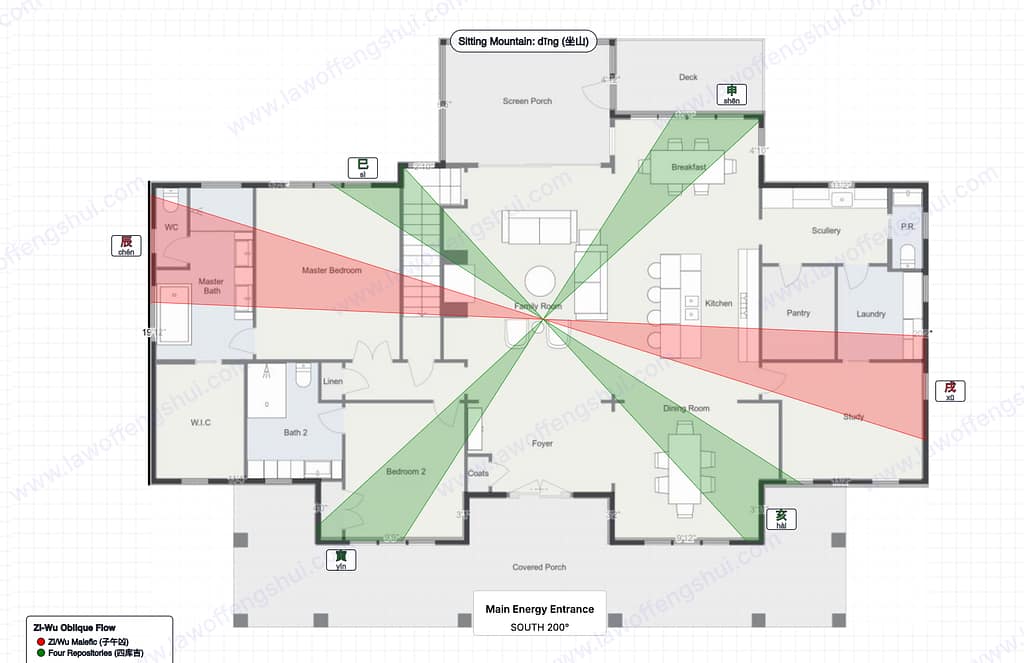
The inner wall of the Study, closest to the Dining Room, touches the wealth sector. The outer wall, against the building’s exterior, is in the avoid zone. The desk is in the Study, but where in the Study is the desk?
If it’s against the outer wall facing inward, the person sitting there is working in the avoid zone. If it’s shifted to the inner wall facing outward, they’re working in the wealth zone. Same room, different outcomes, separated by a few feet.
This is the level of precision the Zi-Wu system was designed for. Classical feng shui practitioners don’t just evaluate rooms. They evaluate positions within rooms. A 15-degree compass sector can cut right through the middle of a space, creating a boundary that’s invisible to the eye but mapped precisely on the compass.
If you’ve searched for “feng shui wealth corner” before, almost every result tells you the same thing: it’s in the southeast. Or the far-left corner from the front door if you follow the BTB (Black Tantric Buddhist) school.
That answer comes from a specific lineage. The BTB school was introduced to the West in the 1970s-80s by Professor Lin Yun. It simplified classical compass-based feng shui into a doorway-oriented system that doesn’t require a compass at all. The southeast placement comes from the Ba Gua trigram Xun (巽), which is associated with wealth and wind. In the BTB method, Xun always maps to the same position relative to the entrance.
It’s a real method. But it’s not the only method, and it’s not what classical feng shui practitioners use for wealth placement.
Classical compass school feng shui calculates wealth positions from the building’s actual compass bearing. The Zi-Wu Oblique Flow (子午斜流) system is one of the oldest of these methods. And it produces a very different map.
Four wealth corners, not one. The Ba Gua identifies one wealth sector (southeast). Zi-Wu identifies four. You have four fortune spots to work with.
Calculated from compass bearing, not the front door. The Ba Gua wealth corner is the same for every building using that method. The Zi-Wu wealth corners change position based on the building’s actual sitting direction. Two homes on the same street facing different directions will have different fortune spots.
Diagonal energy channels. The Ba Gua divides space into a grid. Zi-Wu maps diagonal flows that cut across the grid at angles determined by the 12 Earthly Branches. This creates wealth zones that don’t align with the standard 8-direction framework, which is why people who’ve only used the Ba Gua are surprised when they see the Zi-Wu overlay.
One practical caution: some guides recommend placing water features (fountains, aquariums) in the southeast wealth corner for every home. In classical feng shui, adding water to the wrong compass sector can cause financial loss and legal disputes rather than prosperity. The direction matters, and it’s building-specific. Running a compass-based analysis before adding water features is always the safer approach.
Neither system is wrong. They evaluate different layers. The Ba Gua maps broad energy zones based on a universal grid. The Zi-Wu maps specific accumulation points based on your building’s actual compass orientation. Running both gives you the fullest picture.
Curious whether any of your rooms sit inside a built-in fortune zone?
Our sample report runs Zi Wu Oblique Flow on a real property and shows all 4 fortune spots mapped across the floor plan.
2026 is the Year of the Fire Horse. Fire energy is expansive and momentum-driven. In a year where the element of Fire dominates and Water is absent from the annual chart, activating your wealth zones becomes more about intention and placement than about passive accumulation.
There’s also a notable alignment this year: the annual Flying Star #9 (Purple Right Assistant, a future-prosperity star in Period 9) lands in the Southeast. This hasn’t happened since 2007 and won’t again until 2043. If your Ba Gua wealth corner is in the southeast AND one of your Zi-Wu fortune spots overlaps with that sector, 2026 is a particularly strong year for that zone. Two systems reinforcing the same area at the same time.
The Four Repositories are “storage” zones. In a Fire year, storage matters more than usual because Fire energy burns fast. Having your financial items, career tools, and prosperity symbols anchored in the right compass sectors gives them a stable foundation.
A few suggestions for the fortune spots this year:
Place a jade plant or money tree in the wealth zone closest to your living area. Green plants represent Wood, which feeds Fire. In 2026, this creates a supportive elemental cycle: Wood (plant) generates Fire (year energy) generates Earth (stability).
If you have a home safe, consider whether it’s in one of the four fortune spots. Moving it a few feet into a wealth zone aligns the storage of financial assets with the energy of accumulation that the Four Repositories represent.
For home offices, the desk position matters most. If your office is in a wealth zone, you’re already set. If it’s not (like the outer wall of the Study in this case study), shifting the desk toward the inner wall can cross the boundary.
None of this requires buying anything new. You’re repositioning what you already own to align with the compass sectors your building already has.
The Four Repositories are calculated from the sitting mountain. If you know your building’s compass sitting direction, the correspondence is fixed:
The calculation itself isn’t complicated, but it requires accurate compass measurement. A few degrees of error can shift the sitting mountain and produce completely wrong fortune spot locations. This is why feng shui practitioners use a Luo Pan (feng shui compass) rather than a phone app.
Curious what 15+ classical feng shui systems reveal about a real home?
Our sample report shows every overlay on an actual floor plan so you can see the difference between classical analysis and generic advice.
What is a feng shui wealth corner? In classical feng shui, a wealth corner is a compass sector where prosperity energy naturally accumulates. The Zi-Wu Oblique Flow system identifies four wealth corners called the Four Repositories (四庫) based on the building’s sitting direction. They’re ideal locations for desks, safes, altars, and money plants.
Where is the feng shui money corner in my house? It depends on your building’s compass sitting direction. Unlike the Ba Gua method which places the wealth corner in the southeast for everyone, the Zi-Wu system calculates four specific fortune spots from your building’s actual compass bearing. Two homes facing different directions will have different money corners.
What should I put in my feng shui wealth corner? The Fortune Spot Placement Guide recommends desks and office furniture (for career support), safes and financial storage (for wealth protection), money plants and prosperity symbols (to activate chi flow), and altars or sacred items (for spiritual and material alignment). All items that can be moved without renovation.
How many feng shui wealth corners does a home have? The Zi-Wu Oblique Flow system identifies four wealth corners (Four Repositories) and two avoid zones in every building. The four prosperity sectors form a diagonal pattern across the floor plan. Different rooms may overlap with different wealth corners depending on the building’s compass orientation.
Is the feng shui wealth corner always in the southeast? Only in the Ba Gua system (or the far-left corner in BTB/Western feng shui). The Zi-Wu Oblique Flow system calculates wealth corners from the actual compass sitting direction, so they can fall in any direction depending on the building’s orientation. The two systems evaluate different things and can be used together.
Can furniture placement really affect feng shui? In the Zi-Wu system, the key factor is which compass sector an activity happens in, not the room name. A desk placed in a wealth zone has different feng shui implications than the same desk placed in an avoid zone, even within the same room. Moving furniture a few feet can cross a sector boundary.
What is the difference between Zi-Wu and Ba Gua feng shui? The Ba Gua divides your home into 8 equal sectors (45 degrees each) based on compass directions. Zi-Wu Oblique Flow maps diagonal energy channels using the 12 Earthly Branches and identifies 4 wealth zones (Four Repositories) plus 2 avoid zones. The Ba Gua identifies one wealth sector (southeast). Zi-Wu identifies four. Both are classical methods that can be used together.
How do I activate my feng shui wealth corner in 2026? In 2026 (Year of the Fire Horse), place Wood element items like jade plants or money trees in your wealth zones. Wood feeds Fire, creating a supportive elemental cycle. Position desks, safes, and financial documents in the Four Repository sectors. The Fire Horse year has no Water element in its annual chart, so stable “storage” zones (the Four Repositories) become especially valuable for anchoring financial energy. The annual Flying Star #9 also lands in the Southeast this year, an alignment that hasn’t occurred since 2007.
What if my bathroom is in the feng shui wealth corner? This is one of the most common concerns. In the Ba Gua system, a bathroom in the southeast can feel like a problem because you only have one wealth corner. In the Zi-Wu system, you have four fortune spots. If one happens to overlap with a bathroom, you still have three other wealth zones to work with. Focus your desk, safe, and prosperity items in the other fortune spots. The bathroom itself doesn’t “drain” the whole system.
Can a feng shui wealth corner actually help with money? Classical feng shui doesn’t promise wealth from compass placement alone. What the Zi-Wu system identifies are sectors where energy naturally accumulates and stores rather than passing through. Placing career tools (desk), financial storage (safe), and growth symbols (plants) in those sectors aligns your daily activities with the building’s strongest accumulation points. Think of it as optimizing the environment you already spend time in, not a magic formula.