Address
304 North Cardinal St.
Dorchester Center, MA 02124
Work Hours
Monday to Friday: 7AM - 7PM
Weekend: 10AM - 5PM
Address
304 North Cardinal St.
Dorchester Center, MA 02124
Work Hours
Monday to Friday: 7AM - 7PM
Weekend: 10AM - 5PM

Most people choose their home office location based on which room is available. There’s a spare bedroom, it becomes the office. There’s a corner of the living room, it becomes the desk spot. The decision is driven by square footage and proximity to an outlet, not compass orientation.
Classical feng shui office analysis evaluates workspace placement differently. Two systems work together: one checks whether the compass sector supports office function based on the building’s orientation, and the other checks whether that sector supports the specific person sitting there. The building says “this is the best office sector.” Your birth year says “but is that sector best for YOU?”
I tested this on a real apartment where two remote workers share one dedicated office room. The result: the room labeled “office” by the builder was the worst possible spot for one of them.
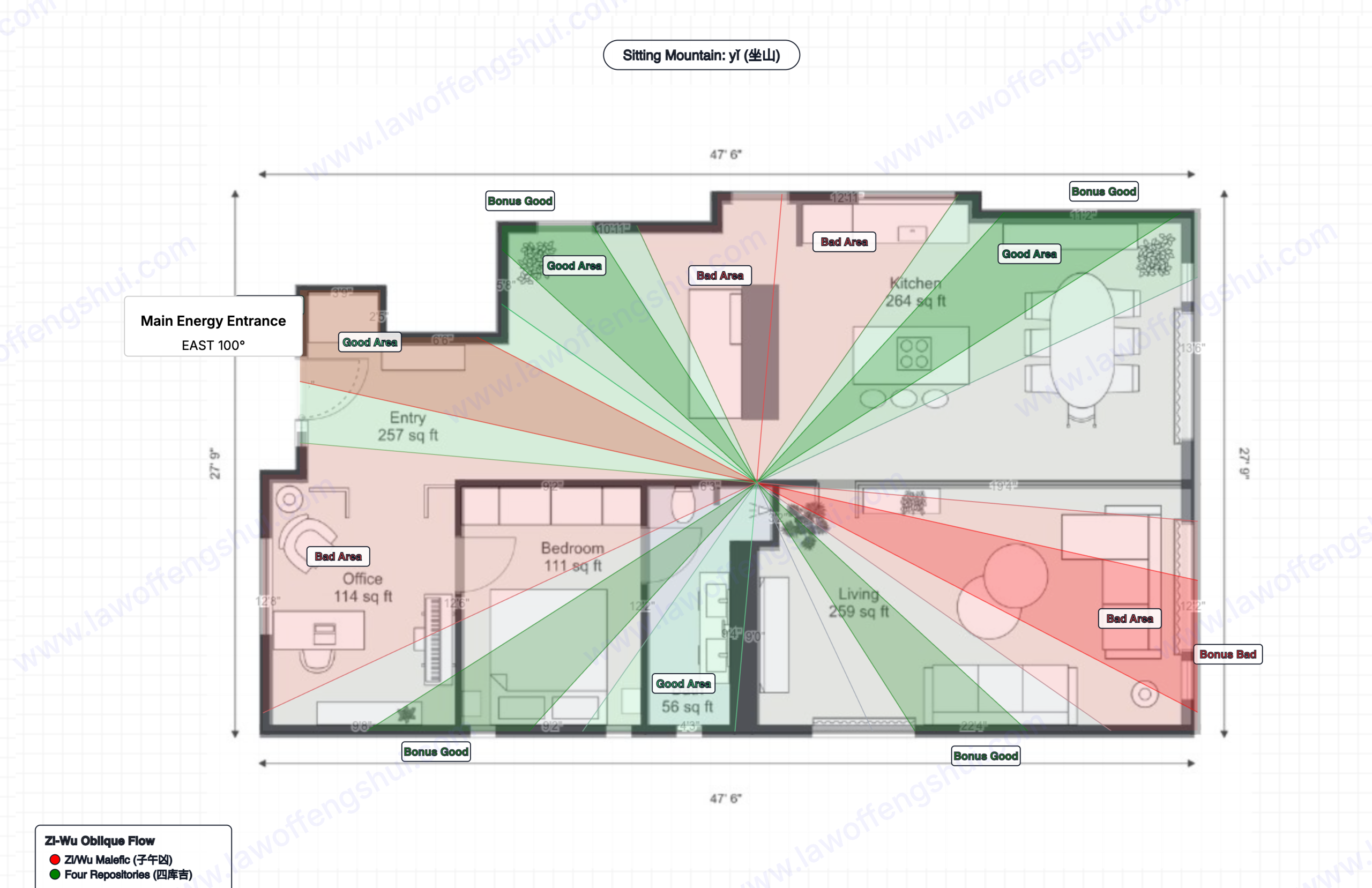
The property is a west-facing apartment in San Diego, sitting on Yi mountain (乙山) with the main energy entrance at East 100 degrees. The floor plan has six rooms:
David (born 1990, Horse zodiac) and Lisa (born 1987, Rabbit zodiac) both work from home full-time. The apartment has a dedicated 114 sq ft office. The obvious arrangement: they share it or take turns.
Two classical systems say that arrangement is wrong.
The analysis combines two overlays. The first is the Zi-Wu Oblique Flow (子午斜流), which maps structural energy onto the building based on its sitting direction. Every building has sectors the Zi-Wu system marks as malefic (avoid for important functions) and sectors it marks as Four Repositories auspicious (prioritize for wealth positions and key rooms). This is fixed. It doesn’t change based on who lives there. The building’s orientation determines it.
The second is He Chong (合冲), the Harmony/Clash system. This one is personal. Your zodiac animal – determined by birth year – harmonizes with certain compass directions and clashes with others. There are three types of positive relationships:
Six Harmonies (六合): Your zodiac has one natural partner animal. When the compass sector matching your partner’s direction is part of a room, that room supports you. Rabbit’s partner is Dog. Horse’s partner is Goat.
Three Harmonies (三合): Groups of three zodiac animals form elemental triangles. Rabbit belongs to the Wood triangle (Pig-Rabbit-Goat). Horse belongs to the Fire triangle (Tiger-Horse-Dog). Sectors matching any animal in your triangle are favorable.
Six Clashes (六冲): The opposite relationship. Your zodiac has one direct adversary. Rabbit clashes with Rooster. Horse clashes with Rat. The compass sector matching your adversary actively works against you.
When both overlays are active, green zones mean both the building and the person agree: good for an office. Red zones mean one or both systems say avoid.

The dedicated office room sits in the You (酉, Rooster) compass sector.
For Lisa, this is a Six Clash. Mao-You (卯酉), Rabbit vs Rooster. The classical text calls it “Wood-Metal direct clash, severe punishment.” It’s not a mild mismatch. It’s the single worst compass direction for her. The analysis flagged it with a warning: “Not suitable for master bedroom or office.”
The Zi-Wu Oblique Flow independently flagged the same area as a malefic position. Two systems, neither aware of the other’s logic, arrived at the same conclusion: the office room is wrong.
David’s Horse zodiac (午) has no clash with the Rooster sector. It’s neutral for him. Not a harmony direction, but not working against him either. His clash direction is Zi (子, Rat), which falls near the kitchen-entry border in the upper-center of the apartment. That’s far from where he’d put a desk.
The living room (259 sq ft) was also flagged: “Bad Area” plus “Bonus Bad” from the Zi-Wu system. The bottom-right corner of the apartment carries the heaviest negative energy in the entire layout.
The real finding isn’t just that the office is bad. It’s where the analysis says to move.
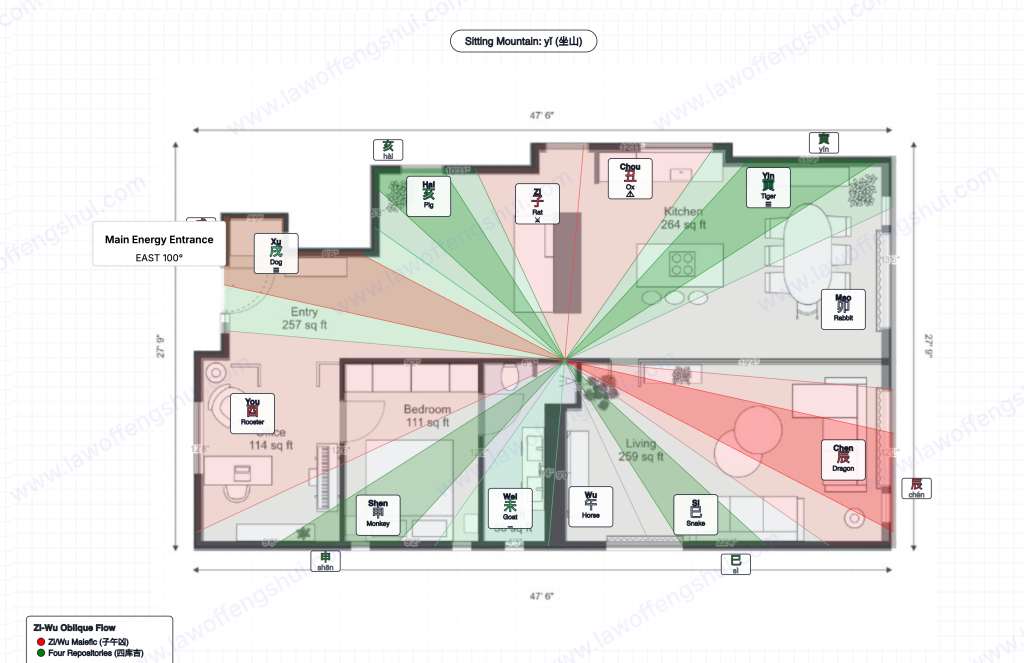
The entry hall sits near the Xu (戌, Dog) sector. For Lisa, Dog is her Six Harmony partner (Mao-Xu, Rabbit-Dog). For David, Dog is part of his Three Harmony fire triangle (Yin-Wu-Xu, Tiger-Horse-Dog). Both overlays mark this area green. Both people harmonize with it.
And the entry is 257 sq ft – more than double the dedicated office’s 114 sq ft. It’s the second-largest room in the apartment after the kitchen.
The feng shui office layout recommendation: David works from the dedicated office (neutral compass alignment, correctly sized for a single workstation). Lisa sets up her desk in the entry hall (her harmony direction, more space, and the building’s structural energy supports it). Or they both move to the entry and repurpose the 114 sq ft office as a guest room or storage.
The feng shui desk placement question isn’t just “where does the desk fit?” It’s “which compass sector does the desk sit in, and does that sector support the person working there?”
This is relevant for architects and interior designers working with clients who have home offices. The room labeled “office” on the floor plan was chosen for plumbing clearance, window placement, or leftover square footage after bedrooms and living areas were sized. It wasn’t chosen based on compass orientation or the future occupant’s zodiac alignment.
That doesn’t mean it’s wrong for everyone. David can work there. But Lisa’s productivity, focus, and overall comfort in that room are energetically undermined by the Rabbit-Rooster clash. Moving her 15 feet to the entry changes the compass sector from her worst direction to her best.
The same logic applies to any feng shui room layout. The Nine Star system (used in Best Kitchen and Best Bedroom modes) identifies which compass sectors best support specific room purposes. He Chong personalizes it per person. A sector rated “best for office work” by the building’s energy map might still be wrong for the person sitting there.
Check the compass sector first. Before buying a desk or picking a wall, figure out which compass sector each room falls in. The building’s facing direction determines the energy distribution.
Run the personal layer. Your zodiac animal (based on birth year) determines which sectors support you and which work against you. Two people in the same household can have opposite maps.
Bigger doesn’t mean better. The 259 sq ft living room was flagged as the worst zone in this apartment. The 114 sq ft office was second-worst for Lisa. Room size and feng shui office quality are independent.
Room labels are suggestions. The builder called it an “office.” The compass analysis says it’s the wrong room for that function. Be willing to move functions between rooms based on what the energy analysis shows.
Shared spaces need compromise maps. When two people share a home, the He Chong overlay can show both simultaneously. Sectors where both harmonize (bright green) are the best candidates for shared workspaces. In this apartment, the entry hall was the only room that worked for both.
Most feng shui office guides answer this question with “face your Kua number’s best direction” or “sit in the commanding position with your back to the wall.” That advice focuses on desk orientation within a room. It skips the bigger question: is the desk in the right room?
The He Chong system evaluates which compass sector the room falls in, then checks whether that sector supports the person sitting there. In this apartment, rotating Lisa’s desk to face a different direction inside the office wouldn’t fix the Rabbit-Rooster clash. The entire room sits in the Rooster sector. The fix is moving the desk to a different room entirely.
Kua number calculations group people into 8 categories. He Chong uses 12 zodiac animals with three distinct relationship types: Six Harmonies (partner animal), Three Harmonies (elemental triangle), and Six Clashes (direct adversary). The resolution is higher. Rabbit and Rooster sit exactly 180 degrees apart on the zodiac compass. A Kua-based approach might place both people in the same favorable group, missing the spatial clash entirely.
Which direction should your desk face? Proper feng shui desk placement starts by confirming the desk is in the right compass sector for your zodiac. Then optimize the facing direction within that sector.
David was born in 1990, a Horse year. 2026 is a Fire Horse year. When your zodiac year returns, classical feng shui considers the timing layer alongside the spatial one.
The apartment’s main entrance faces East (100 degrees). East-facing entrances are considered supportive during Horse years. David working from a neutral-to-positive compass sector during his zodiac year has an additional alignment advantage that Lisa doesn’t share.
This doesn’t change the He Chong analysis. Lisa’s Rabbit-Rooster clash is fixed regardless of the calendar year. But it illustrates why feng shui office placement isn’t static. The building’s energy map stays the same. The personal layer shifts with time.
Does feng shui office direction really affect productivity? Classical feng shui maps career-supporting energy sectors based on the building’s compass orientation. The He Chong system adds a personal layer using your zodiac. A clash direction (like Rabbit vs Rooster in this case) is considered the worst possible alignment for important activities. Whether you frame this as energy flow or environmental psychology, the compass relationship between the person and the space is a core feng shui principle.
How do I find my feng shui office direction? Your optimal office direction depends on two things: the building’s sitting mountain (which determines the structural energy map via Zi-Wu Oblique Flow) and your birth year zodiac animal (which determines personal harmony/clash via He Chong). The He Chong system uses Six Harmonies, Six Clashes, and Three Harmonies to map every zodiac animal’s relationship with 12 compass sectors.
Can two people share a feng shui home office? Yes, but only if the office sits in a compass sector that works for both. The He Chong overlay can show results for multiple people simultaneously. Green zones where both harmonize are safe for shared workspaces. If one person clashes with the sector, that person should work from a different room.
What if my home office is in a bad feng shui direction? You have a few options for improving your feng shui office layout. Move the desk to a different room that falls in a better compass sector for you. If moving isn’t possible, position the desk so you face your harmony direction while sitting. You can also use the room for lower-stakes activities (storage, guest room) and set up your primary workspace in a sector where your zodiac harmonizes.
Does the building’s facing direction change the feng shui office result? Yes. The sitting mountain and facing direction determine the entire Zi-Wu Oblique Flow energy map. Change the facing direction and the malefic/auspicious sectors rotate. The He Chong personal layer is fixed to your birth year, but the structural layer shifts with building orientation. The same apartment facing north would produce a completely different office placement recommendation.
Which direction should my desk face for productivity? Start with the room’s compass sector, not the desk’s facing direction. In this case, Lisa’s desk faced the door in the office – good by conventional advice – but the entire room was her Six Clash direction. Moving the desk to a different room in her harmony sector mattered more than which wall it faced. Once you’re in the right sector, face the entrance if possible.
Is the Kua number the same as zodiac feng shui? No. Kua numbers group people into 8 categories based on birth year and gender. The He Chong zodiac system uses 12 animals with Six Harmonies, Six Clashes, and Three Harmonies to map personal compass compatibility. He Chong is more granular. Two people with the same Kua number can have opposite He Chong maps. Rabbit and Rooster share no Kua connection but have a direct Six Clash in He Chong.