Address
304 North Cardinal St.
Dorchester Center, MA 02124
Work Hours
Monday to Friday: 7AM - 7PM
Weekend: 10AM - 5PM
Address
304 North Cardinal St.
Dorchester Center, MA 02124
Work Hours
Monday to Friday: 7AM - 7PM
Weekend: 10AM - 5PM

Every guide on feng shui living room layout covers the same checklist: sofa against a solid wall, commanding position facing the room entry, clear pathways for energy flow, no clutter blocking the main seating area. In 2026, that’s still where most content on feng shui living rooms stops. It’s a legitimate foundation, and it applies to living rooms everywhere — but it leaves one key question unanswered.
Quick answer: The best feng shui sofa placement combines two layers. Back the sofa against a solid wall in commanding position (clear sightline to the entry without being directly in the door’s path). Then use Ba Zhai Nine Star to identify which wall sits in the most auspicious compass sector for your building’s orientation, and place the sofa there. When both layers agree on the same wall, the placement is confirmed at every level.
Classical compass feng shui adds that second layer. Once you know the form school basics, Ba Zhai Nine Star maps your entire living room into 8 directional sectors based on the building’s compass orientation. Each sector carries a different energy quality. Living rooms don’t have one energy quality throughout — they have zones, and some zones are significantly more favorable than others for main seating placement.
This post covers both layers: the feng shui living room tips that apply universally, and the compass analysis that shows you which zone of the room is actually best for the sofa. We ran a full analysis on a San Diego open-concept 2BR apartment using Law of Fengshui. The result challenged where most people would instinctively place the main seating.
Most feng shui advice for living rooms starts with the same principles, and they work. Here’s what the standard feng shui checklist for living rooms includes:
Sofa backing: The sofa should have a solid wall behind it. This is the 玄武 (Black Tortoise) principle — you want support at your back, not open space or a window. A solid wall behind the main seating creates what classical feng shui calls “mountain backing,” a sense of stability and protection for whoever sits there.
Command position: The main sofa should face the room entry without sitting directly in line with the door. You want to see who comes in without the door’s energy hitting you directly. The feng shui commanding position principle for living rooms mirrors what it does for beds in bedrooms — visibility and psychological ease from a stable position.
Energy flow: Pathways through living rooms should remain clear. Furniture arrangement that blocks the natural circulation path through the room creates stagnant energy. The space in front of and around the sofa matters as much as the sofa’s position itself.
Clutter: Living rooms are high-traffic social spaces. Clutter disrupts energy flow in any room, but in living rooms it’s particularly pronounced because the space is meant to welcome and circulate positive energy rather than trap it. A clutter-free living room allows energy to flow naturally through the space.
Natural light and yin-yang balance: Living rooms function as yang spaces — active, social, energizing. Natural light supports that yang quality. Rooms with limited natural light can feel heavy or yin-dominant. Practical feng shui living room tips often include lamp placement and mirror use to enhance light in darker areas, since mirrors to reflect natural light are a standard tool in feng shui for living rooms.
These are the form school feng shui living room rules. Every feng shui expert will cover these. They work across all living rooms regardless of location or compass direction. But they share a common limitation: they apply the same advice to every space.
The commanding position is the most important feng shui principle for main seating in living rooms. It’s remained central to both classical Chinese practice and modern feng shui living room tips because it works — environmentally and psychologically. Sitting with a clear view of the room’s entry reduces background vigilance and creates the stability associated with “command” in classical texts.
The commanding position tells you the relationship between the sofa and the door. Sit so you can see the entry, with a solid wall behind you, without being directly in line with the door opening. This is the form school answer to feng shui living room layout.
What it leaves open is the compass question. The commanding position gives you a relational rule — where to sit relative to the door. It does not tell you which wall of the living room that position falls on. In an open-concept living room with two or three viable solid walls, each wall occupies a different compass sector, and in Ba Zhai each compass sector has a fundamentally different energy quality. Two walls in commanding position might have completely opposite sector ratings. This is what form school cannot resolve on its own.
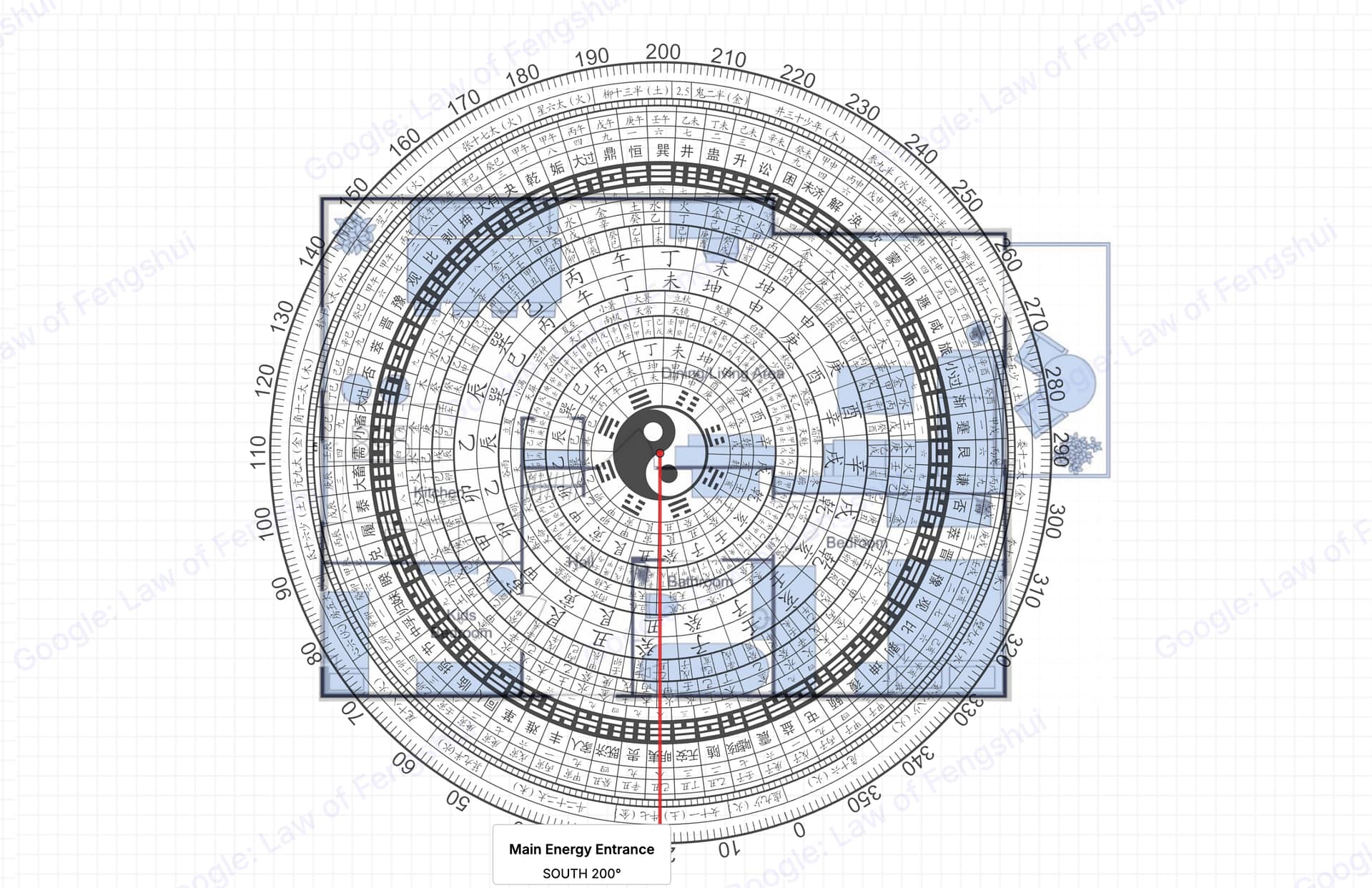
Ba Zhai (八宅), meaning “Eight Mansions,” is a classical Chinese feng shui system that divides any property into 8 directional sectors based on the building’s compass orientation. It’s one of the most widely cited systems in Chinese-language feng shui sources, and it’s universally applied to questions of where to place the main seating in a living room.
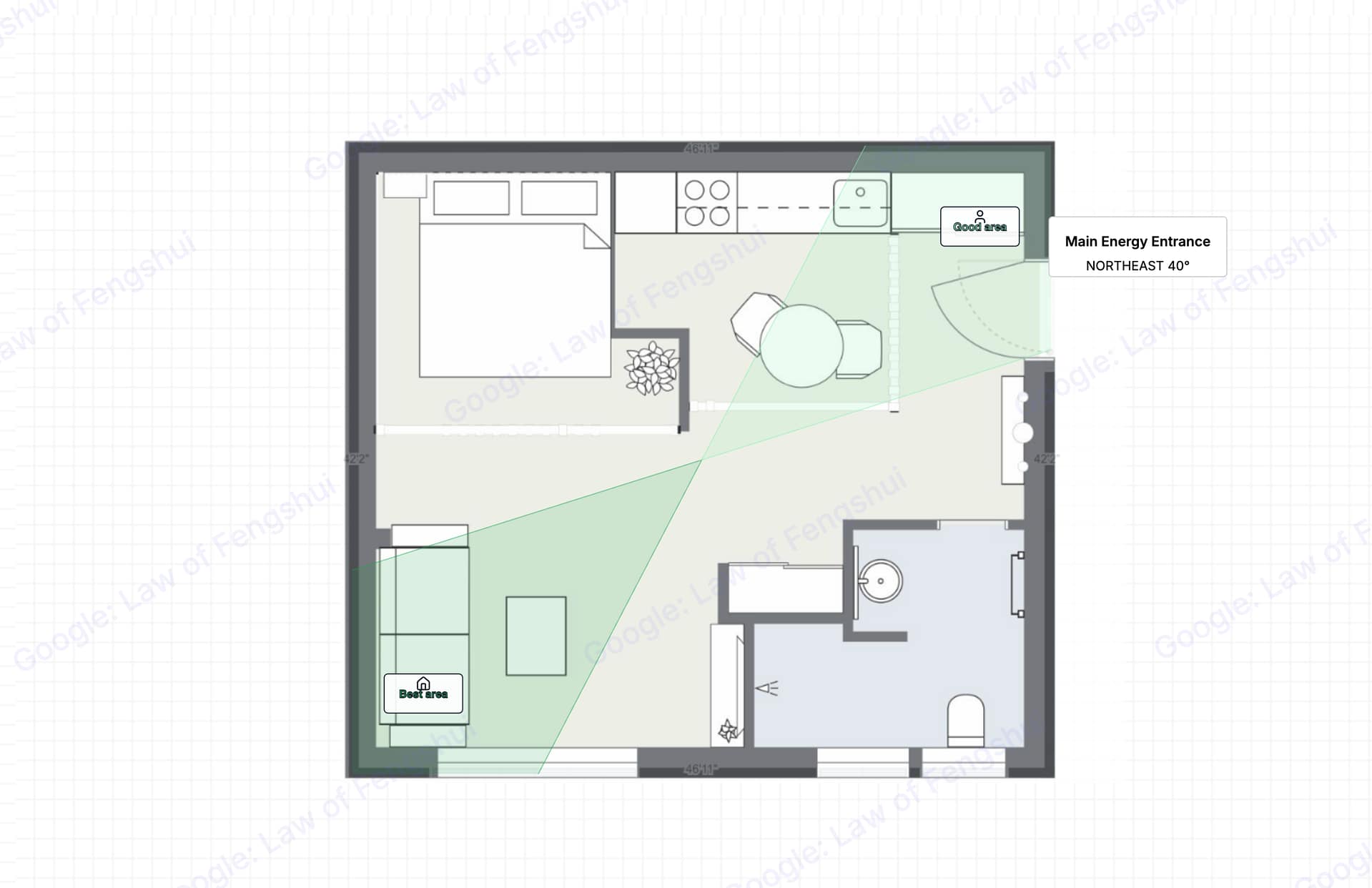
The system produces 4 auspicious sectors and 4 inauspicious sectors for every property:
Auspicious sectors:
Inauspicious sectors:
The key classical principle for living rooms: 坐在吉位相当于坐在财位上 — “sitting in an auspicious sector is equivalent to sitting in a wealth position.” The sofa is where you and your family spend extended time in a seated, restful position. Which sector you’re sitting in matters.
Unlike feng shui ba gua map analysis, which assigns fixed life areas to compass directions regardless of the property’s specific orientation, Ba Zhai Nine Star sectors shift based on how the building is oriented. The same east-facing wall in one apartment can be a completely different sector type in another apartment that faces a different compass direction.
In open-concept living rooms, the Ba Zhai Nine Star overlay maps sectors that extend from the center of the building outward. A large living room will span multiple sectors — parts of it may fall into the Sheng Qi zone, other parts into less favorable zones.
This is what makes compass-based feng shui living room analysis different from treating living rooms as a single unified space. It’s not that living rooms are auspicious or inauspicious as a whole. It’s that different zones within living rooms carry different energy qualities, and the sofa’s specific position within those zones matters.
The practical question becomes: which part of the living room’s floor area sits in the most auspicious sector? That’s the Ba Zhai answer for sofa placement. Then, within that zone, what orientation should the sofa face? That’s where Na Jia Li adds its layer.
Want to see which zone of your living room is best for the sofa?
Our sample report runs Ba Zhai Nine Star on a real floor plan so you can see how the 8 sectors map across a living room and where the sofa energy peaks.
The property is an open-concept 2BR apartment in San Diego, California. The unit has a prominent living and dining area, kitchen to the west side, a balcony at the east-northeast edge, and bedrooms in the southeast quadrant. The main entrance is at the southwest. It’s the type of layout where the living room naturally draws the eye toward the vaulted ceiling section at the top-center of the space.
We set up the floor plan in Law of Fengshui, oriented it to compass north based on the property’s actual coordinates, and activated the Ba Zhai Nine Star overlay.
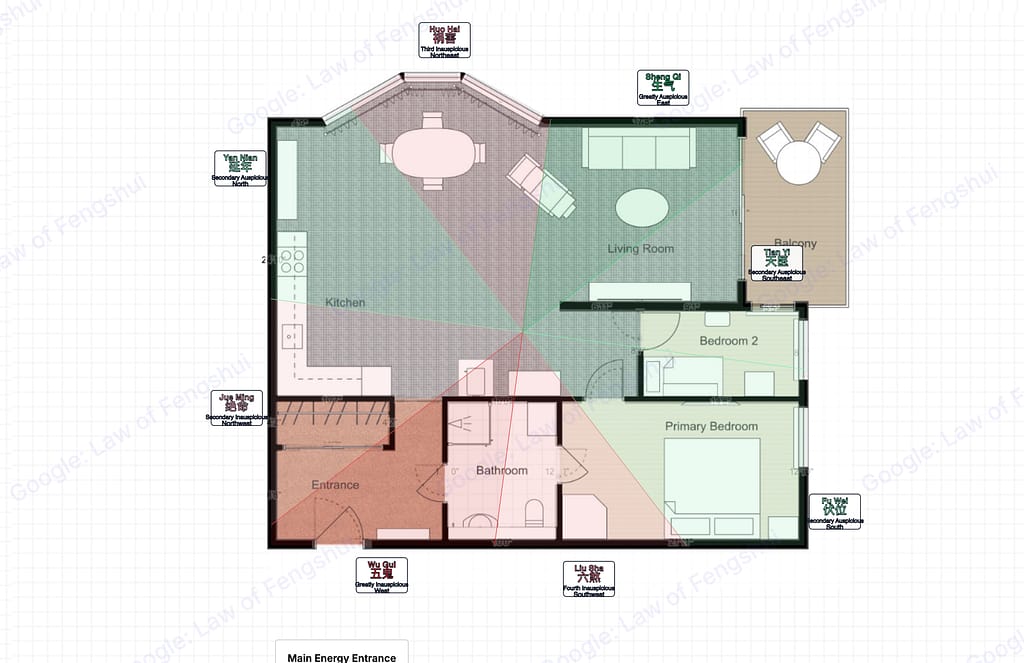
Here’s what the Nine Star overlay revealed for this apartment:
The living room spans multiple zones. Not uniformly auspicious, not uniformly inauspicious — genuinely split, with different energy qualities in different parts of the same open space.
The most visually striking feature in this living room is the vaulted ceiling section at the top-center. It’s the architectural anchor. In any conventional interior design approach, this is where you’d draw the seating cluster. High ceiling, dramatic feature, visual weight — it reads as the “main” part of the room.
But the Nine Star overlay shows this section sits in Huo Hai: the minor inauspicious zone.
The east wall, closer to the balcony, is significantly less dramatic architecturally. It doesn’t command attention the way the vaulted section does. But in Ba Zhai terms, it’s Sheng Qi — the highest-quality sector in the living room for this building’s compass orientation.
This is the consistent pattern that classical compass feng shui reveals in living rooms: the visually dominant feature and the energetically optimal zone rarely coincide. People arrange living rooms around what draws the eye. Ba Zhai maps it around what the compass confirms.
For the sofa, the recommendation is clear: the east wall, in the Sheng Qi zone. Not the vaulted center section, however visually compelling it is. Applying feng shui principles to living rooms means letting the compass data inform placement rather than visual instinct alone.
Na Jia Li (纳甲理) is a separate classical system that works at the individual furniture level rather than the room level. Where Ba Zhai answers “which zone of the living room?” Na Jia Li answers “how should the sofa be oriented within that zone?”
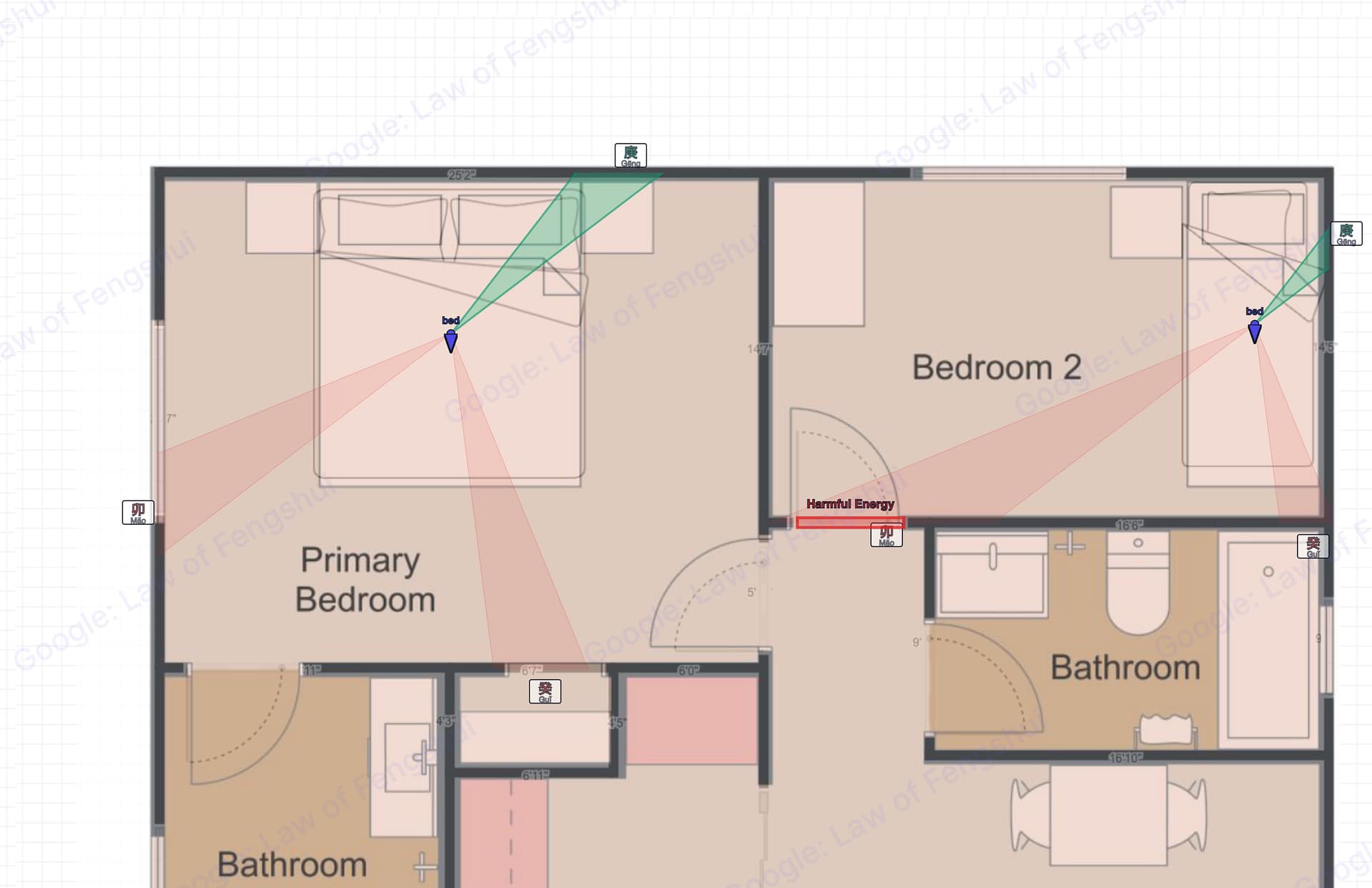
The system calculates a trigram for any piece of furniture based on its sitting direction, then maps 8 energy sectors radiating outward from the furniture. Green sectors indicate favorable directions — ideally, doors and windows in the room should fall within these green sectors for optimal alignment. Red sectors (Jie Sha robbery sha, Ba Sha water sha) indicate directions to avoid for openings and active features.
This is the same system covered in our feng shui furniture placement guide — the Na Jia Li compass formula that maps each piece of furniture to its best directional sectors. In that earlier analysis, we applied Na Jia Li across multiple furniture pieces and rooms. Here, we’re applying it specifically to the sofa, after Ba Zhai has already identified the right zone.
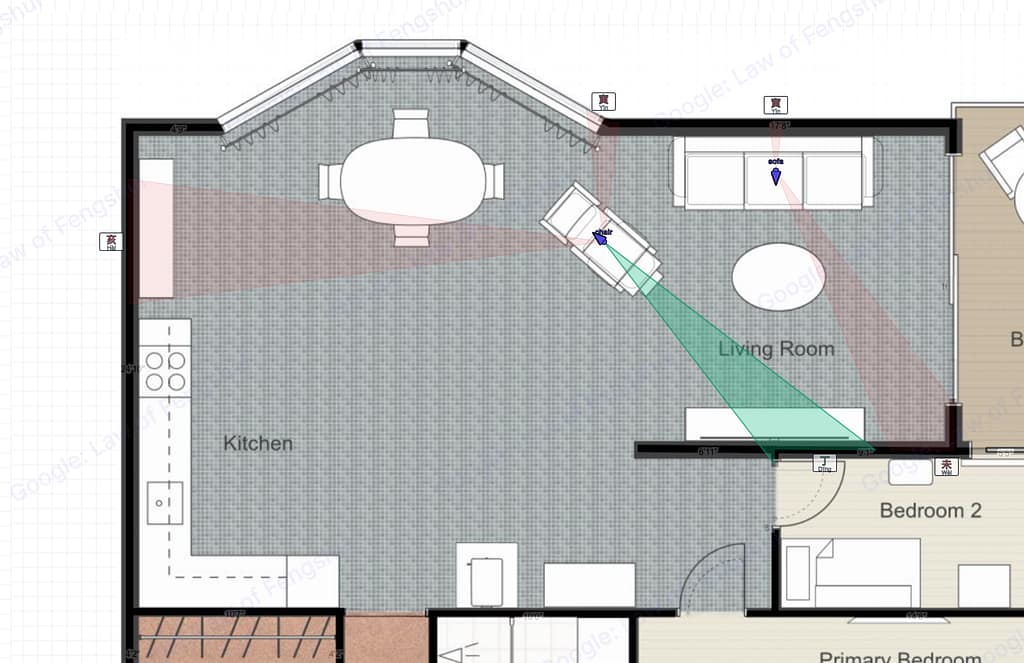
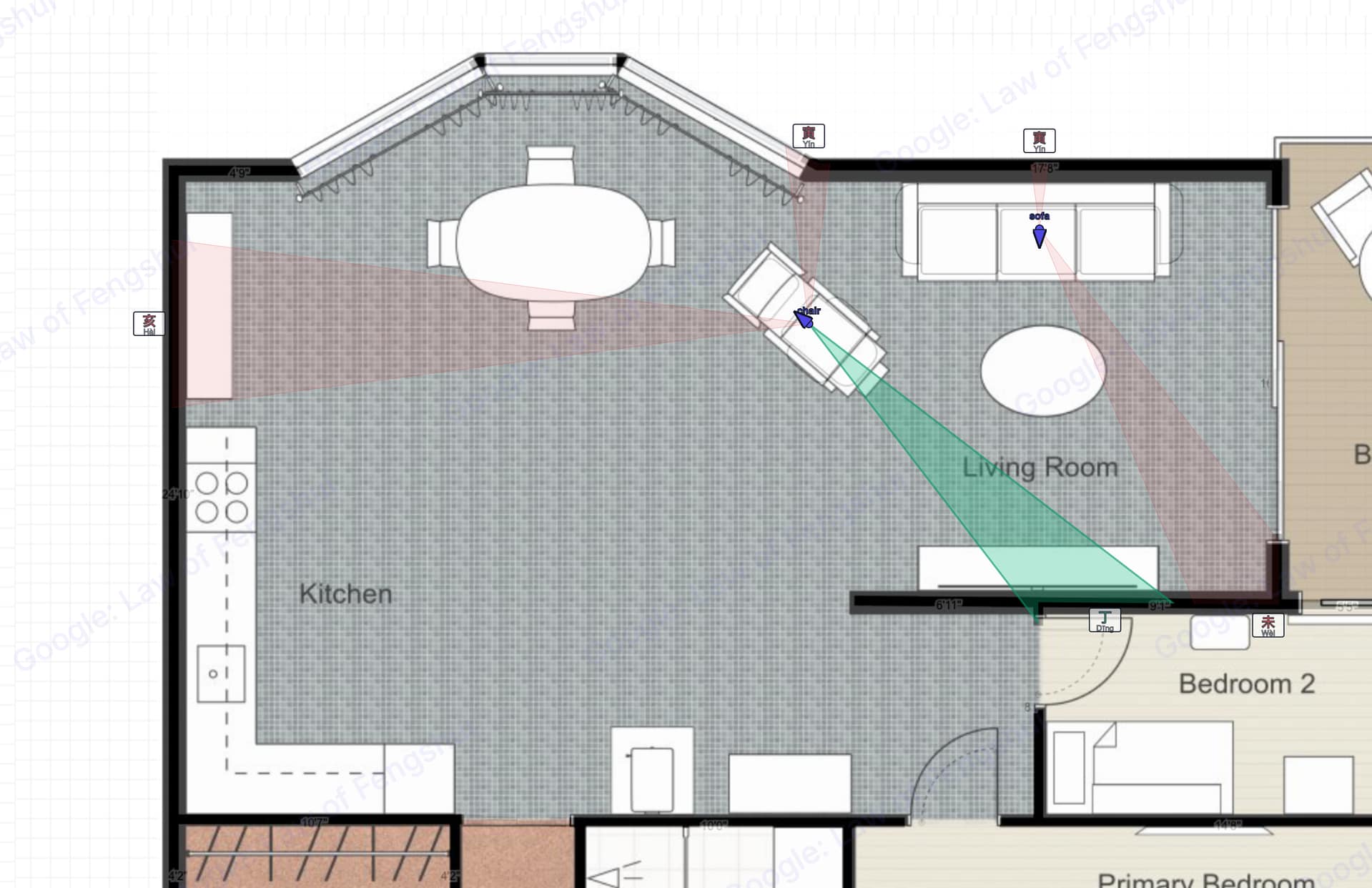
Once the sofa was positioned in the Sheng Qi zone on the east side of the living room, we activated the Find Best Furniture overlay.
The green sectors (the sofa’s own harmony energy directions) fanned outward toward the southeast — pointing toward the bedroom passage, the main opening in that direction. The important check: no red sectors landed on any doors or windows. The red zones (Jie Sha and Ba Sha sha sectors) stayed away from all openings.
The goal stated by the overlay itself: “Check if room doors/windows align favorably with feng shui directional sectors from your furniture placement.” Result confirmed.
Two overlays, one answer. Ba Zhai identified the east wall as the zone. Na Jia Li confirmed the sofa’s orientation within that zone is correct. When both classical systems point to the same placement, the recommendation carries double backing.
This is what distinguishes this approach from generic feng shui living room tips. Form school tells you to back the sofa against a wall and face the door. Compass feng shui tells you which wall, based on sector quality. Na Jia Li tells you how to orient the piece once it’s there. Each layer answers a different question, and together they produce a placement that works on every level.
Curious how Na Jia Li confirms sofa orientation once you’ve found the right zone?
Our sample report runs Na Jia Li Find Best Furniture on an actual property so you can see which directions the sofa’s harmony sectors point toward.
Ba Zhai sectors correspond to the five elements of classical Chinese cosmology — Wood, Fire, Earth, Metal, and Water. The Sheng Qi sector carries a specific elemental quality, and decor choices in that zone can either support or counteract the sector’s energy.
For living rooms where the sofa placement points to a specific sector, aligning decorative choices with that sector’s element can reinforce the beneficial energy. This doesn’t require major renovation — it applies to color choices, materials, and the types of plants or decorative objects placed near the sofa.
The five elements layer adds depth to feng shui living room tips beyond furniture arrangement alone. A sofa in the right zone, with decor that aligns with that zone’s element, creates compounding benefit rather than just neutral placement. The feng shui ba gua map gives a complementary view of which life areas correspond to each zone if you want to layer that perspective as well.
The yin-yang principle matters here too. Living rooms are naturally yang spaces — active, social, full of conversation and movement. Decor that supports yang energy (warm colors, natural light, plants with upward growth) aligns with the room’s function. Yin elements like still water features or very dark color palettes can create imbalance if overdone in a main social space.
Here’s the complete approach for applying feng shui principles to living rooms using both layers:
Form school basics (apply everywhere):
Place the main sofa in commanding position. See the room entry without being directly in line with the door. A clear sightline to the front door from the sofa is the foundation of feng shui living room layout.
Back the sofa against a solid wall. Avoid placing the sofa with its back to a window or open doorway. Solid wall backing is the mountain support principle in classical feng shui — it’s non-negotiable for main seating in living rooms.
Keep pathways clear. Living rooms should allow energy to flow freely. Furniture arrangement that blocks natural circulation creates stagnant energy. Allow a minimum of 30-36 inches for main pathways.
Address clutter actively. Clutter in living rooms doesn’t just affect aesthetics. In feng shui, clutter blocks energy flow and introduces stagnant zones into what should be an active, circulating space. Regular clearing is part of maintaining good feng shui for living rooms.
Watch for sharp corners and poison arrows (煞氣). In classical feng shui, furniture or architectural features with sharp corners aimed directly at the sofa create cutting sha energy. Rounded furniture eliminates this issue entirely. If existing sharp corners can’t be moved, a plant or buffer placed between the corner and the seating area can deflect the angle and soften the sha.
Incorporate the five elements intentionally. Every living room benefits from a balance of the five elements — represented through color, materials, shape, and objects. Rounded furniture and soft shapes support Wood energy. Natural light and candles support Fire. Earthy tones and ceramics support Earth.
Use mirrors to reflect natural light where needed, not to create visual confusion. A mirror that reflects the main entry directly is considered destabilizing in feng shui for living rooms. Mirrors to reflect natural light into a darker corner are a practical enhancement.
Compass layer (apply once you know the sector map):
Identify the Ba Zhai Nine Star sectors for your property. Run the overlay and note which part of the living room falls in which sector. The floor plan layout may surprise you — the Sheng Qi zone often doesn’t land where visual intuition points.
Place the main sofa in the most auspicious available sector. Sheng Qi first, then Tian Yi, then Yan Nian. If the room’s most auspicious sector creates a conflict with the commanding position (the wall is on the wrong side of the room), prioritize commanding position and identify the best sector available from that position.
Run Na Jia Li on the sofa once placed. Check that the green sectors point toward doors and windows. Rotate the sofa orientation if needed to improve alignment.
Check the feng shui front door sector as well. The main entrance’s Ba Zhai sector affects how energy enters the home and reaches the living room. A Jue Ming entrance (as in this San Diego apartment) is notable — it means energy entering the home passes through the most inauspicious sector before reaching the living room, making the sofa’s own sector quality even more important as a counterbalance.
Two additional elements that living rooms benefit from addressing once the sofa placement is established:
Mirrors: In feng shui, mirrors amplify the energy of whatever sector they face. A mirror on the Sheng Qi wall amplifies that sector’s energy into the room. A mirror facing a cluttered corner or an inauspicious sector amplifies those qualities instead. Use mirrors strategically — position them to reflect natural light or to extend the visual depth of an auspicious zone, not merely for decoration.
The feng shui bedroom mirror analysis we ran earlier in this series applies the same compass-sector logic: it’s not just whether mirrors are present, but which sector they face and what they’re amplifying. Living rooms follow the same principle.
Lamps and table lamps: Lighting placement in living rooms supports the yang quality of the space. Table lamps on either side of the sofa create balanced energy around the main seating. Floor lamps in corners can activate otherwise dormant zones. If the living room has a consistently under-lit corner that the Nine Star overlay identifies as an auspicious sector, a floor lamp there can be a practical activation method.
The feng shui wealth corner post covers this concept in more depth for the specific prosperity zones — how to identify them and what to place there for enhancement.
Curious what 15+ classical feng shui systems reveal about a real home?
Our sample report shows every overlay on an actual floor plan so you can see the difference between classical analysis and generic advice.
The best sofa placement in feng shui combines two layers. Form school: back the sofa against a solid wall in commanding position so you can see the room’s entry without being directly in line with the door. Compass layer: identify which part of the living room sits in the most auspicious Ba Zhai Nine Star sector for your building’s compass orientation, and place the sofa there. When both layers agree on the same wall, the placement is confirmed on every level.
Avoid placing the sofa against a window (no solid backing), directly in line with the main door (energy runs through you directly), or in a Ba Zhai inauspicious sector if an auspicious alternative is available in the same room. In the San Diego apartment analyzed here, the vaulted ceiling corner — which most people would instinctively choose — sits in the Huo Hai (minor inauspicious) zone. The compass analysis overrides the visual draw.
Ba Zhai Nine Star is the classical Chinese Eight Mansions system applied as an overlay to a floor plan. It maps 8 directional sectors — four auspicious, four inauspicious — across the entire property based on the building’s compass orientation. The nine star labels describe the energy quality of each sector: Sheng Qi (supreme auspicious), Tian Yi (health), Yan Nian (relationships), Fu Wei (stability), Huo Hai (minor obstacles), Liu Sha (conflict), Wu Gui (major inauspicious), and Jue Ming (most inauspicious). For more on classical feng shui compass systems, see our feng shui compass guide.
Na Jia Li calculates a trigram for a piece of furniture based on its sitting direction, then maps 8 sectors radiating from that furniture. Green sectors are favorable for doors and windows to fall in. Red sectors (Jie Sha and Ba Sha sha sectors) should avoid doors and windows. For sofa placement, once Ba Zhai identifies the right zone, Na Jia Li confirms the correct orientation within that zone. This feng shui furniture placement guide covers the full Na Jia Li formula in detail.
Yes, and Ba Zhai Nine Star is particularly useful for open-concept living rooms because the sector analysis applies across the entire open floor area, not room by room. An open-concept living/dining space will span multiple sectors visibly — the overlay shows you exactly where they split. This makes it clear which section of the combined open space carries which energy quality, and where to anchor the primary seating accordingly. Open-concept layouts often make the Ba Zhai findings more counterintuitive, because the dominant architectural feature (like a vaulted area) doesn’t necessarily sit in the dominant energy zone.
Feng shui applies the same compass-sector logic across all rooms — the Ba Zhai Nine Star analysis for a bedroom works on the same principles as for a living room, though the systems used for specific items differ. For beds, He Chong and Zi-Wu Oblique Flow provide personal birth-year analysis. For sofas, Ba Zhai Eight Mansions is the primary system. The feng shui bed placement guide covers how the two-layer approach works in bedrooms, while this post covers the living room equivalent. See also our analysis of how feng shui scoring differs across life areas — the same compass sector can score differently for health versus relationships versus career depending on the overlay.
No. The commanding position principle says to sit where you can see the main entry without being directly in line with it. Direct alignment places the sofa in the path of energy rushing straight through the door — classical feng shui considers this destabilizing for the primary seating. The correct position in most living rooms: the sofa sits on a side wall with a diagonal or angled sightline to the entry, not a wall directly opposite the door where energy hits the sofa head-on. You want visibility without direct alignment.
Generally no. Placing the sofa in front of a window removes the solid wall backing — the mountain support principle (玄武) in classical feng shui. Without solid backing, the sofa position lacks stability, and the window allows energy to disperse rather than collect behind the seating. The practical exception: if the window has a substantial solid sill and the sofa is pushed fully against the wall below the window frame, some practitioners accept this as conditional backing. But in feng shui living rooms where a solid wall alternative exists, solid wall backing is always the preferred choice for main seating.
A corner sofa (L-shape sectional) isn’t inherently bad feng shui. The relevant questions are: does the primary seat maintain commanding position (clear sightline to the main entry), and which Ba Zhai sector does the primary seating fall in? If a sectional allows one end to sit in an auspicious zone with solid backing and a clear sightline to the door, the placement works. If the sectional forces primary seating into an inauspicious zone or puts the back against a window or open doorway, that’s where feng shui problems arise. Placing a plant or buffer furniture at the interior corner of the L can also mitigate any sha energy created by the interior right angle of the sectional pointing toward seating.