Address
304 North Cardinal St.
Dorchester Center, MA 02124
Work Hours
Monday to Friday: 7AM - 7PM
Weekend: 10AM - 5PM
Address
304 North Cardinal St.
Dorchester Center, MA 02124
Work Hours
Monday to Friday: 7AM - 7PM
Weekend: 10AM - 5PM

Every feng shui living room guide tells you the same things. Put the sofa against a solid wall. Keep the space open for energy to circulate. Avoid clutter in the corners. Use plants to bring in the Wood element. These are solid starting points, and they come from real classical principles.
But here's what none of those guides include: a compass. Not one of them tells you which solid wall the sofa should go against. And in a living room where four walls are all equally "solid," the sofa's compass direction is the question that actually changes the energy quality of the space.
This guide covers feng shui living room design from the ground floor to the classical layer: the universal principles that every school agrees on, plus the Ba Zhai Eight Mansions system that maps your living room into eight compass sectors and identifies where the auspicious zones actually land. We'll also cover the five elements, mirror placement, furniture arrangement, and a full case study of a Chicago apartment where the most visually dramatic wall of the living room turned out to be the worst energetic placement for the sofa.
The art of feng shui applied to living rooms is, according to experts in the classical tradition, far more site-specific than popular interior design guides suggest. This is the guide to that classical level of analysis: the approach that transforms your living room from a generically arranged space into a compass-verified energy environment.
The bedroom is a yin space designed for rest. The home office is a focused, productive space. The kitchen is a fire-element environment with very specific classical rules. Each room has a dominant energy quality that determines how feng shui principles apply.
The living room is different because it's the primary yang gathering space in the home. It's where residents and guests spend waking hours together, where social energy flows, where conversations happen. Feng shui is an ancient Chinese practice, and in the classical system, the living room is treated as a critical energy distribution hub: chi (qi) enters the home through the main door, passes through the entry, and disperses through the living room to the rest of the home. Where the chi goes first, how it moves through the open space, and where it settles matters at the whole-home level.
This is why sofa placement in the living room carries more classical weight than it might appear. The people sitting on the sofa absorb the energy of whatever compass sector that sofa occupies. In an apartment where residents spend two to four hours in the living room each evening, the compass sector of the main seating area is a sustained exposure point, second only to the bedroom.
Most feng shui living room tips address furniture arrangement aesthetics, traffic flow, and elemental balance. Classical compass feng shui asks which sector of the eight Ba Zhai zones does the sofa sit in, and is that sector auspicious for the residents of this specific home. The two questions are related but not the same, and the compass answer frequently surprises people.
Before compass analysis, the living room layout starts with two foundational principles that apply universally: chi flow and commanding position.
The energy flow through a home follows pathways similar to water moving through a landscape: chi needs paths to circulate and shouldn't pool or rush too fast in any direction. A feng shui living room layout supports this flow by keeping main pathways clear, avoiding furniture arrangements that block natural circulation routes, and making sure chi from the front door can move through the space rather than hitting a wall immediately.
The commanding position (also called the command position) for the sofa applies the same logic as the bed position in the bedroom: the person seated on the main sofa should have a diagonal view to the entry point of the living room, not sit with their back to the door. This is the form school baseline for living room seating. The 3,000-year-old principle behind the feng shui commanding position, that humans rest more comfortably when they can see the entrance from a position of relative protection and solid backing, applies just as much to a living room sofa as to a bedroom bed. That sense of security is what the command position delivers.
The difference is that the living room commanding position is less strict about exact door alignment. The bedroom's direct-in-line-with-door rule (the "coffin position") applies there due to sustained sleep exposure. In the living room, the goal is a general sense of the entry being visible, with the sofa backed against something solid, rather than a precise angular requirement.
From there, the compass layer begins. The living room layout question for classical feng shui isn't "does the sofa face the TV?" It's "which compass sector does the sofa sit in, and is that sector auspicious under Ba Zhai for this home's orientation?"
The most consistent feng shui living room tip across every tradition is this: the sofa should have solid backing. The principle comes from form school feng shui, where the 靠山 (mountain backing) concept describes the energetic support that a solid structure provides to the primary occupant position. The sofa without solid backing behind it leaves the seated person energetically exposed, the same reason a chair with a view of open doorways feels unsettled.
But "solid wall" describes a physical characteristic, not a compass direction. In a standard rectangular living room, every wall is solid. The form school principle tells you to use a wall, not which wall. Classical Ba Zhai (Eight Mansions) answers the second question.
Ba Zhai maps the home's eight compass sectors to eight energy qualities, four auspicious and four inauspicious, based on the home's facing direction. For any given home orientation, two of the eight sectors are particularly potent: 生气 (Shengqi, Peak Vitality) and 天医 (Tianyi, Heavenly Doctor). These are the sectors where sustained occupancy, sitting, sleeping, working, is most supported. The 绝命 (Juming, Life Ending) and 六煞 (Liusha, Six Harms) sectors are where sustained occupancy creates the most ongoing energetic conflict.
Classical feng shui living room advice from Chinese sources is direct on this:
沙发宜与住宅的坐山在同一方位,坐在吉位相当于坐在财位上。 "The sofa should be in the same directional sector as the house's sitting mountain; sitting in an auspicious sector is equivalent to sitting in a wealth position."
For an East-Four house (Kan, Li, Zhen, or Xun orientation), auspicious sofa sectors run east, southeast, south, and north. For a West-Four house (Qian, Kun, Gen, or Dui orientation), auspicious sofa sectors run west, southwest, northwest, and northeast. The sector determines which solid wall is actually worth using.
This is the layer that transforms "put the sofa against a solid wall" from a universal tip into a compass-specific recommendation, and it's the key to feng shui your living room at the classical level rather than the decorating level. According to feng shui practice, furniture placement decisions should follow compass data, not aesthetics.
Five elements theory is one of the oldest frameworks in classical Chinese thought: Wood, Fire, Earth, Metal, and Water exist in a cycle of generation and control. In feng shui living room design, incorporating all five elements creates a balanced, harmonious space. A living room dominated by one element at the expense of others creates imbalance that manifests as specific energy deficiencies.
Wood is represented by live plants, wooden furniture, tall vertical shapes, and green tones. It's the element of growth and vitality. Indoor plants are the most direct Wood element activator in a living room: green plants (live plants specifically, not artificial) bring genuine Wood energy into the space. Taller plants carry more Wood presence than short ones. The east and southeast sectors of any room have a natural Wood affinity in classical feng shui.
Fire is represented by lighting, especially lamps and candles, warm colors (red and orange accents) and pointed or triangular shapes. The living room lamp, whether a floor lamp or a table lamp on a side table, activates the Fire element. Warm lighting at lower levels in the evening is both a yin/yang transition tool (moving the space from yang daytime to restorative evening energy) and a Fire element presence. South-facing walls have a natural Fire affinity.
Earth is represented by ceramics, earthenware, square and flat shapes, and yellow, beige, and terracotta tones. A square or rectangular coffee table is an Earth element anchor in the center of the living room. Earth supports stability and grounding. The center of any space in classical feng shui is an Earth zone.
Metal is represented by metal objects, rounded or circular shapes, and white, gray, and gold tones. Rounded furniture, especially rounded edges on coffee tables or side tables, introduces Metal energy. Metal supports clarity and focus. West and northwest sectors have a natural Metal affinity.
Water is represented by mirrors, water features, dark blue and black tones, and flowing or wavy shapes. In living room feng shui, mirrors are the primary Water element activator. They double what they face, which can be used strategically to amplify light, space, and positive energy, or can create problems if they face clutter, the main door, or chaotic areas.
A balanced living room doesn't need equal quantities of each element. It needs all five represented at some level, with emphasis on elements that support the room's function. The living room benefits from Fire (social energy, warmth) and Wood (growth, vitality) as primary elements, with Earth (stability, grounding), Metal (clarity), and Water (reflective, expansive) in supporting roles.
Curious which corner of your living room is your personal auspicious zone?
Our sample report runs Ba Zhai Eight Mansions and Na Jia Li on a real floor plan, showing exactly which sofa position aligns with your compass-based energy sectors.
Mirrors in the living room are one of the most powerful feng shui tools available, and one of the most commonly misused. Hanging mirrors strategically is, in fact, one of the highest-leverage feng shui decisions in any living room. Because mirrors represent the Water element and have strong reflective energy, their placement matters more than almost any other decorative decision in the room.
The fundamental mirror rule in feng shui living room design: mirrors should reflect something worth doubling. If a mirror reflects natural light coming through a window, it amplifies that light and expands the yang vitality of the space. If it reflects a beautiful view or a well-arranged area of the room, it doubles that positive energy. If it reflects the front door directly, it sends incoming chi back out before it can circulate. If it reflects clutter or a messy corner, it doubles the stagnant energy of that area.
Where to hang a mirror: Side walls perpendicular to the sofa generally work well, especially if they reflect a natural light source or a portion of the room rather than the main door. Walls that capture the view of windows or garden elements are ideal. Mirrors on the ceiling amplify downward-pressing energy and are universally avoided in classical feng shui.
Where not to hang a mirror: Directly facing the main door (chi enters and bounces back), directly facing the sofa from across the room (creates restless, active energy for seated occupants), and anywhere that reflects the kitchen stove (the stove's fire energy shouldn't be doubled in classical feng shui).
Size matters. A mirror large enough to reflect an entire person standing upright is preferable to small, fragmented mirrors that create a broken reflection. Fractured or faceted mirrors scatter energy rather than channeling it. Clean, clear mirrors in good frames maintain the Water element quality. Dusty, spotted, or damaged mirrors introduce stagnant water energy.
Ba Zhai adds the compass layer. Which wall the mirror goes on determines its sector in the Ba Zhai overlay. A mirror on a 生气 or 天医 sector wall can amplify the already-auspicious energy of that sector. A mirror on a 绝命 sector wall amplifies the inauspicious sector energy. For this reason, the specific wall matters in classical living room feng shui, not just the physical relationship to the door and sofa.
Clutter in the living room does what clutter does in any feng shui space: it blocks chi circulation and creates negative, stagnant energy in the areas where it accumulates. The living room, as the primary chi distribution hub of the home, is particularly affected by clutter because stagnant energy here can't distribute properly to the rest of the home. Incorporating feng shui principles for clutter management is one of the most practical tips for enhancing the energy of any living room, and the one that requires no compass data to implement immediately.
Corner clutter is the most common living room feng shui problem. Chi tends to pool in corners where furniture doesn't reach, and accumulated objects in corners amplify that pooling into genuine stagnation. Classical remedies: live plants in corners (Wood energy activates and moves chi), floor lamps (Fire energy burns through stagnant energy), or intentional arrangement of furniture to eliminate the corner as a dead space.
Natural light is a yang energy activator. A feng shui living room should allow for good natural light during daytime hours. Heavy drapes that block natural light reduce the yang vitality of the space. In living rooms with limited natural light, lamps serve a dual function: activating the Fire element and compensating for yang energy deficit. Table lamps and floor lamps at various heights create layered lighting that supports both functional illumination and energetic activation.
Energy flow patterns in the living room relate directly to how furniture is arranged. Furniture placed in a rough U or L shape around a central coffee table creates a circulation path that chi can move through. Furniture pushed against all four walls with an empty center creates a "chi desert" in the middle. Furniture arranged in a straight line forces chi into a corridor rather than allowing it to circulate and settle.
The allow energy to flow principle sounds abstract until you notice it physically: a room that feels easy to move through, that doesn't force you to squeeze between pieces or navigate obstacles, is a room where chi can also move. Feng shui living room layout that works energetically tends to also simply work physically. A mindful approach to how furniture is arranged, keeping the flow of energy in mind alongside aesthetics, is what separates a great-feeling room from one that creates a sense of unresolved tension.
Classical feng shui goes into specific detail on furniture placement in the living room, beyond just the sofa and mirrors. The furniture arrangement as a whole, not just individual pieces, determines the room's overall energy quality. The coffee table, the lamps, and supporting chairs all participate in the room's energy arrangement, and rearranging furniture with these principles in mind can make a room feel noticeably different even without changing what's in it.
Coffee table: A coffee table in the center of the seating arrangement occupies the Earth zone of the living room grouping. Rounded edges are preferred over sharp right-angle corners in classical feng shui, because sharp corners direct concentrated chi energy ("poison arrows") toward wherever they point. If seated occupants are directly in the path of sharp furniture corners, this is considered unfavorable. Rounded furniture is the solution: rounded corners on the coffee table, oval shapes, or soft-edged designs redirect energy rather than focusing it.
Lamps: Table lamps and floor lamps serve as Fire element anchors. Position them to illuminate the room evenly without creating harsh shadows in occupied areas. A floor lamp in a dark corner activates the stagnant energy that would otherwise pool there. In feng shui terms, the lamp "wakes up" the corner chi and keeps it moving. Multiple light sources at different heights, rather than a single overhead source, create more nuanced energy than flat, even overhead lighting.
Secondary seating: Chairs and secondary sofas should arrange to face or partially face the main sofa, supporting conversation rather than turning away from the primary seating. The feng shui living room ideal is a seating arrangement that allows eye contact and energy exchange between occupants, not one where seats face different directions or create isolated energy pockets.
TV placement: The flat-screen TV raises a specific feng shui question because its dark screen acts as a mirror when off: it reflects whatever sits across from it. Placing the TV where it reflects the main sofa introduces the same issues as a poorly placed mirror. Position the TV on a side wall rather than directly opposite the main sofa where possible. Allowing you to see the entrance from your seat while the TV is on a perpendicular wall creates the best balance between commanding position and screen viewing angle.
These details, the coffee table, the lamps, the secondary chairs, are what feng shui living room arrangement by compass sector addresses for full classical analysis.
Plants, colors, and furniture shapes work together to set the elemental balance of the living room. Each choice either adds to or draws from the five elements framework, and the cumulative effect determines whether the room feels energetically balanced or dominant in one direction.
Live plants: Indoor plants bring genuine Wood energy that synthetic alternatives don't replicate. Plants that are well-maintained, watered, and growing carry active Wood vitality. Plants that are dying, leggy, or neglected introduce stagnant Wood energy, which is worse than no plant at all. The east and southeast sides of the living room are the natural Wood zones. That's where live plants carry the most elemental resonance. Avoid cacti and plants with sharp spines in living room settings, as sharp forms concentrate energy in unfavorable ways.
Warm colors: Warm tones (terracotta, amber, warm ochre, and soft reds) bring Fire and Earth energy. They support social warmth and grounding in a gathering space. Cool tones, blues and greens, bring Water and Wood, which are growth-oriented but can make a living room feel less settled if overdone. A feng shui living room typically benefits from a warm-neutral base palette with accent colors tied to the element the resident wants to activate. This approach to color is important in feng shui because it connects material choices directly to elemental balance rather than treating color as purely aesthetic.
Color by sector: Beyond general color theory, Ba Zhai assigns elemental qualities to each compass sector of the home. A room's dominant sector color can be supported or modified by the color choices in that area. This is where feng shui color advice becomes property-specific rather than universal.
Rounded furniture: The Metal element preference for rounded shapes makes rounded-edge furniture a classical feng shui recommendation across living room design. Beyond elemental associations, rounded furniture reduces the "poison arrow" effect of sharp corners. A round dining table in the living room/dining area creates continuous, circular chi movement rather than directional chi projection.
The feng shui Ba Gua map gives the deeper framework for which colors and elements belong in which sectors of your specific home.
Want to see how Na Jia Li analysis works on an actual living room layout?
Our sample report overlays 15+ classical compass systems on a real apartment floor plan so you can see the full picture — not just generic sofa tips.
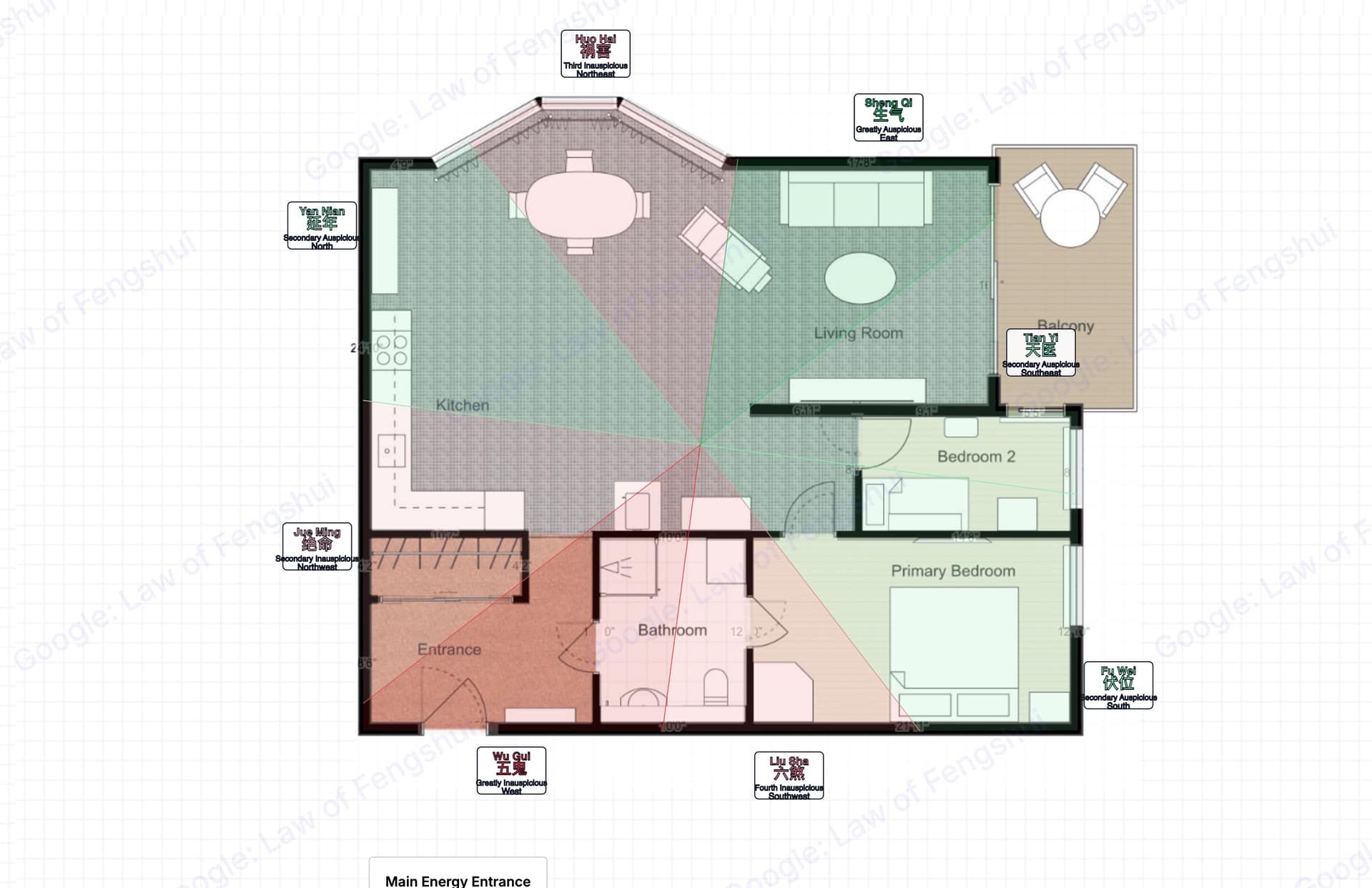
The property is a 2-bedroom open-concept apartment in Chicago, Illinois. The apartment is 911 square feet. Its facing direction is north: the large windows, vaulted ceiling in the living area, and balcony access all face the north side. The main entrance door is on the south wall. This makes it a Kan house (坎宅) in Ba Zhai terminology, an East-Four house.
The layout: The open-concept plan gives the living room a large contiguous space across the north and northwest portions of the apartment. The visually dominant feature of the living room is the vaulted ceiling area in the northwest corner, with a dining table nearby. The sofa seating area occupies the center-right of the open space. The east edge of the living room, where the open concept meets the hallway to the bedrooms, is a less visually striking area of the room.
The Ba Zhai Nine Star sector mapping for a Kan house:
| Sector | Ba Zhai Zone | Energy Quality |
|---|---|---|
| North (facing) | 伏位 Fuwei | Neutral |
| East | 天医 Tianyi (Heavenly Doctor) | Auspicious |
| Southeast | 生气 Shengqi (Peak Vitality) | Most Auspicious |
| South (sitting) | 延年 Yannian | Auspicious |
| West | 六煞 Liusha | Inauspicious |
| Southwest | 绝命 Juming (Life Ending) | Most Inauspicious |
| Northwest | 祸害 Huohai (Calamity) | Inauspicious |
| Northeast | 五鬼 Wugui (Five Ghosts) | Inauspicious |
The counterintuitive finding: The most visually striking area of this living room, the northwest corner with the vaulted ceiling, falls squarely in 祸害 (Huohai, Calamity). It's the most architecturally dramatic wall. It's probably where a designer unfamiliar with compass analysis would anchor the main sofa. Ba Zhai identifies it as an inauspicious zone where sustained seating introduces ongoing conflict with the home's energy structure.
The auspicious sofa target is the east edge of the living room, in 天医 (Tianyi, Heavenly Doctor), one of Ba Zhai's four favorable zones, associated with health and restorative energy. Less dramatic visually. Absolutely the right compass position for the main seating.
Na Jia Li confirmation: The Na Jia Li (纳甲理) "Find Best Furniture" overlay adds a second independent analysis layer. Na Jia Li assigns a trigram to each piece of furniture based on its sitting direction (which way the back of the sofa faces). That trigram then generates Harmony Energy sectors: compass directions where the furniture performs most favorably. Applied to the sofa at the east edge, facing west, the Na Jia Li Harmony Energy sectors align with the 天医 placement. Two systems, independent derivations, same answer.
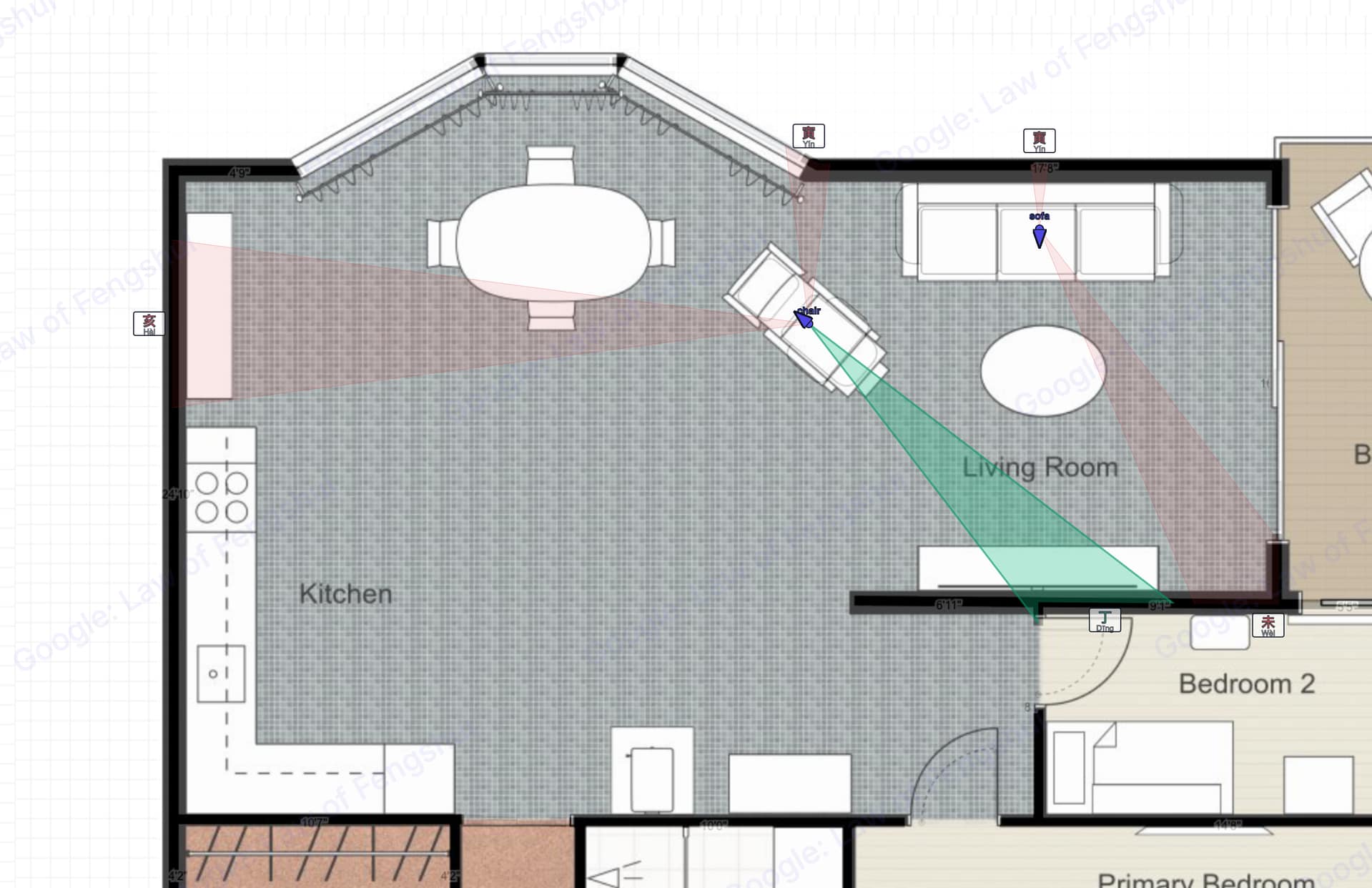
This is the gap that feng shui living room tips built on Ba Zhai sofa analysis expose: the visually obvious choice and the energetically correct choice frequently aren't the same. The compass makes that visible.
Do's:
Back the sofa against a solid wall. The mountain backing principle applies universally: the primary seating should have physical and energetic support from behind.
Choose the solid wall with the best Ba Zhai sector. Not all solid walls are energetically equal. The compass analysis identifies which wall's sector is auspicious for this home's orientation. That wall is the sofa wall.
Maintain a diagonal sightline to the room's entry from the main sofa position. The person seated should be able to see who enters the room without being startled from behind. This is the commanding position applied to living room seating.
Include all five elements. At least some representation of Wood (plants), Fire (lamps, warm tones), Earth (ceramics, square shapes), Metal (rounded furniture, white or silver accents), and Water (mirrors, dark accents) creates elemental balance. Heavy dominance of one element at the expense of others creates imbalance.
Use live plants, particularly in the east and southeast zones. Wood energy in its living form activates chi circulation in the room's growth sectors.
Hang mirrors to reflect natural light, space, or positive views. Position them on side walls where they amplify the room's best features rather than facing the main door or the sofa directly.
Keep the main circulation paths unobstructed. Chi moves through a room the way people do. If you can move easily through the space, chi can too. Feng shui is about creating conditions where vitality circulates freely; the room feel shifts noticeably when this principle is in place versus when furniture blocks every natural path.
Don'ts:
Don't place the sofa in the living room's most inauspicious Ba Zhai sector, regardless of how visually appealing that wall may be. The Chicago case study is the clearest example: the vaulted ceiling corner is 祸害. Visual drama and energetic quality aren't the same thing.
Don't hang mirrors directly facing the main entry door. Chi enters through the front door and shouldn't be immediately reflected back out.
Don't position sharp furniture corners pointing at the primary seating area. Sharp edges concentrate chi into narrow streams directed wherever they point. Rounded furniture or positioning that avoids direct corner projection prevents this.
Don't let corners accumulate clutter. Stagnant energy pools in unused corners. Keep corners active with plants, lamps, or intentional furniture placement.
Don't use dying or neglected plants as Wood element representatives. They introduce stagnant rather than living Wood energy. Maintain plants or remove them.
Don't position the TV directly across from the sofa where its dark screen reflects the seated occupants. A side-wall placement avoids the mirror-when-off problem.
The full classical living room analysis connects to the feng shui wealth corner because the sofa's auspicious sector in Ba Zhai often overlaps with the home's wealth zone. Sitting where prosperity peaks is, in classical feng shui terms, sitting in a position of ongoing positive exposure to the home's best energy. A feng shui expert applying these principles to your living room would begin with the compass reading, not the floor plan, because it's the orientation, not the aesthetics, that determines which pieces of furniture should go where. Modern living spaces benefit from this classical approach precisely because the compass layer is invisible to the eye but measurable with the right tools.
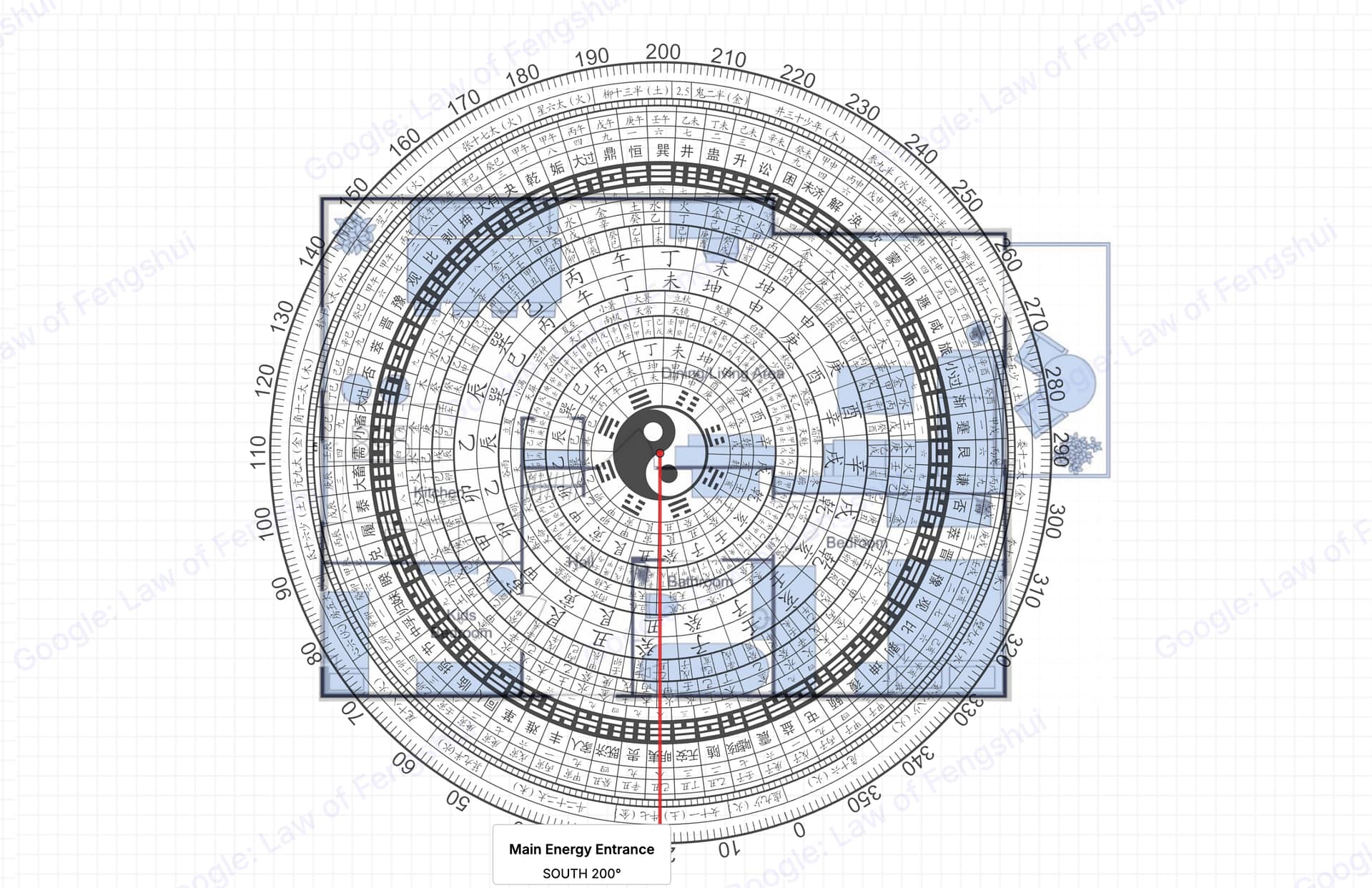
The living room analysis at Law of Fengshui runs two overlays simultaneously: Ba Zhai Nine Star and Na Jia Li Find Best Furniture. The Ba Zhai overlay maps all eight compass sectors across the floor plan, identifying which zones are auspicious and which are problematic for the home's specific orientation. The Na Jia Li overlay then evaluates the individual furniture piece, in this case the sofa, and maps its Harmony Energy sectors based on its sitting direction and trigram assignment.
The output is a two-system consensus: where both overlays agree, the recommendation is strongest. Where they diverge, the classical approach weighs the Ba Zhai sector (house-level auspiciousness) as the primary factor and Na Jia Li (furniture-level harmony) as confirming.
This analysis is property-specific and orientation-specific. The same sofa in a south-facing house produces a different Ba Zhai sector map with different auspicious zones. A north-facing Kan house like the Chicago apartment gives 天医 to the east and 生气 to the southeast. A south-facing Li house maps those labels to completely different compass directions.
For a full analysis of your living room, the tool takes your floor plan, facing direction, and compass orientation and generates the complete eight-sector overlay. From there, the sofa placement recommendation follows from the compass, not from aesthetics.
For a more complete picture that includes your personal birth year data and how it interacts with the home's Ba Zhai profile, a feng shui consultation goes deeper: reviewing the sofa analysis, the bedroom analysis, and the overall home evaluation as a connected system rather than room by room.
Curious what 15+ classical feng shui systems reveal about a real home?
Our sample report shows every overlay on an actual floor plan so you can see the difference between classical analysis and generic advice.
What is the feng shui rule for sofa placement?
The universal form school rule: the sofa should have solid backing (a wall behind it), and the seated occupant should have a diagonal view to the main entry of the room without being directly in line with it. The classical Ba Zhai layer adds: the wall chosen for sofa backing should be in an auspicious compass sector for the home's orientation. For East-Four houses, auspicious sofa sectors include east, southeast, south, and north. For West-Four houses, auspicious sectors are west, southwest, northwest, and northeast.
Should a sofa face the door in feng shui?
The sofa shouldn't face the door directly in a straight line. The preferred position is a diagonal sightline where seated occupants can see the room's entry without sitting directly across from it. Direct face-to-door placement creates a straight chi corridor from the entry to the seated occupant, which classical feng shui treats as excessive energy exposure. A diagonal position captures the benefit of awareness without the direct exposure.
What are the five elements in feng shui, and how do I use them in the living room?
The five elements (Wood, Fire, Earth, Metal, Water) should all be represented in a balanced living room. Wood: live plants, wooden furniture, green tones. Fire: lamps, warm lighting, red or orange accents. Earth: ceramics, square shapes, yellow or terracotta tones. Metal: rounded furniture, metal objects, white or gray tones. Water: mirrors, water features, dark blue or black accents. The living room benefits from Fire and Wood as primary elements (social energy and growth) with the others in supporting roles.
Where should mirrors go in feng shui living rooms?
Mirrors should reflect natural light, open space, or positive areas of the room, not the main entry door or the sofa directly. Side walls perpendicular to the sofa work well, particularly if they capture window light or a pleasant view. Avoid mirrors facing the front door (reflects chi back out) or mirrors directly facing the seated occupant (too much active, reflective energy in a space meant for relaxation). The classical Ba Zhai layer also evaluates which sector wall the mirror occupies for additional guidance.
What is Ba Zhai in feng shui?
Ba Zhai (八宅, Eight Mansions) is a classical Chinese feng shui system that divides any home into eight compass sectors based on the home's facing direction. Each sector carries one of eight energy qualities: four auspicious (生气 Shengqi, 天医 Tianyi, 延年 Yannian, 伏位 Fuwei) and four inauspicious (绝命 Juming, 六煞 Liusha, 五鬼 Wugui, 祸害 Huohai). Ba Zhai determines which rooms and which furniture positions are best suited for sustained occupancy in any given home.
Is it bad feng shui to have the sofa against a window?
A sofa backed against a window lacks the solid mountain backing that classical feng shui recommends for primary seating. The glass provides a visual opening rather than stable support, which leaves the seated occupant energetically exposed. Heavy curtains or shades that create visual density behind the seating are a partial mitigation when a window wall is unavoidable. A solid wall is always preferred.
What plants are good feng shui for the living room?
Live plants in good condition are good feng shui for the living room regardless of species. Plants that are growing, healthy, and well-maintained carry active Wood energy. Avoid plants with sharp spines (cacti, yucca) in seating areas as sharp forms concentrate chi in pointed directions. Taller plants carry more Wood presence. The east and southeast sides of the living room are the natural placement zones for plants in classical feng shui.
How do I fix stagnant energy in my living room corners?
Corners are natural chi pooling points. Three classical remedies: live plants (Wood energy activates stagnant chi), floor lamps (Fire energy burns through stagnation), or a small piece of furniture that fills the corner intentionally. The goal is to make the corner an active energy zone rather than a neglected dead space. Avoid storing clutter in corners, as it amplifies the pooling rather than resolving it.
Does living room color matter in feng shui?
Color directly affects elemental balance. Warm tones (reds, oranges, terracotta, amber) bring Fire and Earth energy: social warmth and grounding. Cool tones (blues, greens) bring Water and Wood energy: growth and reflection. The living room generally benefits from warm-neutral base tones with strategic color accents tied to the element you want to activate. Ba Zhai also assigns elemental qualities to each compass sector; the dominant color of a sector's wall or furnishings can reinforce or counteract the sector's natural energy.
What is Na Jia Li in feng shui furniture placement?
Na Jia Li (纳甲理) is a classical Chinese system used in the Law of Fengshui tool's "Find Best Furniture" feature. It assigns each piece of furniture a trigram based on its sitting direction (which way the back faces), then maps Harmony Energy sectors for that furniture piece based on its trigram. The Harmony Energy sectors indicate compass directions where the furniture performs most favorably. Applied to a sofa, it provides a second independent layer of analysis that can confirm or refine the Ba Zhai sector recommendation.
What is the classical difference between East-Four and West-Four houses?
Ba Zhai classifies homes into two groups based on their facing direction. East-Four houses (Kan, Li, Zhen, Xun orientations, facing north, south, east, or southeast) have their auspicious sectors in the east, southeast, south, and north. West-Four houses (Qian, Kun, Gen, Dui orientations, facing west, southwest, northwest, or northeast) have their auspicious sectors in the west, southwest, northwest, and northeast. A sofa in an East-Four house should target east, southeast, south, or north walls. In a West-Four house, it should target west, southwest, northwest, or northeast walls.
How long should I spend on living room feng shui analysis before making changes?
The form school baseline (commanding position, solid wall backing, clear circulation, elemental balance) can be evaluated in a single walkthrough with a compass app. The classical Ba Zhai analysis requires knowing the facing direction of the home and looking up the sector mapping for that orientation. The Na Jia Li layer adds evaluation of the sofa's specific sitting direction. A full analysis combining both classical systems, plus any annual flying star adjustments, is best done with a floor plan and a compass reading at the center of the space.
Alex Song is the founder of Law of Fengshui, a classical feng shui analysis platform applying Ba Zhai, He Chong, Xuan Kong, and Na Jia Li systems to residential and commercial floor plans. Law of Fengshui is the first rule-based system to automate classical feng shui compass analysis at scale.