Address
304 North Cardinal St.
Dorchester Center, MA 02124
Work Hours
Monday to Friday: 7AM - 7PM
Weekend: 10AM - 5PM
Address
304 North Cardinal St.
Dorchester Center, MA 02124
Work Hours
Monday to Friday: 7AM - 7PM
Weekend: 10AM - 5PM

Your feng shui kitchen placement was probably decided by a plumber. That’s how most kitchens end up where they are – layout, pipes, ventilation, proximity to dining. All practical decisions. But in classical feng shui room layout analysis, the kitchen is one of the highest-priority rooms to place correctly because it’s where food gets prepared.
The compass sector your kitchen sits in determines the energy quality of everything cooked there. Two separate systems evaluate this – the Nine Star Turning Trigram Palm and the Zi-Wu Oblique Flow – and when you run them both on the same floor plan, the result is pretty clear.
I ran both on a one-bedroom apartment. The kitchen landed in the worst possible sector.
The best feng shui kitchen placement is in the Tian Yi (天醫, Heavenly Doctor) compass sector. This star promotes health and healing, and classical texts say food prepared in a Tian Yi sector carries that beneficial energy to everyone eating it. The exact location of Tian Yi depends on your building’s sitting mountain – it’s different for every building.
In classical feng shui, the ideal kitchen placement depends on the building’s sitting mountain – the compass direction the back of the building points toward. The Nine Star Turning Trigram Palm (九星翻卦掌) uses this measurement to distribute eight “wandering stars” across the eight compass sectors of your floor plan. Each star carries a different energy quality, and the star that lands on your kitchen determines whether that room’s energy supports or undermines your household’s health.
Most feng shui kitchen rules you’ll find online focus on the commanding position (can you see the door while cooking?), keeping the stove away from the sink (fire-water separation), and avoiding the northwest sector. Those are valid general guidelines. But the Nine Star system goes deeper – it calculates the specific energy star for your kitchen based on your building’s unique compass reading. Two buildings facing different directions will have completely different star distributions.
The eight stars, from best to worst:
Auspicious:
Inauspicious:
For feng shui kitchen placement specifically, the classical texts recommend Tian Yi (天醫), the Heavenly Doctor. Tian Yi’s energy is associated with health and healing. The reasoning: food prepared in a Tian Yi sector carries that beneficial energy to everyone eating it. The kitchen is the health engine of your home. Where it sits matters.
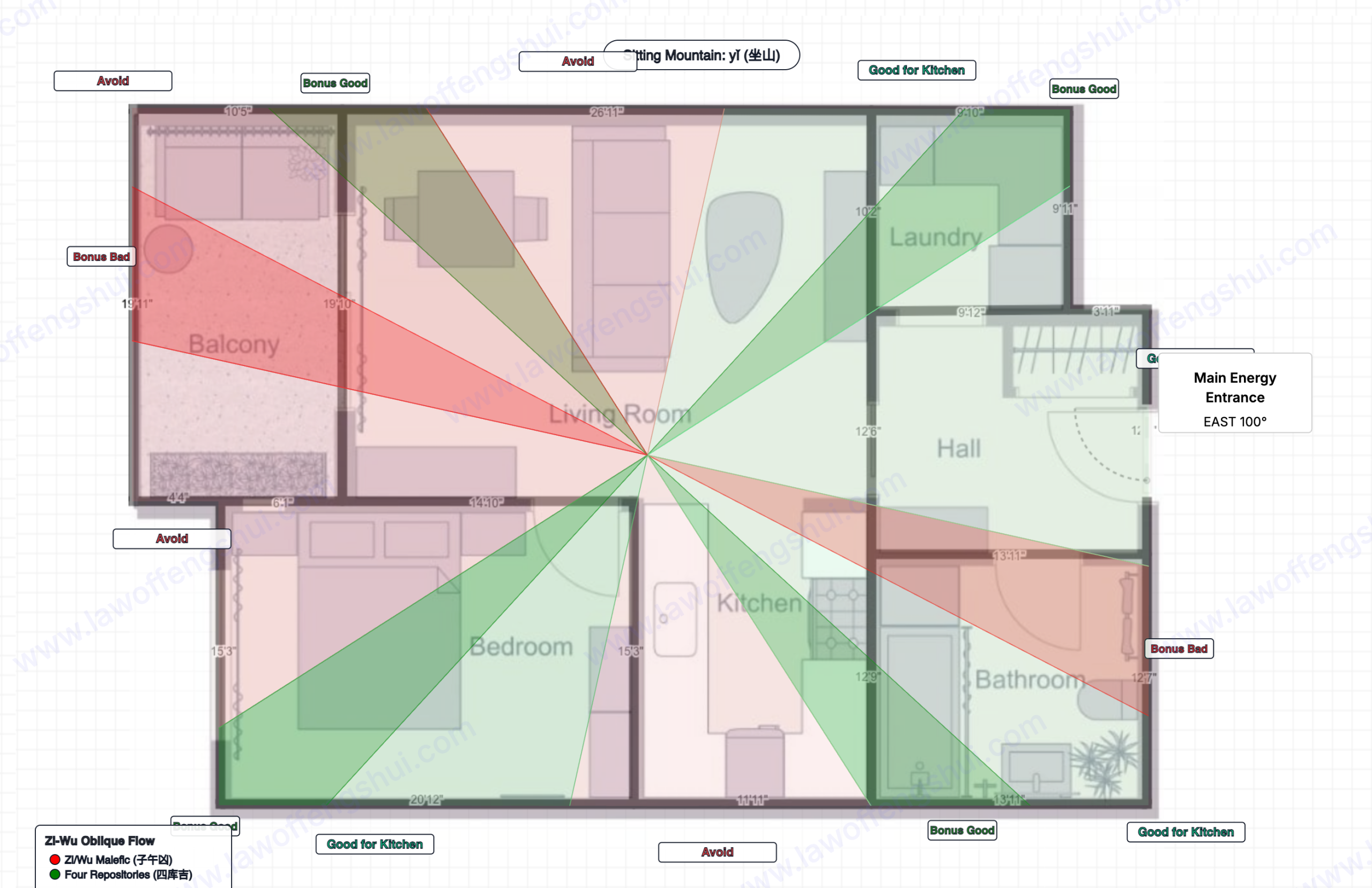
The property is a one-bedroom apartment with a compact layout – living room in the center, bedroom in the southwest, galley kitchen in the south, bathroom in the southeast, entrance hall on the east side.
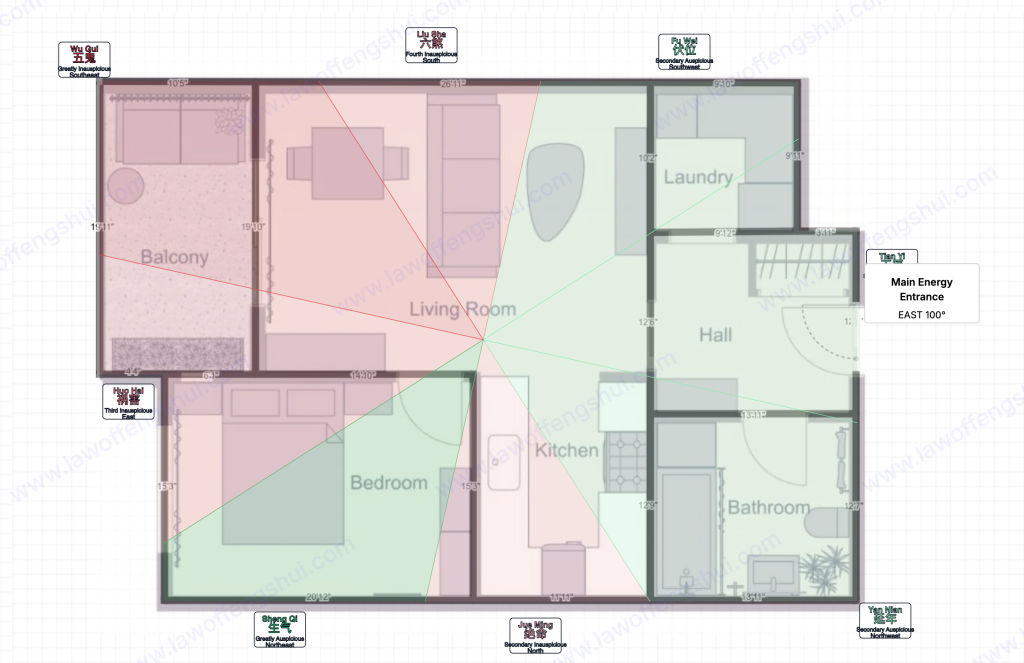
Here’s the Nine Star distribution for this apartment (Sitting Mountain: Yi 乙山):
| Direction | Star | Classification | Room |
|---|---|---|---|
| Northwest | Wu Gui (五鬼) | Major Inauspicious | Balcony |
| North | Liu Sha (六煞) | Medium Inauspicious | Living Room (upper) |
| Northeast | Fu Wei (伏位) | Neutral | Laundry |
| East | Tian Yi (天醫) | Medium Auspicious | Entrance/Hall |
| Southeast | Yan Nian (延年) | Major Auspicious | Bathroom |
| South | Jue Ming (絕命) | Supreme Inauspicious | Kitchen |
| Southwest | Sheng Qi (生氣) | Supreme Auspicious | Bedroom |
| West | Huo Hai (禍害) | Minor Inauspicious | – |
The kitchen got Jue Ming. That’s the most dangerous star in the entire system – associated with total loss and severe illness. And Tian Yi, the star specifically recommended for kitchens, landed at the front entrance. You can’t put a kitchen in your hallway.
The Nine Star system is one layer. Classical feng shui runs a second, independent check using the Zi-Wu Oblique Flow (子午斜流).
This system maps Earthly Branches to compass sectors based on the sitting mountain and classifies each sector into three categories:
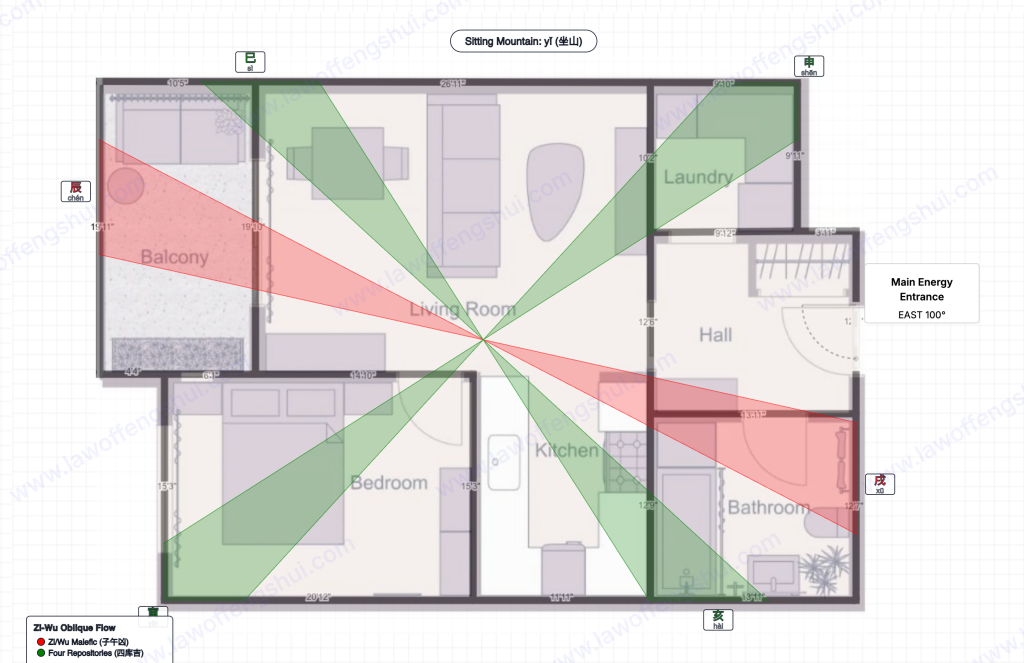
The Zi-Wu overlay adds another dimension. Green bands mark the Four Repositories (favorable), red bands mark the Zi-Wu malefic positions (avoid). When both systems are layered together, you get a combined view that accounts for both.
When you layer the Nine Star and Zi-Wu Oblique Flow together, the combined overlay shows labels for each sector:
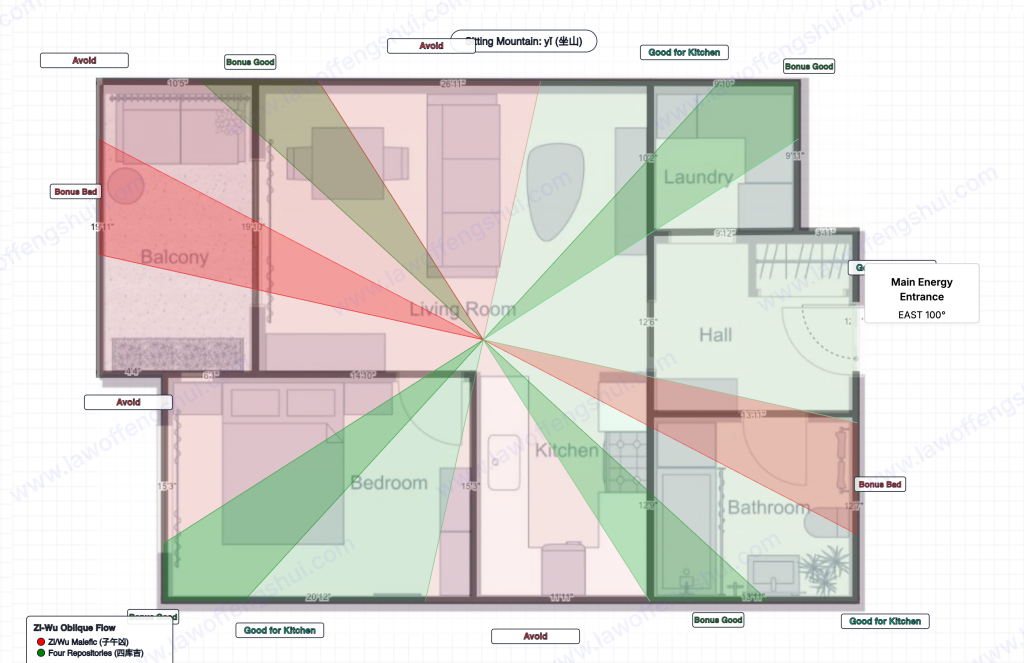
The result:
The builder put the kitchen where it made sense for pipes and ventilation. The two feng shui systems say the three best kitchen sectors are currently occupied by the laundry room, bathroom, and bedroom.
Most people can’t rip out their kitchen and rebuild it in the laundry room. That’s not realistic. But the analysis is still useful at a finer level.
Even a few feet of shift matters. If the stove (the fire element, the most energetically active part of the kitchen) can be positioned closer to the boundary of a neighboring favorable sector, that’s a meaningful adjustment. A kitchen that straddles two sectors isn’t locked into the worst one.
If you’re picking between two units in the same building, this analysis shows you which unit has the kitchen in a better sector. Same building, same rent, very different feng shui kitchen placement.
If you’re designing a layout from scratch, running this check before finalizing the floor plan costs nothing and can change which room goes where. The kitchen doesn’t have to go in the south just because the plumbing stub is there.
Classical feng shui also has remediation techniques for kitchens in inauspicious sectors. Five Elements balancing – adding or reducing specific feng shui elements based on the sector’s properties – is the primary approach. Feng shui colors tied to the Five Elements (red for Fire, blue or black for Water, green for Wood, white or gold for Metal, yellow or brown for Earth) can shift the elemental balance of a room. Placement of specific feng shui items and adjustments to the stove orientation can also mitigate unfavorable energy.
The kitchen uniquely combines two opposing feng shui elements in one room: Fire (the stove) and Water (the sink). That elemental tension is present in every kitchen regardless of compass direction. The feng shui five elements – Wood, Fire, Earth, Metal, Water – cycle through productive and destructive relationships. Fire and Water are in a destructive relationship, and the kitchen forces them into the same space.
When the kitchen also sits in an inauspicious compass sector, the tension amplifies. When it sits in a favorable sector – especially Tian Yi, the Heavenly Doctor – the fire-water interaction is channeled productively. Feng shui colors and elements work together here: the sector’s elemental association determines which colors and materials can help balance the fire-water clash. A kitchen in a Wood sector, for example, benefits from green feng shui colors because Wood feeds Fire productively while draining Water’s destructive potential.
Classical texts call the kitchen the “health engine” of the household. The sitting mountain determines which sectors carry which stars, and the stars carry specific energetic qualities that affect everything that happens in that sector. Food prepared under Jue Ming carries different energy than food prepared under Tian Yi. That’s the classical reasoning, and it’s why kitchen placement ranks alongside bedroom and main entrance as a top-priority layout decision in feng shui room layout analysis.
Q: Where should a kitchen be placed according to feng shui? A: In the Nine Star system, the ideal feng shui kitchen placement is in the Tian Yi (天醫, Heavenly Doctor) sector, which promotes health and healing. The second-best options are Sheng Qi (生氣, Generating Breath) or Yan Nian (延年, Longevity). The specific sector locations depend on your building’s sitting mountain (compass direction). The Zi-Wu Oblique Flow system provides a second layer of analysis to confirm or refine the placement. General guidelines recommend east, southeast, or south, but the Nine Star system personalizes this to your specific building.
Q: What direction should a kitchen face in feng shui? A: There is no single “best direction” for all kitchens. The optimal feng shui kitchen direction depends on the building’s sitting mountain. The Nine Star system calculates which compass sector receives the Tian Yi (Heavenly Doctor) star – that’s the best direction for your specific building. Generic advice like “south-facing kitchens are good” oversimplifies what is actually a building-specific calculation.
Q: What is the Nine Star system in feng shui? A: The Nine Star Turning Trigram Palm (九星翻卦掌) is a classical feng shui compass formula that distributes eight “wandering stars” across the compass sectors of a floor plan based on the building’s sitting direction. Each star has a specific energy quality ranging from Supreme Auspicious (Sheng Qi) to Supreme Inauspicious (Jue Ming). The system is used to evaluate room placement for kitchens, bedrooms, offices, and other functional spaces.
Q: What is the worst feng shui kitchen placement? A: Jue Ming (絕命, Life-Ending) is the most dangerous sector for a feng shui kitchen. It’s associated with total loss and severe illness. Since the kitchen is where food is prepared for the household, having it in a Jue Ming sector means the energy of that preparation is affected. Wu Gui (五鬼, Five Ghosts) is the second-worst, associated with fire hazards – especially concerning in a room with open flames.
Q: Can you fix bad feng shui kitchen placement without moving the kitchen? A: Yes, to some degree. You can reposition the stove within the kitchen toward a more favorable sector boundary. Five Elements balancing (adding or reducing specific elements based on the sector’s properties) can mitigate some inauspicious energy. Classical feng shui also recommends specific remediation items and stove orientation adjustments. The most important element to position correctly is the stove, since it represents fire and is the most energetically active component.
Q: What are the Five Elements in feng shui and how do they relate to kitchens? A: The feng shui five elements are Wood, Fire, Earth, Metal, and Water. Kitchens uniquely combine Fire (stove) and Water (sink) in one room, creating elemental tension. The compass sector the kitchen occupies determines which additional elements interact with this fire-water combination. In a favorable sector, the interaction is productive. In an inauspicious sector, the tension amplifies. In 2026 (Year of the Fire Horse), fire element awareness in kitchens is especially relevant.