Address
304 North Cardinal St.
Dorchester Center, MA 02124
Work Hours
Monday to Friday: 7AM - 7PM
Weekend: 10AM - 5PM
Address
304 North Cardinal St.
Dorchester Center, MA 02124
Work Hours
Monday to Friday: 7AM - 7PM
Weekend: 10AM - 5PM

The kitchen is the heart of the home in feng shui. Every feng shui expert will tell you that. The kitchen represents nourishment, health, and the fire element that sustains a household. It’s where raw ingredients become meals and where the energy in your kitchen affects everyone who eats there.
Search “feng shui kitchen” and you’ll find dozens of guides covering the same ground. Keep the sink and stove apart because the fire and water elements clash. Use the command position so you can see the door while cooking. Keep your knives out of sight. Add a bowl of fruit. Clean your kitchen regularly because a messy kitchen blocks positive chi.
Those are solid feng shui tips. But they’re identical regardless of which building you live in. A studio in San Diego gets the same advice as a colonial in Connecticut.
Classical compass feng shui adds something those guides never cover: a formula-based zone map that rates every sector of your floor plan for kitchen suitability. The map is specific to your building’s compass orientation, and it changes for every building.
When it comes to feng shui in the kitchen, most people think about what’s inside the kitchen – appliance placement, cabinet layout, colors, countertops. Classical feng shui starts one step earlier: is the kitchen in the right sector of the building?
The system is called Nine Star (九星翻卦掌, Nine Star Turning Trigram Palm). It assigns eight “wandering stars” to compass sectors based on the building’s sitting direction. Four stars are auspicious. Four are inauspicious. Each carries a specific energy quality.
The star that classical texts identify as ideal for kitchen placement is Tian Yi (天醫), which translates to “Heavenly Doctor.” It’s associated with health, healing, and nourishment. A kitchen in the Tian Yi sector means food preparation happens in the zone most supportive of the household’s wellbeing.
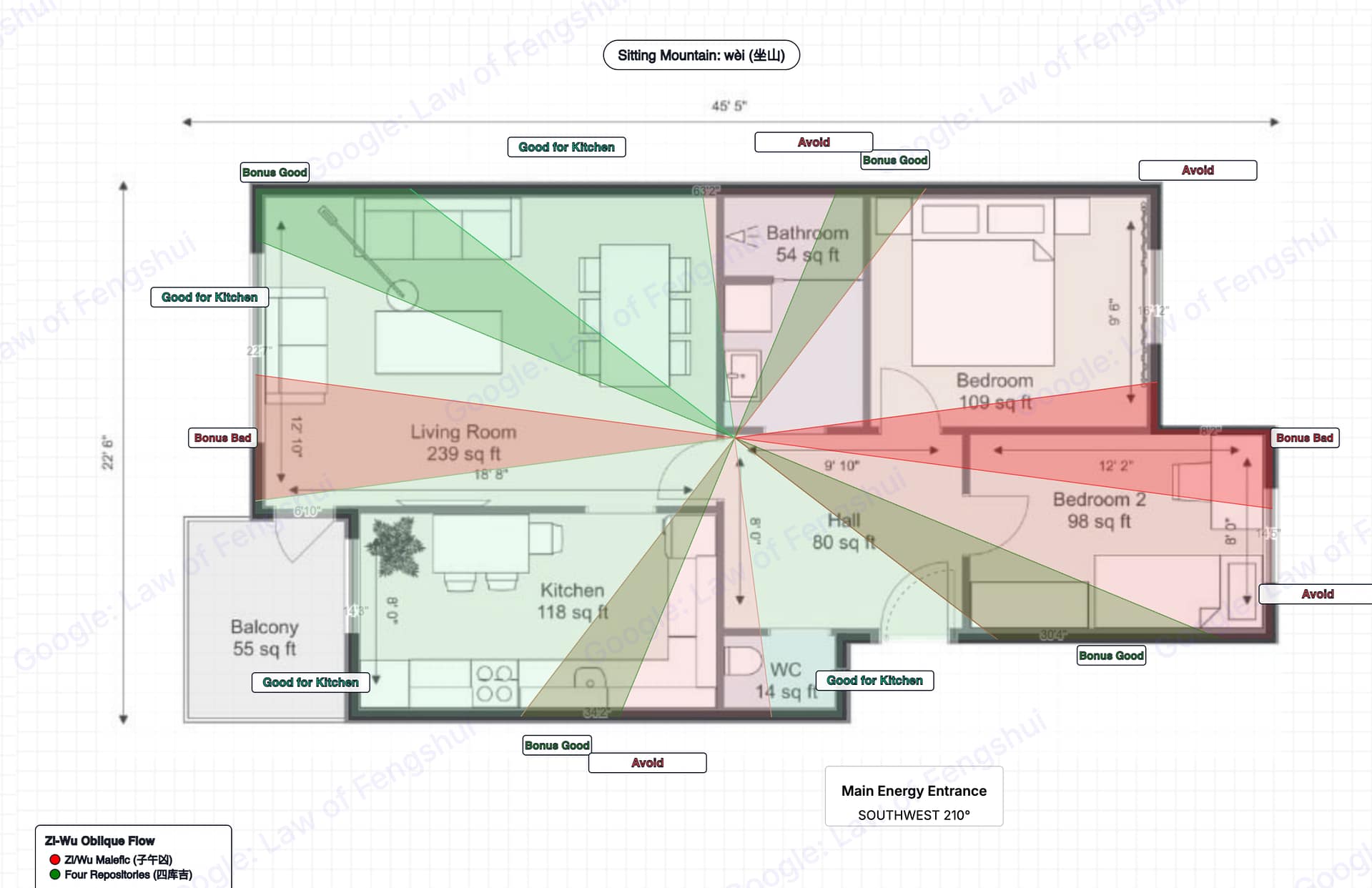
A secondary system called Zi-Wu Oblique Flow (子午斜流) adds a precision layer. It marks certain positions as “Bonus Good” (the Four Repositories) and others as malefic (the Zi and Wu directions). Together, these two systems generate a color-coded zone map: green for “Good for Kitchen,” red for “Avoid.”
The key insight: where Tian Yi lands depends entirely on the building’s sitting direction. Change the compass orientation and every star shifts. The same apartment layout with a different facing angle produces a completely different kitchen verdict.
We covered this system in an earlier feng shui kitchen analysis where the kitchen landed in the worst possible sector. This time, the result was different.
We ran both systems on a 2-bedroom apartment in San Diego. About 770 square feet total, with a 118 square foot kitchen. The building sits toward the southwest on the wèi (未) mountain with a main energy entrance at Southwest 210 degrees.
The Find Best Kitchen Spot mode generated a zone map covering the entire floor plan.
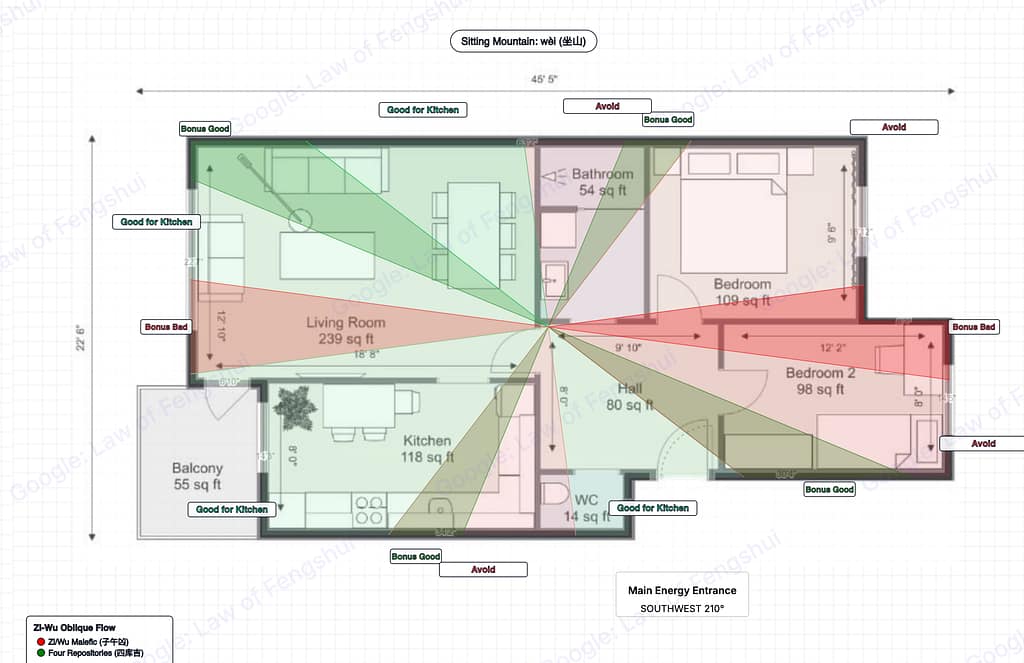
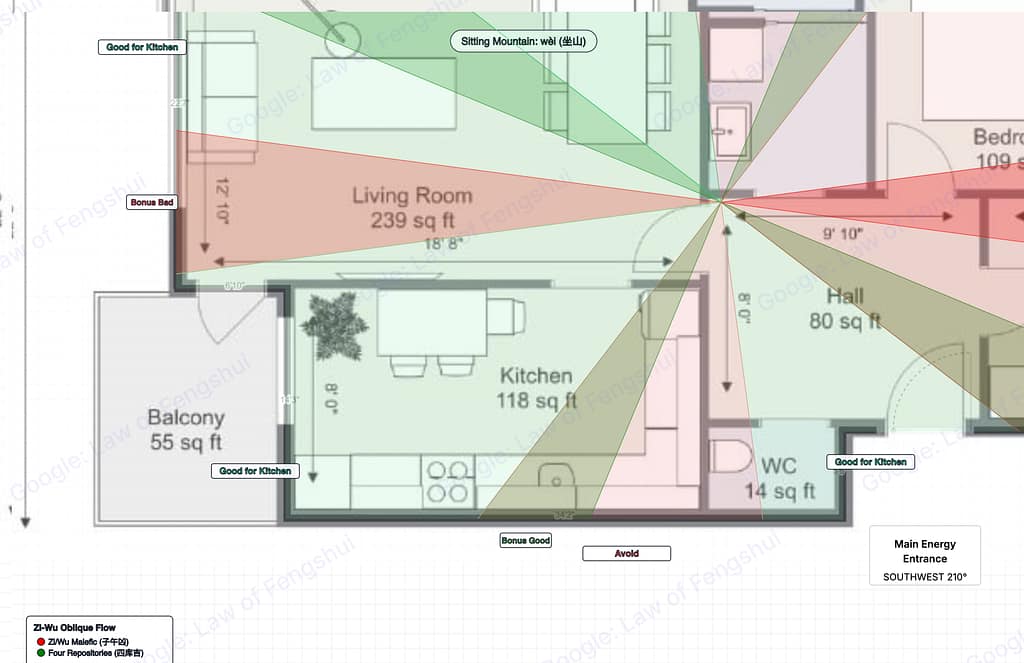
The result: the kitchen sits in a green “Good for Kitchen” zone. Both systems confirmed the placement is favorable for this building. The green zones sweep through the west and southwest portions of the floor plan. The red “Avoid” zones hit the north and east sectors, right where the bedrooms and hallway sit.
The Zi-Wu layer adds refinement within the green zones. “Bonus Good” labels mark specific positions from the Four Repositories, while other spots are flagged as neutral. The kitchen area also shows “Good for Kitchen” labels extending from the balcony side through the WC area, confirming the favorable rating from multiple angles.
This is the part that separates classical feng shui from generic kitchen feng shui tips. According to feng shui compass principles, the zone map is building-specific. Rotate this same floor plan so the building faces northeast instead of southwest, and the entire map redistributes. Green becomes red. Red becomes green. The kitchen that passed the test in one orientation could fail it in another.
That’s why the best feng shui kitchen advice can’t be reduced to a list of universal rules. “Face your stove south” and “add warm paint colors” apply everywhere. But whether your kitchen is in the right sector of the building? That’s a calculation specific to your compass orientation.
This same principle applies to every room. We’ve mapped it for feng shui living rooms, feng shui studio apartments, and feng shui bedrooms. The zone map changes every time because the input – the building’s compass direction – changes every time.
Want to see which sector of your building is best for the kitchen?
Our sample report runs the Nine Star and Zi-Wu Oblique Flow systems on a real floor plan and shows a color-coded zone map rating every sector for kitchen suitability.
Classical texts go deeper than just which sector the kitchen should be in. There’s a stove-specific principle called “sit inauspicious, face auspicious” (坐凶向吉). The stove is considered the most important appliance in the kitchen from a feng shui perspective because the stove represents fire – the element that transforms raw ingredients into nourishment.
The principle: the stove should physically sit in a sector governed by an inauspicious star and face toward a sector governed by an auspicious star. The logic is that the stove suppresses the negative energy by sitting on it while drawing positive energy from the direction it faces.
This is another building-specific calculation. Which sectors are auspicious and which are inauspicious depends on the Nine Star distribution, which depends on the compass orientation. It’s a fundamentally different concept from the generic advice to “face your stove south.”
Every feng shui kitchen guide mentions the fire and water elements, and for good reason. The kitchen is where these two opposing elements of feng shui meet.
The stove represents fire. The sink represents water. In the five elements cycle, water controls fire. When the sink and stove sit directly opposite each other or side by side without separation, classical feng shui flags this as an elemental clash that creates negative energy.
The practical fix most feng shui design guides recommend: place a wood element between the sink and stove. A cutting board, a small herb garden, or even a wooden kitchen island between your sink and stove area acts as a bridge. Wood feeds fire in the five elements cycle, creating a productive flow of energy instead of a clash.
If your kitchen has counter space between the sink and stove, that separation already helps. The energy flow in the kitchen improves when the fire and water elements have breathing room between them.
The compass-based zone map tells you whether the kitchen is in the right sector. These practical tips address what happens inside the kitchen itself.
Keeping your kitchen clean and organized. Clutter on countertops blocks the flow of energy and creates stagnation. A messy kitchen doesn’t just look bad – it affects the chi that circulates through the space. Put pots and pans away after use. Store appliances away from counter surfaces when not in use. Keep good energy flowing by keeping surfaces clear.
The stove is working and maintained. Every burner should work. Broken items in the kitchen, including a broken or chipped items like plates and appliances, carry stagnant energy. If your stove is working on all burners, it signals abundance. If one burner is dead, fix it. Feng shui encourages filling your kitchen with things that function properly.
Lighting in your kitchen matters. Natural light is ideal. If your kitchen doesn’t get much daylight, layered lighting – overhead plus task lighting at the counter – keeps the energy in the kitchen bright and active. Good lighting promotes a healthy appetite and makes the kitchen is a place people want to spend time.
Cabinet and kitchen cabinets maintenance. Keep cabinet interiors organized. Don’t let kitchen cabinets become a dumping ground for expired food or forgotten appliances. The inside of a cabinet carries energy too, even if you can’t see it.
Bring in positive energy with food and plants. A bowl of fruit on the kitchen counter signals abundance and nourishment. Fresh herbs in a pot bring the wood element into your kitchen and keep good energy flowing. Feng shui luck in the kitchen comes from keeping it alive and full, not sterile and empty.
Countertops as energy surfaces. Your kitchen counter and counter space represent the foundation of kitchen activity. Keep countertops clear of clutter and cutting boards stored after use. A clean countertop invites feelings of productivity and calm. Simple feng shui principles work here: clear surface equals clear energy.
What to avoid. Keep your knives out of sight in a block or drawer – exposed blades create sharp energy. Remove broken or chipped items immediately. Don’t keep stainless steel appliances that don’t work. Kitchen decor to prevent: anything that feels heavy, dark, or stagnant. The heart of the kitchen should feel bright and welcoming.
Curious where the Heavenly Doctor star lands in your building?
Our sample report maps all 8 Nine Star sectors onto a real floor plan so you can see which areas are ideal for your kitchen based on your building’s compass orientation.
Most people can’t relocate their kitchen. The plumbing is where it is. But classical feng shui kitchen design still offers options even when the kitchen stays put.
If your kitchen is in a less favorable sector, you can adjust within the kitchen. Which wall does the stove face? Where do you stand while cooking? Can you turn your kitchen layout so the cook faces toward a green zone? These micro-adjustments don’t require kitchen remodeling but they shift how you interact with the compass sectors.
You can also balance elements into your kitchen. If the kitchen sits in a metal sector, add wood element accents (plants, wooden shelves) to bridge the fire-metal relationship. If it’s in a water sector, the fire and water elements need a wood intermediary. The elements of feng shui give you a framework for adjustment even when the floor plan is fixed.
For a modern kitchen renovation, knowing the compass analysis beforehand helps with design tips that go beyond aesthetics. Deciding where to place the stove, which direction it faces, and how to create a kitchen that aligns with the building’s energy map, these are the questions a classical feng shui analysis answers.
The kitchen is the heart of the home. Whether you have a modern kitchen with an island or a galley with no counter space, the feng shui element that matters most isn’t the backsplash material or the paint colors. It’s which sector of the building the kitchen occupies and how that sector’s energy interacts with the fire element of cooking.
Generic feng shui kitchen tips cover what every kitchen should have. The compass analysis covers what your specific kitchen needs based on where it sits. Both matter. But only one changes for every building.
The kitchen represents nourishment in feng shui. Where that nourishment happens in the energy map of your home, that’s the question the compass answers. And as we saw in this San Diego apartment, sometimes the builder got it right by accident. Sometimes they didn’t. The only way to know is to check.
When it comes to kitchen feng shui, the zone map is the starting point. Everything else – the table is in the kitchen or the dining room, the stove is considered to be facing this direction or that, the back of the home versus the center of the house, center of the home placement – all of it sits on top of which sector the kitchen occupies. Start with the compass. Then worry about the bowl of fruit.
Curious what 15+ classical feng shui systems reveal about a real home?
Our sample report shows every overlay on an actual floor plan so you can see the difference between classical analysis and generic advice.
Which direction should a kitchen face according to feng shui? There’s no single “best direction” that applies to every building. Classical feng shui assigns the best feng shui kitchen sectors based on the building’s sitting direction using the Nine Star system. The Tian Yi (Heavenly Doctor) star is ideal for kitchen placement, and where it falls changes for every building. A feng shui expert runs the compass calculation to determine the specific answer for your property. If you want general guidance, the kitchen traditionally works well in sectors governed by auspicious stars, and the Ba Gua energy zones provide the foundational map.
Is it bad feng shui to have the kitchen in the center of the house? Classical feng shui generally advises against placing the kitchen in the center of the home because the center is considered the “heart” of the building’s energy. Fire element in the center can destabilize the overall energy balance. The center is better suited for gathering spaces. That said, many apartments and condos have kitchens near the center by necessity. The compass analysis helps determine whether the specific center sector is governed by a favorable or unfavorable star.
What is the feng shui relationship between the sink and stove? The sink represents water. The stove represents fire. Directly opposing them creates an elemental clash. Classical feng shui recommends separation, ideally with a wood element between them (like the stove) like a wooden cutting board, a plant, or at minimum some counter space. An island between your sink and stove area can also serve as a buffer.
Does feng shui kitchen color matter? Paint colors in the kitchen should support the element of the sector it occupies. Earthy tones (yellows, beiges) work well in earth-element sectors. Green and brown support the wood element. White and gray align with metal. Red and orange amplify fire but should be used sparingly since the kitchen already carries strong fire energy. The specific recommendation depends on your building’s compass orientation and which feng shui element governs the kitchen sector.
Can feng shui improve a kitchen that already feels good? Yes. Even if your kitchen is in a favorable sector, the flow of energy inside the kitchen still matters. Keeping your kitchen clean, ensuring the stove is working on all burners, maintaining natural light, and clearing clutter from countertops all bring in positive energy. The zone map tells you the macro position is good. The practical tips optimize the micro experience.
How is this different from regular feng shui kitchen tips? Most feng shui kitchen tips are form-based: commanding position, element balance, cleanliness. Those apply universally. The compass-based analysis we describe here is building-specific. It uses mathematical formulas tied to the building’s sitting direction to generate a zone map. Two buildings with different orientations get different maps. Is feng shui real? The spatial principles behind these zone maps have been practiced for centuries and overlap with environmental psychology.