Address
304 North Cardinal St.
Dorchester Center, MA 02124
Work Hours
Monday to Friday: 7AM - 7PM
Weekend: 10AM - 5PM
Address
304 North Cardinal St.
Dorchester Center, MA 02124
Work Hours
Monday to Friday: 7AM - 7PM
Weekend: 10AM - 5PM

Your feng shui house doesn’t have one score. It has five.
When someone evaluates a property and tells you it has “good feng shui,” the follow-up question should always be: good for what? Financial prosperity? Career advancement? Love? Family harmony? Health? Classical feng shui evaluates the same 24 compass sectors around a property through each of these lenses, and the results don’t always agree.
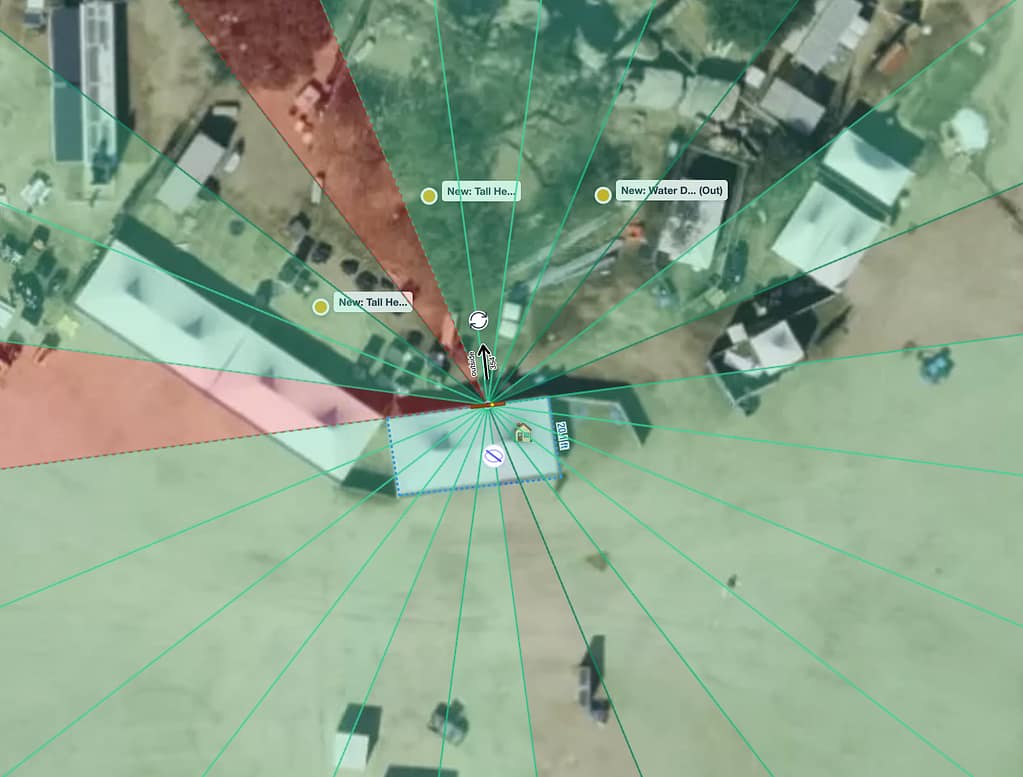
I ran Financial and Career category scoring on a north-facing property in Austin, Texas. Same address. Same surrounding landscape features. Same compass data. Financial scored +80. Career scored +61. A 19-point gap from the same property, because the Nine Stars that govern each sector carry different weights depending on what life domain you’re asking about.
This isn’t a theoretical exercise. For real estate agents, feng shui consultants, and homebuyers, category scoring changes the conversation from “is this house good?” to “is this house good for what you need?”
Ask ten people and you’ll get ten different checklists. Most online guides cover the same ground: don’t buy at a T-intersection, avoid houses with missing corners, make sure the front door doesn’t face a staircase. Binary rules. Yes or no. Good or bad.
That approach works for eliminating obvious problems. But it can’t tell you how good a property is, or good for what purpose. A feng shui house evaluation that only says “good” or “bad” is like a medical checkup that only says “alive” or “dead.” Technically accurate. Not very useful.
Classical feng shui goes further. It maps the Nine Stars to the building’s 24 compass sectors based on the sitting direction, evaluates what physical features exist at each bearing (trees, buildings, water, roads), and produces separate scores for Financial prosperity, Career advancement, Love, Family harmony, and Health. The result is five maps, not one. Five scores, not a binary pass/fail.
This is what the rest of this article demonstrates on an actual property.
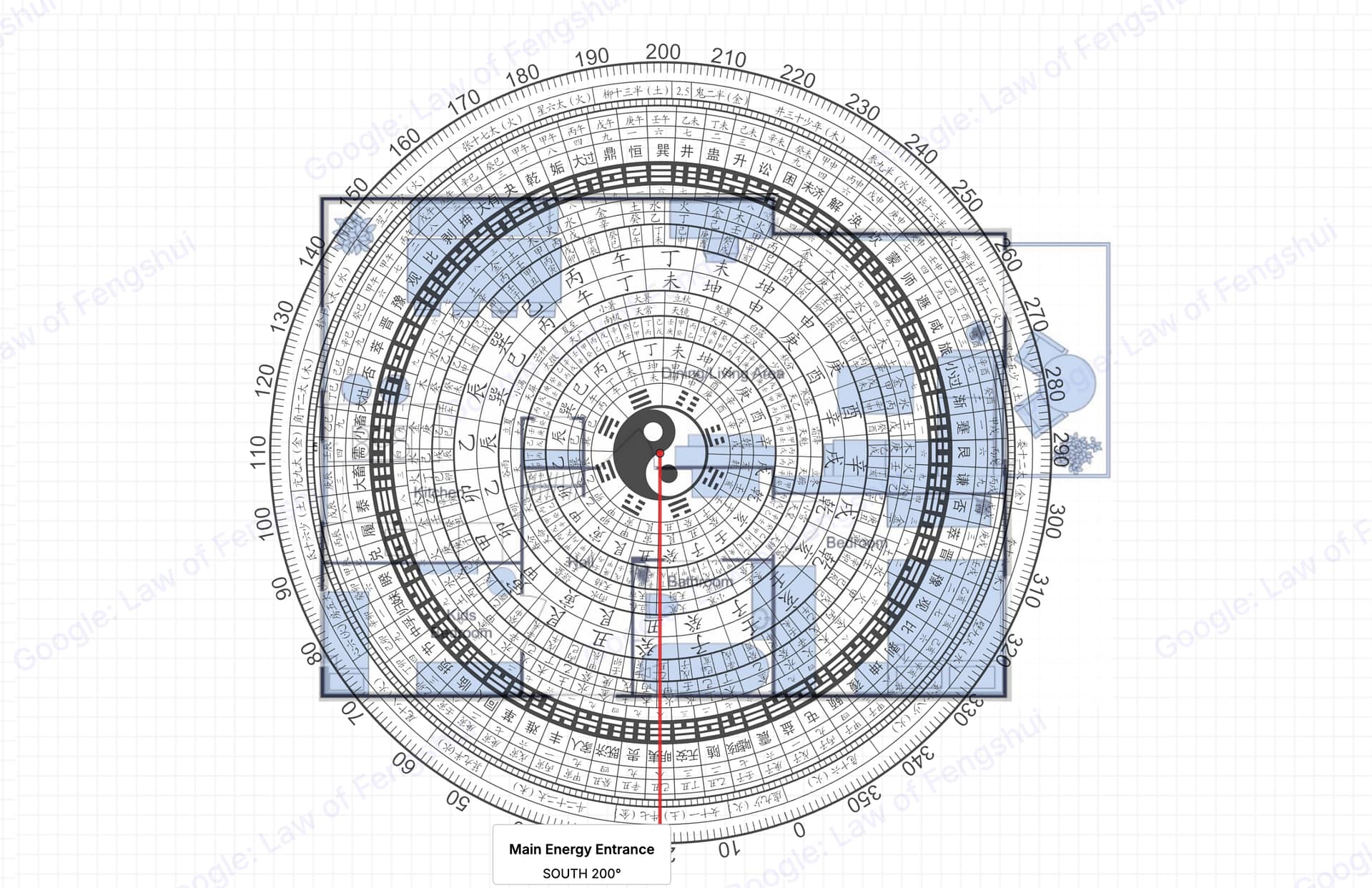
Classical feng shui maps 24 compass sectors around a property, each 15 degrees wide. Each sector is governed by one of the Nine Stars based on the building’s sitting direction. These stars have been classified for thousands of years as auspicious, inauspicious, or cautionary.
Category scoring takes this a step further. Instead of giving each star a single “good” or “bad” rating, the system assigns different point values per life domain:
Financial scoring weights the stars for wealth generation:
Career scoring weights the stars for professional advancement:
The key difference: Wen Qu scores +20 Mountain for Career but only +5 for Financial. A compass sector governed by Wen Qu with tall structures or trees would glow green on the Career map and stay nearly gray on the Financial map.
Want to see how Financial and Career scores break down on a real property?
Our sample report runs 15+ classical systems and shows exactly why Financial and Career scores can diverge across the same floor plan.

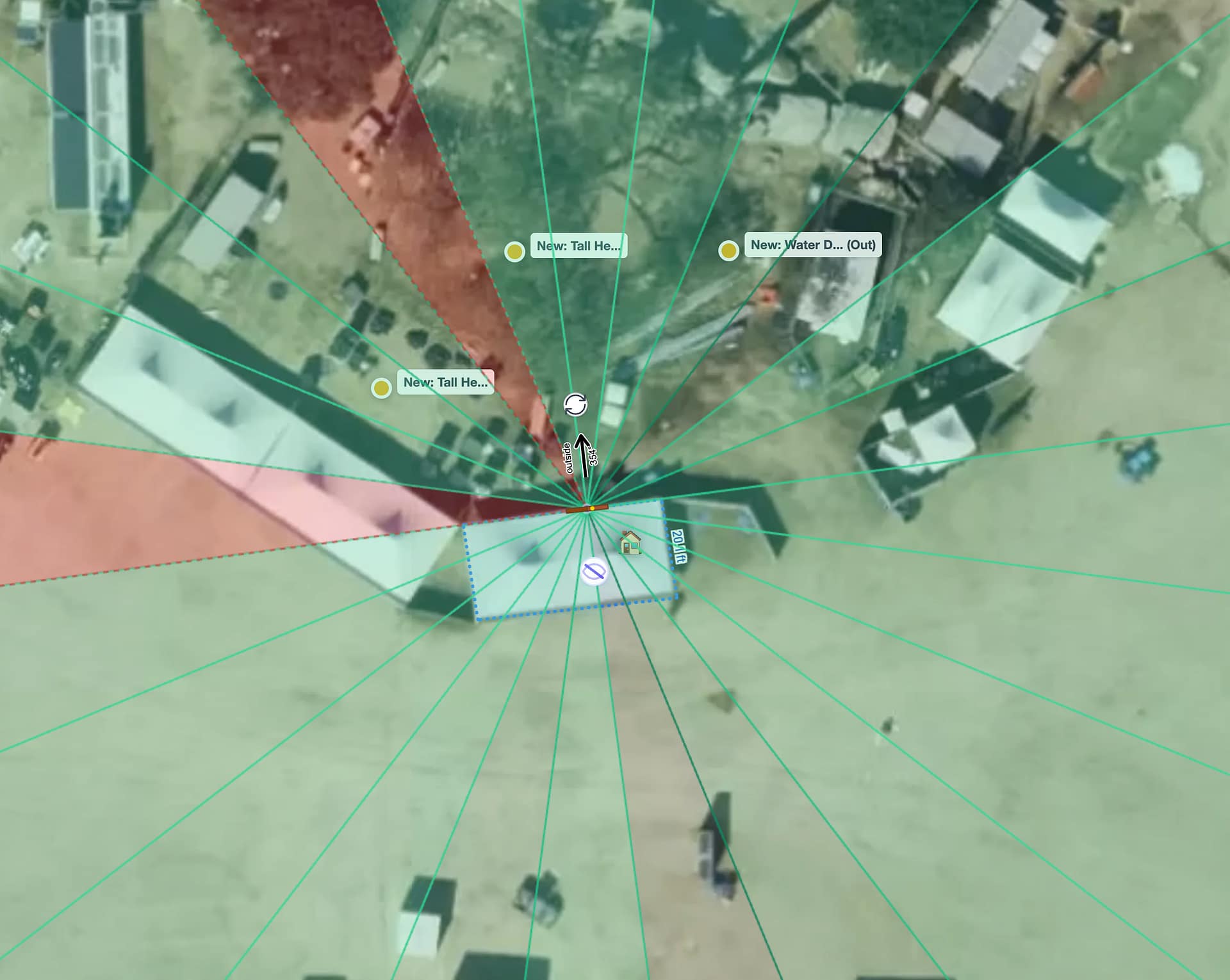
Property details:
Three objects mapped in the surrounding landscape:
No Ba Sha Huang Quan violations. No Jie Sha positions. Clean property.
Overall energy score: 82/100 (Excellent).
But the category breakdown:
| Category | Score |
|---|---|
| Financial | +80 |
| Family | +65 |
| Career | +61 |
| Health | +60 |
| Love | +50 |
A 30-point spread from highest to lowest. Same property. Five different evaluations.
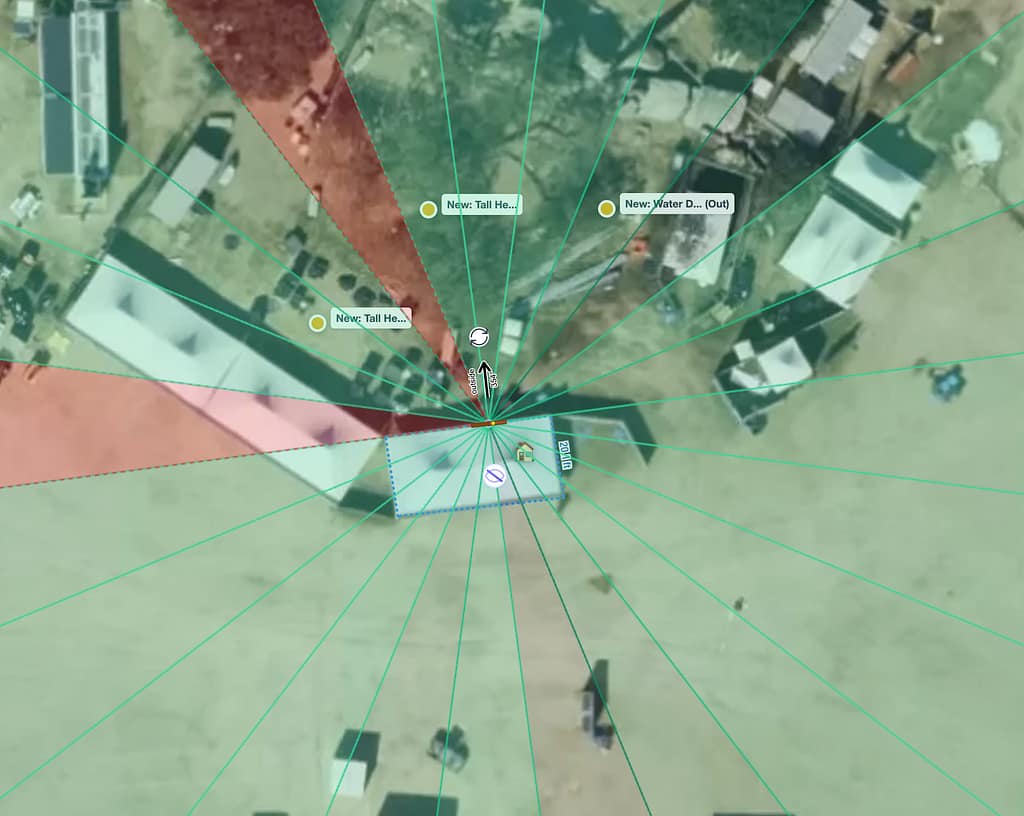
The gap between Financial (+80) and Career (+61) comes primarily from how each category weights the Fu Bi star.
Fu Bi (辅弼, the Assistant star) combines the Left Assistant and Right Adjutant energies. Both trees in this case study sit in Fu Bi sectors. Here’s how each category scores them:
| Star | Financial Mountain | Career Mountain | Gap Per Object |
|---|---|---|---|
| Fu Bi (辅弼) | +25 | +18 | 7 points |
Seven points difference per tree. Two trees. That’s 14 points of gap from the Mountain Star scoring alone. Factor in the water star differences across all 24 sectors and the final spread reaches 19 points.
Fu Bi is considered one of the best financial stars because it represents “assistance and helpful support” which, in financial terms, means resources flowing toward you. For Career, it still scores well (+18), but Career’s top star is Tan Lang (贪狼, +25 Mountain), which governs ambitious forward movement and new opportunities. The weight distribution reflects what each category values most.
A feng shui consultant looking at this property would note several things:
Financial strength is the property’s natural advantage. +80 is strong. The surrounding landscape features – the trees, the drainage pattern, the absence of violations – all align well with financial prosperity. An investor or business owner would find this property supportive.
Career is positive but not the property’s peak. +61 is still solidly above neutral. But someone whose primary focus is career advancement might want to evaluate what additional landscaping or features could improve career-weighted sectors. A tall structure or healthy tree in a Tan Lang sector would have more career impact than another Fu Bi sector placement.
Love is the weakest category at +50. Still positive, but notably lower than Financial. This doesn’t mean the property is bad for relationships. It means the surrounding landscape features are less aligned with the stars that carry the heaviest Love weights.
The overall 82/100 masks the category variation. A buyer who only sees “82/100 Excellent” misses that Financial is carrying the average up while Love is pulling it down. The category view tells the complete story.
Most “feng shui money corner” or feng shui wealth corner advice points to the southeast sector of a Ba Gua map and calls it your wealth zone. Place a feng shui money tree there, add a water fountain, hang a crystal, and prosperity flows. Search “where is my money corner” and every result says the same thing: southeast (compass school) or back-left (BTB school). Fixed location. One map for every house.
That approach has two problems.
First, it uses 8 sectors (45 degrees each) instead of 24 (15 degrees each). A feature sitting at 120 degrees and one at 150 degrees would both be “southeast” in the simplified map. But in the 24 Mountains system, they fall in different sectors governed by different Nine Stars with completely different scores.
Second, and more relevant to today’s case study: it gives every sector one label. “Wealth.” “Career.” “Love.” Fixed. The same southeast corner is always “wealth” regardless of the building’s actual compass bearing.
Classical category scoring is the opposite. The sectors don’t have permanent labels. Which sectors score highest for Financial depends on the building’s sitting direction, which determines where the Nine Stars land. Then the surrounding landscape features (trees, buildings, water, roads) interact with those stars, and each category weighs those interactions differently.
For this Austin property (sitting South, Li house), the highest Financial sectors aren’t in the southeast. They’re wherever Fu Bi and Wu Qu govern the compass, which is determined by the 午子 configuration. The simplified map would miss this entirely.
Curious which rooms drag down your financial score and which boost career?
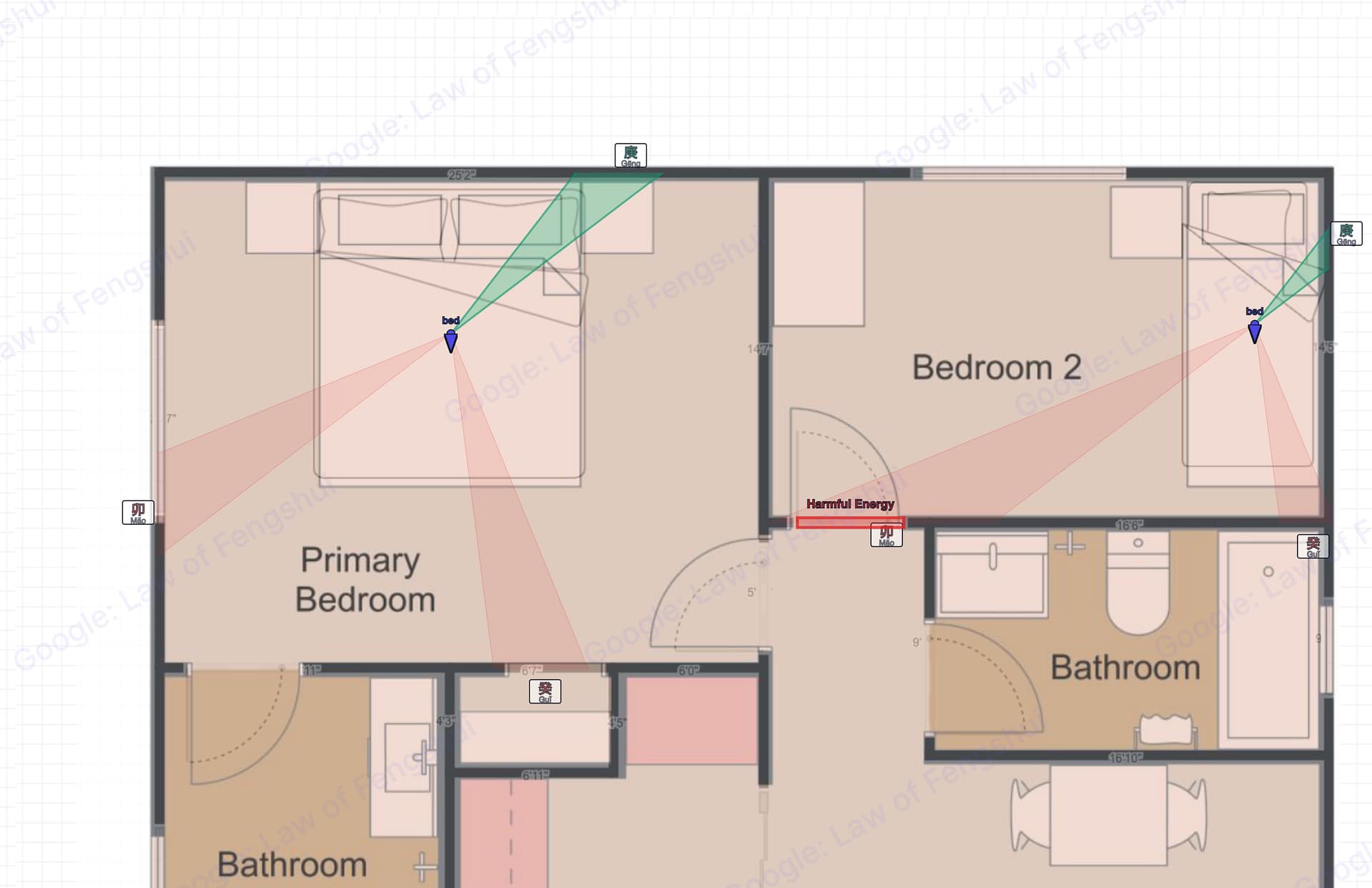
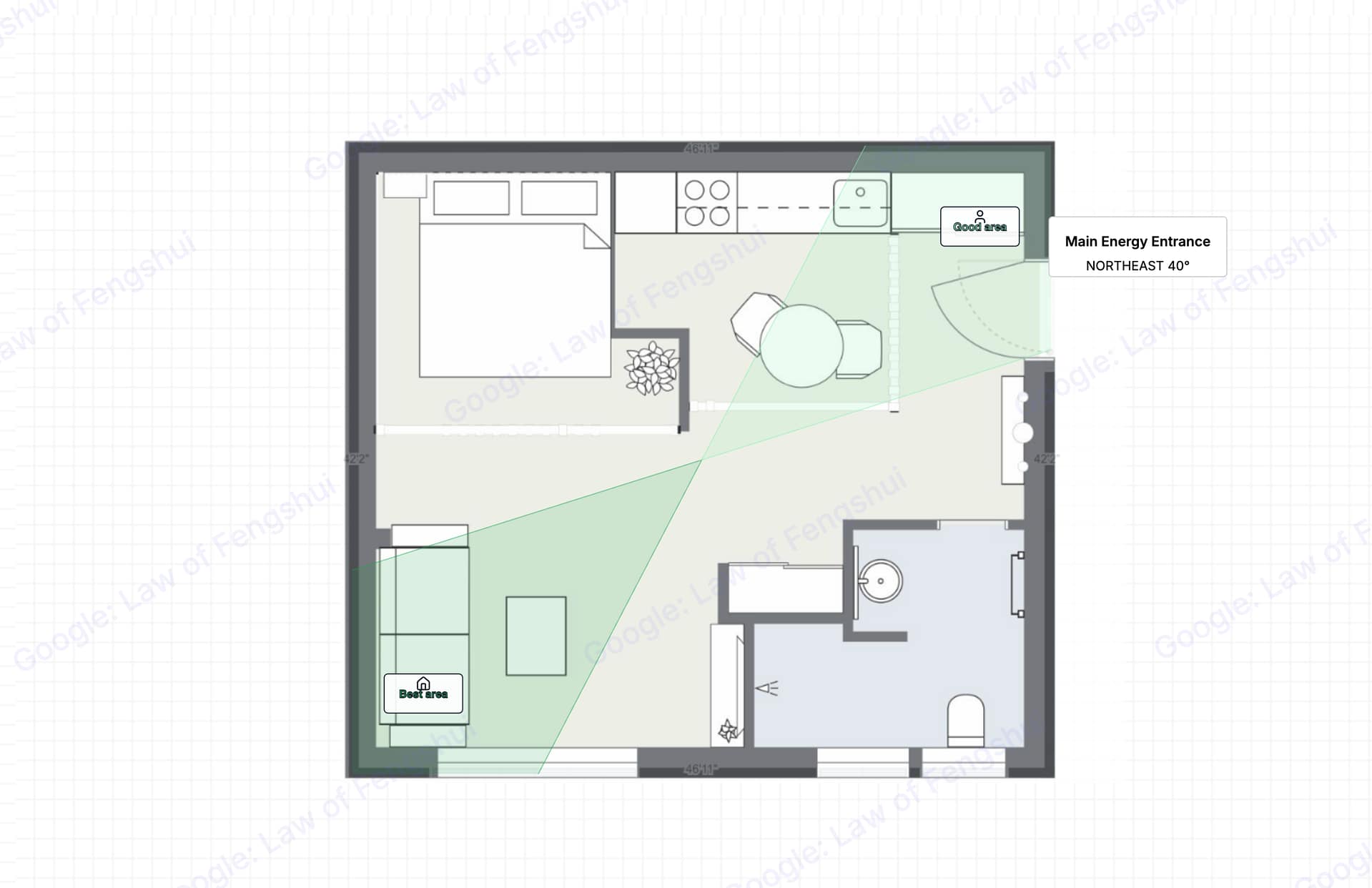
Our sample report scores every room across 5 life areas on a real floor plan so you can see where the numbers come from.
For real estate agents interested in feng shui real estate applications, category scoring turns vague “good energy” claims into specific, defensible evaluations. And the market is there: according to the National Association of Realtors, 86% of Chinese Americans say feng shui will play a role in future home buying decisions, and 79% would pay an average of 16% more for a feng shui-compliant home.
Scenario 1: The Investor. A buyer looking at this Austin property as investment real estate hears: “Financial category scored +80 out of 100. The surrounding landscape features, including two mature trees in Fu Bi star sectors and favorable drainage, score strongly for wealth accumulation. No compass violations detected.”
Scenario 2: The Career Mover. A tech professional relocating to Austin hears: “Career scored +61, still above neutral and supported by the clean landscape, but the property’s peak strength is Financial. If career advancement is your top priority, we can look at properties where Career-weighted sectors align with different surrounding features.”
Scenario 3: The Young Couple. Love scored +50 on this property. An agent might focus on properties where the Love-weighted sectors have better landscape alignment, or discuss how targeted landscape additions could shift the balance.
The key shift: instead of “this house has good/bad feng shui,” the agent has data to match properties to buyer priorities. That’s a differentiation most competing agents don’t offer.
The average feng shui consultation costs around $821, with a typical range of $587 to $1,534 depending on property size and consultant experience. Most consultations involve a walkthrough, a compass reading, room-by-room recommendations, and color/material suggestions.
What they typically don’t include: quantified scoring per life category. Most feng shui consultants give you qualitative advice: “this room has good energy,” “move the bed here,” “add a water feature there.” Valuable, but subjective. Two consultants might give different recommendations for the same room.
Category scoring adds a layer of objectivity. The Nine Star weights are fixed per category. The compass bearing is measurable. The surrounding features are observable. Financial scoring +80 isn’t an opinion. It’s the result of specific star weights applied to specific landscape features at specific compass positions. A consultant who can show you these numbers alongside their experiential recommendations gives you something most consultations don’t: data you can compare across properties.
For homebuyers doing feng shui home evaluation as part of their purchase decision, the question isn’t whether to hire a consultant. It’s what kind of analysis you want: qualitative feelings, quantified scores, or both.
Based on the Nine Star weight tables:
A property optimized for Financial prosperity would have:
A property optimized for Career advancement would have:
The overlap exists – Wu Qu scores well for both. But the differences in Wen Qu (+20 Career vs +5 Financial) and Fu Bi (+18 Career vs +25 Financial) mean the maps diverge depending on where the surrounding landscape features actually sit.
2026 is a Fire Horse year (丙午). For this Austin property sitting on 午 wu (Fire, South), the Tai Sui (Grand Duke Jupiter) aligns with the sitting direction. This creates additional considerations for feng shui energy flow in 2026, particularly around the southern sectors.
We’re also in Period 9 (2024-2043), governed by the Li trigram and the Fire element. This Austin property is a Li (离) house, which means its base element aligns with the current period. In classical feng shui, a house whose trigram matches the ruling period carries additional favorable energy. Category scores may shift annually as flying stars rotate, but the base Nine Star configuration from the building’s compass bearing remains constant. The Period 9 alignment adds a background boost that compounds with the category-level scoring.
Curious what 15+ classical feng shui systems reveal about a real home?
Our sample report shows every overlay on an actual floor plan so you can see the difference between classical analysis and generic advice.
What is feng shui category scoring? Category scoring evaluates a property across five life domains – Financial, Career, Love, Family, and Health – using different Nine Star weights per category. The same compass sectors score differently depending on which category you’re evaluating.
Why does the same property score differently for financial and career? Each life category weights the Nine Stars differently. The Fu Bi star is +25 Mountain for Financial but +18 for Career. Tan Lang is +25 Mountain for Career but +20 for Financial. These weight differences compound across all 24 compass sectors.
What is the feng shui money corner? The traditional “feng shui money corner” refers to the southeast sector in simplified Ba Gua maps. Classical category scoring replaces this with a full 24-sector analysis where the highest Financial sectors depend on the building’s actual compass bearing, not a fixed zone.
How does a feng shui consultant use category scoring? A feng shui consultant can match properties to client priorities. Instead of a generic “good/bad” assessment, category scoring provides specific data: “This property is +80 for Financial but +61 for Career” helps buyers make informed decisions based on their goals.
Can you improve a property’s category score? Targeted landscaping and structural additions in specific compass sectors can improve category scores. Adding a mature tree in a Tan Lang sector would boost Career scoring more than Financial. The key is knowing which sectors carry the highest weights for the category you want to improve.
What is the Fu Bi star in feng shui? Fu Bi (辅弼) is the Assistant star, combining Left Assistant and Right Adjutant energies. It governs support, advancement, and helpful resources. Fu Bi is one of the top Financial stars (+25 Mountain) and scores moderately well for Career (+18 Mountain).
Does the feng shui wealth corner apply to every house? No. In classical feng shui, the sectors that score highest for financial prosperity depend on the building’s sitting direction, which determines where the Nine Stars land. Two houses facing different directions will have their “wealth sectors” in completely different compass positions.
What’s the difference between 8 Ba Gua zones and 24 compass sectors? Ba Gua uses 8 zones at 45 degrees each. Classical feng shui uses 24 sectors at 15 degrees each, providing three times the precision. A feature at 120 degrees and one at 150 degrees would both be “southeast” in Ba Gua but fall in different sectors with different star assignments in the 24 Mountains system.
How do trees and water affect feng shui house scoring? Trees, buildings, and tall structures are classified as “Mountain” energy. Water, roads, driveways, and drainage are “Water” energy. Each type interacts with the Nine Stars differently. A tree in a Fu Bi sector adds +25 Mountain for Financial. Water draining outward through a Lian Zhen sector can remove negative fire energy and bring wealth.
What does outgoing water in a Lian Zhen sector mean? Lian Zhen (廉贞) is typically a negative star. But as outgoing (draining away from the property) water, it removes fire hazards and brings wealth. The classical interpretation is that negative energy exits through outgoing water, turning an inauspicious star into a beneficial drainage path.
How do I know if my house has good feng shui? A comprehensive feng shui house evaluation goes beyond binary checklists. It maps 24 compass sectors, identifies the Nine Stars at each bearing, evaluates surrounding landscape features, checks for compass violations (Ba Sha Huang Quan, Jie Sha), and scores the property across five life categories. A score of 82/100 overall with Financial +80 and Career +61 tells you far more than “good” or “bad.”
Does feng shui affect property value? Research suggests it can. 79% of Chinese Americans would pay an average of 16% more for a feng shui-compliant home, and 86% say feng shui will factor into future home buying decisions. In markets with significant Asian-American demographics, feng shui compliance is increasingly treated as a property feature, similar to a good school district or walkability score.
Can feng shui help with career success? Classical feng shui evaluates career potential through the Career category, which weights specific Nine Stars for professional advancement. Tan Lang (贪狼) is the top career star (+25 Mountain), followed by Wu Qu (武曲, +25 Water) and Wen Qu (文曲, +20 Mountain for intellectual work). A property’s Career score depends on whether tall structures, trees, or water features align with these stars at the correct compass bearings.