Address
304 North Cardinal St.
Dorchester Center, MA 02124
Work Hours
Monday to Friday: 7AM - 7PM
Weekend: 10AM - 5PM
Address
304 North Cardinal St.
Dorchester Center, MA 02124
Work Hours
Monday to Friday: 7AM - 7PM
Weekend: 10AM - 5PM


You picked your feng shui home for the neighborhood, the schools, the kitchen, the light. But classical feng shui evaluates the same property three separate ways for the personal side of your life: Love, Family, and Health. And those three scores can land in completely different places.
I ran Love, Family, and Health category scoring on a south-facing property in Savannah’s historic district. Same address. Same surrounding live oaks, same incoming traffic from Lincoln Street, same compass data. Love scored -15. Family scored -45. Health scored -40. A 30-point gap between Love and Family from the same property, because the Nine Stars that govern each sector carry different weights depending on which part of your personal life you’re asking about.
Yesterday’s case study showed Financial +80 vs Career +61 on an Austin property – a 19-point gap on a strong property. Today’s Savannah case study shows what happens when a property has real problems. The gaps get wider. The stakes get higher. And one category dodges a penalty that the others can’t.
Most feng shui home guides give you a checklist. Don’t buy at a T-intersection. Front door shouldn’t face stairs. Put a plant in the southeast corner. Binary rules that apply the same way to every house.
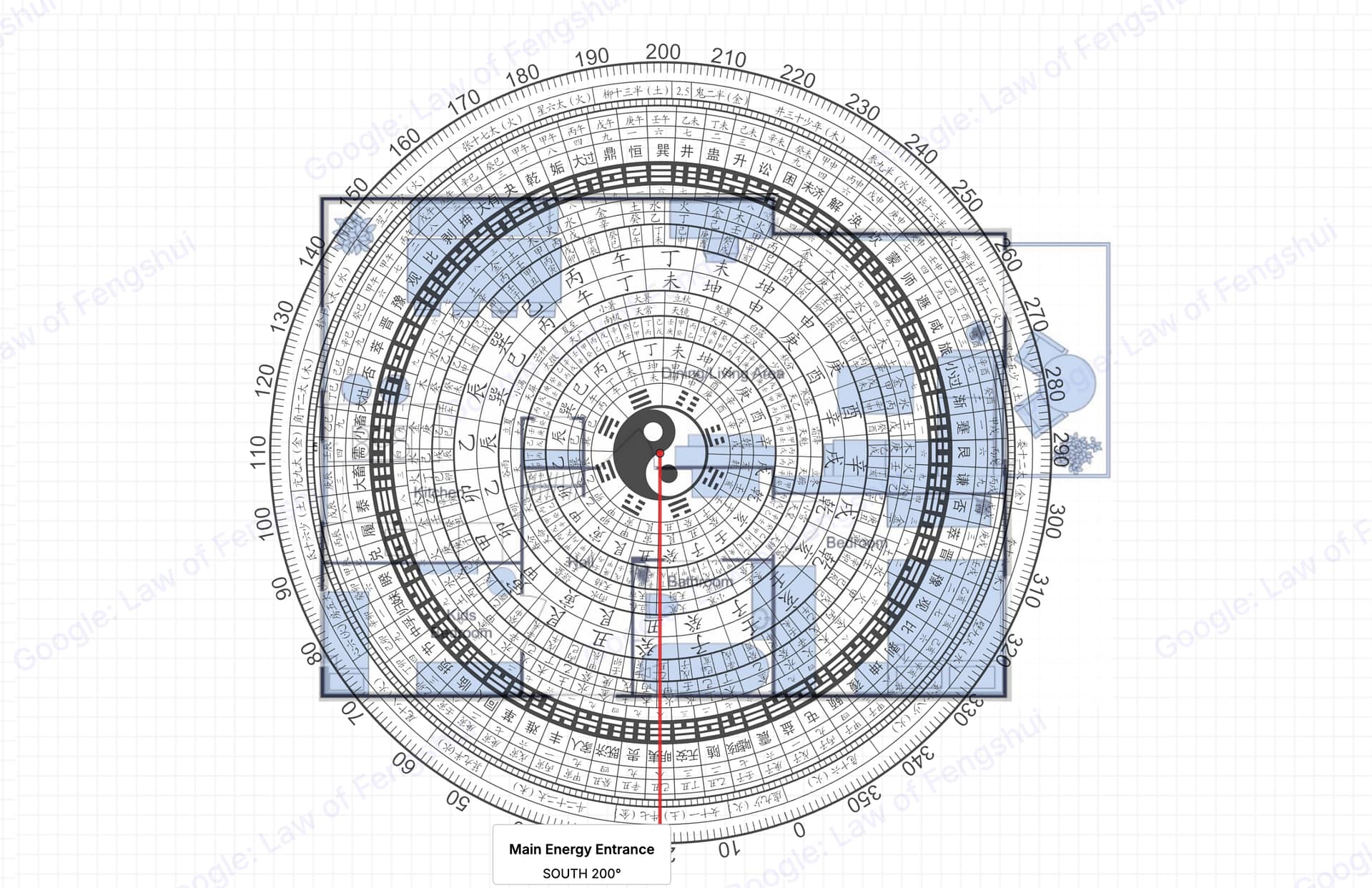
Classical feng shui goes further. It maps 24 compass sectors around a property – each 15 degrees wide – and assigns one of the Nine Stars to each sector based on the building’s sitting direction. Then it evaluates what physical features exist at each compass bearing: trees, buildings, water, roads. Each feature interacts with its sector’s star. And here’s what most people don’t realize: the scoring changes depending on whether you’re asking about Love, Family, Health, Financial, or Career.
Five categories. Five different maps. The same tree in the same sector can score +25 for Love and literally zero for Health. Not a rounding error. A fundamental difference in how each category weights the stars.
Each category weights the Nine Stars differently for both Mountain energy (trees, buildings, tall structures) and Water energy (roads, rivers, drainage).
Love scoring weights the stars for romantic connection and relationships:
Family scoring weights for household harmony and family bonds:
Health scoring weights for physical wellbeing and vitality:
The key difference: Wen Qu is +25 for Love but 0 for Health. Lian Zhen costs -20 for Love but -30 for Health. Health takes the hardest hit from negative stars and gets the least help from intellectual ones.
But the biggest difference isn’t in the star weights. It’s in the violations.

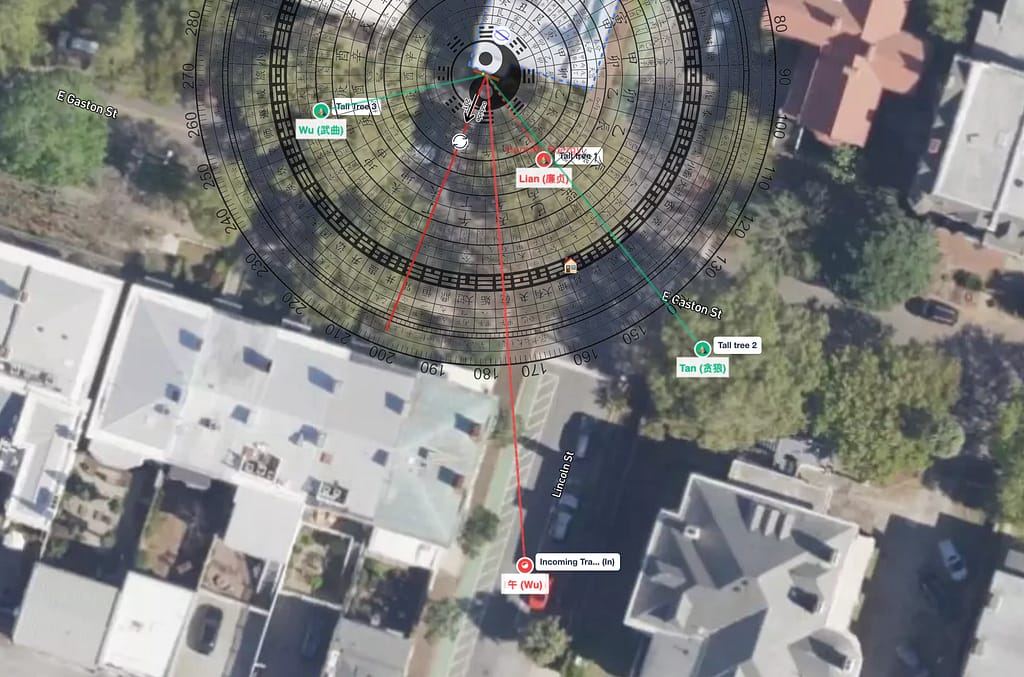
Property details:
Four objects mapped in the surrounding landscape:
No Ba Sha Huang Quan violations. But the Jie Sha hit and Three Elements Violation create serious category-level damage.
Overall energy score: 39/100 (Poor).
The category breakdown:
| Category | Score |
|---|---|
| Career | +0 |
| Financial | -15 |
| Love | -15 |
| Health | -40 |
| Family | -45 |
A 45-point spread from highest to lowest. Same property. Five different evaluations. Career breaks even. Family falls off a cliff.

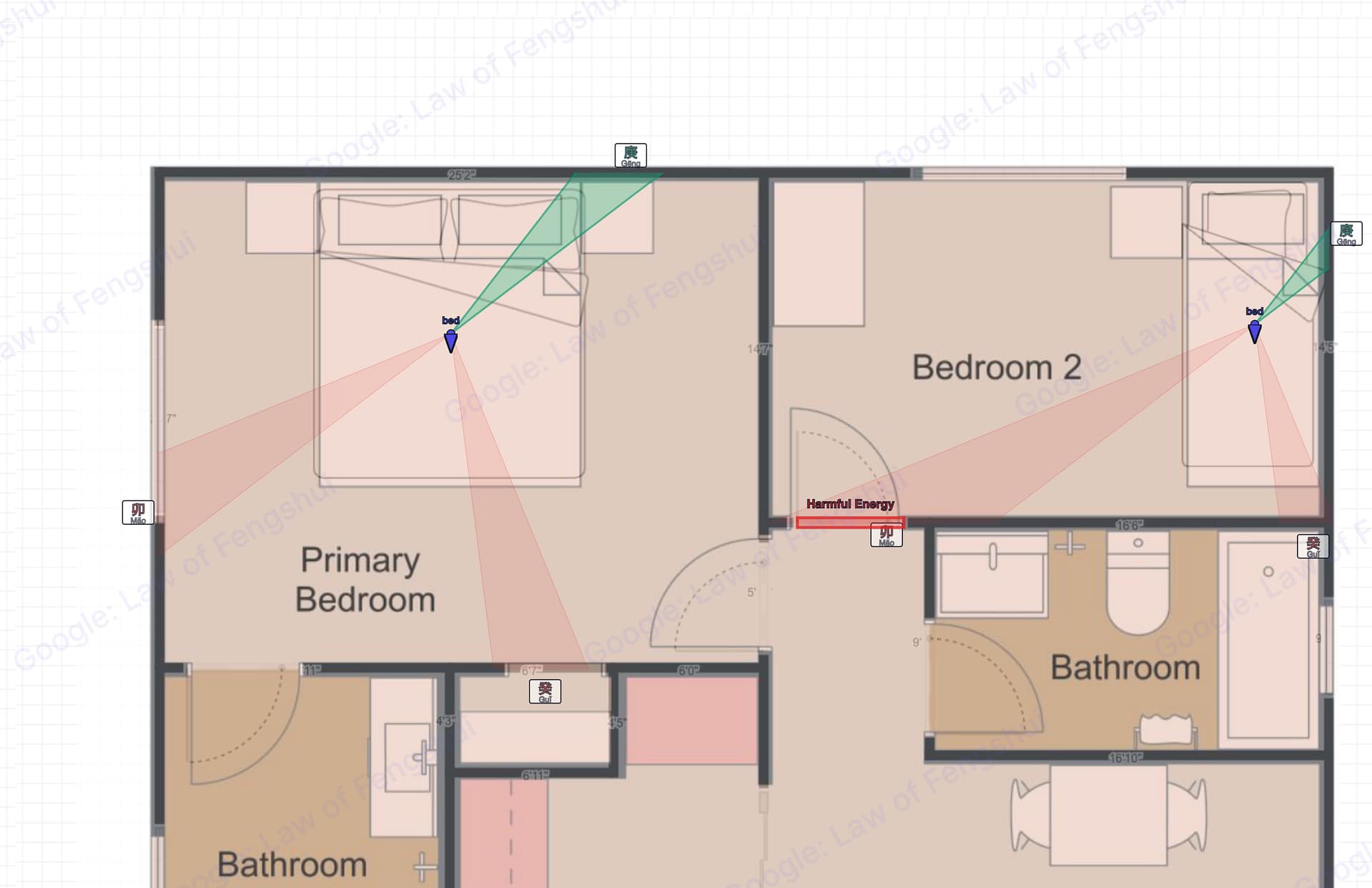
Want to see how Love, Family, and Health scores map onto a real floor plan?
Our sample report runs 15+ classical systems and shows why these three life areas rarely score the same across your rooms.
Here’s the part that changes how you think about feng shui home scoring.
Jie Sha is a compass violation where a physical feature sits in a “robbery” direction relative to the building’s sitting mountain. Tall tree 1 sits in the Jie Sha sector at 巳 (Si) for this property. The penalties by category:
| Category | Jie Sha Penalty |
|---|---|
| Financial | -25 |
| Career | -15 |
| Family | -15 |
| Health | -15 |
| Love | 0 |
Love is immune. Completely. The Jie Sha violation that costs Financial -25 points and Family -15 points doesn’t touch Love at all.
The same pattern holds for Ba Sha Huang Quan violations. Ba Sha penalties by category: Health -40, Family -30, Financial -30, Career -20, Love 0. This property doesn’t have a Ba Sha violation, but if it did, Love would dodge that too.
In classical feng shui, Love scoring treats compass violations as irrelevant. The theory: romantic connection depends on the quality of energy in specific star sectors, not on whether a feature happens to cross a taboo bearing. Family harmony and physical Health, on the other hand, are directly affected by environmental threats at those positions.
This is why Love scored -15 on this property while Family scored -45. Love avoided the -15 Jie Sha penalty that Family absorbed. Remove that one penalty and the gap narrows. But the star weights compound the difference further.

Family scored -45 – the worst of all five categories. Here’s why it accumulates damage faster than the others.
Lian Zhen (廉贞) Mountain penalty: Tall tree 1 sits in a Lian Zhen sector. For Love, that’s -20. For Health, -30. For Family, -25. Family takes the second-worst hit from this star.
Jie Sha penalty: -15 for Family. Zero for Love.
Three Elements Violation: The incoming traffic triggered a Three Elements Violation (三元俱全), which means all three element types (Heaven, Human, Earth) are violated simultaneously. This is the most severe Yin-Yang Spousal Pairing warning in classical feng shui. The report specifically flags “Marriage conflicts and family disharmony” as a primary risk. Every category gets penalized, but the qualitative impact on Family is the most direct.
Lu Cun (禄存) incoming water: Inauspicious incoming water in a Lu Cun sector. Lu Cun Mountain is -15 for Family (the worst among all categories). The water configuration creates “stagnation and health issues.”
Weak positive offsets: Tan Lang Mountain is only +5 for Family. Wu Qu Mountain is +10 for Family. Compare that to Career: Tan Lang is +25, Wu Qu is +20. The same two auspicious trees that rescue Career barely help Family.
That’s the math. Family takes full damage from every negative source, gets minimal credit from the positives, and the Three Elements Violation lands squarely on household harmony. -45.
Career scored 0 on a property rated 39/100 Poor. How?
Tan Lang (贪狼) is the single best Career star at +25 Mountain. Tall tree 2 sits in a Tan Lang sector. That’s +25 Career points from one tree.
Wu Qu (武曲) is +20 Mountain for Career. Tall Tree 3 sits in a Wu Qu sector. Another +20 Career points.
Those two trees generate +45 Career Mountain energy. That’s enough to offset the Jie Sha penalty (-15), the Lian Zhen damage (-25 Career), and the Three Elements Violation penalty. Career’s star weight table happens to reward exactly the features this property has – two healthy trees in the right sectors.
For Family, those same trees contribute +5 and +10. Fifteen points instead of forty-five. Same trees. Different math. That’s why Career breaks even and Family collapses.
Most guides answer this with vibes: “Does the space feel light? Can energy flow?” Competitor checklists check for T-intersections, staircase alignment, and clutter. Those matter. But they give one pass/fail verdict for the entire property.
Category scoring answers the question five separate ways. A feng shui home is “good” for Career if its surrounding landscape features sit in sectors governed by high-weight Career stars (Tan Lang +25, Wu Qu +20). The same home is “bad” for Family if those features barely register on Family’s weight table (+5, +10). Good and bad aren’t binary. They’re category-specific.
This Savannah property would pass every simplified checklist. No T-intersection. No staircase facing the door. No bathroom at the entrance. But category scoring reveals Career at 0, Family at -45. The checklist says “fine.” The scoring says “fine for Career, harmful for Family.” If you’re evaluating a feng shui house for a growing family, those are two very different answers.
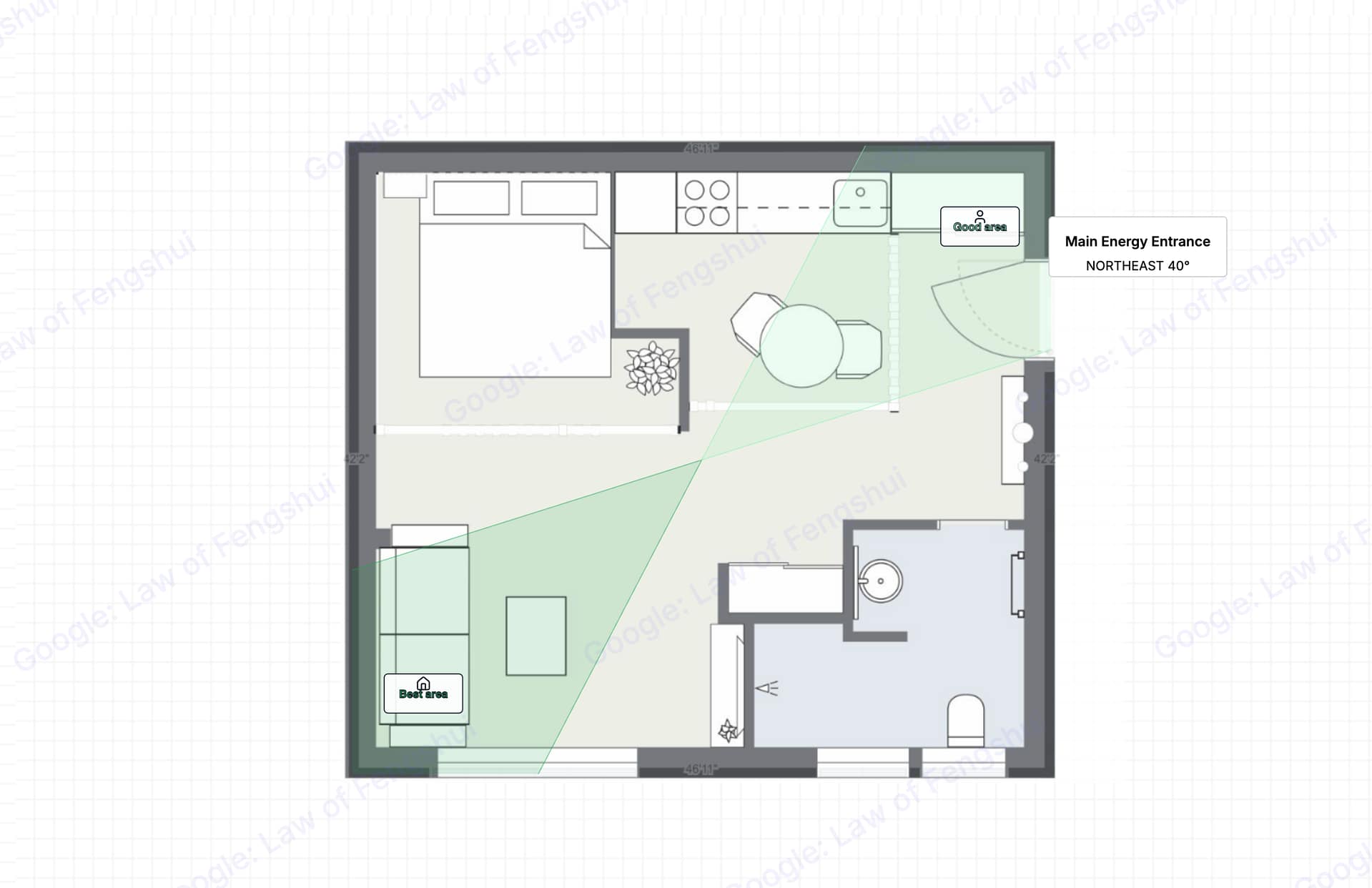
Curious which rooms score highest for health and which for relationships?
Our sample report breaks down 5 life area scores room by room on a real floor plan so you can see where each category is strongest.
Most “feng shui bedroom” advice focuses on what’s inside the room. Pink sheets, pairs of objects, no mirrors facing the bed. Those are innerview considerations that matter. But Love category scoring operates at the outerview level – it evaluates the surrounding landscape and how the Nine Stars weight those features for romantic connection.
Wen Qu (文曲, the Literature star) is the top Love star at +25 Mountain. It governs artistic expression, intellectual connection, the kind of energy that draws people toward each other through shared ideas and creative resonance. A tall, well-formed tree or building in a Wen Qu sector would add +25 to Love scoring.
For Health, that same Wen Qu sector scores 0. Nothing. The star that powers romantic attraction has zero effect on physical wellbeing. A tall oak tree in a Wen Qu position would glow green on the Love overlay and stay completely gray on the Health overlay.
This Savannah property doesn’t have a feature in a Wen Qu sector, but the principle matters: the stars that support your love life and the stars that support your health are fundamentally different. A feng shui home that scores well for relationships might offer nothing for physical wellbeing, and the overlay maps would show you exactly where the gap sits.
If you search “feng shui for health and wealth,” most results bundle them together. Place a water fountain for wealth. Add green plants for health. As if the same remedy fixes both.
Category scoring separates them completely. And Health turns out to be the most vulnerable of all five categories:
Health takes the biggest penalties and gets the smallest bonuses. On this Savannah property, Health scored -40, dragged down by the Lian Zhen tree (-30), the Jie Sha penalty (-15), the Three Elements Violation, and the Lu Cun water issue. The auspicious trees barely offset any of it because Health’s star weights don’t reward Wu Qu (+5) or Tan Lang (+15) the way Career does (+20 and +25).
If you’re evaluating a feng shui home with health as a priority – recovering from illness, aging in place, raising young children – the Health category overlay is the one that matters most. And it’s the one most likely to show red where the other maps show green.
The incoming traffic on this Savannah property triggered a Three Elements Violation (三元俱全) in the Yin-Yang Spousal Pairing analysis. This is the most severe warning in the spousal pairing system.
Classical feng shui classifies the 24 compass sectors into three element types: Heaven (天元), Human (人元), and Earth (地元). When water arrives from a bearing where all three element types conflict with the building’s sitting mountain, that’s a Three Elements Violation. The report flags it with specific warnings: financial loss, relationship breakdown, health issues, career obstacles.
For this property, the incoming traffic at 午 (Wu) creates this triple conflict against the 癸 (guǐ) sitting mountain. Every category takes a -15 penalty. But the qualitative warnings hit Family and Health hardest: “marriage conflicts and family disharmony” and “chronic illnesses and weak constitution.”
The advice from the report is direct: “IMMEDIATE ACTION: Relocate water feature, change entrance orientation, or consult feng shui master.” On a property level, this might mean redirecting traffic flow, adding landscape barriers, or reconsidering the entrance approach.
2026 is a Fire Horse year (丙午). This property faces 丁 dīng (Fire, South), and the incoming traffic issue sits at 午 (Wu) – the Horse position. The Tai Sui (Grand Duke Jupiter) alignment with the Horse position in 2026 adds additional sensitivity to features at this compass bearing. A Three Elements Violation at 午 during a Fire Horse year compounds the concern.
We’re in Period 9 (2024-2043), governed by the Li trigram and the Fire element. This Savannah property is a Kan (坎) house, Water element – the opposite of the current period’s governing element. In classical feng shui energy flow theory, a house whose trigram opposes the ruling period faces additional headwinds. Category scores may shift annually as flying stars rotate, but the base Nine Star configuration from the building’s compass bearing remains constant.
Curious what 15+ classical feng shui systems reveal about a real home?
Our sample report shows every overlay on an actual floor plan so you can see the difference between classical analysis and generic advice.
What is feng shui category scoring? Category scoring evaluates a property across five life domains – Financial, Career, Love, Family, and Health – using different Nine Star weights per category. The same compass sectors score differently depending on which life domain you’re evaluating.
Why does my feng shui home score differently for love and family? Love and Family weight the Nine Stars differently. Wen Qu is +25 Mountain for Love but +15 for Family. Fu Bi is +20 for Family but +15 for Love. More importantly, Love is immune to compass violations (Jie Sha and Ba Sha Huang Quan) while Family takes full penalties. These differences compound across all 24 compass sectors.
Is love really immune to feng shui compass violations? In classical category scoring, yes. Ba Sha Huang Quan penalizes Health at -40, Family at -30, Financial at -30, Career at -20, and Love at 0. Jie Sha follows the same pattern: every category takes a penalty except Love. The theory is that romantic connection depends on star quality in specific sectors, not on whether features cross taboo bearings.
What makes Health the most vulnerable feng shui category? Health takes the highest Ba Sha Huang Quan penalty (-40 vs -30 for Financial/Family, -20 for Career, 0 for Love). Health also gets the smallest bonuses from many auspicious stars: Wu Qu Mountain is only +5 for Health but +25 for Financial. Wen Qu Mountain is 0 for Health but +25 for Love. Health takes more damage and receives less help.
Can a feng shui home score good for career but bad for family? Absolutely. This Savannah property scored Career +0 (neutral) and Family -45 (very poor). Career’s top stars – Tan Lang (+25) and Wu Qu (+20) – aligned with the property’s auspicious trees. Family’s star weights gave those same trees only +5 and +10. Same features, different math, 45-point gap.
What is a Three Elements Violation in feng shui? A Three Elements Violation (三元俱全) occurs when water arrives from a compass bearing where all three element types (Heaven, Human, Earth) conflict with the building’s sitting mountain. It’s the most severe Yin-Yang Spousal Pairing warning, flagging risks across financial loss, relationship breakdown, health issues, and career obstacles.
How do trees affect feng shui home scoring? Trees are classified as Mountain energy. Each tree sits in a compass sector governed by one of the Nine Stars. A tree in a Tan Lang (贪狼) sector adds +25 for Career and +15 for Love. A tree in a Lian Zhen (廉贞) sector costs -30 for Health and -25 for Family. The same tree helps or hurts depending on which sector it occupies and which category you’re evaluating.
Does the Ba Gua map show love, family, and health zones? Simplified Ba Gua maps assign fixed labels: “southwest is love,” “east is family,” “east is health.” Classical category scoring replaces these fixed zones with a full 24-sector analysis where the highest-scoring sectors depend on the building’s actual compass bearing and the Nine Star weights specific to each life domain.
What is the best feng shui house direction for health? There’s no single best direction. Health scoring depends on which Nine Stars govern the 24 sectors around your property (determined by sitting direction) and what physical features exist at each bearing. The same south-facing property that scored -40 for Health might score differently if the surrounding landscape features were in different sectors. The direction matters, but only in combination with what’s actually out there.
Can you improve a feng shui home’s family score? Targeted landscaping in specific compass sectors can shift category scores. Adding a mature tree in a Fu Bi sector would boost Family scoring (+20 Mountain) more than Love (+15) or Health (+15). Removing or screening a feature in a Lian Zhen sector would reduce the -25 Family penalty. The key is knowing which sectors carry the highest weights for the category you want to improve.
How does feng shui compare to good feng shui checklists? Most “good feng shui” checklists give binary pass/fail answers. Category scoring gives you five separate evaluations with specific numbers. A property that passes every checklist item could still score -45 for Family if the surrounding landscape features sit in the wrong star sectors. The checklist tells you “no obvious problems.” Category scoring tells you “here’s exactly how this property serves each part of your life.”
Does a poor overall feng shui score mean bad for everything? Not necessarily. This Savannah property scored 39/100 Poor overall but Career scored 0 (neutral). The overall score averages across categories, which can mask individual category performance. A buyer focused on career advancement would see a different picture than a couple prioritizing family harmony. Category-level scoring tells the complete story.
How do I tell if a home has bad feng shui before buying? Simplified checklists flag layout problems (T-intersections, staircases facing doors, bathrooms at entrances). Classical compass analysis goes further: it maps 24 sectors around the property, checks for compass violations (Ba Sha Huang Quan, Jie Sha), and runs category scoring across Financial, Career, Love, Family, and Health. A home can pass every checklist item and still score -45 for Family because of how the surrounding landscape interacts with its compass bearing. Category scoring catches what checklists miss.
What feng shui should I focus on when buying a home for my family? Run Family and Health category scoring first. Family takes the worst penalties from compass violations and gets the smallest bonuses from most auspicious stars. Health is the most vulnerable category overall, with the highest Ba Sha penalty (-40) and weakest star offsets. If both Family and Health score above zero, the property’s surrounding landscape supports household stability and physical wellbeing at the compass level. Then check Love, Financial, and Career for the complete picture.
What is the Kan house type in feng shui? Kan (坎) is one of the eight trigram house types, corresponding to the Water element. A property sitting North (癸 guǐ) is classified as a Kan house. The house type determines which Nine Stars govern which compass sectors, which in turn determines category scoring for all five life domains. Different house types produce different star maps even at the same address if the facing direction changes.