Address
304 North Cardinal St.
Dorchester Center, MA 02124
Work Hours
Monday to Friday: 7AM - 7PM
Weekend: 10AM - 5PM
Address
304 North Cardinal St.
Dorchester Center, MA 02124
Work Hours
Monday to Friday: 7AM - 7PM
Weekend: 10AM - 5PM

Setting up a feng shui home office sounds straightforward. Get the desk into the command position, put a solid wall behind you, face the door but not directly, add some plants, and you’re done. That’s the advice you’ll find across most guides on home office feng shui.
But that advice skips a more fundamental question: which room should the home office be in?
Most people answer that by default. The room with the spare door becomes the office. Or the smallest bedroom. Or whatever space isn’t already claimed. Nobody checks whether that room is actually the right one for focused work, for their specific building, for their specific profile.
Classical feng shui has a system for exactly that question.
Feng shui is an ancient Chinese practice of arranging space to support the flow of energy through it. A feng shui home office analysis isn’t just about desk placement or clutter management — it starts with identifying which area of the floor plan carries the most favorable work energy for the person using it.
The classical approach to office placement uses the sitting direction of the building as a starting point, then maps multiple energy systems across the floor plan. The result is a zone map: certain areas of the apartment or house score favorably for a desk and focused work. Others are neutral. Some should be avoided.
This is different from generic feng shui tips about desk direction. The zone map is specific to the building. And when a personal compatibility layer is added, it becomes specific to the individual as well.
The command position — where you can see the door without being directly in line with it, with a solid wall behind you — is one of the most widely cited feng shui rules. According to feng shui, this position supports a sense of stability and control, and it has real environmental psychology backing: humans feel more secure when they can monitor the entry point of a room.
But the command position tells you how to position your desk within a room. It doesn’t tell you which room to be in. And for a home office, that second question matters just as much as the first.
A feng shui consultant working with classical systems will typically map the energy zones of the entire floor plan before advising on desk placement. Placing your desk in the optimal zone of the right room is more valuable than placing it in command position inside the wrong one.
The feng shui analysis in this case study uses two overlapping systems to produce the zone map.
He/Chong (合冲) — Personal Zodiac Compatibility
He/Chong is a classical feng shui framework that evaluates which compass sectors of a floor plan harmonize or clash with a person’s zodiac year. The term “He” (合) refers to harmony — directions and sectors that support the person’s energy. “Chong” (冲) refers to clash — sectors that work against it.
The He/Chong layer is personal. Different birth years produce different compatibility results in the same apartment. Two people living in the same home will often have different optimal rooms for a home office, desk, or bed.
Zi-Wu Oblique Flow (子午斜流) — Structural Energy Flow
Zi-Wu Oblique Flow maps the structural energy directions of a floor plan based on the building’s sitting orientation. Unlike the He/Chong layer, this component is fixed — it doesn’t change with the resident. It reflects the directional qi patterns generated by the building’s compass alignment.
Combined, the two systems produce a zone map where each area of the floor plan gets rated for desk and work placement. The overlap between what’s favorable for this building (Zi-Wu) and what’s favorable for this person (He/Chong) determines the final ranking.
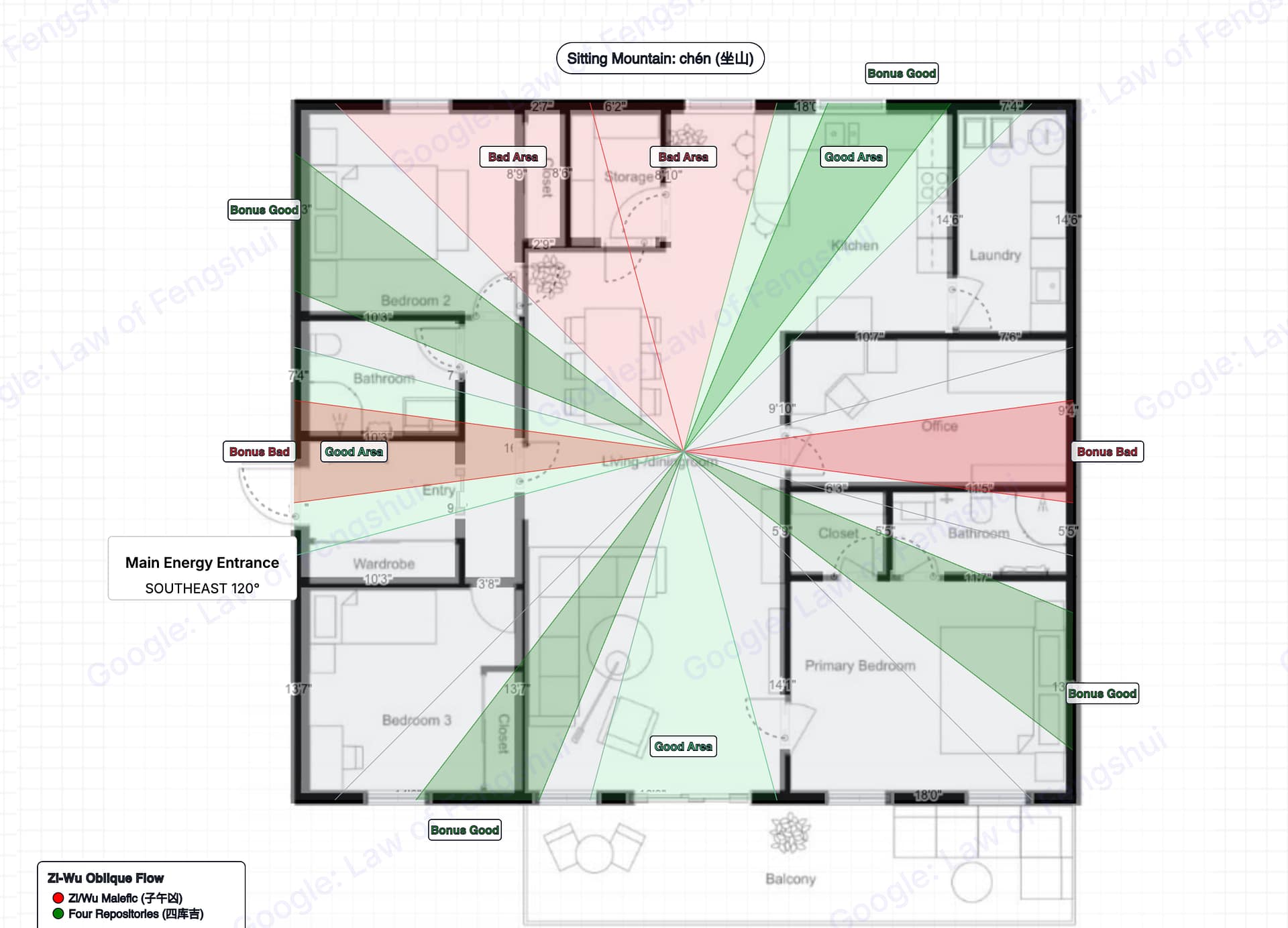
The apartment is a 3-bedroom unit in La Jolla, California. It has a primary bedroom, two secondary bedrooms — one of which Marcos designated as his dedicated home office — a central living and dining room, a kitchen and laundry area, and a balcony facing south.
Marcos works remotely in tech. He set up the office room the same way most people do: desk against the wall, monitor positioned to avoid window glare, chair with a high back for support. He had arranged the desk to face the door. He knew the basics of home office feng shui.
The analysis used He/Chong for Marcos’ specific birth year and Zi-Wu Oblique Flow for the apartment’s sitting orientation (Sitting Mountain: chén/辰, southeast).
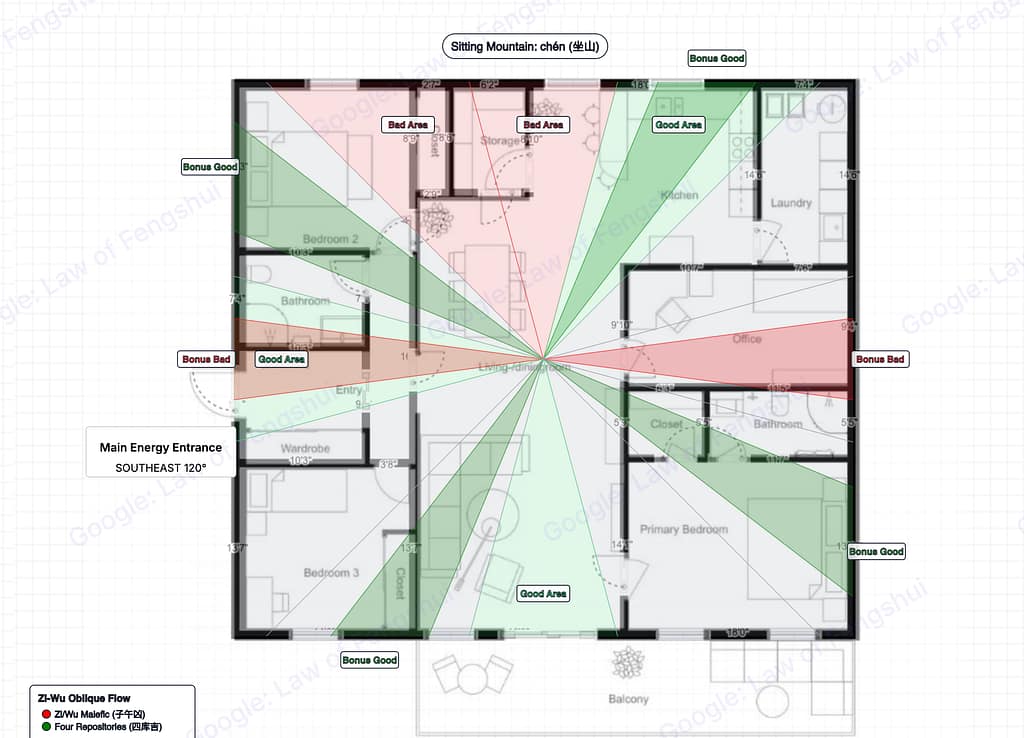
The overlay produces four zone types:
Good Area — the highest-rated zone in the apartment. For Marcos, this fell on the kitchen and laundry side of the floor plan. Both overlays agree this sector has the most favorable energy for his desk placement.
Bonus Good — the second tier. Three rooms in this apartment scored Bonus Good: the primary bedroom, the third bedroom (Bedroom 3), and the entry zone. Any of these would be a better choice for a home office than the room currently being used.
Bonus Bed — a zone that scores well for sleeping but isn’t the optimal pick for focused work. This is where the dedicated Office room landed.
Bad Area — two zones in the storage and hallway area at the top center of the floor plan. These should be avoided for any important function.
The room labeled “Office” in the floor plan isn’t a bad zone. A Bonus Bed rating means it’s a neutral-to-supportive area for rest. But for productivity, mental clarity, and focused work output, feng shui energy in that sector doesn’t peak the way it does in the Bonus Good zones.
The placement of your desk matters. The room that desk is in matters more.
What makes this result counterintuitive is that Marcos did everything right within the office room itself — command position, solid wall behind him, no clutter. But the zone itself was working against the intent. It’s the feng shui equivalent of optimizing your coffee order while sitting at the wrong table.
The Good Area zone — the strongest in the apartment — sits over the kitchen and laundry side. That’s not a practical desk location. But the three Bonus Good rooms are all proper living spaces. Any one of them would support Marcos’ work energy better than the dedicated Office room.
This is one of the more useful aspects of classical home office feng shui: the analysis is person-specific, not just property-specific.
The Zi-Wu Oblique Flow component stays constant. It’s based on the building’s sitting direction and doesn’t change with the occupant. The He/Chong layer, however, is tied to the person’s zodiac year. Different birth years produce different compatibility profiles. Run this analysis for someone born in a different year in the same La Jolla apartment and the zone rankings shift.
This means the “best home office room” isn’t a feature of the apartment. It’s a combination of the property and the person. A feng shui expert working with classical systems will always run both layers together before advising on desk placement.
If you’re thinking about desk placement and home office setup through a feng shui lens, here’s where to start:
Choose the room first. The command position and desk orientation matter — but only after you’ve identified the right room. Optimizing desk placement in a suboptimal zone is the wrong order of operations.
Understand that the result is building-specific. The feng shui home office analysis depends on your building’s sitting orientation. A south-facing apartment in La Jolla produces a different zone map than a north-facing apartment on the same block. Generic feng shui home office guides can’t account for this — they’re giving you universal rules for a property-specific question.
Understand that the result is also person-specific. Position your desk in the zone that aligns with your He/Chong profile. The best feng shui office layout for you may not be the best layout for your partner or housemate working in the same space.
Position your desk in command position within the right room. Once you’ve identified the best room, apply the desk placement rules: solid wall behind you, able to see the door, avoid placing your desk near a window that creates glare or puts your back to open space.
Keep the workspace uncluttered. An uncluttered space supports clear energy flow regardless of zone. Clutter interrupts the qi patterns that the zone analysis is trying to work with. This is one feng shui rule that applies universally.
Consider natural light. Position your desk to use natural light from the side rather than directly in front of or behind the screen. This aligns with both feng shui principles and practical workspace ergonomics.
Browns and earth tones support stability. According to feng shui, earth element colors — browns and earth tones — help create a grounding, stable environment for a home office space. A wooden desk naturally brings this in without any additional effort.
What is the best direction to face in a feng shui home office? Classical feng shui home office analysis determines this from two inputs: the building’s sitting direction and the occupant’s personal zodiac year. The goal is to find zones where both systems agree on favorable energy — and then to position your desk in command position within that zone. There’s no single “best direction” that applies to every home office.
Does the command position still matter in feng shui? Yes — once you’ve identified the right room. The command position (able to see the door, solid wall behind you) is a foundational desk placement principle. But it’s a within-room rule, not a room-selection rule. The zone analysis comes first.
Can a bedroom work as a feng shui home office? Yes. In classical feng shui home office analysis, a bedroom that scores Bonus Good or Good Area will support work energy better than a dedicated office room that scores lower. The label on the room doesn’t determine its energy quality — the zone analysis does.
How often does the feng shui home office zone map change? The structural component (Zi-Wu Oblique Flow) stays constant for a property. The personal component (He/Chong) is tied to your birth year, so it doesn’t change unless you’re running the analysis for a new occupant. Annual feng shui updates using flying star systems can shift the picture year by year, but the classical zone analysis based on sitting direction is a stable baseline.
Is feng shui home office analysis only for traditional spaces? No. The classical analysis works for any floor plan — apartments, condos, open-plan lofts, houses. The sitting direction of the building is the key input, and that exists for any structure.