Address
304 North Cardinal St.
Dorchester Center, MA 02124
Work Hours
Monday to Friday: 7AM - 7PM
Weekend: 10AM - 5PM
Address
304 North Cardinal St.
Dorchester Center, MA 02124
Work Hours
Monday to Friday: 7AM - 7PM
Weekend: 10AM - 5PM

You rotated the sofa three times before settling on a spot. The desk went by the window for natural light. The bed ended up against the far wall because that’s where it fit. Most feng shui furniture placement advice would tell you to check the commanding position and make sure nothing blocks the door.
There’s a deeper layer. Classical compass feng shui has a system that maps each piece of furniture to its own optimal compass sector based on the direction it faces. Not the room it’s in. The specific piece. A sofa facing east and a desk facing north aren’t interchangeable in this system. They each get their own compass profile, their own trigram assignment, and their own set of best-use sectors.
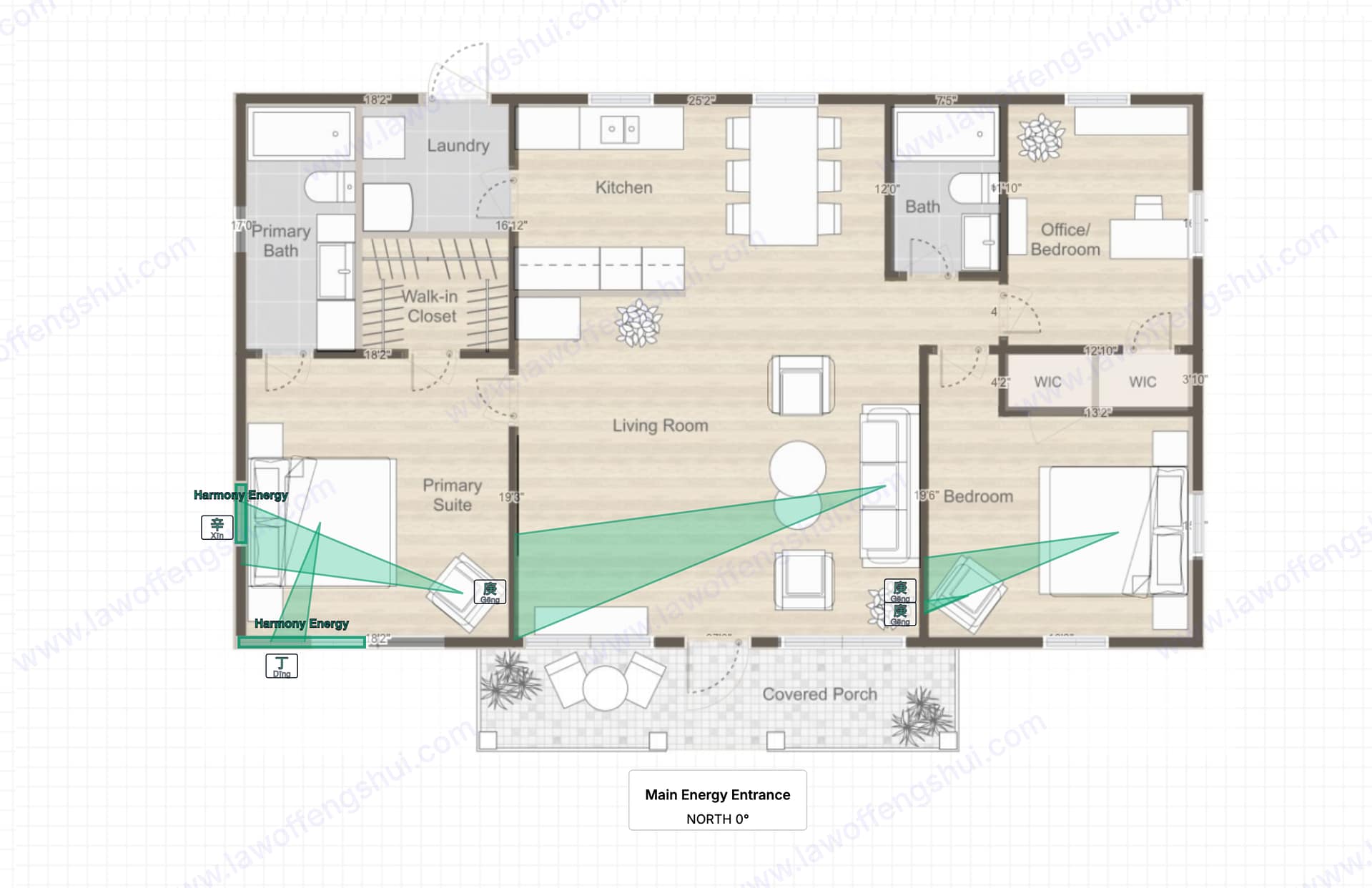
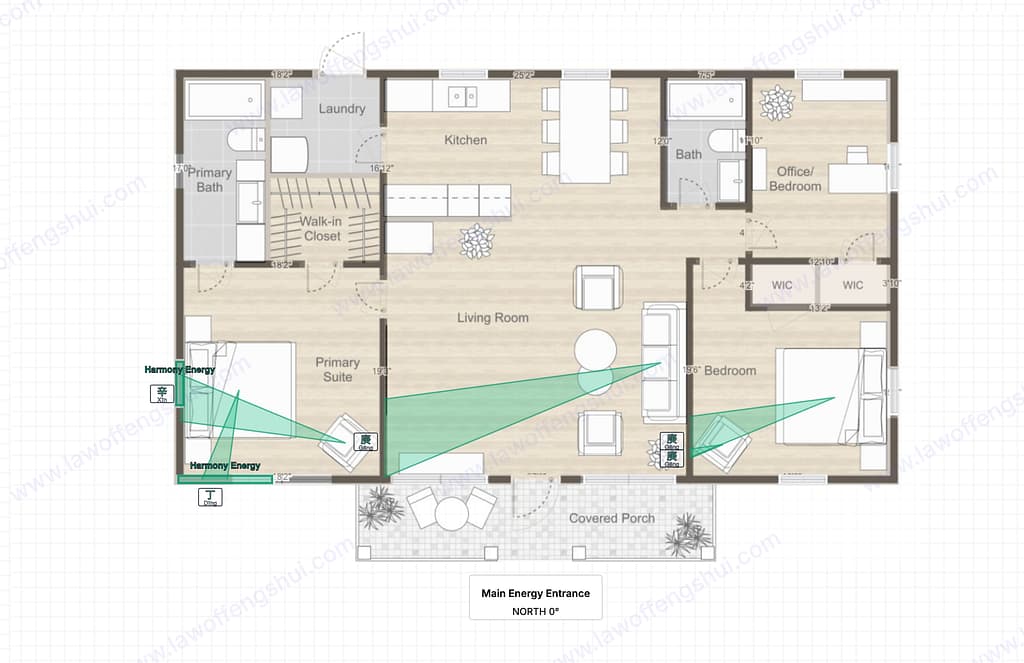
We tested this on a 3BR house in Sacramento, California. The building faces South (entrance at 180 degrees). The overlay lit up green “Harmony Energy” zones for the furniture in the primary suite, showing exactly which compass sectors amplify each piece’s energy.
In this post:
If you search “feng shui furniture” or “feng shui living room arrangement,” you’ll get a consistent set of tips. Place the sofa in the commanding position where you can see the door. Don’t put the bed directly in line with the bedroom doorway. Keep the desk facing outward, not against a wall. Use pairs of objects for balance. These are real feng shui decorating principles backed by centuries of practice and, in many cases, environmental psychology research.
But they’re all room-level guidelines. They tell you how to position furniture relative to the door, the walls, and the room’s function. They don’t address the compass. Some sources go further and suggest specific directions – “face the sofa south” or “position the desk facing east.” Those add a directional layer, but they apply one generic rule to everyone regardless of the building’s actual orientation. In classical compass feng shui, the direction a piece of furniture faces determines which sectors of the home amplify its energy. That’s a different question from “can you see the door?”
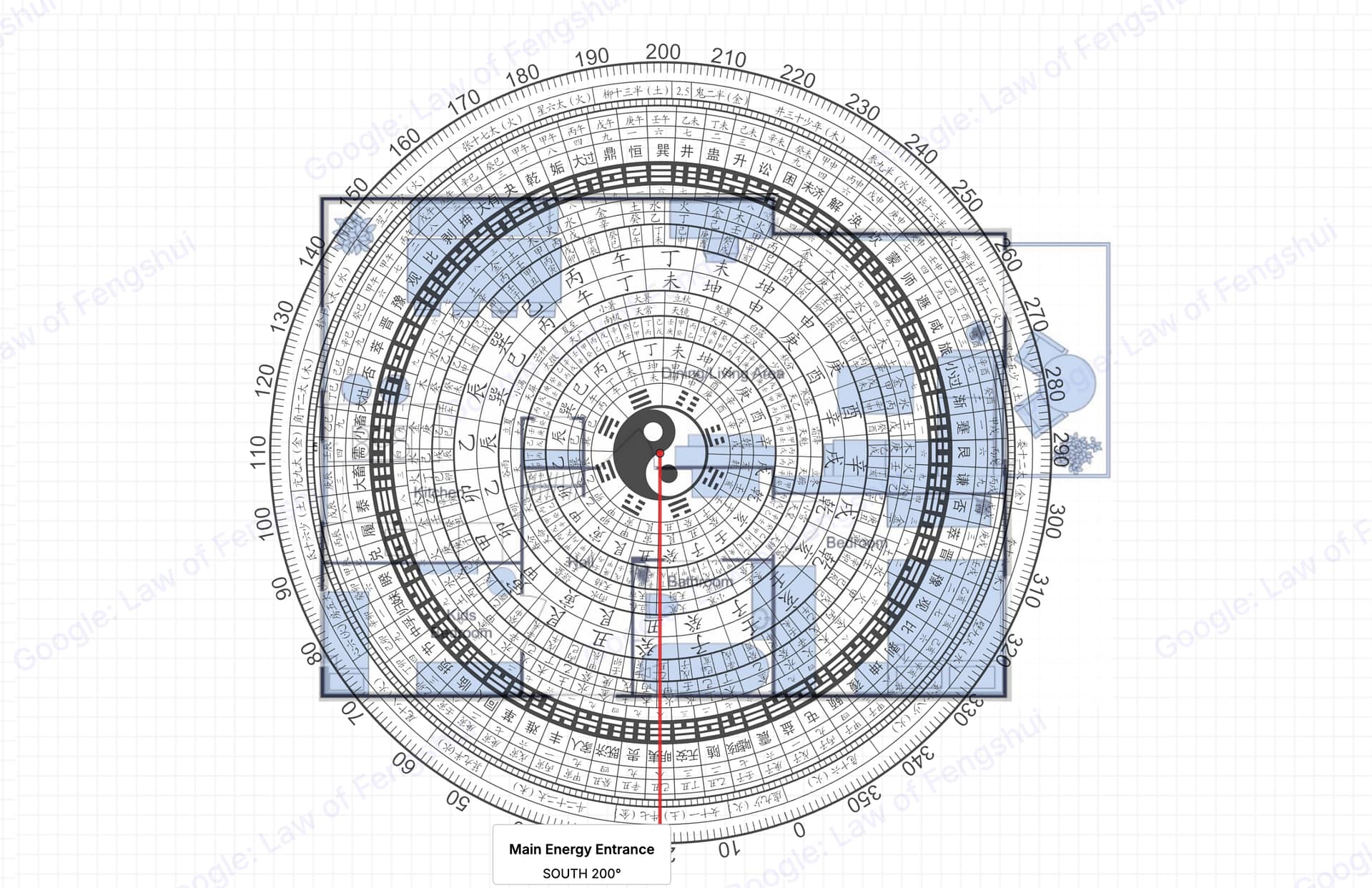
The system that answers this question has been used by practitioners for centuries. In classical Chinese texts, it’s called Na Jia (纳甲), which translates roughly to “incorporating the heavenly stems.” It maps compass directions to trigram groups, and each trigram group has defined sectors where its energy is optimized.
The mapping follows a clear sequence:
Step 1: Find the sitting direction. Every piece of furniture has a “sitting direction” – the compass direction its back faces. Just like a building has a sitting direction (the direction opposite its main entrance), each piece of furniture has one based on how it’s oriented. A sofa with its back against the west wall is “sitting west.” A bed with its headboard against the north wall is “sitting north.”
Step 2: Map the sitting direction to a trigram. The 24 mountains compass divides 360 degrees into 24 sectors of 15 degrees each. Each sector belongs to one of 8 trigram groups through the Na Jia mapping. The sitting direction of the furniture falls into one of these 24 sectors, which assigns it to a specific trigram.
Step 3: Look up the best-use sectors. Each trigram has defined compass sectors where its energy performs best. The system renders these as green “Harmony Energy” zones on the floor plan. These zones show exactly where that piece’s energy is optimized.
Rotate the furniture 90 degrees and Step 1 changes. A different sitting direction often means a different trigram assignment. Which means different best-use sectors. The whole analysis shifts with the furniture’s orientation.
Want to see how furniture direction scoring works on a real floor plan?
Our sample report runs Na Jia Li on every piece of furniture and scores each direction against the building’s trigram map.
The Na Jia system maps the 24 compass mountains to 8 trigram groups, and each group has specific “best use” directions associated with an element type:
Qian (乾, Heaven): Best use directions are Jia (Wood) and Ren (Water). This trigram represents the creative, initiating energy.
Kun (坤, Earth): Best use directions are Yi (Wood) and Gui (Water). Receptive, nurturing energy.
Gen (艮, Mountain): Best use direction is Bing (Fire). Stillness and contemplation energy.
Dui (兑, Lake): Best use direction is Ding (Fire). Joyful, social energy.
Kan (坎, Water): Best use direction is Wu (Earth). Deep, career-focused energy.
Li (离, Fire): Best use direction is Ji (Earth). Clarity and recognition energy.
Zhen (震, Thunder): Best use direction is Geng (Metal). This trigram is specifically noted as best for wealth energy.
Xun (巽, Wind): Best use direction is Xin (Metal). Also specifically noted as best for wealth energy.
The Zhen and Xun trigrams stand out because classical texts flag them as the wealth-associated groups. Furniture that happens to face a direction mapping to either of these trigrams connects to sectors linked to financial energy. This isn’t about the room being a “wealth corner” – it’s about the individual piece’s compass profile.
This is the part that surprises most people. If you have a sofa facing east and an armchair facing south in the same living room, they can belong to different trigram groups. The sofa’s best-use sectors might point northwest while the armchair’s point northeast. Same room. Same feng shui room layout. Different compass answers for each piece.
This granularity is what separates the Na Jia system from most feng shui furniture advice online. The Ba Gua sector map divides your home into 8 energy zones, and it tells you that the southeast zone corresponds to wealth, the southwest to relationships, and so on. That’s valuable room-level information. But Na Jia adds a furniture-level layer: within that room, each piece has its own compass relationship with the building.
For a feng shui living room layout, this means the arrangement isn’t just about flow, aesthetics, and the commanding position. There’s a compass dimension that evaluates each piece individually. Some pieces may already be in their optimal orientation by accident. Others may benefit from a small rotation.
We ran the analysis on a 3-bedroom house at 2336 Portola Way in Sacramento’s Curtis Park neighborhood. The building faces North (0 degrees), sits South (180 degrees), with the main entrance through the Covered Porch at the north side.
The floor plan includes a Primary Suite in the lower-left, a central Living Room, a Kitchen at the top, an Office/Bedroom flex room in the upper-right, and a second Bedroom in the lower-right.
When the Na Jia Li overlay was activated, the furniture in the Primary Suite generated green “Harmony Energy” fan sectors on the floor plan. These sectors radiate outward from each piece, pointing toward the compass directions where that piece’s energy is optimized. The fans visually show the “best use” directions for each individual item.
The furniture in the Primary Suite faces specific compass directions based on the building’s orientation. Those directions mapped to trigram groups through the Na Jia formula, and the green zones lit up accordingly. Different pieces showed sectors pointing in different directions, confirming the per-piece analysis.
For designers, the Na Jia furniture mapping fills a gap in client conversations. When a client asks “does it matter which way the sofa faces?” or “should I move the desk to the other wall?”, most designers answer based on room flow, natural light, and aesthetics. Those are the right answers. But for clients who specifically ask about feng shui or spatial energy, the trigram mapping gives you a compass-based framework to point to.
The practical workflow looks like this:
You don’t need to memorize the trigram mapping table. The overlay calculates it automatically. But understanding the concept helps you explain it to clients: “Your sofa faces northwest, which maps to a trigram group. The best-use sectors for that group are in specific compass directions. Your sofa is already well-positioned” – or – “A small rotation might put it in better alignment.”
This pairs well with other feng shui analysis layers. The fortune spots analysis identifies wealth zones at the room level. The best office analysis identifies which room works best for each person. Na Jia adds the furniture-level detail within those rooms.
Curious which of your furniture pieces face the right direction?
Our sample report checks each piece of furniture’s facing direction against auspicious and problematic trigrams on a real floor plan.
No. And this is one of the things that makes the Na Jia system practical for designers and homeowners.
Some feng shui analysis methods shift annually. The romance stars (Tianxi and Hongluan) change every year based on the Earthly Branch. The study area stars (Wenchang) vary by the resident’s birth year. Those are valid systems, but they produce recommendations that expire or shift.
The Na Jia furniture mapping is static. Same building orientation, same furniture facing direction, same trigram assignment, same best-use sectors. Whether it’s the 2026 Fire Horse year or any other year, the mapping stays the same. It doesn’t change based on who lives there. The mapping is purely about the compass relationship between the furniture and the building.
For feng shui interior design professionals, this means a Na Jia-based furniture recommendation holds indefinitely. You make the recommendation once, and it stays valid unless the client physically rotates the furniture.
The Ba Gua map and Na Jia operate at different scales.
Ba Gua sectors divide the home into 8 zones based on the compass. Each zone corresponds to a life area: career (North), fame (South), wealth (Southeast), relationships (Southwest), and so on. This is room-level or zone-level analysis. It tells you which PART of your home relates to which life area. Most “feng shui living room layout” guides work at this level.
Na Jia operates at the furniture level. It doesn’t tell you which room is the wealth zone. It tells you which compass sector amplifies a specific piece of furniture based on the direction that piece faces. Two pieces in the Ba Gua wealth zone can have completely different Na Jia profiles.
They’re complementary, not competing. Ba Gua tells you the zone. Na Jia tells you whether the furniture within that zone is optimally oriented. Together, they cover both the room question (“where?”) and the furniture question (“which direction?”).
The 24 mountains system provides the compass precision that makes Na Jia possible. Instead of 8 broad directions (N, NE, E, etc.), the 24 mountains give you 15-degree precision. This matters because a piece facing NNW vs NNE may map to different trigram groups, producing completely different best-use sectors.
Curious what 15+ classical feng shui systems reveal about a real home?
Our sample report shows every overlay on an actual floor plan so you can see the difference between classical analysis and generic advice.
1. Does feng shui furniture direction actually matter? In classical compass feng shui, yes. The direction a piece faces determines its trigram group, which determines which compass sectors amplify its energy. This is different from general placement tips (commanding position, room flow) which are important but don’t address the compass dimension. The Na Jia system has been used by practitioners for centuries specifically to evaluate furniture and feature orientation.
2. What is the best feng shui living room arrangement? A good feng shui living room layout starts with the commanding position (main seating facing the door) and room flow. The Na Jia compass layer adds precision: each piece’s facing direction maps to specific best-use sectors. The optimal arrangement balances room flow with compass alignment, so the main seating both commands the room AND faces a direction that maps to favorable sectors.
3. How do I know which direction my furniture should face? You need the building’s compass orientation first. Then each piece’s “sitting direction” (where its back faces) gets mapped to a Na Jia trigram. The mapping table shows which compass sectors work best for that trigram. In practice, an overlay tool calculates this automatically and shows green “Harmony Energy” zones on the floor plan.
4. Is the Na Jia system the same as the Ba Gua map? No. The Ba Gua map divides the home into 8 zones (wealth, career, relationships, etc.) at the room level. Na Jia evaluates individual furniture pieces based on their compass facing direction. They’re complementary – Ba Gua tells you which room is the wealth zone, Na Jia tells you whether the sofa in that room is optimally oriented.
5. Does the feng shui furniture mapping change every year? No. Unlike some feng shui systems (Flying Stars, Tianxi/Hongluan, Wenchang) that shift annually or by resident, the Na Jia mapping is static. Same building, same furniture facing, same result regardless of year or who lives there. Once you find the optimal orientation, it holds indefinitely.
6. Which direction should my sofa face for good feng shui? Generic advice says face the sofa south or toward the main entrance. The compass-level answer is more specific. Your sofa’s sitting direction (where its back faces) maps to a Na Jia trigram group, and each group has defined best-use sectors. A sofa with its back to the west is sitting west, which maps to a different trigram than a sofa sitting north. The “best” direction depends on your building’s compass orientation and where the sofa actually faces. There’s no one-size-fits-all answer, which is exactly what makes this system useful for feng shui sofa placement.
7. What is the best feng shui furniture placement for wealth? Two of the eight Na Jia trigram groups (Zhen and Xun) are specifically noted as “best for wealth” in classical texts. If your furniture’s sitting direction maps to either of these trigrams, the best-use sectors connect to wealth energy. You can check whether rearranging key pieces would shift them into a Zhen or Xun trigram group. The fortune spots analysis covers the room-level wealth zones.
8. Does feng shui apply to every piece of furniture? The Na Jia system can map any piece with a clear facing direction. In practice, practitioners focus on the major pieces: beds, desks, sofas, dining tables, and workstations. These are the pieces where orientation matters most because people spend significant time at or on them. Decorative pieces (side tables, lamps) typically aren’t analyzed separately.
9. How is Na Jia different from the commanding position? The commanding position tells you WHERE to sit relative to the door (diagonal, facing the entrance, back against a solid wall). Na Jia tells you which COMPASS DIRECTION the furniture should face once it’s in position. They work at different scales: commanding position is about room geometry, Na Jia is about compass orientation. Both are valid layers.
10. Do I need to know my birth year or zodiac for furniture placement? Not for the Na Jia system. Unlike the Wenchang study area (which uses birth year) or He/Chong bedroom analysis (which uses zodiac), Na Jia is purely compass-based. The mapping depends only on the building’s orientation and the furniture’s facing direction. No personal data required.