Address
304 North Cardinal St.
Dorchester Center, MA 02124
Work Hours
Monday to Friday: 7AM - 7PM
Weekend: 10AM - 5PM
Address
304 North Cardinal St.
Dorchester Center, MA 02124
Work Hours
Monday to Friday: 7AM - 7PM
Weekend: 10AM - 5PM


If you search “feng shui front door direction,” every result gives you the same answer: look up your Kua number, find your personal lucky direction, face your front doors that way. It’s tidy. One variable, one answer. The problem is that Kua number tells you about you. It says nothing about what’s physically around your front doors — what trees sit at which compass bearings, whether a road approaches from a forbidden sector, whether the elevation features near your main door carry auspicious or inauspicious mountain stars.
Quick answer: The best direction for front doors in feng shui isn’t a single lucky number. It’s the facing degree where five simultaneous classical analyses produce the highest combined score: Mountain Nine Star, Water Nine Star, Ba Sha Huang Quan, Jie Sha, and Yin-Yang Spousal Pairing. The optimal direction depends on what’s physically around your specific front doors — surrounding trees, roads, elevation — not a universal lucky bearing.
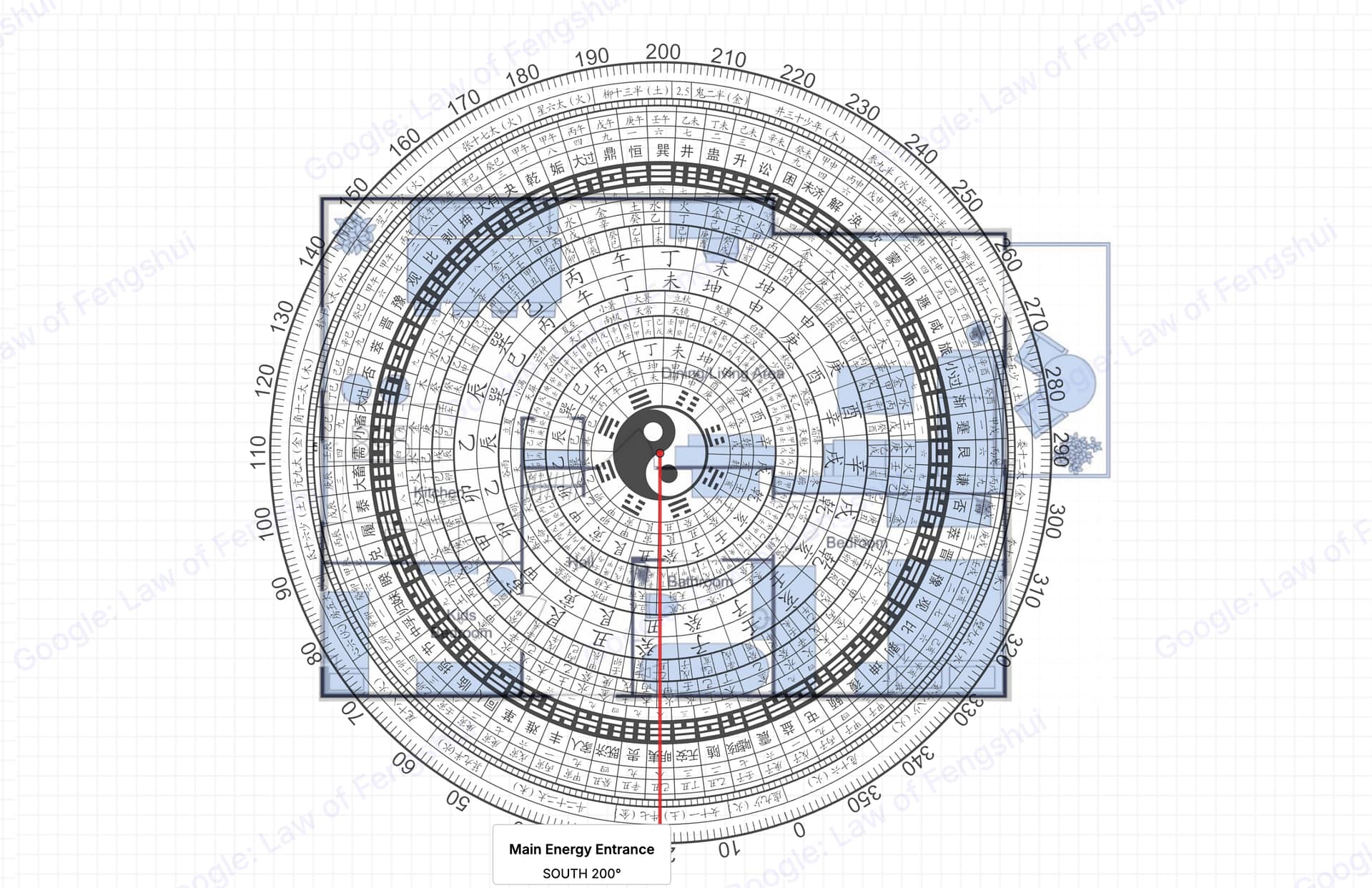
We ran this analysis on a Portland, OR property using the Law of Fengshui Entrance Optimizer. (2026 is a Fire Horse year, a cycle with high fire energy where grounding the home’s primary entry point carries particular classical significance.) The result was a 56-point score swing from an 8-degree rotation — both directions pointing WNW. Same front door. Same trees. Same road junction. Different compass sector on the 24 Mountains wheel.
In classical feng shui, the main door is called the “water mouth” (水口) — the primary opening through which qi enters the home. This framing is crucial. Front doors aren’t just an entry point for people. They’re the point where the building’s relationship with its surrounding environment becomes active.
Every classical system that evaluates front door direction does so from this premise: the direction front doors face determines which parts of the surrounding environment are “incoming” (facing the door, carrying their energy toward it) and which parts are “sitting” (behind the building, providing backing). Same trees, same roads, same elevation features — but their energetic meaning changes completely depending on where the front doors point.
This is also why the sitting direction (the compass direction behind the building, opposite the facing) matters as much as the facing direction. The sitting direction determines which sector is forbidden under Ba Sha Huang Quan, which element governs the house type, and which mountain star readings apply to objects in the sitting position. Front door facing and sitting direction are two sides of the same compass calculation. You don’t evaluate one without the other.
Mountain Nine Star evaluates tall objects — trees, elevated terrain, buildings — at compass bearings around the property. Each object gets assigned one of nine stars depending on which 24 Mountains sector it falls in relative to the front door’s facing direction. Auspicious stars include 武曲 (Military, linked to authority and wealth), 辅弼 (Assistant, promotion and support), 贪狼 (Greedy Wolf, vitality), 巨门 (Giant Gate, good fortune), and 天辅 (Heaven’s Aid). Inauspicious stars include 廉贞 (Fire/Integrity, legal troubles and inflammatory illness) and 破军 (Breaker, sudden calamity and accidents).
Tall trees close to front doors are among the most significant objects in this analysis. Their star rating from the facing direction has direct implications for the residents’ health, career prospects, and stability.
Water Nine Star evaluates water features and roads (which count as “virtual water” in classical feng shui) at compass bearings around the property. Incoming water — water flowing toward front doors — is evaluated against nine stars. 巨门 (Giant Gate) incoming is the most auspicious: good fortune, health, and prosperity both flowing in. 文曲 (Literature star) incoming is inauspicious. The direction front doors face determines which water star governs each road and water feature near the property.
Ba Sha Huang Quan is the Yellow Spring taboo, one of the priority-one checks in classical feng shui. For each sitting direction (determined by where front doors face), one specific 24 Mountains sector is absolutely forbidden for water flow, roads, and main door openings. The classical mnemonic verse encodes eight forbidden pairings — one for each trigram direction. The mechanism is Five Elements restraint: the forbidden sector’s element restrains the sitting direction’s governing element.
When a tree, road, or water feature sits in this forbidden sector, or when front doors open toward this sector, the texts describe rapid and direct effects: financial leakage, unexpected illness, legal friction. This is why Ba Sha Huang Quan is checked before almost any other system in a classical feng shui assessment of front doors.
Jie Sha identifies robbery star sectors — specific 24 Mountains positions where active objects (moving water, busy roads, traffic junctions) create a drain on the property’s energy. A road junction in a Jie Sha sector is a more significant concern than a stationary object in the same position. Like Ba Sha Huang Quan, the Jie Sha sectors shift when the sitting direction changes.
Yin-Yang Spousal Pairing evaluates whether the yin/yang type of the incoming water features and roads matches the yin/yang type of the entrance. A proper match creates harmony. A mismatch creates what the classical texts call “water spousal discord” — energy dissonance between what flows toward the front door and the door itself.
Different schools of feng shui handle the front door direction question differently. In non-compass schools, the front door is the fixed reference point and sectors are mapped inward regardless of compass bearing. In the classical compass school of feng shui, compass bearing is everything — and that’s the framework the five-system Entrance Optimizer uses.
Kua number (the personal trigram from Ba Zhai / Eight Mansions, calculated from birth year and gender) gives you a personal lucky direction. If your Kua number is 4 (Xun), your auspicious directions include Southeast and South. This is a real classical system, and it applies well to questions like bed orientation, desk placement, and which sectors of the home to prioritize for sleep or work.
But Kua number as a front door facing answer has a significant limitation: it treats the door as an isolated variable and ignores the surrounding environment entirely. It can’t tell you whether facing your personal lucky direction Southeast creates a Ba Sha Huang Quan violation for your specific sitting mountain. It can’t tell you what Mountain stars the trees in your yard carry relative to a Southeast-facing door. It can’t tell you whether the road that approaches from the Southeast is in an auspicious or inauspicious water star sector from that same facing direction.
A property where the Kua-favorable direction also happens to be clean on Ba Sha Huang Quan, carries auspicious Mountain stars on surrounding trees, and has good water star readings on nearby roads would be an excellent confirmation. But when those systems diverge, the property-level environmental checks — Mountain Nine Star, Water Nine Star, Ba Sha Huang Quan, and Jie Sha — carry significant weight. Front doors connect the building to its environment. The environment has to be part of the calculation.

The property used for this case study is a residential home in Portland, Oregon. Portland sits in a natural bowl between the West Hills to the west and the Willamette River to the east — a distinctive terrain profile with elevated terrain, forested slopes, and a major water feature within close range.
We mapped 4 surrounding objects: three tall trees (two near the front of the property, one from a neighbor’s yard) and one road junction (a traffic joining point visible on the approach to the property). We then ran the Entrance Optimizer with all five systems active.
Starting direction: 286° WNW — facing 辛 xīn (Metal-West)
At this facing direction, the sitting mountain is 乙 yǐ (Wood-East), giving a 乙辛 configuration with Na Jia Li trigram group 坤 (Kun).
Mountain Nine Star (all inauspicious):
Zero auspicious mountain readings out of three tall objects analyzed.
Water Nine Star (one auspicious):
Ba Sha Huang Quan:
Jie Sha:
Overall score: 6/100 Poor. Category breakdown: Financial -100, Love -55, Family -100, Health -100, Career -85.
Two violations on a single tree, three inauspicious mountain star readings, scores deep in negative territory across all five life categories. The only positive: the road junction incoming from a Giant Gate water star — which would reverse at the optimized direction.

Optimized direction: 294° WNW — facing 戌 xū (Earth-Northwest)
At 294°, the sitting mountain shifts to 辰 chén (Earth-Southeast), giving a 辰戌 configuration with Na Jia Li trigram group 坎 (Kan).
Mountain Nine Star (all auspicious):
Three auspicious mountain readings out of three. The same trees, now carrying completely different star assignments.
Water Nine Star (one inauspicious):
The road junction that was Giant Gate at 286° became Literature star at 294°. This is the trade-off the optimizer surfaced.
Ba Sha Huang Quan:
Jie Sha:
Overall score: 62/100 Good. Category breakdown: Financial +45, Career +31, Family +20, Love +10, Health +10.
The difference between 辛 xīn (Metal-West, which occupies roughly 277.5–292.5° on the 24 Mountains wheel) and 戌 xū (Earth-Northwest, approximately 292.5–307.5°) is a single sector boundary. Both sit in the WNW region of the compass. To most people, both would feel like “facing roughly west-northwest.”
But in classical feng shui, the sector matters more than the general direction. The sitting mountain determines which compass sector is forbidden under Ba Sha Huang Quan. At facing 辛 (sitting 乙, Wood-East), the Ba Sha forbidden sector is 申 (Shen). The tall tree to the left happened to sit in that sector. At facing 戌 (sitting 辰, Earth-Southeast), the Ba Sha configuration changes entirely, and the same tree no longer lands in the forbidden sector.
This is the precision argument for using 24 Mountains divisions rather than just 8 cardinal directions in front door analysis. An 8-direction check would put both 286° and 294° in the same “West” or “WNW” bucket. The 24 Mountains distinguishes them. That’s the difference between a Ba Sha violation and clean clearance. Between 6/100 and 62/100.
The Mountain star flip is explained by the same principle. The three trees sit in fixed compass positions around the property. Their bearing from the door (and therefore their sector assignment in Mountain Nine Star) shifts with every degree of door rotation. At 286°, those bearings placed the trees in 廉贞 and 破军 sectors. At 294°, the same bearings placed them in 武曲 and 辅弼 sectors. Same landscape, completely different energetic reading.
The Water Nine Star result is worth examining directly. At 286°, the road junction incoming from the south was 巨门 (Giant Gate) — the most auspicious water star for incoming water, linked to health, wealth, and family prosperity. At 294°, the same junction registered as 文曲 (Literature star) incoming — inauspicious, with a warning for difficult family dynamics.
This is a real trade-off, not a rounding error. The optimized direction has a less favorable water reading than the original direction. So why does 62/100 beat 6/100? Because Mountain Nine Star violations and Ba Sha Huang Quan violations carry greater weight in the combined score than a Water Nine Star rating on a single road junction. Three inauspicious mountain stars plus two taboo violations outweigh the benefit of one good water star reading.
The Entrance Optimizer finds the facing direction where the combined score across all five systems is highest — not where each individual system is perfect. In practice, a direction where three auspicious mountain stars cover the surrounding trees and both taboo systems show clean clearance will typically outscore a direction with one auspicious water reading and three inauspicious mountain stars, even if the water trade-off feels counterintuitive.
This is also why the bad feng shui front door checks — Ba Sha Huang Quan and Jie Sha specifically — are evaluated alongside the positive star systems rather than separately. A high Mountain Nine Star score with a Ba Sha violation is not simply “good minus one thing.” The violation changes the calculation significantly.
The most direct solution is reorienting front doors to the optimal compass bearing. This doesn’t necessarily mean rebuilding the entire entry — even a few degrees of reorientation in the door frame can shift which 24 Mountains sector the door occupies if the current facing is near a sector boundary, as in the Portland case.
Knowing which system is driving the low score still matters. If the issue is a Ba Sha Huang Quan violation, a qi-redirecting screen or vestibule between the front door and the main interior space can modify what the energy encounters before reaching living areas. Curved pathways leading to front doors soften directional energy from an inauspicious sector. And if the current facing direction is near a 24 Mountains sector boundary, a minor physical reorientation of the door frame may be enough to shift sectors entirely — 8 degrees was all it took in the Portland case.
Don’t add water features, fountains, or aquariums near front doors without running the Water Nine Star check first. Water in an inauspicious water star sector near front doors amplifies the inauspicious quality. The instinct to “activate” front doors with water is sound classical feng shui — but it requires checking which water star sector applies to the door’s facing direction first.
The best direction for front doors in feng shui is the facing bearing that produces the highest combined score across Mountain Nine Star, Water Nine Star, Ba Sha Huang Quan, Jie Sha, and Yin-Yang Spousal Pairing — all five systems analyzed for the specific property. This isn’t a universal answer. Different properties have different surrounding landscapes, different tree placements, different road approaches. The optimal facing direction for front doors in a Portland property with forested terrain to the west may be different from the best direction for front doors in a San Diego property near the coast. Run the analysis for the specific address.
Yes — the Ba Sha Huang Quan forbidden sector for your property’s sitting direction. For a property sitting East (乙 yǐ), the forbidden sector is 申 (Shen, west-southwest). Front doors opening toward this sector, or roads and water approaching from this sector, trigger a Yellow Spring violation. This is considered one of the highest-priority bad feng shui conditions for main doors. The forbidden sector changes with every change in sitting direction — it’s property-specific, not universal.
Yes, significantly. A house where front doors face north (facing 子 Zi direction, sitting south) has a completely different sitting mountain than a house where front doors face south, face east, or face west — and therefore a completely different Mountain Nine Star reading for surrounding trees, a different Ba Sha forbidden sector, and different water star assignments for nearby roads. Front doors facing south and front doors facing north are not equivalent alternatives with slightly different character. They produce different five-element configurations for every system in the analysis.
That depends entirely on your specific property’s surrounding landscape. Front doors facing east (roughly 60–90° on the compass) sit in one of several 24 Mountains sectors (甲 Jia, 卯 Mao, or 乙 Yi depending on exact bearing). Which mountain stars apply to the trees near east-facing front doors depends on which sector those trees fall in relative to the door. Whether a Ba Sha violation exists depends on the sitting mountain’s governing element. Good feng shui for front doors facing east requires running the full five-system analysis on your specific property, not a generic “east facing is favorable” rule.
Front doors facing west fall in one of three 24 Mountains sectors depending on exact bearing: 庚 Geng (roughly 255–270°), 酉 You (270–285°), or 辛 Xin (285–300°). In the Portland case study, front doors at 286° faced 辛 xīn (Metal-West, just into the 辛 sector) and scored 6/100 Poor. At 294° (facing 戌 xū, which is actually Northwest, not West) they scored 62/100 Good. West-facing front doors aren’t inherently good or bad — the 24 Mountains sector within the western range, plus the specific landscape around the property, determines the result.
The bad feng shui front door check is a priority-one assessment because the door’s Ba Sha and Jie Sha status affects how energy enters the home before any interior system applies. A positive feng shui ba gua map sector or auspicious feng shui commanding position for the main sofa won’t counteract energy that enters through a Ba Sha-violated front door. Classical practitioners address exterior door violations before interior placements. The feng shui compass analysis for the surrounding environment is the foundation layer.
Door color is a Five Elements activation tool in feng shui — a Metal-element facing direction (like 辛 xīn) can be supported with white, gold, or metallic door colors. But door color doesn’t address a Ba Sha violation or inauspicious Mountain star readings. If the surrounding trees near your front doors carry 破军 (Breaker) star at your current facing direction, painting the door a different color doesn’t change the compass sector those trees occupy relative to the door. Color supports the element quality of a direction; it doesn’t change what the direction is.
Yes — Law of Fengshui offers a feng shui consultation service where a practitioner runs the full five-system analysis and delivers recommendations specific to your property’s address and entrance placement.
In classical feng shui, the facing direction of front doors (which compass bearing they point toward) matters more than whether the door opens inward or outward. The compass sector determines Mountain Nine Star readings, Ba Sha Huang Quan status, and water star assignments for every object near the entrance. That said, doors that open inward are generally preferred in classical form school feng shui because inward-opening doors pull energy into the home rather than deflecting it outward when entering. This is a form school consideration; it operates separately from the five-system compass analysis.
If renovation isn’t possible, practical approaches include: a qi-redirecting vestibule or screen between the external front door and the main interior space, curved pathways leading to front doors to soften incoming directional energy from an inauspicious sector, and addressing Ba Sha violations through screening or planting around the offending object. These won’t change the compass sector the front doors face, but they modify what the energy encounters before reaching the main living areas. If the facing direction is near a 24 Mountains sector boundary, a minor reorientation of the door frame may shift sectors entirely.
Door color in feng shui is a Five Elements activation tool applied to the facing direction. Metal-element facing directions (辛 xīn, 庚 Gēng, 酉 Yǒu — roughly west-facing) are supported by white, silver, or metallic door colors. Wood-element directions (甲 Jiǎ, 卯 Mǎo, 乙 Yǐ — roughly east-facing) by green. Fire-element directions (丙 Bǐng, 午 Wǔ, 丁 Dīng — roughly south-facing) by red. Earth-element directions (辰 Chén, 戌 Xū — northwest/southeast) by earth tones. Water-element directions (壬 Rén, 子 Zǐ, 癸 Guǐ — roughly north-facing) by dark blue or black. Note: door color activates the element quality of the direction. It doesn’t address Ba Sha violations or inauspicious Mountain star readings near front doors. Run the five-system analysis first; apply door color after the direction is confirmed clean.