Address
304 North Cardinal St.
Dorchester Center, MA 02124
Work Hours
Monday to Friday: 7AM - 7PM
Weekend: 10AM - 5PM
Address
304 North Cardinal St.
Dorchester Center, MA 02124
Work Hours
Monday to Friday: 7AM - 7PM
Weekend: 10AM - 5PM

Your architect optimized the floor plan for building codes, natural light, and traffic flow. Maybe they even checked the view from the primary bedroom or the morning sun angle in the kitchen. Good stuff. All legitimate design considerations.
But there’s one check most architects never run: which compass sector does the front door sit in?
If you search “feng shui front door,” you’ll find advice about painting your door red, clearing the entryway, and hanging wind chimes. Those tips aren’t wrong. But they skip the structural question underneath. In classical feng shui, the front door is the “mouth of chi” (氣口) – the primary point where energy enters the building. And the compass sector it sits in matters far more than the color you paint it.
The Eight Mansions (八宅) Nine Star system rates every direction around a building as favorable or unfavorable for exterior openings. Based entirely on the building’s sitting direction.
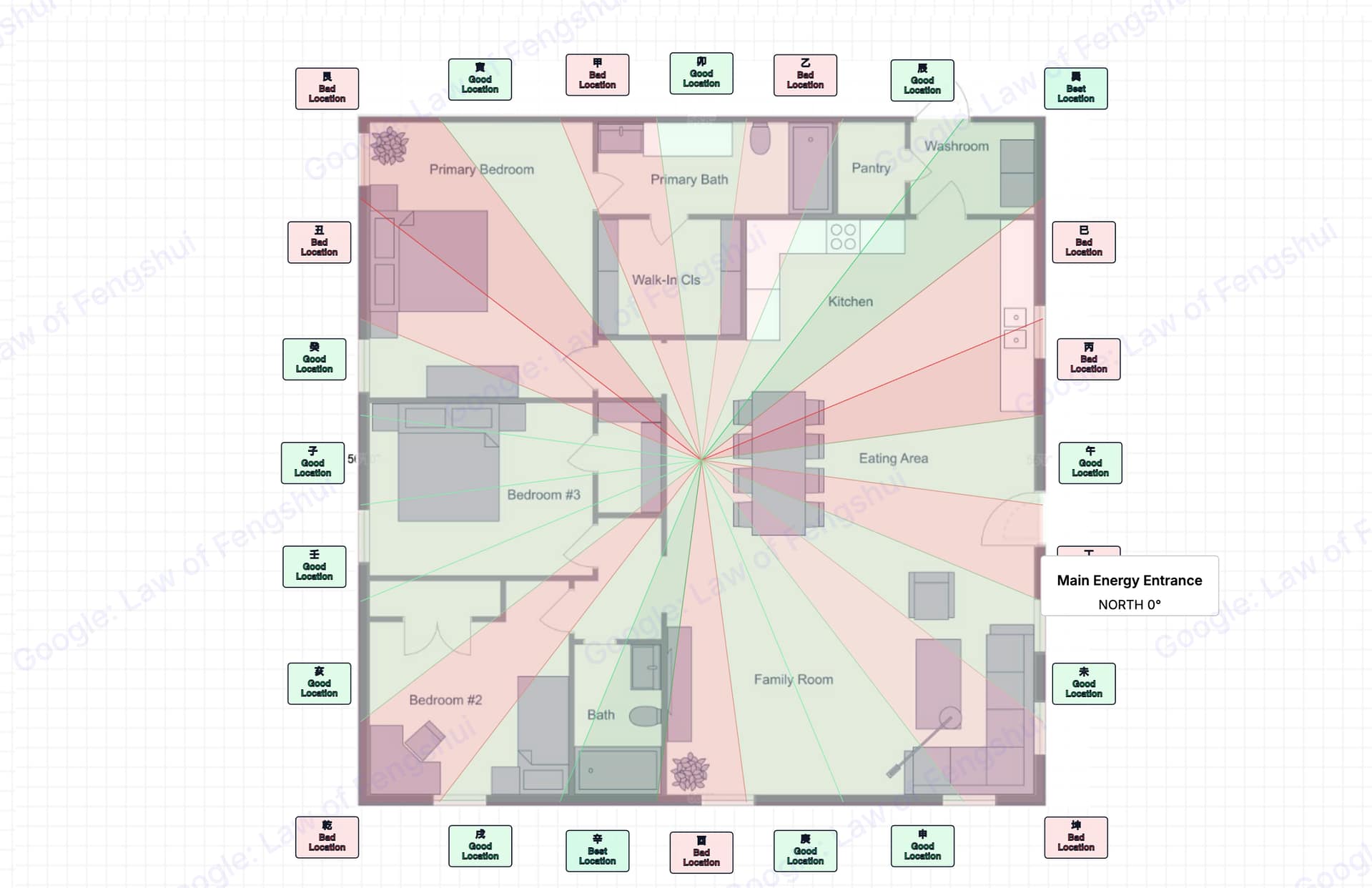
I ran this analysis on a south-facing 3BR barndominium (~1,600 sq ft) sitting North. The overlay mapped eight stars across the compass, and the front door’s sector determines whether the main entrance invites prosperity or admits loss.
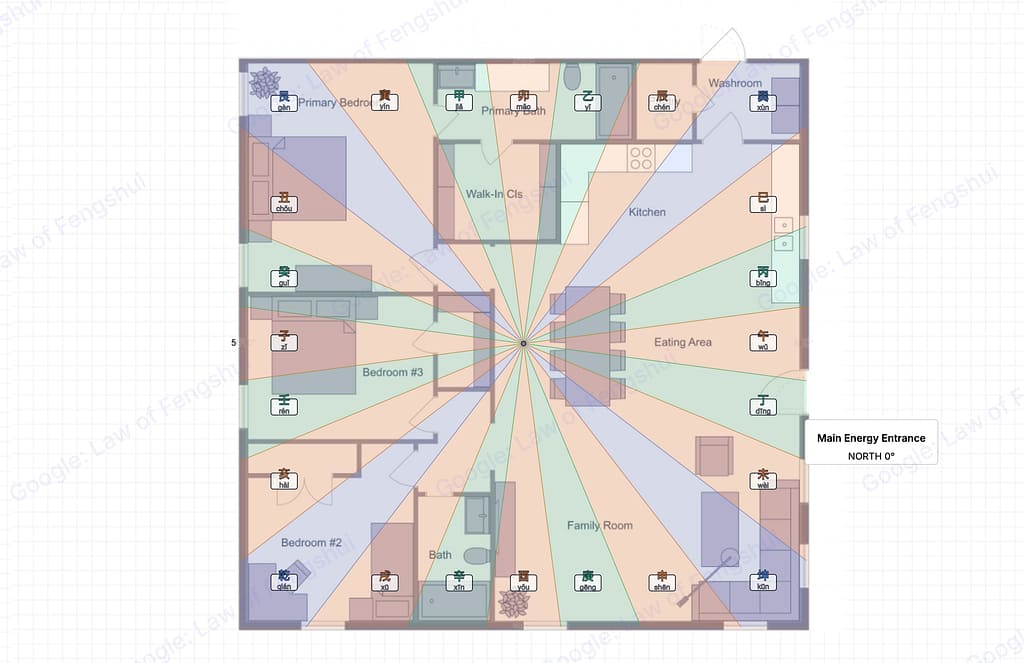
The “mouth of chi” (氣口) is the classical feng shui term for the primary opening where energy enters a building. In most residential properties, the mouth of chi is the front door. It’s called a “mouth” because it functions like a building’s intake – drawing in directional energy from whatever compass sector it faces, and distributing that energy through the interior.
Every exterior opening on a building’s perimeter wall is a qi mouth: the front door, back door, side entries, and windows. But the front door is the primary qi mouth because it handles the most traffic. More usage means more energy throughput. A front door that gets used daily moves significantly more directional energy than a guest room window that’s rarely opened.
This is why feng shui door placement starts with the front door. It’s the opening that carries the most weight. And the Eight Mansions system provides a way to evaluate exactly what quality of energy that front door is admitting based on its compass sector.
The feng shui front door is more than a design element. In classical practice, it’s the building’s primary qi mouth – the opening with the highest traffic and the largest energy throughput. Every time someone walks through the front door, they carry directional energy from that compass sector into the building.
The Eight Mansions system assigns one of eight stars to each compass direction based on the building’s sitting position. Four stars are favorable for exterior openings. Four are unfavorable. The star your front door sits in determines the quality of energy entering the building through its most important opening.
This isn’t the simplified version where someone tells you to paint your door red and hang wind chimes. This is a compass-level structural analysis. The kind that happens during the design phase, not after move-in.
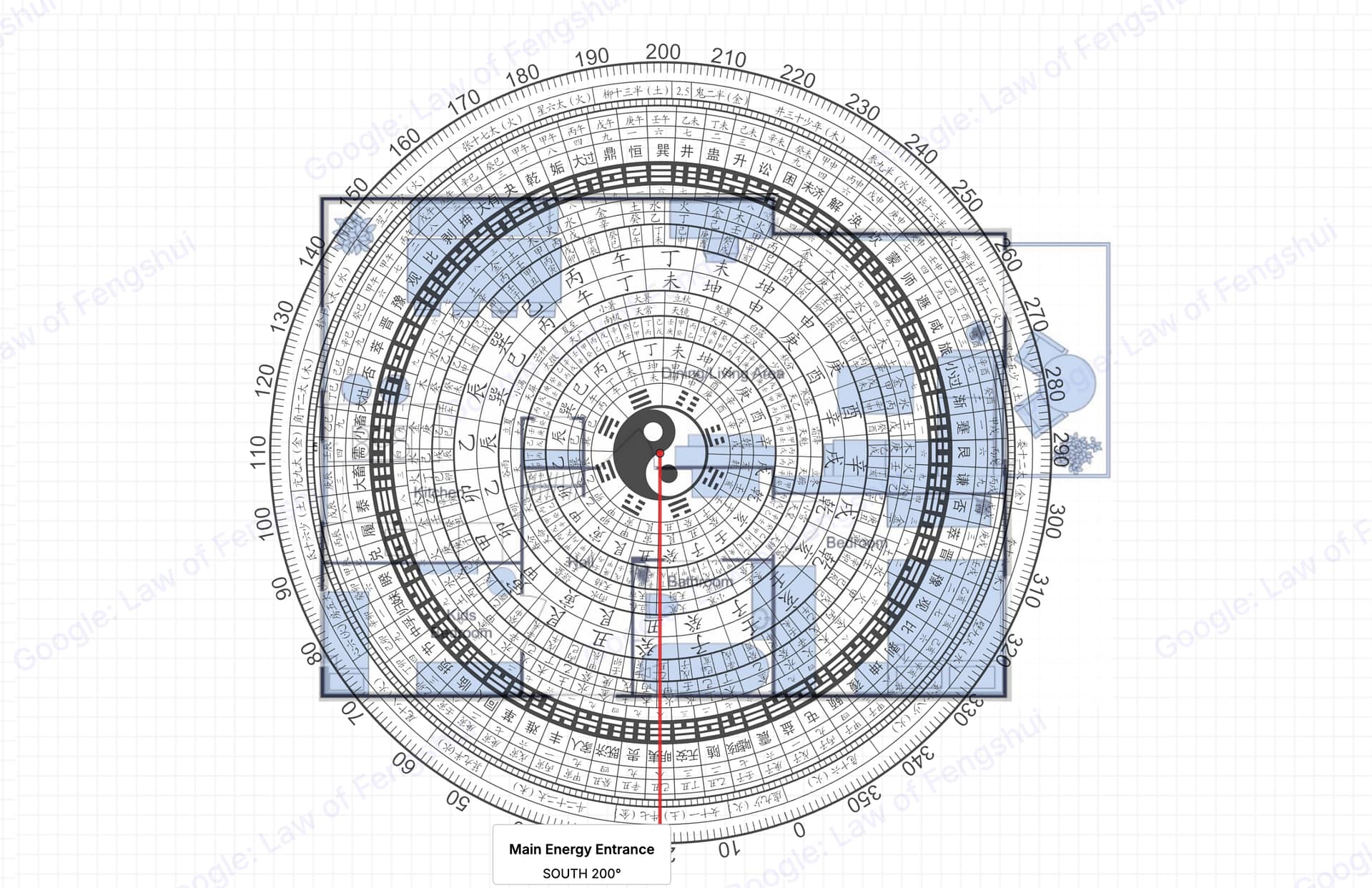
The Eight Mansions (八宅) system, also called Ba Zhai, divides the compass into eight zones based on the building’s sitting direction. Each zone receives one of eight stars. For a Kan (坎) house sitting North, facing South, the stars map like this:
Sheng Qi 生氣 (Supreme Auspicious) Wealth, vitality, career success, upward mobility. This is the “Best Location” for your feng shui front door. A main entrance in the Sheng Qi sector receives energy that supports financial growth and personal advancement. In the Door & Window Placement Guide, this sector shows bright green.
Yan Nian 延年 (Major Auspicious) Relationships, longevity, marriage harmony, stable partnerships. A “Good Location” for doors and large windows. Energy entering through Yan Nian supports lasting relationships and social connections.
Tian Yi 天醫 (Medium Auspicious) Health, healing, recovery, medical support. Another favorable sector for openings. Especially relevant for bedrooms or areas where recuperation happens. Energy from this direction supports physical wellbeing.
Fu Wei 伏位 (Neutral/Mildly Positive) Stability, calm, no major change. The mildest of the favorable group. A door here won’t generate dramatic prosperity, but it won’t cause harm either. Steady, reliable energy.
Huo Hai 禍害 (Minor Inauspicious) Small mishaps, annoyances, minor setbacks. The least harmful of the negative stars. A door here creates friction but nothing severe. Think constant small repairs and minor disputes.
Liu Sha 六煞 (Medium Inauspicious) Backstabbing, affair energy, relationship breakdown, scandals. Doors and windows in this sector can invite interpersonal conflicts and trust issues. Not ideal for a feng shui front door that the whole household uses daily.
Wu Gui 五鬼 (Major Inauspicious) Fire hazards, lawsuits, paranormal disturbance, major disputes. One of the two most dangerous stars for an exterior opening. Energy entering through Wu Gui carries aggressive, destructive qualities.
Jue Ming 絕命 (Supreme Inauspicious) Total loss, severe illness, financial ruin, accidents. The worst possible sector for your feng shui front door. Energy entering through Jue Ming is associated with catastrophic outcomes. This is the sector most practitioners flag immediately when assessing a floor plan.
Property details:
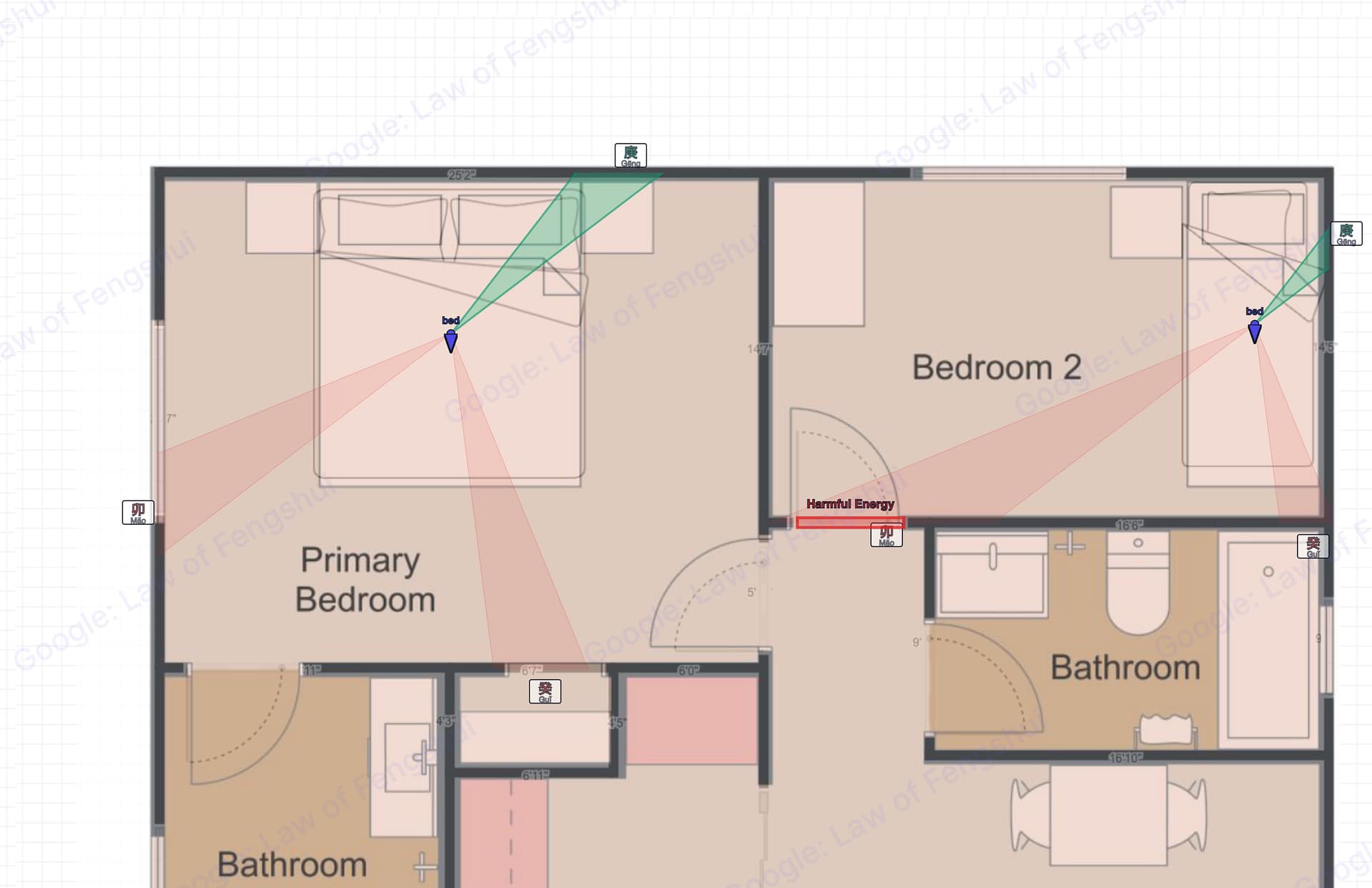
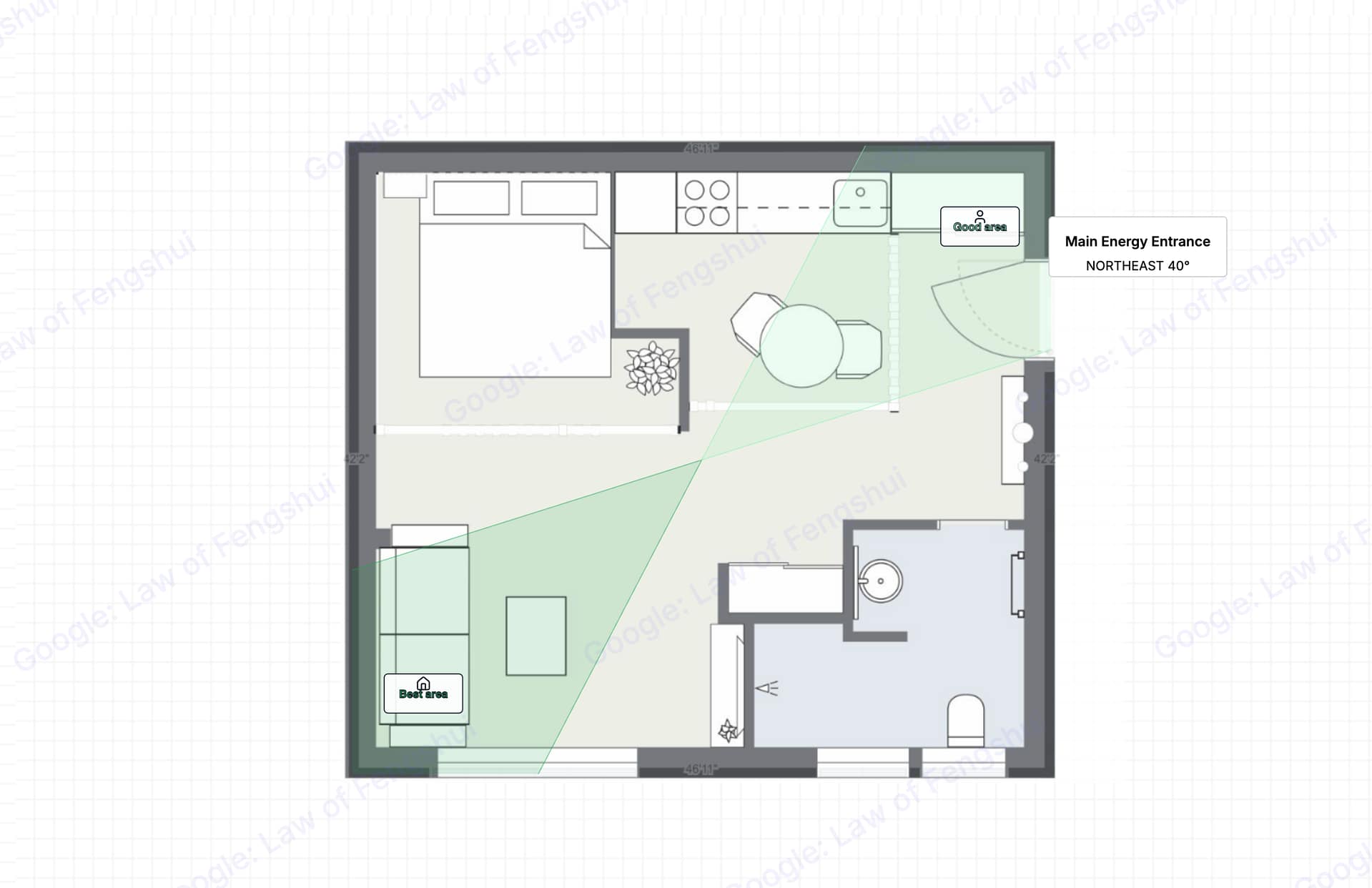
The Door & Window Placement Guide mapped all eight stars around the building’s outer perimeter walls. Green zones appeared along wall segments where the auspicious stars (Sheng Qi, Yan Nian, Tian Yi) govern. Red zones marked where inauspicious stars (Wu Gui, Jue Ming, Liu Sha) sit.
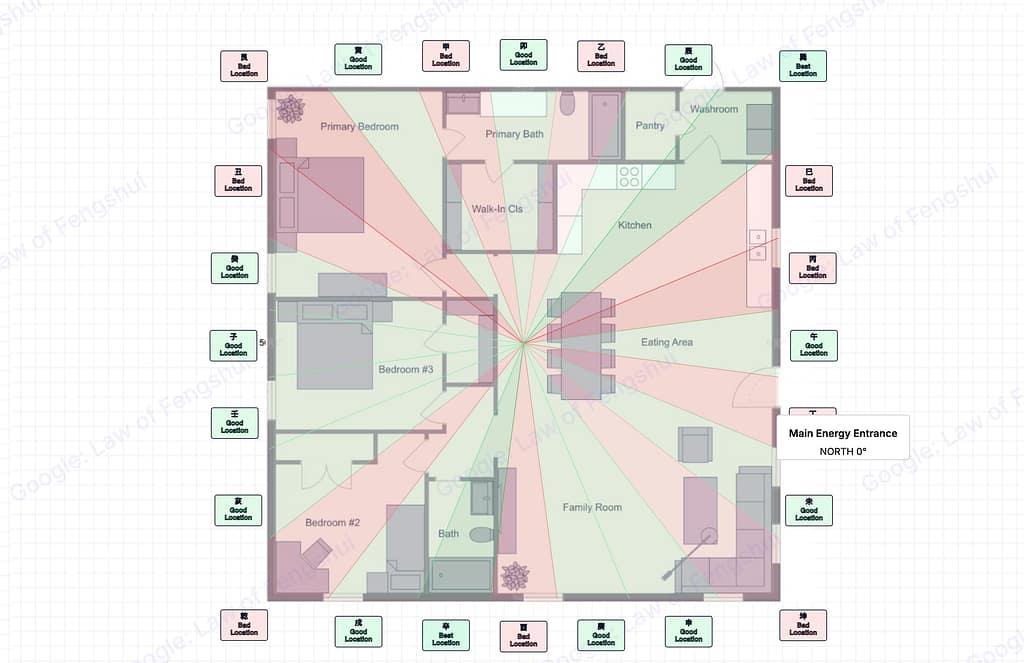
The front door, positioned at the bottom-center of the floor plan on the south wall, landed in the Sheng Qi sector. That’s the best possible placement. The “Best Location” marker confirms it. Energy entering through this door carries the supreme auspicious star’s qualities: wealth, vitality, career growth.
But here’s where it gets practical. The south wall spans multiple compass sectors. Move that front door a few feet to the left or right along the same wall, and it can cross a sector boundary into an adjacent star. The wall is the same. The door is the same. The star assignment changes because the compass bearing shifts.
Want to see how doors and windows score on a real floor plan?
Our sample report checks every door and window against Ba Sha Huang Quan and the 24 Mountains to flag problematic placements.
“Is a south-facing front door good feng shui?” is one of the most common questions people ask. The short answer: it depends on the building’s sitting direction, not the facing direction alone.
For this barndominium, the front door faces South. The building sits North, making it a Kan (坎) house. Under the Eight Mansions star map for a Kan house, certain southern compass sectors receive auspicious stars while adjacent sectors receive inauspicious ones. The front door happened to land in the Sheng Qi sector along the south wall – supreme auspicious. But a different south-facing house with a different sitting direction would get a completely different star assignment for the same door position.
The common advice “south-facing doors are good for fame and recognition” comes from simplified Ba Gua mapping, where South corresponds to the Fame/Recognition sector. That’s a generalization. The Eight Mansions system adds the building’s sitting direction as a variable, which means two south-facing front doors on two different buildings can receive opposite ratings. One gets Sheng Qi (wealth). The other might get Jue Ming (total loss). Same direction. Different sitting. Different star.
If your feng shui front door faces south, run the Eight Mansions check to find out which star actually governs your specific sector. The direction alone doesn’t tell you enough.
A common question: what about interior doors? The bedroom door, the bathroom door, the door between the kitchen and the hallway?
Interior doors don’t carry the same compass weight. The Eight Mansions star assignment applies to openings on the outer perimeter walls – the doors and windows that connect the building’s interior to the external environment. These are the qi mouths. They’re the points where directional energy from outside crosses the building envelope.
An interior door between two rooms is moving energy that’s already inside the building. It’s not receiving new directional energy from a compass sector. The front door, back door, side door, and perimeter windows are the openings that matter for this analysis.
This is a critical distinction for architects and developers reviewing a floor plan. You don’t need to worry about which star governs the hallway door between the master bedroom and the ensuite bath. But you absolutely need to check which star governs the sliding glass door on the east wall of the family room, because that’s an exterior opening receiving directional energy.
The entire Eight Mansions star assignment flows from one input: the building’s sitting direction. Change the sitting direction and every star moves.
For this south-facing barndominium, sitting North makes it a Kan (坎) house. The Kan trigram belongs to the East Life group. The star map that results places Sheng Qi in a specific compass sector, Jue Ming in another, and so on for all eight stars.
If the same floor plan faced East instead of South, it would be a different trigram house. The sitting direction would shift to West, making it a Dui (兌) house. The entire star map would change. The wall segment that was Sheng Qi under Kan could become Wu Gui under Dui. Same wall. Same door position. Completely different energy rating.
This is why feng shui architecture starts with measuring the sitting direction precisely. A few degrees of error can shift the trigram classification and rearrange the entire star map. The 24 Mountains system divides the compass into 24 fifteen-degree sectors for exactly this reason – precision matters at this level of analysis.
“Feng shui front door color” is one of the most searched topics in feng shui. And yes, door color has classical associations – red for fire element energy, black for water, green for wood, white for metal. These aren’t wrong. Element theory is real.
But door color is a surface-level adjustment. It’s like adding a coat of paint to a house with a cracked foundation. The color of your feng shui front door doesn’t change which compass star sector it sits in. A red door in a Jue Ming sector is still a door in a Jue Ming sector. The color might add a mild element influence, but it doesn’t override the directional energy flowing through that opening every time it’s used.
The priority sequence matters: position first, then color. Get the front door into a Sheng Qi, Yan Nian, or Tian Yi sector. Then consider which element color supports or balances that sector’s energy. Color is the fine-tuning step, not the foundation.
If you’ve already built the house and the front door is in an unfavorable sector, color adjustments and remedies are the next best option. But for architects and developers still in the design phase, moving the door position along the wall to reach a favorable sector is a far more effective intervention than any post-construction remedy.
Curious if your front door direction passes the classical compass check?
Our sample report runs the full entrance audit on a real property and shows which directions are flagged by the Yellow Spring system.
Another common search: should you place a feng shui mirror facing the front door? Classical practice has specific rules about this.
If the front door sits in a favorable sector (Sheng Qi, Yan Nian, Tian Yi), placing a mirror directly facing it can deflect the incoming positive energy before it circulates through the house. In this case, avoid a mirror facing the door. You want that energy to enter and spread.
If the front door sits in an unfavorable sector (Wu Gui, Jue Ming, Liu Sha), some practitioners use a mirror facing the door as a deflection remedy. The theory: the mirror bounces some of the negative directional energy back before it enters the building’s interior. This is a secondary measure, not as effective as repositioning the door, but useful when the structure is already built.
Feng shui mirrors in general follow the rule of intentional placement. A mirror in the commanding position of a room (where you can see the door from your seat) serves a different function than a mirror facing the front entrance. Context determines the effect.
For architects and developers incorporating feng shui room design principles during the design phase:
In 2026, the Year of the Fire Horse, compass-level assessments are drawing more attention from both practitioners and homeowners. Annual feng shui adjustments layer on top of the permanent Eight Mansions star map. Some sectors carry additional annual significance that makes door placement even more impactful.
For properties being designed or renovated in 2026, running the door and window placement check before finalizing the floor plan is worth the time. The Eight Mansions system is permanent – it doesn’t change year to year. But annual stars can amplify or reduce the effect of a door’s sector assignment, making some years better or worse for openings in specific directions.
Before finalizing door and window positions on a floor plan, run the Eight Mansions star map. It takes seconds. If your feng shui front door falls in a Jue Ming or Wu Gui sector, consider shifting it along the wall. Even a small repositioning can cross a sector boundary and change the star assignment.
For windows, the same logic applies: a bedroom window in a Tian Yi sector receives health-supporting energy. A bedroom window in a Liu Sha sector admits relationship-disrupting energy. Same room, same window size, different compass sector, different classical assessment.
This doesn’t replace structural requirements, building codes, or architectural best practices. It adds a compass-level optimization layer that most architects never check. And for the feng shui front door – the single most important opening in any building – getting the compass sector right is the foundation of everything else in classical feng shui house design.
Curious what 15+ classical feng shui systems reveal about a real home?
Our sample report shows every overlay on an actual floor plan so you can see the difference between classical analysis and generic advice.
What direction should a feng shui front door face? There’s no single “best” direction for all buildings. The optimal front door direction depends on the building’s sitting position, which determines the Eight Mansions star map. For a Kan house (sitting North), the Sheng Qi sector is the best direction for the front door. For a different house type, Sheng Qi falls in a different compass direction.
Does feng shui front door color affect energy? Door color adds an element influence (red = fire, black = water, green = wood) but doesn’t override the compass sector rating. A front door in a favorable sector benefits from a color that supports that sector’s element. A front door in an unfavorable sector isn’t fixed by changing the color alone.
Should I put a mirror facing my front door? It depends on the door’s compass sector. If the front door sits in a favorable sector, avoid a mirror facing it – you want that positive energy to enter. If the front door is in an unfavorable sector, a mirror facing the door can serve as a deflection remedy, bouncing some negative energy back before it enters.
What is the Eight Mansions (Ba Zhai) system? The Eight Mansions system divides the compass into eight zones based on a building’s sitting direction. Each zone receives one of eight stars ranging from Sheng Qi (supreme auspicious) to Jue Ming (supreme inauspicious). It’s used to evaluate room functions, door placement, and window positions.
Do interior doors matter for feng shui door placement? Interior doors between rooms don’t carry compass weight in the Eight Mansions system. Only doors and windows on the outer perimeter walls function as qi mouths that receive external directional energy. The analysis applies to openings that connect inside to outside.
What is a qi mouth in feng shui? A qi mouth is any opening where energy enters or exits a building. The front door is the primary qi mouth. Back doors, side entries, and windows are secondary qi mouths. Each one receives directional energy from the compass sector it faces.
How do I find which Eight Mansions star my front door sits in? Measure the building’s sitting direction (opposite of facing). Determine the house type (Kan, Li, Zhen, Xun, Qian, Kun, Gen, or Dui). Map the eight stars to the eight compass directions based on that house type. Locate which direction your front door faces – that’s your front door’s star assignment.
Can I change my front door’s star sector after construction? During the design phase, yes – moving the door along the perimeter wall can shift it into an adjacent sector. After construction, repositioning a door is a significant renovation. Post-construction alternatives include using a different entry as the primary qi mouth or applying classical remedies like mirrors and element adjustments.
Does window size affect how much energy enters? Larger windows and sliding glass doors allow more energy throughput than small fixed windows. A floor-to-ceiling window in a Sheng Qi sector receives more positive energy than a small bathroom window in the same sector. Size matters for the volume of energy, but the star rating is the same regardless of window size.
How does the Eight Mansions system differ from flying star feng shui? Eight Mansions assigns permanent stars based on the building’s sitting direction – they don’t change year to year. Flying star (玄空) assigns stars that rotate on annual and monthly cycles. Both systems are valid and complement each other. Eight Mansions is more relevant for permanent structural decisions like door and window placement.
Is a south-facing front door good feng shui? It depends on the building’s sitting direction, not the facing direction alone. A south-facing front door on a Kan house (sitting North) could land in Sheng Qi (supreme auspicious) or an adjacent inauspicious sector depending on the exact compass bearing. The simplified advice “south = good for fame” comes from Ba Gua mapping and doesn’t account for the Eight Mansions star assignment. Run the full star map to know for certain.
Should a feng shui front door open inward or outward? Classical feng shui recommends the front door open inward. An inward-opening door draws energy into the building, while an outward-opening door can push energy away from the entrance. However, the compass sector the door sits in (Eight Mansions star assignment) has a larger impact on energy quality than the swing direction. Get the sector right first, then consider the swing.
What is the mouth of chi in feng shui? The mouth of chi (氣口) is the classical term for a building’s primary energy intake point, which is almost always the front door. Every exterior opening on a perimeter wall is a qi mouth, but the front door handles the most traffic and therefore moves the most directional energy. The compass sector your mouth of chi sits in determines whether the building receives auspicious or inauspicious energy.