Address
304 North Cardinal St.
Dorchester Center, MA 02124
Work Hours
Monday to Friday: 7AM - 7PM
Weekend: 10AM - 5PM
Address
304 North Cardinal St.
Dorchester Center, MA 02124
Work Hours
Monday to Friday: 7AM - 7PM
Weekend: 10AM - 5PM

Every building sits inside a 12-phase feng shui energy flow cycle that mirrors a complete human life: birth, growth, maturity, peak power, decline, illness, death, and rebirth. The Twelve Longevity Cycles (十二長生) map these phases onto the compass in 30-degree sectors. Each room in your home sits in one of these life phases, and the phase determines the energy quality of that space.
I mapped this system onto a west-facing apartment on Naples Island in Long Beach. The result was one of the clearest splits I’ve seen – the apartment divided almost perfectly in half between auspicious life phases and inauspicious ones.
The Twelve Longevity Cycles is a classical feng shui compass system that distributes 12 life-stage energies around a building based on the sitting mountain’s element. It’s one of the deeper feng shui principles used by classical practitioners, related to but distinct from flying star feng shui systems.
The 12 phases, in cycle order:
Auspicious phases:
Usable phases:
Inauspicious phases:
One variable controls the entire distribution: the sitting mountain’s element.
The sitting mountain is the compass direction the back of your building faces. Each sitting mountain belongs to one of five feng shui elements – Fire, Metal, Wood, Water, or Earth. The element determines where the Longevity phase (the cycle’s starting point) begins on the compass:
From the starting point, the remaining 11 phases distribute clockwise in 30-degree increments. Change the element and the whole wheel rotates. Two buildings on the same street facing different directions can have completely opposite phase distributions.
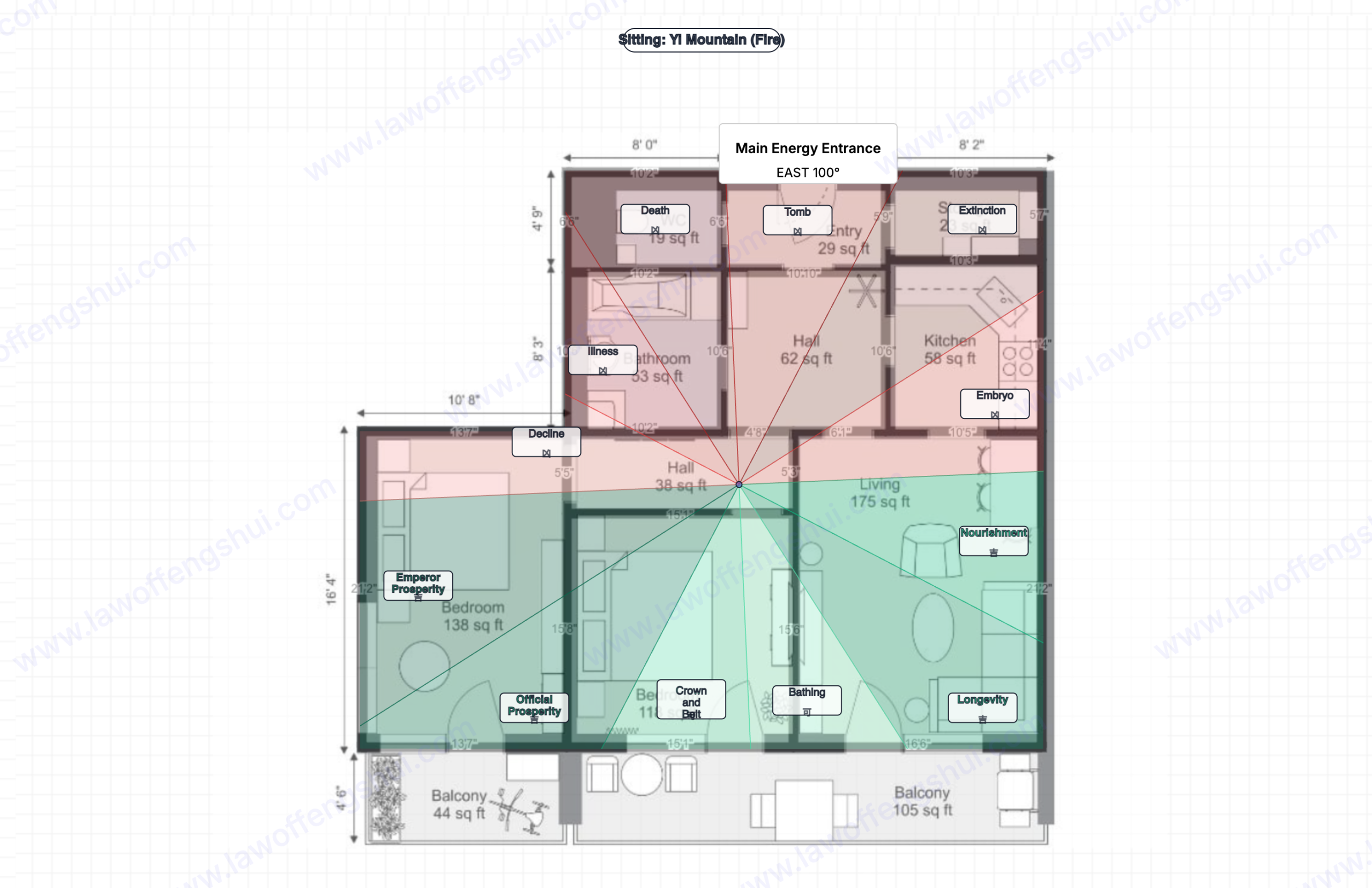
The property is a two-bedroom apartment on Naples Island, Long Beach. West-facing (sitting direction: Yi Mountain 乙山, Fire element). Main Energy Entrance at EAST 100°.
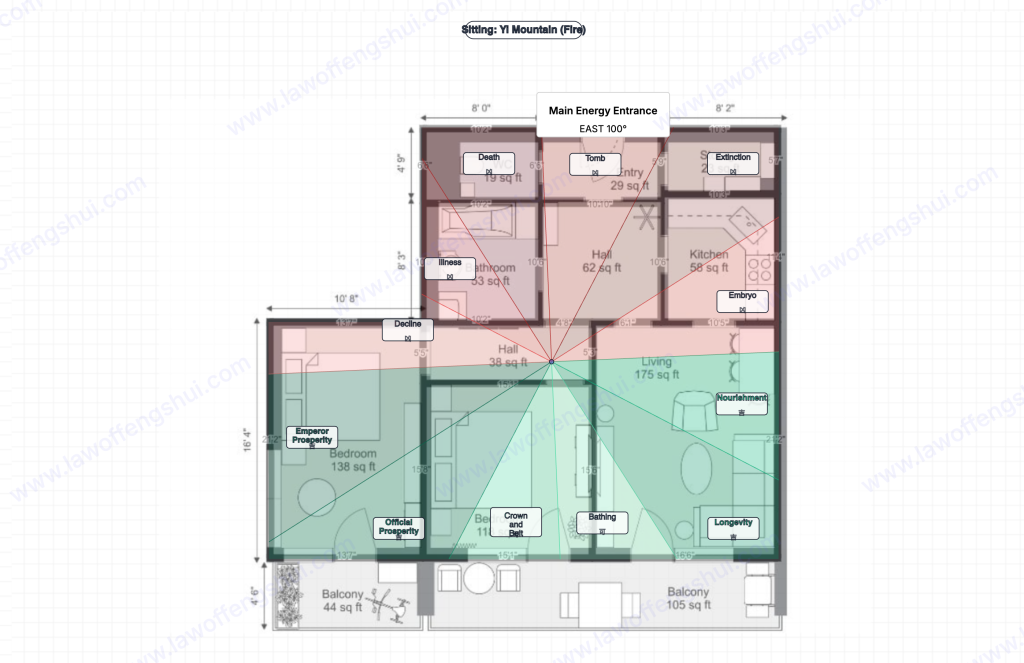
The apartment split almost perfectly in half:
| Room | Phase | Classification | Suitable Use |
|---|---|---|---|
| Bedroom 1 (138 sq ft) | Emperor Prosperity (帝旺) | Auspicious | Living Room, Master’s Office |
| Bedroom 2 (118 sq ft) | Crown and Belt (冠帶) | Usable | Study, Office, Teenager’s Room |
| Living Room (175 sq ft) | Nourishment (養) | Auspicious | Kitchen, Dining, Family Room |
| Balcony 1 (44 sq ft) | Official Prosperity (臨官) | Auspicious | Master Bedroom, Office |
| Balcony 2 (105 sq ft) | Longevity (長生) | Auspicious | Master Bedroom, Study |
| Entry (29 sq ft) | Tomb (墓) | Inauspicious | Storage, Garage only |
| WC (19 sq ft) | Death (死) | Extremely Inauspicious | Warehouse, Basement only |
| Bathroom (53 sq ft) | Illness (病) | Inauspicious | Storage, Utility only |
| Storage (23 sq ft) | Extinction (絕) | Inauspicious | External Storage, Tool Shed |
| Kitchen (58 sq ft) | Embryo (胎) | Inauspicious | Guest Room, Temporary Room |
Emperor Prosperity sounds like the best possible placement for a bedroom. Maximum power, wealth, nobility. But the classical texts carry a specific warning: “Not suitable for long-term residence.” The energy is too intense for sleeping. Emperor Prosperity is ideal for a living room or a home office where you spend active hours, not a room where you need rest and recovery every night.
The second bedroom in Crown and Belt is actually a better match for a teenager or someone using it as a study. Crown and Belt promotes intellectual maturity and academic achievement.
The storage room sits in Extinction (絕) – the phase of severance, where the cycle reaches its lowest point. The classical recommendation? “External storage, tool shed.” That is literally what this room is used for. The builder placed storage in the one sector where storage belongs, without knowing anything about the 12-phase system. This happens more often than you’d expect. Sometimes layouts accidentally align with the energy map.
The main entrance lands in the Tomb sector. Every time you walk into this apartment, the first energy you encounter is burial and closure. Tomb is suitable for “storage room, garage” – not a hallway you walk through daily. This is the kind of finding that explains why some homes feel heavy the moment you step inside. The entry sets the first impression, and in this apartment, that impression is Tomb energy.
The Twelve Longevity system doesn’t just evaluate rooms. It also assesses every water feature near the property using a two-tier hierarchy called the Changsheng Water Method (長生水法).
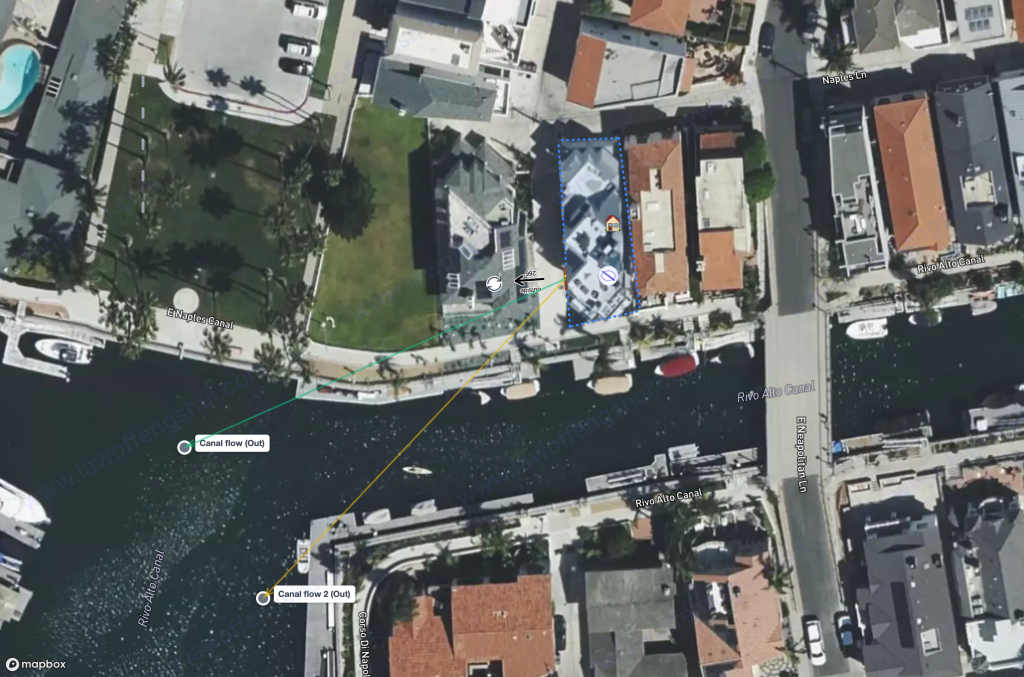
Naples Island is surrounded by canals, making it a natural test for water assessment. Two canal flows were analyzed:
Canal flow 1 (246.1° bearing, Tian Pan position: Shen 申)
Canal flow 2 (223.4° bearing, Tian Pan position: Wei 未)
The water assessment uses the Tian Pan (天盘, Heaven Plate), which is shifted 7.5 degrees from the standard 24 Mountains feng shui compass. This distinction between celestial and terrestrial coordinate systems is specific to water analysis – reflecting the classical principle that water connects heaven and earth.
Both canal flows are outgoing water, and neither is harmful. The Tomb-phase canal is actually beneficial. For a property surrounded by water on multiple sides, this is a relatively favorable result.
2026 is the Year of the Fire Horse (丙午). The dominant elemental energy this year is Fire.
When a building’s sitting mountain is also Fire element – like this Naples Island apartment – the Twelve Longevity distribution carries amplified weight. The annual energy reinforces rather than offsets the building’s permanent phase map. Emperor Prosperity in the bedroom isn’t just auspicious in general. In a Fire-dominant year on a Fire-sitting mountain, that phase intensifies.
Multiple feng shui masters have flagged 2026 as a year of excessive Fire energy. For buildings that already sit on Fire mountains, the practical implication is straightforward: the auspicious phases get stronger, but the inauspicious phases also deepen. That Death sector in the WC? Worse this year. That Tomb energy at the entrance? Heavier. The split in this apartment becomes more pronounced, not less.
This is why timing matters in classical feng shui. The Twelve Longevity Cycles are permanent for the life of the building, but their intensity fluctuates with the annual elemental cycle. A Metal Horse year would moderate a Fire-sitting building. A Fire Horse year amplifies it.
In classical feng shui, energy flow direction is determined by the compass, not by room layout or furniture placement. The sitting mountain sets the orientation, and the Twelve Longevity Cycles distribute 12 energy phases from that fixed starting point. Energy doesn’t “flow” through a house like air through a vent. It’s assigned to sectors based on compass measurement.
The practical answer: energy should flow from the sitting direction (the back of the building) toward the facing direction (the front). The sitting direction anchors the building’s energy identity. The facing direction is where that energy meets the outside world. In this apartment, the sitting is east (Yi Mountain) and the facing is west. The energy orientation runs east to west.
But “flow” is a simplification. Each 30-degree sector has its own fixed energy quality. You don’t redirect energy flow – you choose which sectors you spend time in. If your bedroom is in a Death sector, moving your bed to the other side of the room doesn’t change the sector. Moving to a bedroom in a different sector does.
If you’ve encountered the “twelve stages of life” in BaZi (四柱命理, Four Pillars of Destiny), you already know the 12 phases: Longevity, Bathing, Crown and Belt, Official Prosperity, Emperor Prosperity, Decline, Illness, Death, Tomb, Extinction, Embryo, Nourishment. Same names, same cycle order.
The difference is the application. BaZi maps these 12 stages onto a person’s birth chart – the phases describe the strength of a specific element in your natal pillars across the Earthly Branches. It’s personal astrology.
The Twelve Longevity Cycles in feng shui map the same 12 stages onto a building’s compass. The phases describe the energy quality of physical sectors around the building. It’s spatial analysis.
Same theory, different domain. A BaZi practitioner reads the twelve stages in your birth chart to understand your personal elemental strength. A feng shui practitioner reads them on the compass to understand which rooms in your building carry which life-phase energy. The two systems can even be cross-referenced – your personal BaZi phases can interact with the building’s spatial phases for a layered analysis.
The entire feng shui energy flow distribution depends on one measurement: the compass direction the back of your building faces. Find that direction, determine its element (Fire, Metal, Wood, Water, or Earth), and the 12-phase starting point is fixed. Everything else follows from there.
The bedroom is where you spend the most passive time. An auspicious phase (Longevity, Official Prosperity, Nourishment) supports rest and recovery. An inauspicious phase (Death, Illness, Extinction) works against it. Emperor Prosperity is a special case – great for active rooms, too intense for sleeping.
If your bedroom sits in an inauspicious phase but your study or living room sits in an auspicious one, consider whether swapping room functions is practical. The energy doesn’t change, but you can choose which rooms you spend the most time in.
If you live near water – a river, lake, canal, creek, or even a prominent drainage feature – the Twelve Longevity Water Effect can tell you whether that water is helping or hurting your property based on its compass bearing and whether it’s flowing toward or away from you.
Q: What are the Twelve Longevity Cycles in feng shui? A: The Twelve Longevity Cycles (十二長生) is a classical feng shui compass system that maps 12 life-stage energies around a building. The phases represent a complete life arc from birth (Longevity) through peak power (Emperor Prosperity) to death and rebirth (Nourishment). Each room in a building sits in one of these phases, and the phase determines the room’s energy quality for different functions like sleeping, working, or storage.
Q: How does the sitting mountain determine feng shui energy flow? A: The sitting mountain is the compass direction the back of your building faces. Its associated feng shui element (Fire, Metal, Wood, Water, or Earth) determines where the Longevity phase begins on the compass. From that starting point, all 12 phases distribute clockwise in 30-degree increments. Changing the element rotates the entire cycle, so two buildings facing different directions have different phase distributions.
Q: What is the best feng shui phase for a bedroom? A: Longevity (長生), Official Prosperity (臨官), and Nourishment (養) are the best phases for bedrooms. Emperor Prosperity (帝旺) sounds ideal but classical texts warn against using it for long-term residence because the energy is too intense for sleep. Illness (病), Death (死), and Extinction (絕) should never be used as bedrooms.
Q: How does the Twelve Longevity Water Effect work? A: The system assesses nearby water features using a two-tier hierarchy. First, the Changsheng Water Method checks 24 specific rules tied to the sitting mountain. If those rules give a neutral result, the system falls back to the general phase meaning. Incoming water in auspicious phases amplifies wealth. Incoming water in inauspicious phases (Death, Extinction) brings calamity. Water positions use the Tian Pan (Heaven Plate), shifted 7.5 degrees from the standard 24 Mountains compass.
Q: What is the difference between flying star feng shui and the Twelve Longevity Cycles? A: Flying star feng shui uses time-based star charts that change with periods and years. The Twelve Longevity Cycles are based on the sitting mountain’s element and remain fixed for the life of the building. Both are classical feng shui compass systems, but they evaluate different aspects. Flying stars focus on temporal energy shifts, while the Twelve Longevity Cycles focus on the permanent life-phase distribution of the building’s spatial energy.
Q: Which direction should water flow in feng shui? A: Whether water flow is favorable depends on the compass bearing and the building’s sitting mountain, not a single “correct” direction. The Twelve Longevity Water Effect assesses each water feature by its compass position relative to the building. Outgoing water at certain phases (like Tomb) is favorable because it carries away negative energy. Incoming water at auspicious phases (like Longevity) amplifies wealth. The same water direction can be good for one building and bad for another depending on their sitting mountains.
Q: What is the difference between the Twelve Longevity Cycles in BaZi and feng shui? A: BaZi (Four Pillars of Destiny) maps the 12 life stages onto a person’s birth chart to assess personal elemental strength. Feng shui maps the same 12 stages onto a building’s compass sectors to assess room energy quality. Same 12 phases, same cycle order, different application domain. BaZi is personal astrology; the Twelve Longevity Cycles in feng shui is spatial analysis of a physical building.