Address
304 North Cardinal St.
Dorchester Center, MA 02124
Work Hours
Monday to Friday: 7AM - 7PM
Weekend: 10AM - 5PM
Address
304 North Cardinal St.
Dorchester Center, MA 02124
Work Hours
Monday to Friday: 7AM - 7PM
Weekend: 10AM - 5PM

You bought a feng shui crystal ball. Maybe you hung it from a red string in the window, where it catches light and throws rainbow prisms across the room. Maybe you added citrine on the shelf, rose quartz on the nightstand, black tourmaline by the front door. You searched “where to put feng shui crystals” and found advice like this: citrine in the southeast for wealth. Rose quartz in the bedroom for love. Amethyst in the living room for clarity. Hang a crystal ball in a long hallway to slow down fast-moving chi.
The advice sounds specific. It’s generic. It doesn’t account for your building’s compass direction, its sitting position, or which sectors are auspicious vs inauspicious for your particular property. And in classical feng shui, that’s what determines where every crystal goes. Not the room name. Not a simplified Ba Gua map. The building’s actual compass bearing.
Classical feng shui uses five overlapping compass systems to build a crystal placement grid. Each system adds a different layer. Each layer assigns a different crystal type to specific compass sectors. The result: a graduated energy field that starts with perimeter protection and works inward to a central intention point.
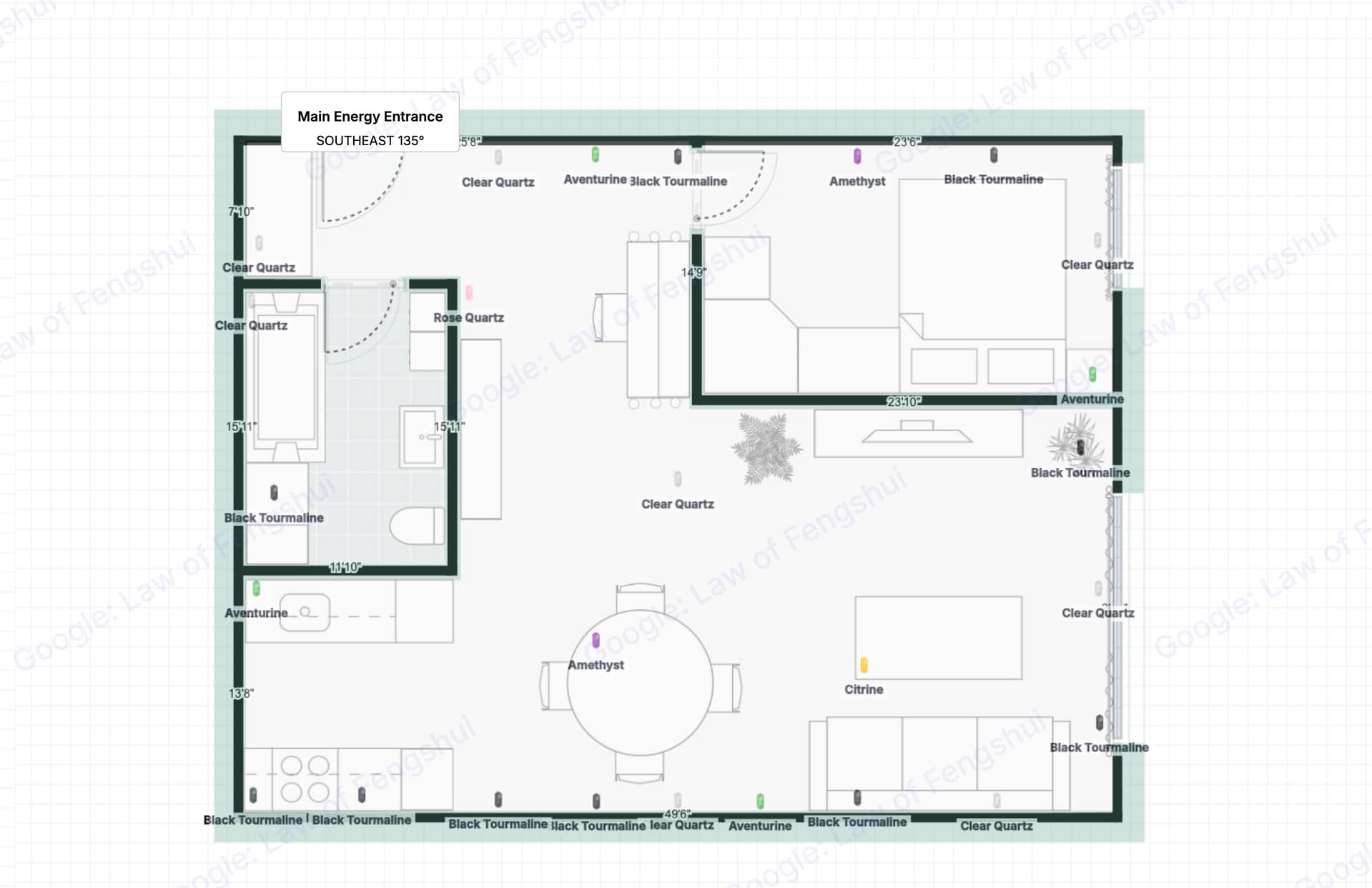
I ran all five systems on a northwest-facing 1BR apartment in Sedona, Arizona. About 572 square feet. Xun (巽) house, sitting Southeast. The final grid placed about 24 crystals across 6 types. Every placement traced back to a compass calculation.
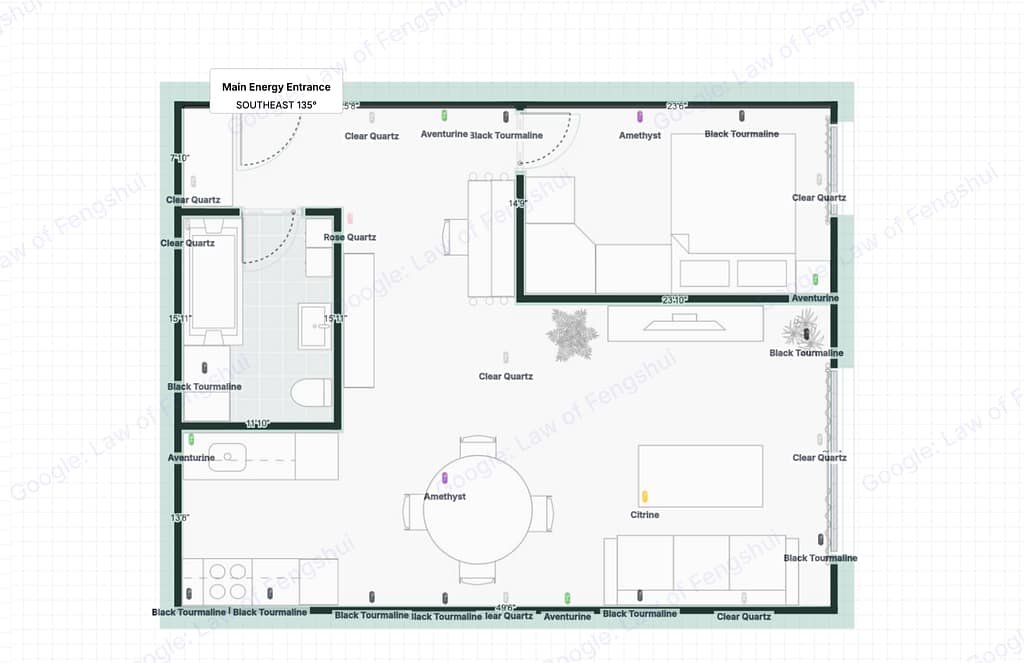
A feng shui crystal grid is a system of crystals placed at compass-calculated positions throughout a building. Unlike the simplified approach of placing a feng shui crystal ball in a “wealth corner” or dropping rose quartz on a bedroom nightstand, a proper crystal grid uses multiple classical feng shui systems to determine each crystal’s position, type, and function.
The grid works in layers. Each layer uses a different compass system. Each system rates compass sectors differently. Where the systems agree, the crystal placement is reinforced. Where they disagree, the closer layer (nearer to the building’s center) takes priority.
The final grid creates a graduated energy field. Perimeter crystals handle boundary-level energy: amplifying good sectors and shielding bad ones. Mid-zone crystals target specific life areas like career, romance, and joy. The centroid crystal at the exact center ties the entire grid together.
This is fundamentally different from room-based crystal placement. Room-based advice tells you to put career crystals in the office and romance crystals in the bedroom. Compass-based placement tells you to put career crystals where the career star falls, regardless of which room occupies that sector. Sometimes they overlap. When they don’t, the compass calculation takes priority in classical practice.
Five classical feng shui systems layer on top of each other. Each step uses a different overlay. Each overlay determines which crystal type goes where.
The first system maps eight stars around the building’s outer perimeter based on the sitting direction. This is the same eight-zone energy system that governs room-level feng shui assessments, but here it’s applied specifically to crystal placement.
Each of the eight compass sectors receives one star:
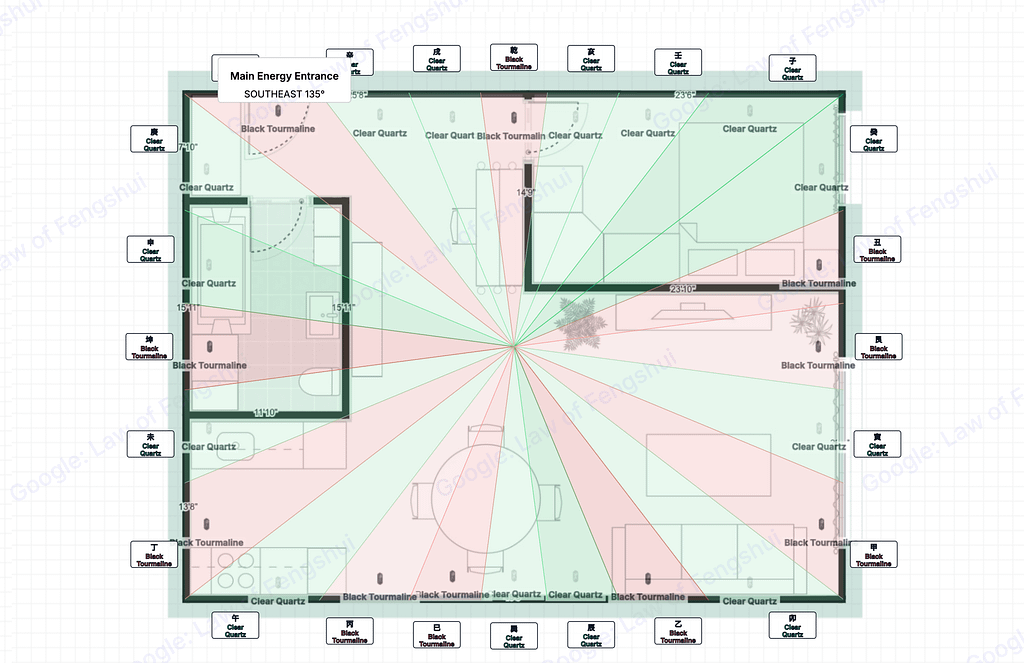
Clear Quartz goes at every auspicious sector along the perimeter walls. It amplifies the beneficial energy already present in those sectors. Black Tourmaline goes at every inauspicious sector. It absorbs and neutralizes negative energy before it circulates through the building.
For this Sedona apartment, Step 1 placed about 16 crystals along the building perimeter. The perimeter ring is the building’s first line of energy management.
The second system overlays fan-shaped sectors radiating from the building’s geometric centroid. This is the same Zi-Wu system that identifies fortune spots in a floor plan, applied here to refine crystal placement.
The Zi-Wu Oblique Flow identifies two types of zones:
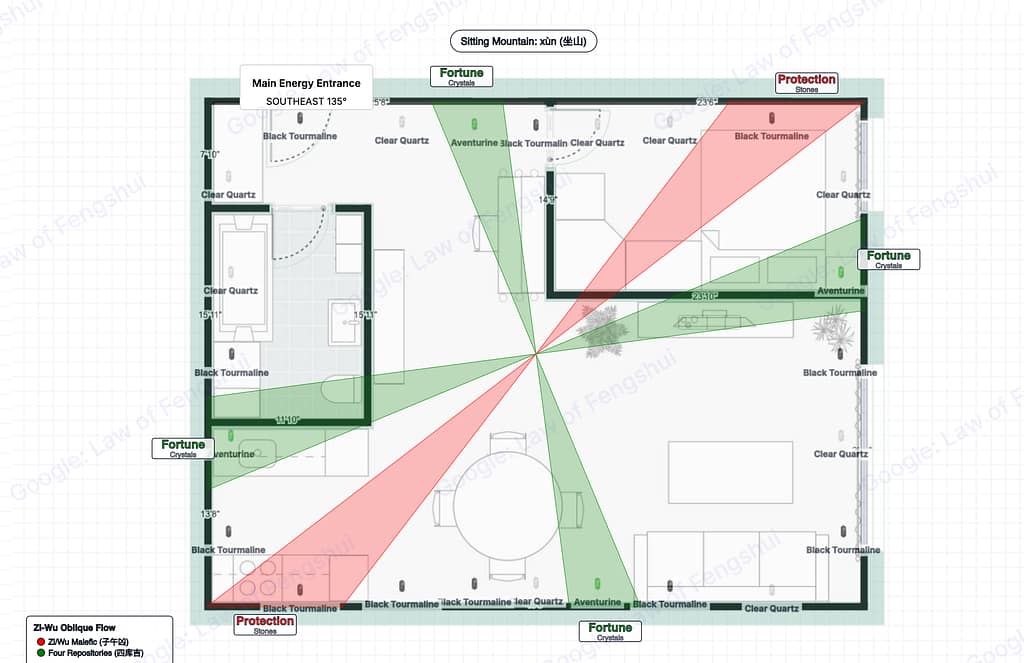
This is a replacement layer, not additive. Where the Zi-Wu system disagrees with the Nine Star Mountain layer, the Zi-Wu placement wins because it’s calculated on a closer plane to the building’s center. Two compass systems analyzing the same floor plan can assign different ratings to the same sector. The closer system takes priority.
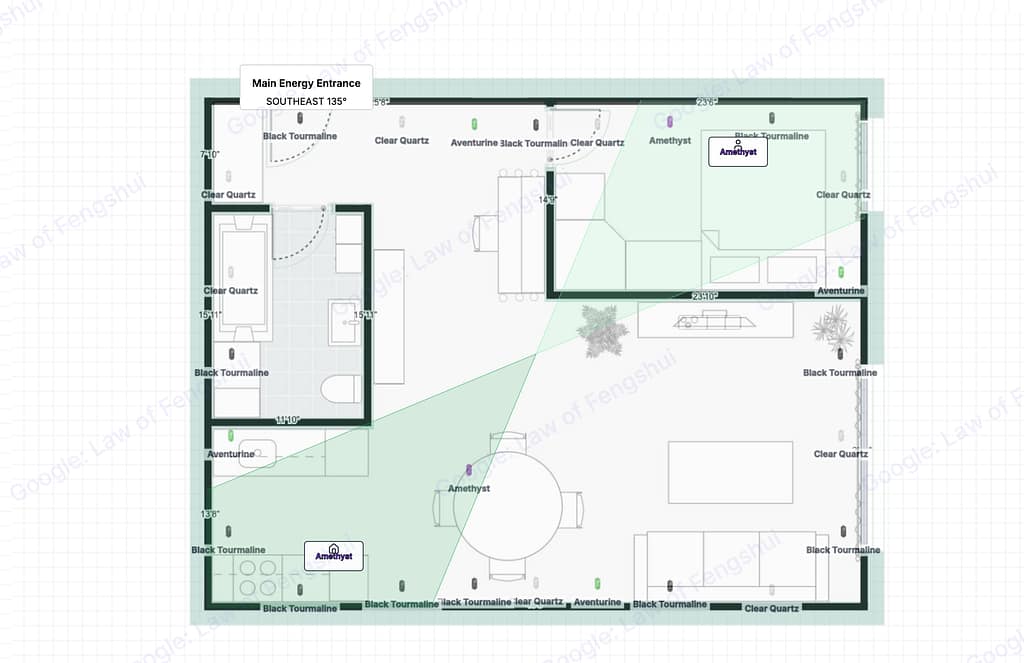
The residential Wenchang position is calculated from the building’s sitting direction. This is the same system covered in the home office Wenchang analysis, but here it determines where to place Amethyst.
Amethyst supports mental clarity, academic performance, thinking capability, and career advancement. It goes at the Wenchang position regardless of which room occupies that sector. If the Wenchang star falls in the kitchen, the Amethyst goes in the kitchen. The crystal follows the star, not the room name.
This step is additive. The Amethyst is placed in addition to any existing perimeter crystals.
Two annual stars get their own crystal types:
In 2026, the Year of the Fire Horse, Tianxi benefits those born in Rabbit years and Hongluan benefits those born in Rooster years. These annual positions rotate based on the Chinese zodiac cycle. The same analysis covered in the 2026 romance star bedroom post applies here for crystal placement.
This step is additive. Both crystals stack on top of existing perimeter placements.
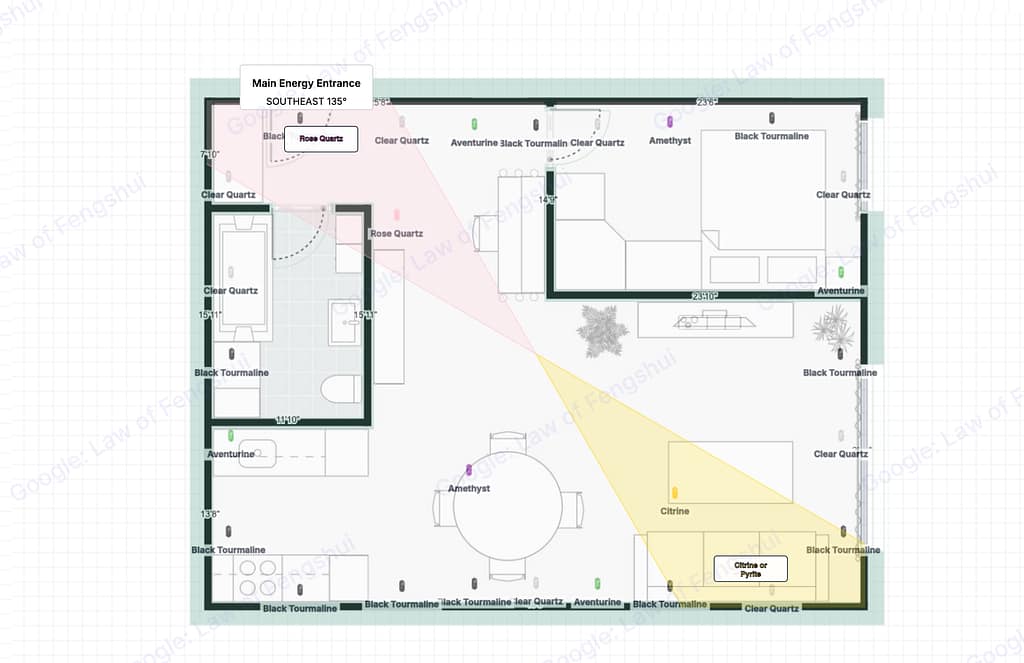
The final crystal goes at the exact geometric center of the building. For this apartment, Clear Quartz was selected as a general-purpose amplifier. The centroid crystal acts as the grid’s heart. It amplifies and distributes energy from all surrounding crystals, tying the graduated field together.
The centroid crystal is the homeowner’s intention point. Different crystal types serve different primary goals:
The building size doesn’t matter. A 572 sq ft apartment and a 4,000 sq ft house use the same centroid calculation. The geometric center is the geometric center regardless of floor area.
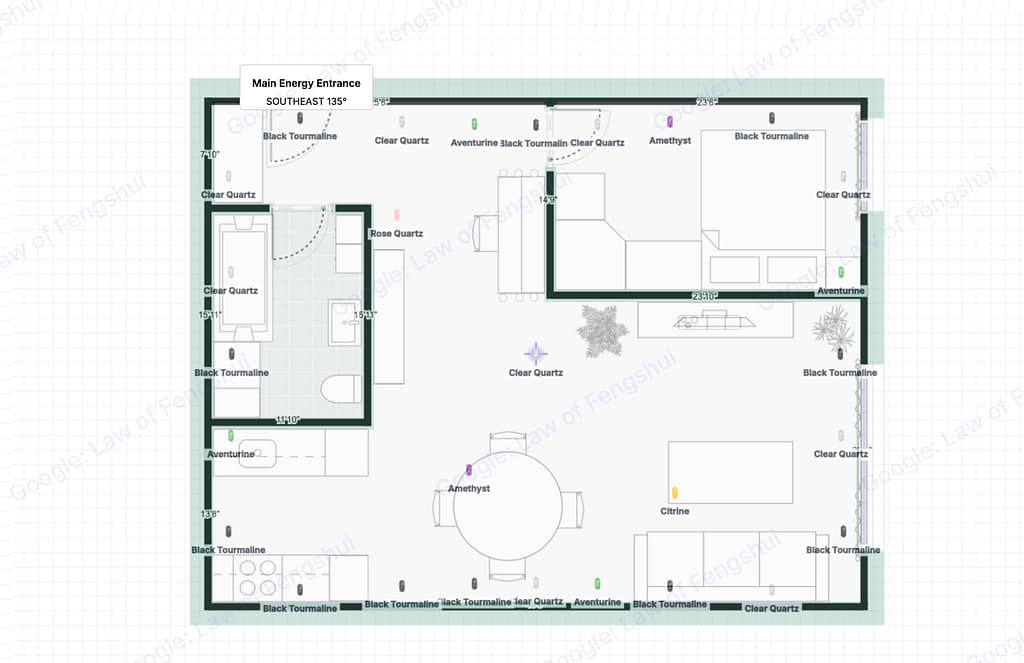
Property details:
Crystal inventory:
The graduated field is visible in a single image. Perimeter protection along the outer walls. Mid-zone enhancement at the career, romance, and joy positions. Central amplification at the centroid. The small floor area makes the entire energy field visible at once.
The surprise finding: Rose Quartz landed near the bedroom area. But it was placed there because the Hongluan romance star calculated to that compass sector, not because the room is a bedroom. The generic version of this advice says “put romance crystals in the bedroom.” The classical version says “the Hongluan star falls at this compass bearing, which happens to overlap the bedroom in this particular floor plan.” Same result. Different logic. In a different floor plan, the romance star might fall in the kitchen or the living room.
Manual adjustments: After the system placed crystals automatically at compass-calculated positions, small aesthetic adjustments were made. Crystals were nudged within their correct compass sectors to avoid overlapping furniture. The compass math sets the sector. The homeowner chooses the practical spot within it. This is normal practice. Precision without impracticality.
Want to see exactly where crystals should go based on your property’s energy map?
Our sample report includes a crystal grid overlay on a real floor plan with specific crystal type recommendations per sector.
This is one of the most searched questions about feng shui crystals. The standard advice says: hang a feng shui crystal ball from a red string, cut to a multiple of nine inches. Place it in a window to create rainbow prisms. Hang it halfway between your bed and the door if they’re aligned. Use it in a long hallway to slow down fast-moving chi. Leave it for 27 days to modulate the qi.
None of that advice is wrong. But it’s solving a different problem. A feng shui crystal ball hung in a window is a spot remedy. It addresses energy at one specific point. It doesn’t tell you whether that point is in an auspicious compass sector or an inauspicious one.
The compass-calculated crystal grid answers a bigger question: where should every crystal in your home go, based on the building’s actual sitting direction? A crystal ball at the centroid of the grid (Step 5) serves a specific amplification function calculated from compass math. A crystal ball hung in a random window serves a general dispersion function. Same crystal. Different placement logic. Different scale of intervention.
If you’re going to hang a feng shui crystal ball in a window, the crystal grid tells you which windows are in auspicious sectors (where you’d want to amplify energy) vs inauspicious sectors (where you might want protection instead). It’s the compass layer underneath the placement decision.
A feng shui crystal ball is typically a single sphere (often Clear Quartz or lead crystal) placed at a specific location for energy dispersion. Crystal balls are common feng shui remedies. They’re used to slow down fast-moving energy in long hallways, activate stagnant corners, and create rainbow light effects in dark areas. Most guides recommend hanging them from red strings in windows or doorways.
A crystal grid is a system of multiple crystals working together across an entire building. The grid uses different crystal types at different positions, each one serving a specific function based on compass calculations. A feng shui crystal ball might be one element within a crystal grid (Clear Quartz at the centroid, for example), but the grid is the larger system.
The relationship: a feng shui crystal ball is a single remedy for one location. A crystal grid is a coordinated treatment plan for the entire building. The crystal ball addresses one spot. The grid addresses every compass sector. Most feng shui crystal ball placement guides stop at “hang it in a window.” The crystal grid starts by asking which compass sector that window is in.
Each crystal type in the grid connects to the Five Elements system (五行, Wu Xing). The element association determines how the crystal interacts with the energy in its assigned sector.
| Crystal Type | Element | Function in Grid |
|---|---|---|
| Clear Quartz | Metal | Amplification, general purpose |
| Black Tourmaline | Water | Absorption, protection |
| Green Aventurine | Wood | Growth, prosperity attraction |
| Amethyst | Fire | Transformation, mental clarity |
| Citrine | Earth | Grounding, joy, good luck |
| Rose Quartz | Fire | Heart connection, romance |
The feng shui elements don’t just categorize the crystals. They determine how each crystal interacts with its assigned sector’s energy. A Wood-element crystal (Green Aventurine) at a fortune zone feeds the growth cycle. A Water-element crystal (Black Tourmaline) at a malefic zone absorbs excess negative energy without reflecting it back.
This is why you can’t substitute crystal types randomly. Each type is assigned to its position based on both the compass sector rating and the element interaction.
Feng shui plants are another common remedy. And yes, they follow some of the same principles. A jade plant or money tree placed at a prosperity sector amplifies the Wood element energy there. But feng shui plants and feng shui crystals serve different functions in classical practice.
Plants are living elements. They grow, change, and require care. They’re best suited for sectors that benefit from active, growing Wood energy. Crystals are stable. They maintain a consistent energy presence without maintenance. They’re suited for both amplification and protection roles.
In a crystal grid, feng shui plants can complement but not replace the crystal placements. A plant at the same sector as a Green Aventurine crystal adds another Wood element influence. But the crystal holds the compass-calculated position permanently. The plant adds living energy on top.
The common advice “put a feng shui money tree in the southeast” follows the same generic pattern. Classical practice checks whether the southeast is actually an auspicious sector for your specific building before recommending any remedy there.
Curious how the 5-step compass grid places crystals on a real floor plan?
Our sample report maps citrine, rose quartz, pyrite, and other crystals to specific compass sectors based on a real property’s energy analysis.
The color of each crystal isn’t decorative. It’s functional. Feng shui colors correspond to the Five Elements, and the crystal’s color reinforces its element association:
When you see feng shui colors recommendations (“paint the north wall black for career”), the same element logic applies. The color carries an element frequency. In the crystal grid, the crystal’s color and composition both carry that frequency to its compass-calculated position.
This is why a purple Amethyst goes at the Wenchang career position and not at a protection sector. Fire element energy (transformation, clarity) supports the career star’s function. Water element energy (Black Tourmaline’s absorption) supports the protection function at inauspicious sectors.
In 2026, the Year of the Fire Horse, the Tianxi and Hongluan stars occupy specific compass sectors based on the annual zodiac rotation. These positions affect Step 4 of the crystal grid.
Tianxi (Heavenly Joy) benefits Rabbit-born individuals this year. Hongluan (Red Matchmaker) benefits Rooster-born individuals. The crystals placed at these annual star positions (Citrine and Rose Quartz) carry the year’s influence into the building.
The other four steps (Nine Star Mountain, Zi-Wu, Wenchang, and centroid) are permanent. They don’t change year to year. They’re based on the building’s sitting direction, which is fixed. The annual stars in Step 4 are the only rotating element. This means most of the crystal grid stays the same across years. Only two crystals move when the annual stars shift.
A feng shui crystal ball on a shelf is a starting point, not a system. Classical feng shui calculates crystal placement from the building’s compass direction using five overlapping systems. Each system identifies specific sectors for specific crystal types. The result is a graduated field: perimeter protection (Black Tourmaline), sector amplification (Clear Quartz, Green Aventurine), career enhancement (Amethyst), romance and joy activation (Citrine, Rose Quartz), and central distribution (Clear Quartz at centroid).
The building size doesn’t change the methodology. A 572 sq ft apartment uses the same five compass layers as a mansion. More perimeter wall means more perimeter crystals, but the systems and star assignments are identical.
If you’ve bought feng shui crystals and they’re sitting on a nightstand or in a bowl by the door, consider this: the building’s compass direction already determined where each one should go. The question isn’t which crystal to buy. It’s which compass sector each crystal belongs in. Five systems answer that question with 24 Mountains precision.
Curious what 15+ classical feng shui systems reveal about a real home?
Our sample report shows every overlay on an actual floor plan so you can see the difference between classical analysis and generic advice.
What is a feng shui crystal ball used for? A feng shui crystal ball is traditionally used to disperse energy in a specific location. It slows fast-moving chi in long hallways, activates stagnant corners, and refracts light. In a compass-calculated crystal grid, a Clear Quartz sphere at the building’s centroid serves as the grid’s heart, amplifying and distributing energy from surrounding crystals. But a feng shui crystal ball is a single remedy. The grid is the complete system.
Where should I put feng shui crystals in my home? Classical feng shui places crystals based on your building’s compass direction, not room function. Five systems layer on each other: Nine Star Mountain determines perimeter placement, Zi-Wu Oblique Flow refines fortune zones, Wenchang identifies the career position, Tianxi/Hongluan marks joy and romance positions, and the centroid gets a central crystal. The sitting direction determines the entire map. Generic advice like “citrine in the southeast” skips this compass calculation.
Do feng shui crystals actually work? In classical feng shui, crystals function as energy remedies placed at compass-calculated positions. Each crystal type interacts with its sector’s energy through Five Element associations. Clear Quartz amplifies auspicious energy. Black Tourmaline absorbs inauspicious energy. The effectiveness depends on correct placement based on the building’s compass direction, not random positioning by room name.
What is the difference between feng shui crystals and feng shui plants? Both are classical feng shui remedies but serve different functions. Crystals are stable energy holders suited for both amplification and protection. Plants are living Wood-element remedies best for sectors that benefit from active growth energy. In a crystal grid, feng shui plants can complement crystal placements but follow different positioning rules. A money tree and a Green Aventurine crystal at the same fortune zone stack their Wood element influence.
How many crystals do I need for feng shui? A compass-calculated crystal grid for a typical home uses approximately 20-30 crystals across 6 types. The exact number depends on the building’s perimeter length and how many compass sectors the perimeter walls span. A small apartment might need about 24 crystals. A larger house with more perimeter wall segments would need more. The methodology is the same regardless of building size.
What are the feng shui crystal colors and their meanings? Feng shui crystal colors correspond to the Five Elements. Clear/white (Metal) amplifies. Black (Water) protects. Green (Wood) attracts prosperity. Purple (Fire) transforms and clarifies. Yellow/gold (Earth) stabilizes. Pink (Fire) connects hearts. Each color carries its element’s frequency to the compass-calculated position where that element interaction serves the grid’s purpose.
Can I use a feng shui crystal ball instead of a full crystal grid? A feng shui crystal ball addresses one spot. A crystal grid addresses the entire building. The crystal ball is a single remedy, often used at a doorway, window, or hallway to manage energy flow at that specific point. The grid is a coordinated system of 20-30 crystals placed at compass-calculated positions to manage energy across all sectors. They serve different scales of intervention.
Does building size affect feng shui crystal placement? The methodology is identical regardless of building size. A 572 square foot apartment and a 4,000 square foot house use the same five compass systems. More floor area means more perimeter wall to cover (more perimeter crystals), but the star assignments, sector ratings, and crystal type selections are determined by the building’s sitting direction, not its size.
What is the Zi-Wu Oblique Flow in feng shui crystal placement? The Zi-Wu Oblique Flow (子午斜流) is the second compass layer in the crystal grid system. It overlays fan-shaped sectors radiating from the building’s centroid. Where it identifies fortune zones (四库吉位), Green Aventurine replaces the first layer’s crystal to attract prosperity. Where it identifies malefic zones (子午凶), Black Tourmaline reinforces protection. It refines the Nine Star Mountain’s broader sector assignments with more precise calculations.
How do annual feng shui stars affect crystal placement? Annual stars (Tianxi and Hongluan) shift each year based on the Chinese zodiac cycle. In 2026 (Fire Horse year), Tianxi benefits Rabbit-born and Hongluan benefits Rooster-born. The crystals at these positions (Citrine and Rose Quartz) are the only ones that move year to year. The other three layers (Nine Star Mountain, Zi-Wu, Wenchang) are permanent, based on the building’s fixed sitting direction.
Where should I hang a feng shui crystal ball in my window? If you’re hanging a feng shui crystal ball in a window, the compass-calculated crystal grid tells you which windows are worth activating. A crystal ball in a window that sits in a Sheng Qi (supreme auspicious) sector amplifies beneficial energy entering through that opening. A crystal ball in a window in a Jue Ming (supreme inauspicious) sector could amplify energy you’d rather deflect. Run the Eight Mansions star map first to determine which windows are in favorable compass sectors before choosing a hanging location.
Should I use a bagua map or compass direction for crystal placement? The simplified Ba Gua map (BTB method) places crystals by room position relative to the front door. Classical compass feng shui places crystals based on the building’s measured sitting direction using five overlapping systems. The compass method is more precise because two buildings facing different directions will get completely different crystal placement maps, even with identical floor plans. The Ba Gua map gives the same placement regardless of compass orientation.
Can I place feng shui crystals in every room? A compass-calculated crystal grid does place crystals across the entire building, but not by room. Crystals go at specific compass sectors, which may or may not align with room boundaries. The perimeter crystals (Steps 1-2) ring the outer walls regardless of rooms. Interior crystals (Steps 3-5) go where the career star, romance star, joy star, and centroid fall. Some rooms may get multiple crystals. Others may get none. It depends on which compass sectors the rooms occupy, not the room name or function.