Address
304 North Cardinal St.
Dorchester Center, MA 02124
Work Hours
Monday to Friday: 7AM - 7PM
Weekend: 10AM - 5PM
Address
304 North Cardinal St.
Dorchester Center, MA 02124
Work Hours
Monday to Friday: 7AM - 7PM
Weekend: 10AM - 5PM

Most people assume that living near water is good feng shui. Waterfront property, canal views, a pond in the backyard. The reasoning seems simple: water represents wealth in feng shui, so more water nearby equals more prosperity. Right?
Not exactly. A feng shui compass evaluation can determine whether each water feature around your property is actually working in your favor. The system is called Yin-Yang Spousal Pairing (阴阳配偶), and it treats the relationship between your property and its water like a marriage. Some matches are harmonious. Some are neutral. And some create the single worst violation in the entire system.
This matters especially in 2026. The Four Pillars for the Fire Horse year have zero Water element. Water governs wealth luck, and its absence is the defining challenge of this year. Every feng shui source is recommending people add water features to compensate. But what if the water around your property is compass-mismatched? Having water nearby doesn’t help if the pairing is wrong.
I ran this analysis on a property in the Venice Canal Historic District in Los Angeles, one of the most desirable waterfront neighborhoods in Southern California. The property is literally surrounded by canals. The results were not what you’d expect.
The short answer: no. Classical feng shui principles require precise compass measurement to determine whether water features help or hurt a property. The direction and compass sector of each water feature relative to your building’s facing and sitting orientation determines the outcome, not proximity.
This is where Yin-Yang Spousal Pairing comes in.
Yin-Yang Spousal Pairing is a core principle in San Yuan feng shui (三元理氣). It evaluates whether water features around a property are properly matched with the building’s compass orientation using the 24 Mountains directional system.
The key concept is the Three Elements classification. The 24 Mountains (the 24 compass sectors used in classical feng shui) are divided into three groups:
Each mountain belongs to exactly one type. Your building’s facing direction sits in one of these groups. The water features around your property sit in others. The question is whether they match.
The system checks for three levels of positive pairing, each increasingly rare and beneficial.
The classical 12-pair system. It uses dual-direction analysis: your facing direction is tested against outgoing water, and your sitting direction (180 degrees opposite) is tested against incoming water. Twelve specific yin-yang mountain pairs determine whether a match exists. Because both facing and sitting are checked independently, a single property can have up to 24 pairing opportunities.
If a water feature’s compass sector forms one of these 12 pairs with your facing or sitting mountain, that’s a conjugal pair. It brings prosperity, descendants, and stability. On the feng shui compass overlay, these show as green solid lines.
This checks element harmony. If a water feature has both an inlet and outlet, and those two points plus your facing direction ALL belong to the same Three Elements type (all Heaven, or all Human, or all Earth), that’s a combo pair. It creates balanced element resonance.
The critical rule: the inlet and outlet must be in different 24 Mountains sectors. Same sector doesn’t count. These show as teal dashed lines on the overlay.
The rarest and most auspicious configuration. A combo pair that also satisfies one of the 12 conjugal pairing rules. Both element harmony and traditional yin-yang balance at the same time. These show as gold lines forming a triangle pattern on the overlay.
There’s a fourth possibility, and it’s the worst finding in the entire system.
If the water features combined with the building’s facing and sitting directions collectively span ALL three element types, that’s a Three Elements Violation (三元俱全, pronounced “san yuan ju quan”). Heaven + Human + Earth all present together. The classical texts classify this as 大凶, the most severe inauspicious rating.
The violation overrides any positive pairings that might exist. It doesn’t matter if one canal forms a perfect conjugal pair. If the collective feng shui energy picture spans all three types, the violation takes priority.
Classical predictions for Three Elements Violation:
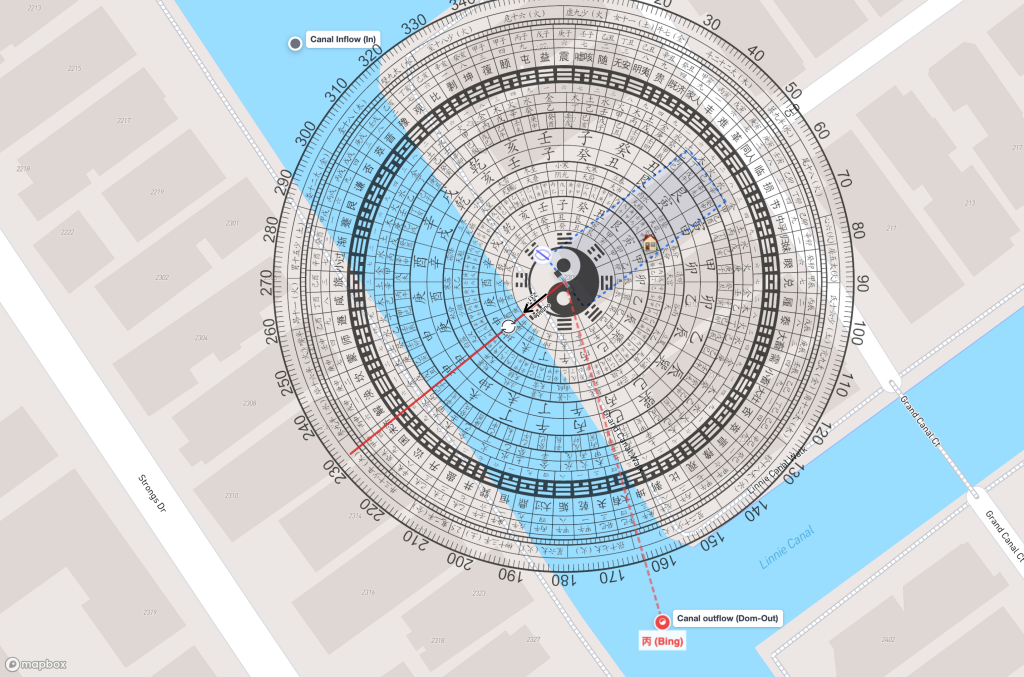
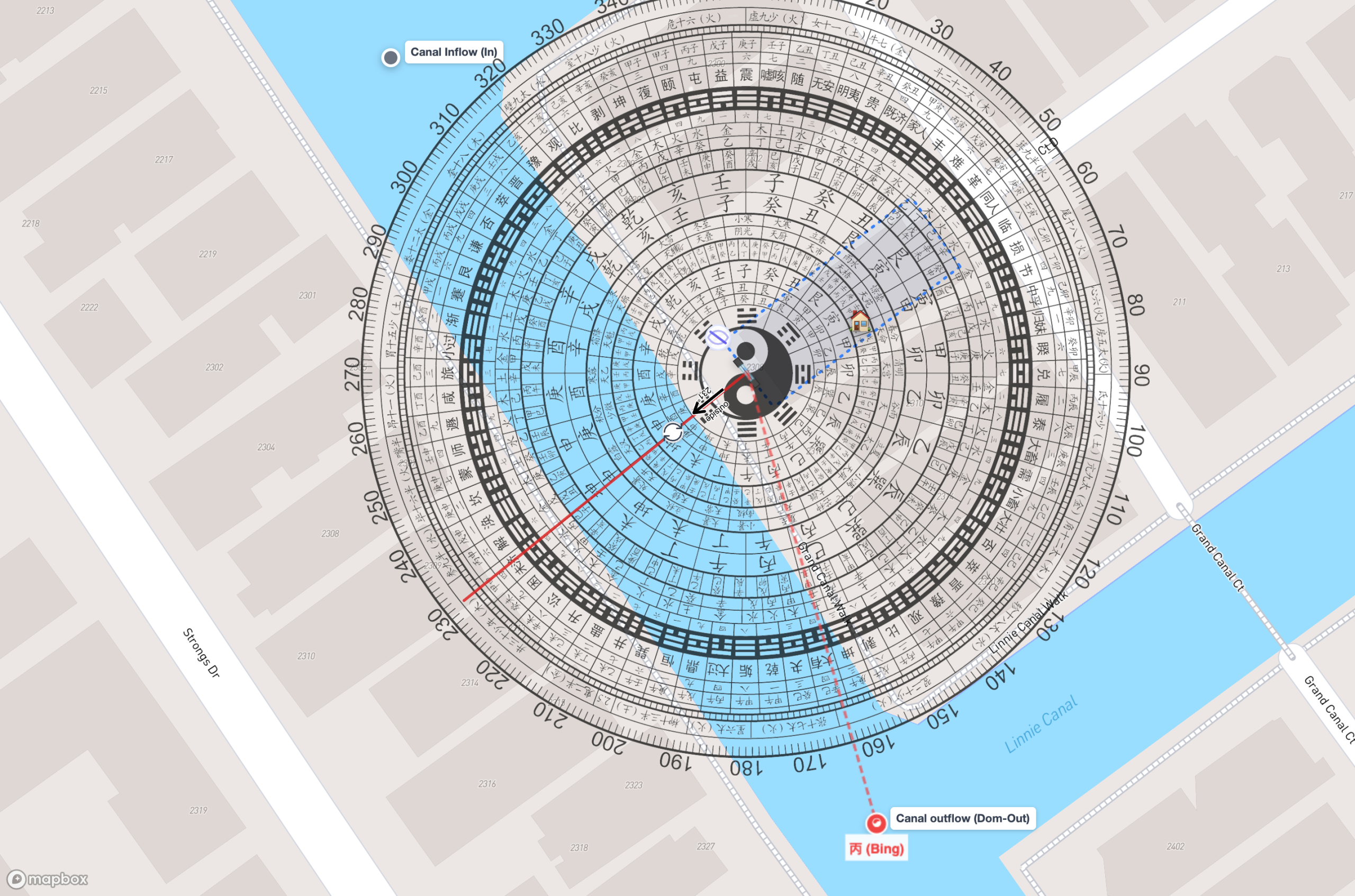
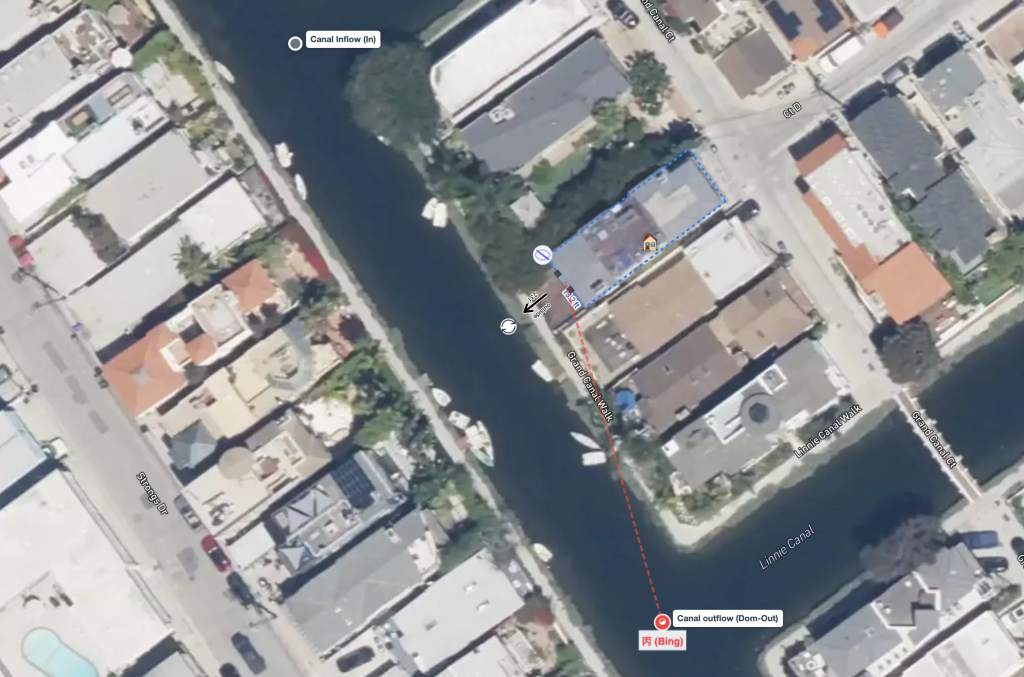
This feng shui house sits at Venice’s historic canal district, originally built by Abbot Kinney in 1905. About 350 homes line 6 navigable canals. On satellite view, you can see the Grand Canal running along the property and Linnie Canal intersecting nearby.
Property orientation:
Two water features were analyzed: a canal inflow from the northwest and a dominant canal outflow to the south.
The finding: The canal outflow sits in the Bing (丙) sector, which belongs to Heaven Yuan. The property’s facing (Kun) and sitting (Gen) are both Earth Yuan. The canal inflow from the northwest contributes Human Yuan. Add them together:
Earth (property) + Heaven (outflow) + Human (inflow) = All three types present.
Three Elements Violation.
Neither canal forms a valid conjugal pair with the property’s orientation. Zero positive pairings. The feng shui compass analysis on this property shows red lines, not green.
Direction is everything. The Venice Canals are beautiful. The neighborhood is architecturally significant. Property values reflect desirability by every conventional real estate measure. But the feng shui compass relationship between the canals and this particular building’s orientation creates the worst possible configuration.
Two properties on the same canal block, with different feng shui house direction orientations, can have completely different pairing results. One might show green conjugal pair lines. Another might trigger a Three Elements Violation. The water is the same. The distance is the same. The compass orientation is the difference.
Most online feng shui water advice stops at “water = wealth” or discusses flow direction in general terms (clockwise vs counterclockwise, toward vs away from the house). Those are Form School basics. Yin-Yang Spousal Pairing goes deeper: it checks the precise 24 Mountain compass sector of each water feature against the building’s Yuan classification. That’s Compass School analysis, and it’s what separates general feng shui principles from property-specific evaluation.
This is why classical practitioners insist on precise compass measurement. A few degrees of difference in facing direction can shift a mountain from one Yuan type to another, completely changing the pairing analysis.
The 2026 Four Pillars (Paht Chee) birth chart has zero Water element. Water governs wealth luck in the annual feng shui energy framework, and its complete absence makes this the defining challenge of the Fire Horse year.
Feng shui practitioners across the board are recommending people introduce water features and blue/black color schemes to compensate (per fengshuimall.com, fengshuiandprosper.com, wofs.com). Water fountains, aquariums, and even blue decor are standard recommendations.
But here’s the catch: adding water only helps if the compass pairing works. This Venice Canal property is surrounded by water on multiple sides. If proximity alone mattered, it should be one of the best-positioned properties in 2026. Instead, the compass analysis shows the worst possible finding. The canals at the wrong compass bearings create a Three Elements Violation that overrides any benefit from the water’s presence.
If you’re following 2026 feng shui advice to add water features, check the compass direction first. The sector where you place water relative to your building’s facing direction determines whether it helps or hurts.
For existing buildings, the most practical approach is usually changing which door serves as the primary entrance. In classical feng shui, the main entrance defines the feng shui house direction. A different facing direction means a different Yuan classification for the facing mountain. That can break the three-element conflict by removing one of the three types from the equation.
Other options include adding screening (walls, dense plantings) between the property and problematic water directions, or enhancing the connection to beneficial water directions by opening views or adding windows.
For new construction, knowing where valid pairing sectors exist before choosing the building orientation is dramatically easier than trying to fix violations after the fact. A feng shui house evaluation before construction can identify which facing directions avoid the three-element conflict entirely.
It’s also worth noting that roads count as “virtual water” in this system. Traffic corridors, driveways, and intersections follow the same spousal pairing rules as real water. Even if you’re not near a canal or river, the T-junction at the end of your block gets assessed the same way.
Yin-Yang Spousal Pairing (阴阳配偶) is a classical San Yuan feng shui principle that evaluates whether water features around a property are properly matched with the building’s compass orientation. It uses the 24 Mountains directional system and Three Elements classification (Heaven, Human, Earth Yuan) to determine if water is beneficial, neutral, or harmful. It’s part of the feng shui compass school methodology.
A Three Elements Violation (三元俱全) occurs when the water features combined with a building’s facing and sitting directions collectively span all three element types (Heaven Yuan, Human Yuan, and Earth Yuan). It’s the most severe finding in classical feng shui compass analysis, associated with financial loss, relationship breakdown, health issues, and career obstacles. It overrides any positive pairings.
No. Classical feng shui evaluates water through precise compass measurement, not proximity alone. A canal or river can be beneficial (conjugal pair), neutral (no pairing), or harmful (Three Elements Violation) depending on its compass bearing relative to the building’s orientation. Two properties on the same canal can have opposite results if they face different directions. The direction matters more than the distance.
The most practical approach is changing the primary entrance orientation. In classical feng shui, the main door defines the facing direction. A different facing direction changes the Yuan classification, which can break the three-element conflict. Physical screening (walls, plantings) between the property and problematic water directions is another option. For new construction, choosing the right building orientation before construction avoids the problem entirely.
Yes. Classical feng shui treats traffic corridors, driveways, and intersections as “virtual water.” Roads follow the same Yin-Yang Spousal Pairing rules as real watercourses. This means the feng shui compass analysis applies to all properties, not just those near natural water features.
Direction of water flow is critical. In Yin-Yang Spousal Pairing, outgoing water is assessed against the building’s facing direction, while incoming water is assessed against the sitting direction. The same water feature can be auspicious or harmful depending on which compass sector it occupies relative to the building. Classical feng shui principles evaluate both flow direction and compass bearing together.