Address
304 North Cardinal St.
Dorchester Center, MA 02124
Work Hours
Monday to Friday: 7AM - 7PM
Weekend: 10AM - 5PM
Address
304 North Cardinal St.
Dorchester Center, MA 02124
Work Hours
Monday to Friday: 7AM - 7PM
Weekend: 10AM - 5PM

You’ve probably seen the rule. Don’t put a mirror facing the bed. It’s in every feng shui bedroom article, every Pinterest pin, every interior design listicle. And it’s real. But it’s also just one layer of a three-layer system. The other two layers don’t care which direction the mirror faces inside the room. They care which compass sector of your building the mirror sits in.
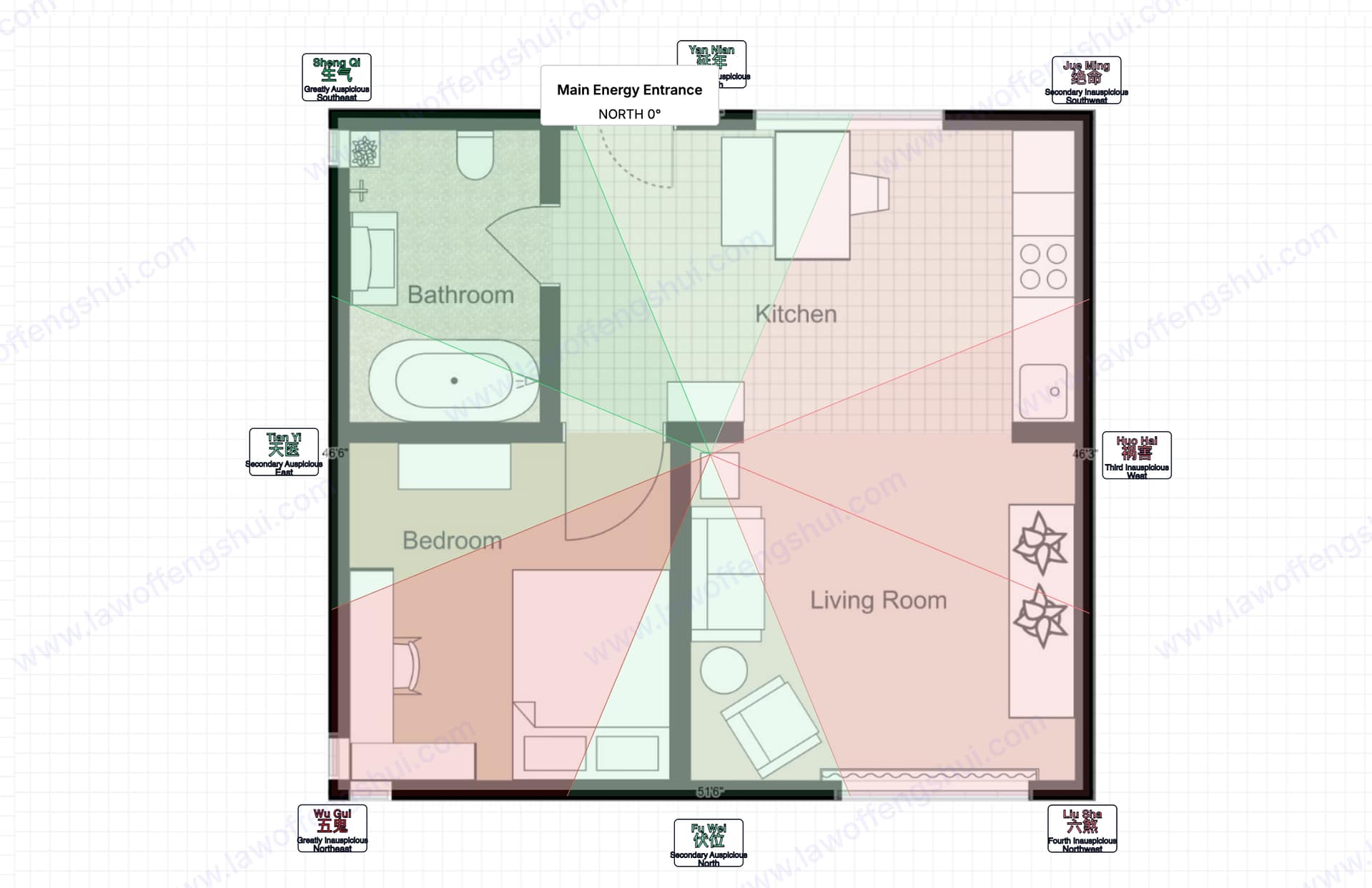
I ran the Ba Zhai (Eight Mansions) compass overlay on a north-facing 1BR condo in La Jolla. The bedroom straddles two compass sectors. One sector is Tian Yi (天醫), colored green, classified as “Medium Auspicious: Health, Healing.” The other is Wu Gui (五鬼), colored red, classified as “Major Inauspicious: Fire Hazards, Theft.” A mirror on the Tian Yi wall amplifies healing energy. A mirror on the Wu Gui wall amplifies destructive energy. Same bedroom. Same mirror. Different compass sectors. Different outcomes.
Every English-language feng shui bedroom mirror guide I’ve found covers one layer: the physical rules. Don’t face the bed. Don’t face the door. Cover it at night. Those aren’t wrong. But they skip the compass analysis that classical practitioners run before placing any mirror. And the compass analysis is the layer that actually tells you which wall is safe.
The short answer: Classical feng shui bedroom mirror placement requires checking three layers. Layer 1 (Ba Zhai) maps your building’s compass sectors to determine which walls carry auspicious vs inauspicious energy. Layer 2 (Xuan Kong) adds time-based energy shifts. Layer 3 (Form School) covers the physical rules everyone already knows. The compass layers come first. The physical rules layer on top.
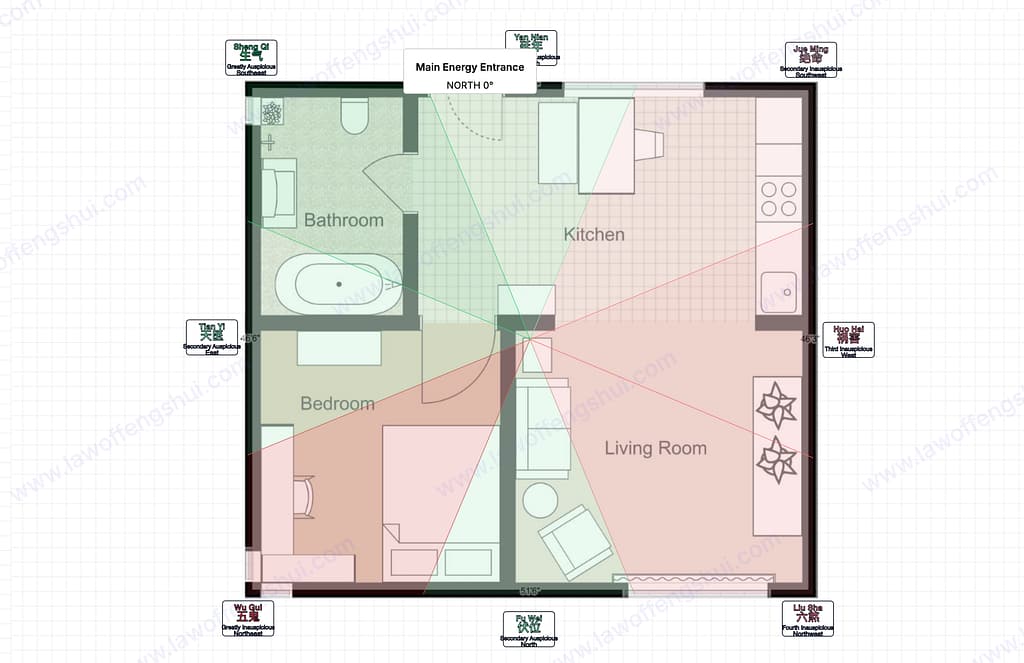
Nine Star (Ba Zhai) overlay. Green sectors are auspicious for mirrors. Red sectors are not. The bedroom spans Tian Yi (health/healing, green) on one side and Wu Gui (fire hazards/theft, red) on the other. A mirror on the green side amplifies healing energy. A mirror on the red side amplifies the opposite.
Most feng shui mirrors advice boils down to “don’t face the bed” and “don’t face the door.” Those are Form School rules. Physical rules based on how energy (qi) moves through openings and bounces off reflective surfaces. They apply the same way in every building, every room, every compass direction.
Classical feng shui mirror placement starts earlier. Before asking “which direction should the mirror face inside the room,” it asks “which compass sector of the building is this wall in?” Because a mirror doesn’t just reflect light. In classical theory, a mirror amplifies the energy of whatever sector it sits in. Put a mirror in a sector carrying Sheng Qi (生氣, Supreme Auspicious) energy? It amplifies wealth, health, and success. Put one in a sector carrying Jue Ming (絕命, Supreme Inauspicious) energy? It amplifies total loss and severe illness.
The feng shui bedroom layout most people learn online uses 8 life-area zones (Career, Love, Wealth, etc.). That’s a good starting point. But the Ba Zhai layer underneath those zones assigns an energy quality rating to each sector based on the building’s sitting direction. Two buildings facing different directions will have completely different auspicious and inauspicious sectors, even with identical floor plans.
The Ba Zhai system divides every building into 8 compass sectors. Each sector gets assigned one of eight “stars” based on the building’s sitting direction. Four stars are auspicious (green). Four are inauspicious (red). This assignment is permanent. It doesn’t change for the life of the building. The system originates from a classical text called Ba Zhai Ming Jing (八宅明鏡), which translates to “Bright Mirror of Eight Mansions.” The text literally puts mirrors in its name. Mirror placement isn’t a footnote in Ba Zhai. It’s built into the foundation of the system.
The four auspicious stars, where mirrors are safe:
The four inauspicious stars, where mirrors should NOT go:
In the La Jolla condo, the bedroom spans Tian Yi (green) and Wu Gui (red). The wall in the Tian Yi sector? Safe for a mirror. A mirror there amplifies healing energy. The dresser mirror, the closet mirror, a decorative wall mirror – all fine on that side. The wall in the Wu Gui sector? A mirror there amplifies fire hazard and theft energy. Same bedroom. Two different verdicts.
This is the layer that no English-language feng shui guide covers. I checked the top 10 search results for “feng shui bedroom mirror.” All 10 gave the same advice: don’t face the bed, don’t face the door, cover it at night. Zero mentioned Ba Zhai. Zero mentioned compass sectors. Zero told you to check which side of the bedroom the mirror wall sits in. The strongest-ranking competitor covers feng shui mirror placement across about 2,800 words and discusses which rooms to put mirrors in (dining room, living room, hallway). But “which room” isn’t the same question as “which compass sector within the room.” The room-level advice is Form School. The sector-level analysis is Ba Zhai. That’s the gap.
On top of Ba Zhai’s permanent sectors, there’s a time-based system called Xuan Kong. It divides history into periods, and each period shifts which compass sectors carry positive vs negative qi.
In the current Lower Yuan period, the positive qi zones are Northwest, West, Northeast, and South. The negative qi zones are North, Southwest, East, and Southeast. A mirror sitting in a negative qi zone during this period can hurt finances and career, even if Ba Zhai rates that sector as auspicious.
The ideal mirror placement passes both layers. Ba Zhai says the sector is green (auspicious), AND Xuan Kong says the sector carries positive qi for the current period. When both systems agree, the mirror is amplifying the right kind of energy at the right time.
When they disagree? Ba Zhai takes priority for permanent placement. It’s the spatial baseline. Xuan Kong adds temporal nuance that practitioners track across 20-year cycles. But for most homeowners making a one-time mirror decision, the Ba Zhai layer is the one that matters most.
In 2026 (Year of the Yang Fire Horse), there’s an additional wrinkle. Mirrors carry Water energy in Five Element theory. The Fire Horse year amplifies Fire element energy across all sectors. Water and Fire clash. This doesn’t mean avoid mirrors in 2026. It means the sector check matters more this year, because a mirror in a Fire-heavy sector adds Water-Fire conflict on top of whatever the Ba Zhai star already says.
This is a system I mention but don’t show on the overlay images, btw. The Law of Fengshui tool runs Ba Zhai via the Nine Star overlay. Xuan Kong is a separate system that adds another layer of analysis on top.
Curious which compass sectors in your bedroom are green vs red?
Our sample report runs the Nine Star (Ba Zhai) overlay on a real property so you can see which walls are safe for mirrors and which aren’t.
This is the layer you’ve read about. The feng shui bedroom rules for mirrors that appear in every article, every blog, every home magazine feature.
Don’t face the bed. Your peripheral vision detects reflected movement during light sleep stages (N1 and N2). Even small shifts, a partner rolling over, curtains moving, shadows changing, register as motion in the mirror. Your brain reads that as a potential threat and triggers micro-arousals. You don’t fully wake up, but your sleep quality drops. There’s a Washington University study on retinal neural circuits that detect this kind of movement. And a 2010 study by Giovannie Caputo found that staring at a mirror in dim light produces a “strange face illusion” where your own reflection distorts. The bedroom is exactly the kind of low-light environment where this happens.
Don’t face the bedroom door. In classical feng shui, the door is where energy enters the room. A mirror facing the door pushes that incoming energy right back out. The room doesn’t receive the qi it’s supposed to. In bad feng shui bedroom configurations, a feng shui mirror facing door setups are among the most common issues.
Don’t face the window. Same logic as the door. Energy enters through the window, hits the mirror, bounces back out. The room loses incoming qi.
These physical rules apply regardless of compass direction. A mirror on a Tian Yi wall (auspicious) that faces the bed is still problematic at the Form School level. The layers stack. Layer 1 (compass) tells you which wall. Layer 3 (Form School) tells you which direction the reflective surface should point once it’s on that wall.
Here’s what the overlay actually showed.
This north-facing 1BR condo has its main energy entrance at North 0 degrees. The sitting direction is south. When you run the Nine Star (Ba Zhai) overlay, the eight compass sectors light up green and red across the entire floor plan.
The bedroom sits in the lower-left portion of the floor plan. It spans two sectors:
If you hung a floor mirror on the Tian Yi side of the bedroom (East compass sector, green), you’d be amplifying health and healing energy. Good placement. If you hung the same mirror on the Wu Gui side (Northeast compass sector, red), you’d be amplifying fire hazard and theft energy. Bad placement. The physical distance between these two zones is maybe 8 feet. But the compass sector boundary cuts right through the room.
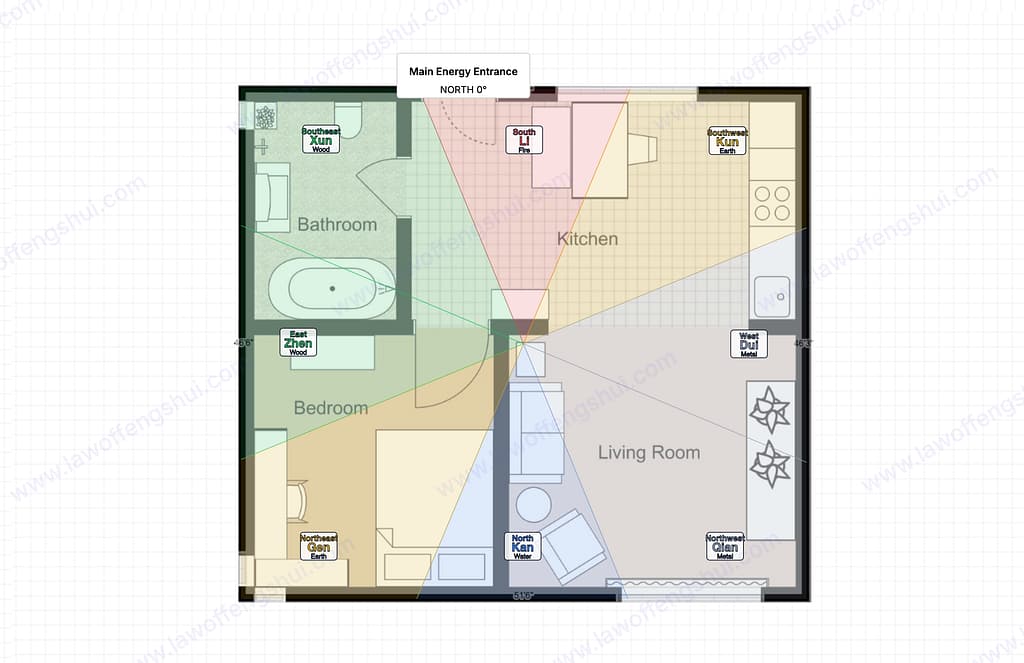
Ba Gua Sectors overlay. The bedroom spans the East/Family sector and the Northeast/Knowledge sector. The Nine Star overlay (Image 1) shows these same areas carry Tian Yi (green) and Wu Gui (red) energy. The Ba Gua tells you the life area. The Nine Star tells you the energy quality.
The Ba Gua Sectors overlay adds context. The bedroom spans East (Zhen/Wood, Family) and Northeast (Gen/Earth, Knowledge). The rest of the floor plan maps out as you’d expect: Career in the North at the entrance, Wealth in the Southeast near the bathroom, Love in the Southwest near the kitchen area.
But the Ba Gua labels alone don’t tell you whether a mirror is safe. “Family” doesn’t mean “good for mirrors.” “Knowledge” doesn’t mean “bad for mirrors.” The energy quality comes from the Nine Star overlay. That’s where Tian Yi (green) and Wu Gui (red) live. The two overlays work together: Ba Gua tells you the domain, Nine Star tells you the verdict.
Mirrors are Water in Five Element theory. They’re reflective, they shimmer, they represent the Water element’s qualities of depth, movement, and absorption.
This matters because of how Water interacts with the element of each compass sector. In the feng shui energy flow framework, Water supports Wood (East and Southeast sectors), is weakened by Earth (Southwest, Northeast, Center), and clashes with Fire (South sector).
A mirror on the East wall (Wood sector) gets a Five Element boost. Water feeds Wood. The mirror’s Water energy nourishes the Family sector. A mirror on the South wall (Fire sector) creates tension. Water and Fire clash. A mirror on the Southwest wall (Earth sector) gets dampened. Earth absorbs Water.
These Five Element interactions add yet another consideration on top of the three layers. But they’re secondary to the Ba Zhai compass check. The energy quality of the sector (auspicious vs inauspicious) outweighs the elemental interaction. A mirror in an auspicious Fire sector with a Water-Fire clash is still better than a mirror in an inauspicious Wood sector with a Water-Wood support relationship.
This is one of the most common pain points I hear about. Sliding mirrored closet doors are standard in apartments and condos built from the 1970s through the 2000s. You can’t remove them without leaving track holes. You can’t easily replace them. And they’re often on the wall directly facing the bed.
From a Form School perspective, mirrored closet doors facing the bed create the same peripheral vision issue as any mirror. The fix most guides recommend: cover them with curtains, apply frosted film, or replace them with solid panels.
From a Ba Zhai perspective, the question is different. Which compass sector is that closet wall in? If the closet wall sits in a Sheng Qi or Tian Yi sector, the mirrored doors are actually amplifying auspicious energy across a large surface area. Covering them would reduce that amplification. If the closet wall sits in a Wu Gui or Jue Ming sector, covering them is the right call regardless of whether they face the bed.
The compass check changes the recommendation. A mirrored closet in an auspicious sector that doesn’t face the bed? Leave it. A mirrored closet in an inauspicious sector? Cover it or replace it, whether it faces the bed or not.
Want to see how the compass overlay splits a bedroom into safe and unsafe zones?
Our sample report maps all 8 Ba Zhai sectors onto a real floor plan with color-coded auspicious and inauspicious ratings.
Standard feng shui bedroom rules for mirrors go like this: side walls are safest, the wall behind the headboard is fine, closet interiors are neutral, and vanity mirrors should face away from the bed. All valid Form School guidance.
The compass adds specificity. Not all side walls are equal. The side wall in a Sheng Qi sector is actively beneficial for a mirror. The side wall in a Huo Hai sector is mildly problematic. “Side wall” isn’t enough information. You need to know which compass sector that wall occupies.
For feng shui furniture placement in general, this pattern repeats. The physical rule gives you a starting position. The compass analysis tells you which of the physically acceptable positions is actually best. Mirrors are no different. The Form School picks the wall type. Ba Zhai picks the specific wall.
There’s a popular claim that placing a mirror in the “wealth corner” of the bedroom attracts prosperity. In simplified Ba Gua, the wealth corner is the far-left corner from the bedroom door.
Classical feng shui doesn’t calculate wealth corners that way. The feng shui wealth corner in classical systems depends on the building’s compass data, not the door position. The Zi-Wu Oblique Flow system identifies four fortune spots based on the sitting direction. The Ba Gua Wealth sector (Xun/Southeast) is a fixed compass sector, not a relative position from the door.
A mirror can amplify wealth energy if it sits in a Ba Zhai auspicious sector that also happens to overlap with a feng shui kitchen or living area fortune zone. But “far-left corner from the door” is a BTB simplification that doesn’t account for compass bearings. I’ve seen bedrooms where the far-left corner sits in Jue Ming (Supreme Inauspicious). Placing a mirror there to “attract wealth” would amplify the most dangerous sector on the compass.
Without the compass overlay, you can at least narrow things down.
Step 1: Find your building’s facing direction. Use a compass app at your main entrance door. Note the degree reading.
Step 2: Identify your building’s house type. The sitting direction (opposite of facing) determines which of the eight trigram house types applies. Each house type has a fixed Ba Zhai star distribution.
Step 3: Map the eight sectors onto your floor plan. North, Northeast, East, Southeast, South, Southwest, West, Northwest. Each sector covers 45 degrees.
Step 4: Look up which stars fall in which sectors for your house type. The four green stars (Sheng Qi, Tian Yi, Yan Nian, Fu Wei) mark the safe zones for mirrors. The four red stars (Huo Hai, Liu Sha, Wu Gui, Jue Ming) mark the avoid zones.
Step 5: Check which sector your bedroom mirror wall sits in. If it’s green, you’re good at the compass level. If it’s red, consider moving the mirror to a green wall.
That’s the Ba Zhai layer. Adding Xuan Kong (Layer 2) requires knowing your building’s construction period and looking up the flying star feng shui chart for that period. It’s more involved, and most homeowners won’t need it for a single mirror decision. But practitioners who track temporal energy cycles will want both layers checked.
Want to check your own bedroom mirror placement against the compass?
Our sample report shows Ba Zhai sector analysis and Ba Gua life areas on a real property so you can see where mirrors help and where they hurt.
Is it bad feng shui to have a mirror facing the bed?
Yes, at the Form School level. Your peripheral vision detects reflected movement during light sleep, triggering micro-arousals that reduce sleep quality. A 2010 study by researcher Giovannie Caputo also found that dim-light mirror gazing produces face distortion illusions. The fix: reposition the mirror so the reflective surface doesn’t catch the bed, or cover it at night. But this is Layer 3 only. The compass layers (Ba Zhai and Xuan Kong) determine whether the mirror’s wall location is safe before the “facing the bed” rule even applies.
Where should a mirror be placed in a bedroom feng shui?
On a wall that sits in one of the four Ba Zhai auspicious sectors: Sheng Qi (Supreme Auspicious), Tian Yi (Health/Healing), Yan Nian (Longevity/Relationships), or Fu Wei (Stability). The specific sector locations depend on your building’s sitting direction. Once you’ve identified the safe compass wall, apply Form School rules: don’t face the bed, don’t face the door, don’t face the window.
Which direction should a bedroom mirror face?
The compass direction of the wall matters more than which direction the mirror faces inside the room. A mirror on a wall in an auspicious sector amplifies positive energy regardless of its facing angle. Once the wall is confirmed safe via Ba Zhai, point the reflective surface away from the bed, the bedroom door, and any windows. If you can reflect a pleasant view or natural light (without facing the bed), that’s the best setup.
Can I have a mirror in my bedroom if I cover it at night?
Covering a mirror at night addresses the Form School concern about sleep disruption from reflected movement. It doesn’t address the Ba Zhai concern about sector energy. If the mirror sits in a Wu Gui (Major Inauspicious) sector, it amplifies negative energy during the day while uncovered. Covering it at night helps sleep quality but doesn’t fix the compass placement issue.
What about mirrored closet doors?
Check which compass sector the closet wall occupies. If it’s in an auspicious Ba Zhai sector, the large reflective surface amplifies positive energy and may actually be beneficial. If it’s in an inauspicious sector, apply frosted film, hang curtains, or replace with solid panels. The blanket advice to “always cover mirrored closet doors” skips the compass check that determines whether covering them is actually necessary.
Can a mirror facing the bed cause bad dreams?
There’s no direct clinical study linking bedroom mirrors to nightmares. The mechanism that’s plausible: peripheral vision micro-arousals during N1/N2 sleep stages fragmenting sleep architecture, which increases the likelihood of remembering dream content (including unpleasant dreams). Caputo’s strange face illusion research shows that mirrors in dim light can produce unsettling perceptual distortions. Both effects are real, but neither specifically causes nightmares. Moving the mirror off the bed’s sightline eliminates the concern.
Is a mirror behind the bed headboard OK?
If the mirror is behind the headboard and not visible from the sleeping position, the Form School “facing the bed” rule doesn’t apply. The Ba Zhai rule still does. Check which sector that wall occupies. A mirror behind the headboard in a Tian Yi sector is fine. A mirror behind the headboard in a Jue Ming sector is still amplifying bad feng shui energy, even if you can’t see the mirror from bed.
What shape mirror is best for feng shui?
Round and oval mirrors are traditionally preferred in classical feng shui because they lack sharp corners. Sharp corners create “poison arrows” (sha qi) that direct negative energy at whatever they point toward. In practice, the shape matters less than the compass sector placement. A square mirror in a Sheng Qi sector outperforms a round mirror in a Wu Gui sector. Get the compass layer right first. Then pick the shape.
Why do feng shui experts say mirrors invite a third party?
This is a popular belief in some Chinese feng shui circles, but it doesn’t trace back to any classical text I’ve been able to find. The idea: a mirror facing the bed “doubles” the bed, symbolically inviting another person into the relationship. It’s folklore, not compass analysis. The real concern with a mirror facing the bed is the peripheral vision disruption during sleep. Focus on the Form School mechanism and the Ba Zhai sector analysis. Those are the two layers with classical or scientific backing.
Do feng shui bedroom mirrors affect relationships?
In the Ba Gua system, the Southwest sector corresponds to Love/Relationships. If your bedroom mirror sits in a Southwest wall that carries a Ba Zhai auspicious star, the mirror could amplify relationship energy. If that same Southwest wall carries Liu Sha (Conflicts, Disputes), the mirror amplifies conflict energy in the relationship sector. The Ba Gua sector label and the Ba Zhai star together determine the effect.
Can mirrors attract wealth in the bedroom?
Not by sitting in the “far-left corner from the door.” That’s a BTB simplification. Classical feng shui wealth zones depend on compass data. The Zi-Wu system maps four fortune spots per building. A mirror in a Ba Zhai auspicious sector that overlaps a Zi-Wu fortune zone could amplify prosperity energy. A mirror in an inauspicious sector near the “wealth corner” could make things worse.
How many mirrors should be in a feng shui bedroom?
Classical feng shui doesn’t set a number limit. The constraint is compass-based: every mirror should sit on a wall in an auspicious sector. One mirror in the right sector is better than three mirrors spread across auspicious and inauspicious sectors. For most bedrooms, one or two mirrors (vanity + closet or wall mirror) is practical. The key is placement quality, not quantity.
What is the golden rule for mirrors in feng shui?
Check the compass sector first. A mirror amplifies whatever energy already exists in its sector. If the sector carries an auspicious Ba Zhai star (Sheng Qi, Tian Yi, Yan Nian, or Fu Wei), the mirror helps. If it carries an inauspicious star (Huo Hai, Liu Sha, Wu Gui, or Jue Ming), the mirror hurts. The physical rules about what the mirror faces (don’t face the bed, don’t face the door) layer on top of this compass check, not instead of it.
What is a bagua mirror?
A bagua mirror is a small decorative mirror surrounded by an octagonal frame marked with the eight trigrams. In classical practice, it’s placed outside the building (above the front door or facing a specific external threat) to deflect harmful energy. Bagua mirrors are not used inside the home. They address Form School concerns about external sha qi. They’re a different tool from the interior mirrors analyzed through Ba Zhai sector placement.