Address
304 North Cardinal St.
Dorchester Center, MA 02124
Work Hours
Monday to Friday: 7AM - 7PM
Weekend: 10AM - 5PM
Address
304 North Cardinal St.
Dorchester Center, MA 02124
Work Hours
Monday to Friday: 7AM - 7PM
Weekend: 10AM - 5PM

If you’ve searched “feng shui pictures above bed,” you’ve seen the same advice everywhere. Use calm, serene artwork. Hang paired imagery for relationships. Avoid water above the headboard. No heavy frames. No sunset paintings. Soft colors, balanced compositions, nature-inspired themes. Maybe a lotus flower print or a gentle landscape painting.
That advice covers what to hang. It comes from form school feng shui, and it applies universally. A calm landscape is a calm landscape whether your bedroom faces north or south. But classical feng shui asks a question those guides never address: which wall should the artwork go on?
Three compass-based systems map your bedroom walls into favorable and unfavorable zones for placing objects — including pictures, canvas art, and decorative items. The systems are called Na Jia Li, Jie Sha, and Ba Sha Huang Quan. Together they create a color-coded map: green sectors where positive feng shui bedroom art belongs, and red sectors where pictures should not be placed.
The three systems that determine where to hang bedroom art each evaluate a different type of energy based on the building’s compass orientation.
Na Jia Li (納甲理) identifies favorable directional sectors. These appear as green zones on the overlay. Walls in Na Jia Li sectors are ideal for positive, auspicious artwork — prosperity imagery, paired birds, serene floral prints, landscape paintings, or any decor that carries good feng shui energy. The chi flows favorably through these sectors, which means artwork placed here supports the room’s energy rather than disrupting it.
Jie Sha (劫煞) identifies the “robbery sha” sector. This appears in red. According to the 24 Mountains Jie Sha system, features in this sector may manifest as financial loss, injury, or adverse outcomes. Placing prominent artwork, decorative objects, or anything that draws attention to this wall amplifies the negative energy.
Ba Sha Huang Quan (八煞) identifies the “water sha” sector, also in red. This is a categorical prohibition from ancient geomantic formulas. Placing items here — especially water-themed art like waterfalls, ocean scenes, or fish paintings — compounds the problem. According to feng shui principles, water imagery in a water sha zone creates a double negative.
All three systems are determined by the building’s sitting direction. A different compass bearing produces a different zone map. This is why generic advice like “hang peonies on the southwest wall” doesn’t work as a universal rule.
Yes. And the answer changes with the property.
Most people choose which wall to decorate based on visibility or available space. The wall across from the bed — the one you see before falling asleep — is the most common choice for a gallery wall or statement piece of art. The headboard wall, by contrast, often gets skipped because you can’t see it while lying down.
Classical feng shui bedroom analysis flips this. The compass overlay maps energy sectors from the bed’s position, and the favorable or unfavorable rating of each wall depends on its compass direction relative to the building. Two walls in the same bedroom can have opposite ratings.
The form school rules about what to hang still apply regardless of wall choice. But choosing the right art and hanging it on the wrong wall means the artwork’s positive energy gets placed in a negative sector.
Want to see which bedroom walls are favorable for hanging art on a real floor plan?
Our sample report runs Na Jia Li, Jie Sha, and Ba Sha Huang Quan on an actual property and maps green (favorable) and red (unfavorable) zones across every wall.
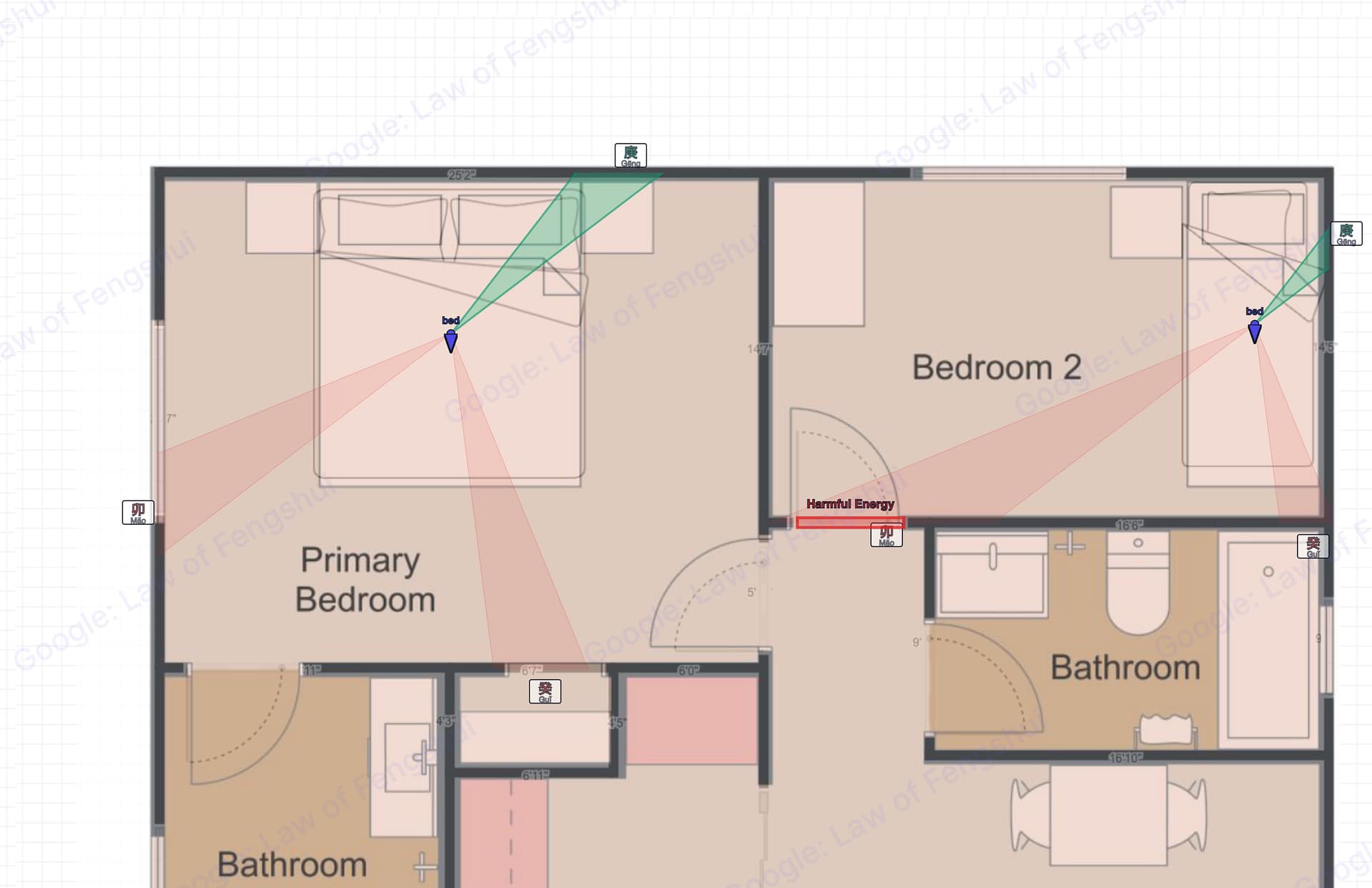
The property is a 2-bedroom, 2-bathroom cottage in La Jolla, California. Approximately 600 square feet with a porch. The main energy entrance faces Northwest at 300 degrees.
Elena recently moved in with her partner. She bought a landscape painting for the primary bedroom and a pair of mandarin duck prints for the guest bedroom. Both are traditional good feng shui bedroom art choices. The question was: which wall in each bedroom should they go on?
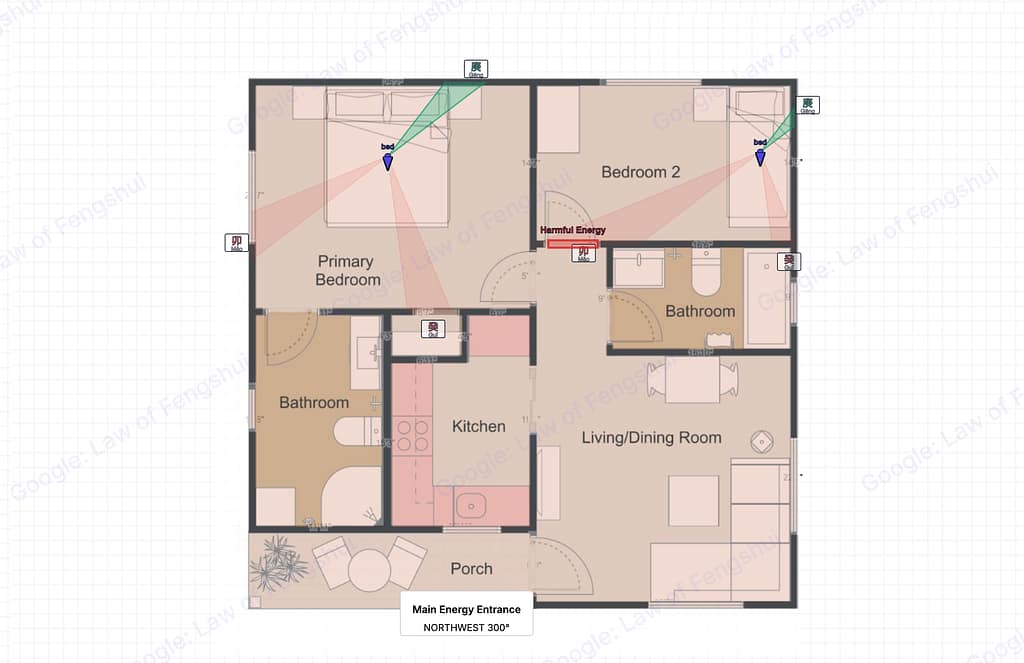
The three-system overlay revealed a clear pattern across both bedrooms.
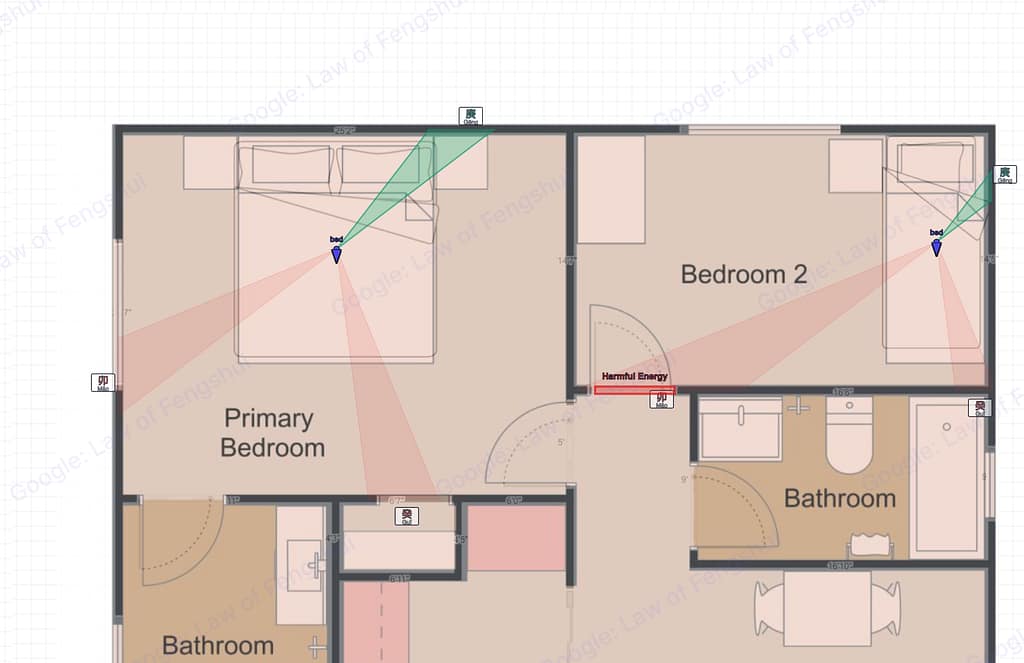
Primary Bedroom (left side of floor plan): The Na Jia Li green sector extended from the bed toward the headboard wall — the top wall where the bed sits against. This is the favorable direction for placing positive artwork. The calm landscape painting Elena picked belongs here, directly above the headboard.
The red sectors — Jie Sha and Ba Sha — fanned from the bed toward the south and southwest walls, covering the wall facing the bed, the wall adjacent to the bathroom, and parts of the lower bedroom area. These walls should remain bare or hold only neutral items. A gallery wall on the south-facing wall — the one Elena was planning to fill with framed prints she could see from bed — would place artwork directly in the robbery sha zone.
Bedroom 2 (right side of floor plan): The same general pattern. Na Jia Li green sector from the bed pointed toward the upper right, covering the headboard area. The mandarin duck prints Elena bought for this room belong on the headboard wall.
Red sectors covered the lower and left portions of the room, including the wall toward the hallway. The hallway between the two bedrooms was marked “Harmful Energy” — placing artwork on the shared wall between bedrooms or in the corridor would be placing decor in an unfavorable zone.
Once you’ve identified the Na Jia Li green wall in your bedroom, the form school rules guide what to hang. These are universal and apply to any feng shui bedroom wall art:
Recommended bedroom art subjects:
What to avoid on ANY wall (form school taboos):
The Na Jia Li, Jie Sha, and Ba Sha Huang Quan sectors are all calculated from the building’s sitting direction. A feng shui compass reading determines which direction the building faces and sits, and each system uses that data to assign favorable and unfavorable sectors.
A bedroom in a south-facing house will have different green and red zones than the same-shaped bedroom in a west-facing house. This is why “always hang art on the east wall” or “peonies go in the southwest corner” are oversimplifications. The compass has to confirm which wall is favorable for your specific property.
In the La Jolla case study, both bedrooms happened to show green zones toward their headboard walls. That’s specific to this building’s 300-degree Northwest entrance. A different cottage oriented differently would produce a different map.
Curious whether your headboard wall or facing wall is in a favorable sector?
Our sample report maps three compass systems onto a real bedroom so you can see which walls support positive artwork and which walls should stay bare.
If you’re choosing where to hang bedroom art using feng shui principles, here’s the practical approach:
Start with the compass, not the art store. Before buying artwork or planning your bedroom wall decor, determine which walls of your bedroom are in favorable sectors. The Na Jia Li system maps this based on your building’s orientation.
The headboard wall is often favorable. In many configurations, the Na Jia Li green sector extends from the bed’s position toward the headboard area. This makes the wall directly above the bed a strong candidate for your best artwork — a carefully chosen landscape painting, a piece of serene floral art, or paired imagery that creates a harmonious feel.
Don’t default to the facing wall. The wall across from the bed feels like the natural choice because it’s what you see. But if it falls in a Jie Sha or Ba Sha red zone, placing your most prominent art there puts positive imagery in a negative sector. The flow of chi through that wall doesn’t support it.
Form school rules are the second layer. After the compass identifies which wall, form school identifies what art. A serene landscape in soft colors on a green-zone wall combines both layers of good feng shui bedroom art.
The map is property-specific. Don’t assume your green and red zones match someone else’s. A feng shui consultation or compass-based analysis maps your specific building. The results are permanent for the property — they don’t change with seasons or years.
Curious what 15+ classical feng shui systems reveal about a real home?
Our sample report shows every overlay on an actual floor plan so you can see the difference between classical analysis and generic advice.
Is it OK to hang pictures above the bed according to feng shui? Yes, if the headboard wall is in a favorable Na Jia Li sector. In many building orientations, the headboard wall lands in a green zone, making it the ideal spot for feng shui bedroom art. The form school caution about heavy frames above the bed still applies — keep the chosen artwork secure and appropriately sized, with the bed at a reasonable height relative to the frame.
What kind of pictures should you hang above your bed feng shui? Calm, nature-inspired art promotes relaxation. Paired imagery (mandarin ducks, two birds, paired flowers) supports relationship energy. Landscape paintings without turbulent water create serenity. Lotus flower artwork and peonies represent prosperity and purity. Avoid dark tones, fierce animals, water themes, and solitary subjects. According to feng shui, the bedroom art should uplift and nurture restful sleep.
What should you NOT hang above your bed? Avoid water imagery (waterfalls, oceans, fish) above the headboard — this can disrupt the room’s energy. No oversized heavy frames (safety and chi pressure). No sunset or declining imagery. No fierce animals. No religious or deity images in the bedroom. And avoid placing any artwork on walls in Jie Sha or Ba Sha red zones, regardless of how calming the piece is.
Does feng shui wall art need to match the five elements? The five elements (wood, fire, earth, metal, water) add another layer. A wall in the east (wood element) benefits from green-toned nature art. A south wall (fire element) should avoid blue or water art. But the Na Jia Li compass analysis comes first — it determines whether that wall is favorable at all. Element matching refines the choice; the compass confirms the wall.
Can the same artwork be good feng shui in one bedroom and bad in another? Yes. The artwork itself doesn’t change, but the wall it hangs on can be in a favorable sector in one room and an unfavorable sector in another — even in the same house. This La Jolla case study showed that both bedrooms had green headboard zones, but the red zones covered different walls. A piece of art that works on one bedroom wall might be placed in a robbery sha sector on a different wall.
What feng shui art attracts love and romance in the bedroom? Paired imagery is the traditional feng shui art for love — mandarin ducks, paired swans, two peonies, or any canvas art featuring pairs. According to feng shui bedroom practice, these should be placed on a wall in the Na Jia Li green sector for maximum effect. Hanging paired imagery in a Jie Sha red zone can undermine the intent.