Address
304 North Cardinal St.
Dorchester Center, MA 02124
Work Hours
Monday to Friday: 7AM - 7PM
Weekend: 10AM - 5PM
Address
304 North Cardinal St.
Dorchester Center, MA 02124
Work Hours
Monday to Friday: 7AM - 7PM
Weekend: 10AM - 5PM

Most feng shui bedroom guides give the same advice: put the bed in the commanding position, clear the clutter, avoid mirrors that face the bed. That advice works. It comes from form school feng shui, and it applies to every bedroom as a reasonable starting point.
But it applies to every bedroom the same way. Same wall, same direction, same logic regardless of who lives there or how the apartment faces. That's where classical compass feng shui starts asking harder questions.
This guide covers the complete feng shui bedroom picture: the universal layout rules that every feng shui expert agrees on, plus the classical compass layer that adds personal specificity to bed placement, headboard position, and energy sector alignment. We'll walk through the He Chong system, the Ba Zhai mirror analysis, yin and yang balance for restful sleep, and a full case study of a Denver apartment where the "obvious" headboard position turned out to be the worst available choice.
If you want to learn how to feng shui your bedroom at the level where it actually gets personal, this is the guide.
Feng shui is an ancient Chinese art of spatial arrangement that has been systematically applied to bedroom design for over three thousand years. The bedroom is a place of sustained energetic exposure, and feng shui offers a precise method for managing that exposure in your favor. The practice centers on arranging the sleeping space to support the flow of chi (qi), the vital energy that moves through all living environments. The bedroom gets special treatment in feng shui for one reason that most guides skip over: sustained exposure time.
You spend six to eight hours a night in a single position in your bedroom, in one compass sector, night after night. No other room comes close to that level of continuous exposure. The bedroom is where classical feng shui applies its most precise recommendations, because the stakes of getting it wrong compound across thousands of sleeping hours.
Most modern feng shui bedroom tips are based on the BTB (Black Tantric Buddhist) system, a Western adaptation of feng shui that maps a standard Ba Gua template onto any room regardless of compass orientation. Under BTB, the wealth corner is always the far left from the door. The relationship corner is always the far right. These positions never change because they ignore compass direction entirely.
Traditional feng shui, at its classical roots, treats compass direction as non-negotiable. From a feng shui perspective, the magnetic compass provides the orientation data that the system requires to generate site-specific recommendations. The sitting and facing direction of your home, the compass sector each wall of your bedroom occupies, and your personal birth year data all interact to determine which positions in your bedroom are genuinely supportive and which create ongoing conflict. This is why two people in identical apartments facing the same direction can have completely different optimal bed positions.
That gap is what this guide addresses. We'll start with the form school baseline that applies universally, then add the classical layers on top.
The commanding position, sometimes referred to as the command position in simplified guides, is the foundation of feng shui bedroom layout. It's also the most scientifically validated concept in all of feng shui. Environmental psychology researchers have confirmed repeatedly that people in beds with a clear sightline to the entry point of a room experience lower background vigilance, better sleep continuity, and reduced cortisol during rest.
The rule is simple: position your bed so you can see the bedroom door from where you sleep, without being directly in line with it. A solid wall should support the headboard behind you. You want a diagonal view to the door, not a straight shot.
Placing the bed directly in line with the door, where your feet point toward the opening, is what classical feng shui calls the coffin position. The direct line of energy flowing from the door toward the sleeping body disrupts rest and is associated with depleted energy over time. It's one of the most consistent rules across every feng shui tradition.
The commanding position doesn't tell you which wall of the bedroom to use. In a standard rectangular room, there are usually two or three viable walls that satisfy the sight-line requirement. Which of those walls you use is where compass direction comes in, and that's a different question entirely.
Our full breakdown of feng shui commanding position, including the environmental psychology research, is worth reading before you finalize bed position. It's the non-negotiable baseline that classical analysis builds on top of.
Once you've identified walls that satisfy the commanding position, the classical system begins. He Chong (合冲) is a Chinese system that maps 12 Earthly Branches to 12 compass sectors. Your birth year determines your personal Earthly Branch. The system then identifies how each compass sector relates to your branch: San He (Three Harmony), Liu He (Six Harmony), Liu Chong (Six Clash), or neutral.
The goal in a bedroom is clear: place the headboard against a harmony-sector wall, and avoid the clash-sector wall. A harmony sector supports your energy while you sleep. A clash sector creates ongoing opposition at the compass level, working against you night after night.
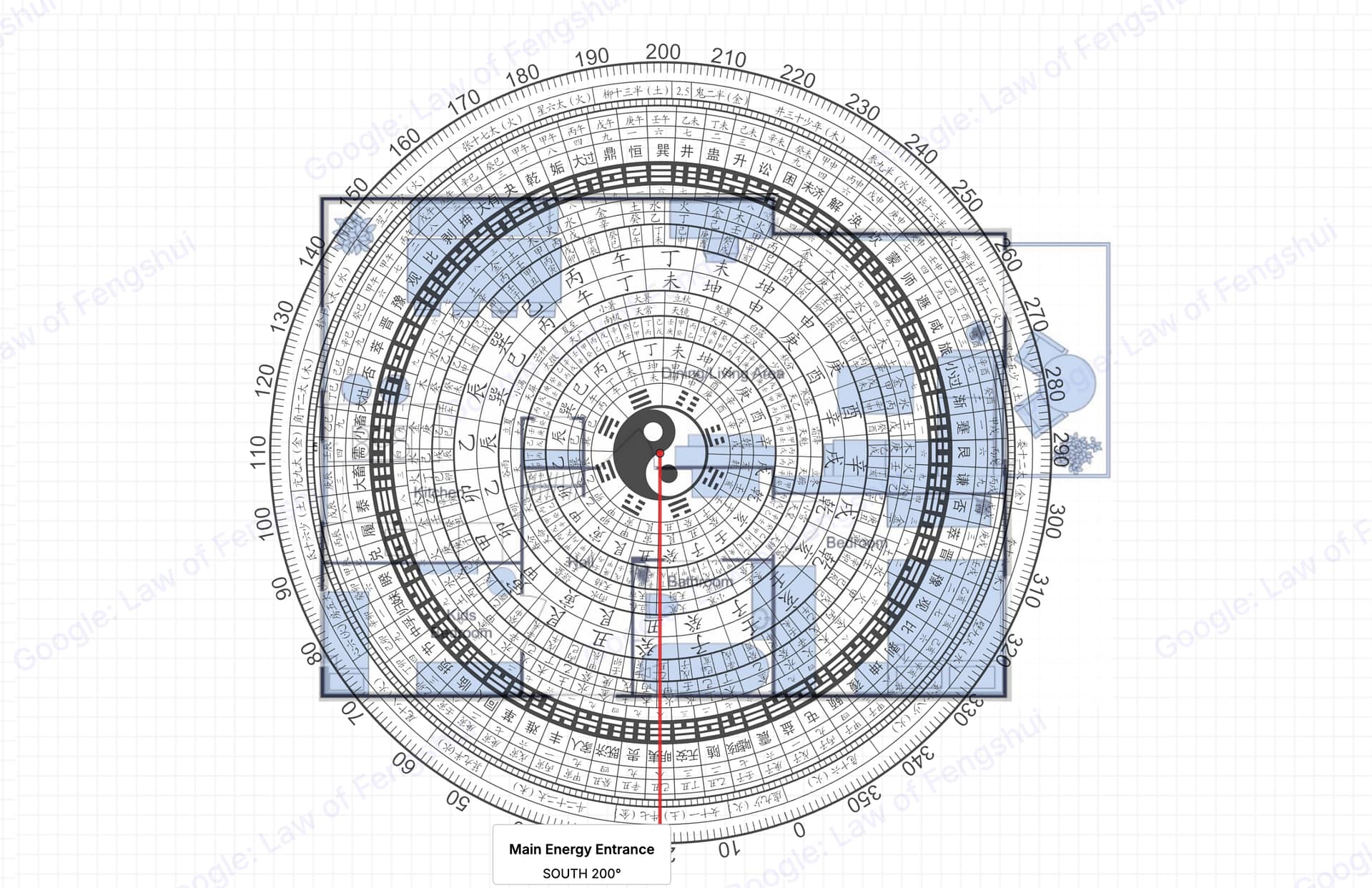
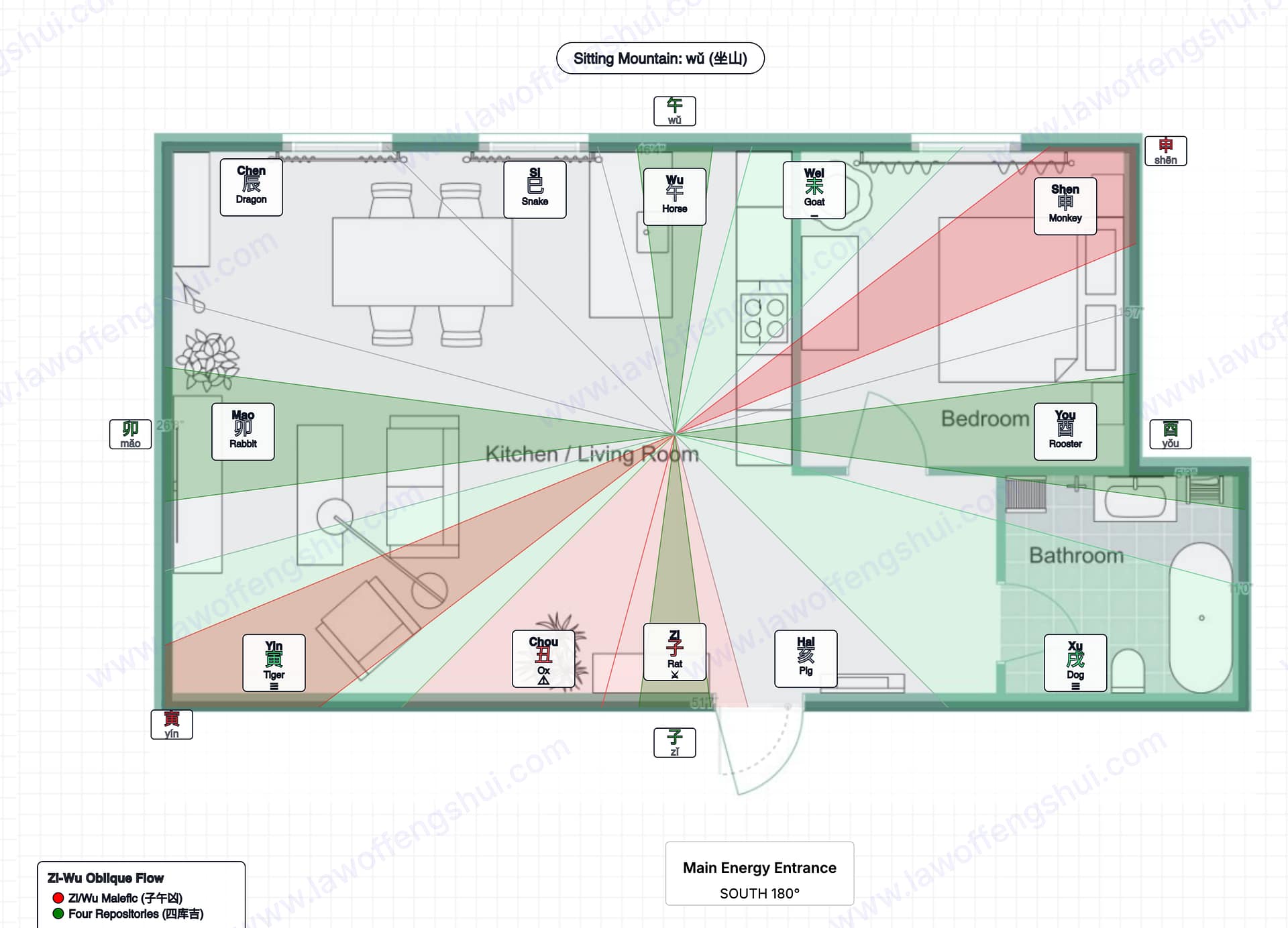
Zi-Wu Oblique Flow (子午斜流) is a second classical system that works independently of personal birth data. It identifies structural energy positions within any building based on compass orientation: two fixed malefic positions at Zi (North, 0 degrees) and Wu (South, 180 degrees), and four auspicious positions called the Four Repositories at ESE, WNW, NNE, and SSW. These positions reflect structural chi flow through the building itself, not personal zodiac relationships.
When both systems agree on a position, either positively or negatively, that consensus carries significant weight in classical feng shui bedroom analysis. A wall that is both a harmony sector under He Chong and a Four Repository position under Zi-Wu is the ideal headboard placement. A wall that triggers a Six Clash under He Chong and sits on the Zi malefic under Zi-Wu is the worst available position, even if it looks like a solid wall from the commanding position perspective.
This two-layer approach is what the feng shui bed placement system uses to generate specific recommendations for each resident. It's not intuitive. It requires compass data and birth year. But it moves bed placement from a generic layout rule to a personal analysis.
The headboard is the focal point of the feng shui bedroom and the most important piece of bedroom furniture in classical analysis. It represents support: structural, energetic, and psychological. Getting the headboard right is a prerequisite before any compass analysis adds value.
Use a solid headboard. Open-frame headboards, metal bars, or designs with gaps and cutouts leave the energy at your head unprotected. A solid, continuous surface, wood being the most commonly recommended material, provides genuine support. The headboard creates the stable backing that the commanding position requires.
Back the headboard against a solid wall, not a window. A bed under a window removes solid wall support behind the headboard entirely. In feng shui, this is considered one of the more serious bedroom layout problems because it leaves the head unsupported during sleep, the period when we're most energetically vulnerable. If a window is unavoidable, a solid, heavy headboard and a window covering that blocks light and creates visual density at the back of the bed are partial mitigations.
Avoid structural beams overhead. A beam running directly over the bed, especially over the sleeping body at the chest or head level, is considered one of the strongest negative influences on sleep quality in feng shui. It's associated with oppressive, downward-pressing energy during the rest period. In a room with exposed beams, the bed position needs to account for beam location before compass analysis begins.
Keep both sides of the bed accessible. Either side of the bed should have clearance and a bedside surface. A bed pushed into a corner with only one accessible side creates asymmetry that classical feng shui considers unsettled. A bedside table on each side, matching where possible, is the traditional recommendation, but the key is symmetry and access, not the furniture itself.
The headboard rules set the physical baseline. Once those are satisfied, compass direction and personal energy data determine which of the compliant walls is the best feng shui bedroom choice for the specific resident. Classical feng shui design adds that personal energy layer: your birth year branch interacts with the compass sectors to identify which headboard wall supports you and which creates ongoing conflict.
Curious which bedroom corner aligns with your personal energy?
Our sample report runs He Chong and Ba Zhai Nine Star on a real floor plan, showing which corner of the bedroom is your best placement based on compass direction.
Mirrors in the bedroom are one of the most debated topics in feng shui. The general rule, well-established in form school, is that mirrors should not reflect the bed. The reasoning is consistent across traditions: a mirror reflecting the sleeping body introduces restless, active energy into what should be a quiet yin space.
The BTB explanation involves "doubling" energy, which creates disruption. The classical explanation is more specific: mirrors are considered yang activators. They amplify movement, light, and activity. The bedroom requires yin energy for restorative sleep. A mirror reflecting the bed keeps the space in a state of energetic arousal that works against deep rest.
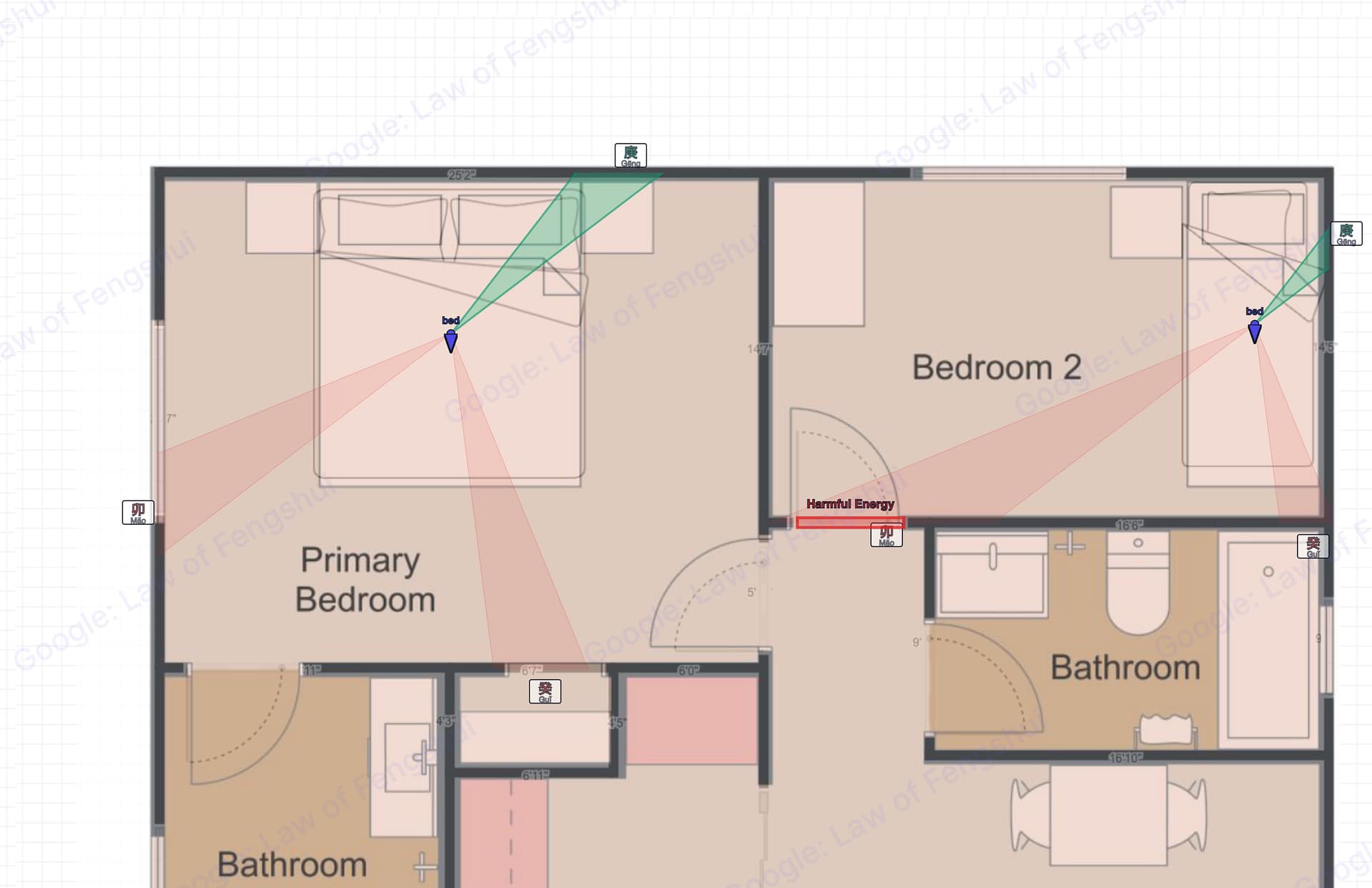
Beyond the universal rule about bed reflection, classical feng shui uses Ba Zhai (Eight Mansions) analysis to evaluate where in the bedroom a mirror creates harmony or conflict based on the compass sector it occupies and the direction it faces. The Ba Zhai system identifies eight directional sectors for any property, each carrying a distinct energy quality. A mirror in an inauspicious sector facing a beneficial direction reads differently than a mirror in a beneficial sector facing an inauspicious one.
This is the layer most bedroom guides skip. Generic advice says "don't reflect the bed." Classical analysis asks which direction the mirror faces, which sector of the room it sits in, and how that relates to the property's sitting and facing direction. The answers change the recommendation significantly depending on the specific apartment.
We ran a full feng shui bedroom mirror analysis using the Ba Zhai compass layer on a separate apartment case study. The classical overlay produced a different placement recommendation than the generic "mirrors on the side wall" default. It's worth reviewing before finalizing any mirror position.
The safe universal rules: no mirror directly facing the bed, no mirror on the ceiling, and no mirror that catches the main entry door's reflection from within the bedroom. Beyond those, the classical layer determines the best available position, and which placement allows positive energy to accumulate in the room rather than being scattered or deflected by an activated reflective surface.
Clutter is the most consistent theme across every feng shui tradition. Classical, BTB, form school, and environmental psychology all agree: accumulated objects in the sleep environment disrupt rest. The mechanisms differ in explanation but converge on the same recommendation.
Clutter under the bed is the most specific feng shui bedroom concern. Items stored under the bed sit in the chi field of the sleeping body during rest hours. Classical feng shui treats this as introducing competing energies into the sleep environment, depending on what's stored. Old documents, clothing, equipment, and especially emotionally charged items are all considered problematic. The simple rule: clear the space under the bed completely when possible. When space constraints make under-bed storage unavoidable, limit it to neutral items like extra linens, and avoid anything with emotional weight or complexity.
Clutter around the bedroom has a different effect. Objects piled on surfaces, closets jammed beyond capacity, and bedroom furniture that blocks natural circulation paths all contribute to what feng shui practitioners describe as stagnant or negative energy. Chi needs to be able to move around the room. When physical clutter blocks the circulation path, the energy pools and stalls. Stagnant energy in the bedroom is associated with persistent fatigue, poor sleep quality, and a general sense that the room doesn't feel restful even after cleaning.
The practical feng shui bedroom standard is clear surfaces, unobstructed circulation paths on both sides of the bed, and nothing stored under the bed that doesn't belong there. These aren't esoteric requirements. They align with what environmental psychology research says about sleep environment complexity and its effect on nervous system arousal during rest. A bedroom where chi can circulate freely accumulates positive energy during sleep hours. A cluttered one allows that energy to escape before it settles and restores.
Yin and yang in the bedroom has a clear directional goal: the space should lean yin. Yang energy is active, stimulating, bright, and fast-moving. Yin energy is quiet, restorative, dim, and still. The bedroom needs to support yin conditions because sleep is fundamentally a yin state.
Most modern bedrooms are over-yang by default. Screens emit blue light that suppresses melatonin and introduces active energy into the sleep environment. Electronics in general bring yang qualities, high-frequency electromagnetic fields, indicator lights, and the psychological weight of connection and activity, into what should be a yin retreat. The feng shui recommendation to remove electronics from the bedroom isn't arbitrary. It's a direct application of yin/yang theory to sleep science.
Color supports yin quality. Soft, muted tones in the cool-neutral to warm-neutral range, think creams, warm whites, sage greens, dusty blues, and soft terracotta shades, promote relaxation. Bright, saturated colors, especially red, orange, and strong yellow, introduce yang stimulation into the bedroom environment. This doesn't mean the bedroom needs to be minimalist or monochromatic. It means the dominant palette should support calm rather than excitement.
Lighting is the other major yin/yang variable in the bedroom. Overhead bright lighting is yang. Soft, warm, directional lighting at lower levels supports the yin transition into sleep. Bedroom lighting ideas from classical feng shui practice are straightforward: warm-toned bulbs, dimmer switches, and no overhead glare during the hour before sleep. Classical feng shui practitioners recommend adjusting bedroom lighting in the evening to gradually shift the space from yang daytime energy to yin sleep energy. Bright lights on until the moment you lie down keeps the bedroom environment in the wrong energetic register.
Natural light during the day is different. Yin and yang are not fixed states, they move through cycles. A bedroom with good natural light during waking hours and the ability to darken effectively at night has the yin/yang balance that classical feng shui considers ideal for sleep. From a feng shui perspective, creating a bedroom that consistently tilts toward yin conditions is the single highest-leverage design adjustment most modern bedrooms can make, and the one that requires the least structural change to achieve.
Small bedrooms present real constraints on commanding position and bed placement options. Knowing how to feng shui your bedroom in limited space means making the best available choice within constraints rather than holding out for the ideal one.
The commanding position remains the priority even in small rooms. If a room is small enough that the bed must be against one of two walls, and only one of those walls gives a sightline to the door, that wall is the choice regardless of compass direction. Form school baseline takes precedence over compass optimization when the alternative is placing the bed directly in line with the door.
For small bedroom layouts where the commanding position is satisfied by multiple options, compass direction determines the final choice. The He Chong personal analysis identifies which of the available walls gives a harmony-sector position. Even a modest advantage in compass alignment is worth choosing when it doesn't compromise the form school baseline.
Clutter becomes more acute in small rooms because there's less space to absorb disorder before it affects the energy quality of the sleep environment. The standard advice to clear under-bed storage is harder to follow when under-bed is the only storage available. In that case, organize it well, keep it limited to neutral items like extra bedding, and avoid emotional or complex items under the bed even when storage is necessary.
Natural light matters more in small bedrooms. The room should be able to receive natural light during daytime hours and darken effectively at night. Blackout curtains or shades that don't make the room feel smaller are worth the investment.
The feng shui room layout framework that maps each piece to its best compass sector applies in small bedrooms too, even with limited options. Sometimes the compass analysis confirms the only viable placement. When it doesn't, knowing which direction each piece is pointing gives you data to work with even when the room is constrained.
Want to see how the commanding position combines with compass-level analysis?
Our sample report runs both physical position checks and 15+ classical compass systems on an actual property so you can see the full picture.
The property is a north-facing 1-bedroom apartment in Denver, Colorado. The resident is Maya, born June 15, 1990. Her Earthly Branch is Horse (午, wǔ).
The compass setup: The apartment faces north. Its main chi entrance runs along the facing side, in the Rat (子) sector. For a Horse-branch resident, this is immediately significant. Rat and Horse hold a direct Six Clash relationship in the He Chong system: a Water-Fire opposition, the strongest conflict pairing in the system. The apartment's primary energy entry, because of the north-facing direction, runs through Maya's worst personal sector.
The bedroom sits on the west side of the apartment, away from the north entrance. This is already a better position at the apartment level. The analysis then moves into the bedroom itself.
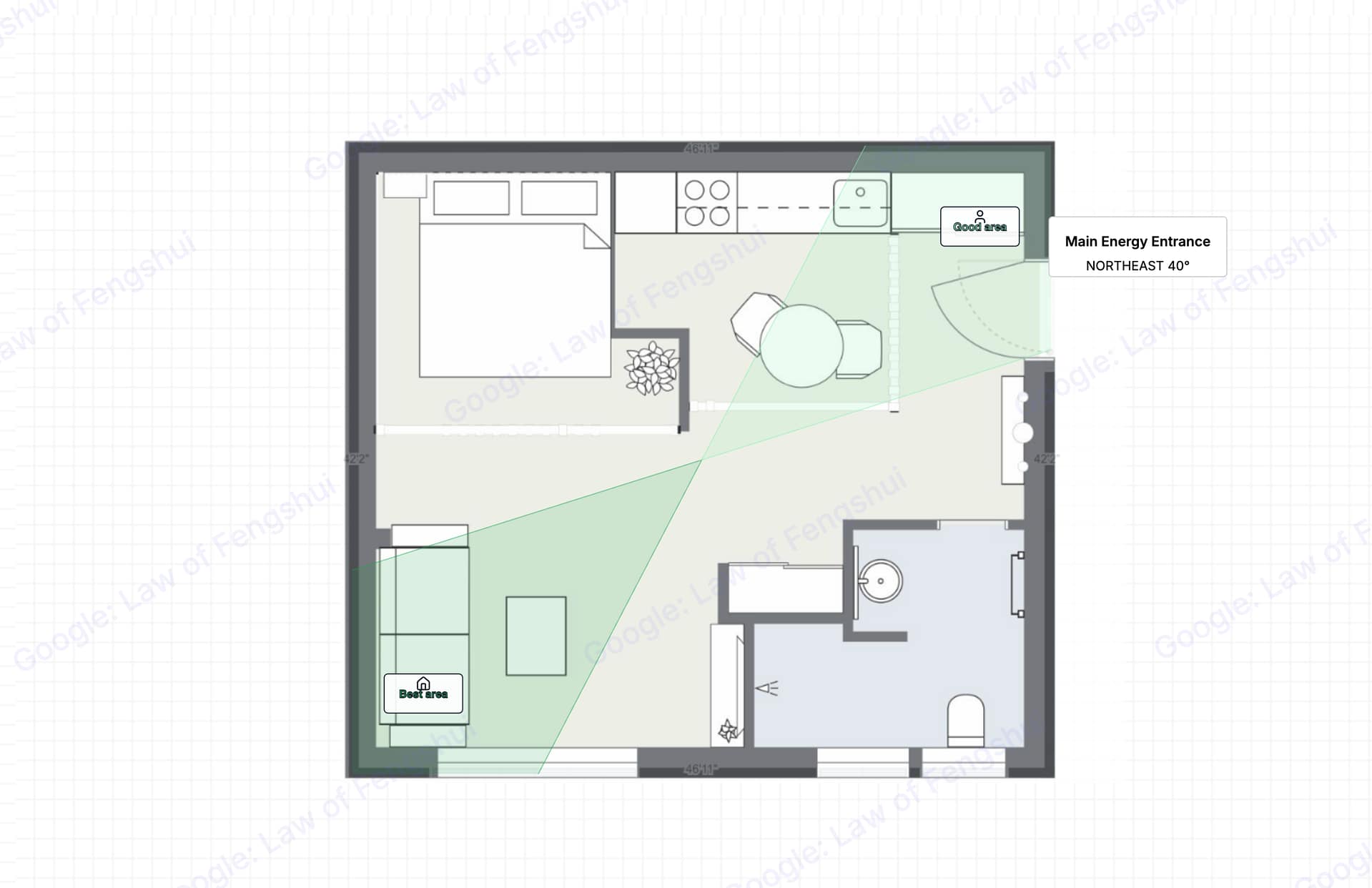
The four-zone bedroom analysis: Applying the "Find Best Bedroom Spot" overlay to Maya's bedroom generates the combined He Chong and Zi-Wu result for each wall and corner of that specific room.
The result was counterintuitive. The north wall of the bedroom, which would typically be the commanding position favorite in a north-facing apartment (it offers a solid wall, solid backing, and allows a diagonal sightline to the main entry), came back as Bad Area under both systems.
Under He Chong, north is the Rat sector: Six Clash with Horse. The strongest conflict pairing. Under Zi-Wu Oblique Flow, north is the Zi direction: one of two fixed malefic positions that the system flags for any building orientation. Two independent systems, same conclusion.
The Bonus Bed position landed in the far SSW corner of the bedroom. In He Chong terms, SSW corresponds to the Goat (未) sector, which holds a Liu He (Six Harmony) relationship with Horse. A compatible pairing, steady and supportive. Zi-Wu independently marks SSW as one of the Four Repositories, a structurally auspicious position. Both systems agree: this is the best available headboard position.

What this means practically: If you set up Maya's bedroom using only the commanding position logic, the north wall looks right. It's solid, it's against the primary entry direction, and it gives a diagonal door view. The compass analysis reveals it as the worst available choice for this resident in this apartment.
The SSW corner, which a form school analysis would overlook or treat as interchangeable with any other wall, is where both classical systems find alignment. Getting there requires measuring compass direction and knowing the resident's birth year. It can't be estimated from a floor plan photo.
This is the gap between generic feng shui bedroom tips and a full feng shui bedroom layout analysis using classical compass systems.
This section consolidates feng shui bedroom tips from both the form school baseline and the classical compass layer. Applied consistently, they help make your bedroom a harmonious feng shui bedroom that supports both personal vitality and restful sleep.
Do's:
Place the bed in the commanding position. See the bedroom door without being directly in line with it. This applies to every bedroom, every person, every compass direction.
Use a solid headboard backed against a solid wall. Avoid windows at the head of the bed. Avoid open-frame or fragmented headboard designs.
Keep matching nightstands on both sides. Balance on either side of the bed supports symmetry and stable energy around the sleep space.
Clear under-bed space completely when possible. What's stored under the bed interacts with the chi field around the sleeping body. Neutral storage like extra linens is the least problematic option when storage is unavoidable.
Check compass direction before finalizing the headboard wall. The commanding position tells you which direction to face from the bed. The He Chong analysis tells you which of the compliant walls is the best feng shui bedroom choice for your personal branch.
Use soft, muted colors. Cool-neutral to warm-neutral tones support the yin energy that sleep requires.
Choose calm art on the wall facing the bed. Peaceful landscapes, gentle natural imagery, and restful artwork reinforce the yin quality the bedroom requires. Active, confrontational, or strongly yang imagery works against the sleep environment you are building.
Keep electronics out of the sleeping environment as much as possible.
Don'ts:
Don't place the bed directly in line with the bedroom door. The foot-toward-door position is the most consistent bad feng shui bedroom rule across every school of thought.
Don't position the headboard under a window. The backing is compromised, and it's considered one of the more significant placement errors in feng shui bedroom design.
Don't put mirrors where they reflect the sleeping body. Mirrors activate yang energy and disrupt the yin conditions that rest requires.
Don't store emotionally complex items under the bed. Even if you can't clear the space completely, what you store there matters.
Don't assume the commanding position answer and the compass answer are the same thing. Maya's case study shows they can point to different walls. When they conflict, the classical approach combines both layers: find the wall that satisfies commanding position and has the best available compass score.
Don't skip the compass layer entirely. Following feng shui bedroom rules also means accounting for annual stars that shift each year, meaning bedroom analysis isn't a one-time event. The classical system treats the bedroom as a dynamic environment that shifts with annual and personal cycles.
Don't let perfect be the enemy of good. A perfect feng shui bedroom isn't achievable in every space. Even a simple feng shui bedroom that gets the commanding position right, keeps the headboard on the best available wall, and clears the major energy blocks delivers the majority of available benefit without renovation.
The bedroom analysis at Law of Fengshui runs the full classical workflow: it takes your floor plan, compass orientation, and resident birth year, and generates the combined He Chong + Zi-Wu four-zone overlay for your bedroom specifically. The result is the Bonus Bed, Good Area, Bad Area, and Bonus Good labels mapped to each corner and wall of your room.
This isn't the same as generic feng shui bedroom tips that apply regardless of who lives there. The overlay is personal. Two residents in the same apartment get different Bonus Bed recommendations. A Horse-branch resident and a Rat-branch resident in the same north-facing apartment will have opposite conclusions about the north wall.
If you want to run your own bedroom analysis, the tool lets you upload a floor plan, set the compass orientation, and enter the birth year. The output is the four-zone map for your bedroom. From there, you can apply the headboard and bed placement rules described in this guide using your actual compass data.
For a more complete picture, working with a feng shui consultant through our feng shui consultation service adds the practitioner layer: reviewing the combined overlay across all rooms, checking how the bedroom result fits with the home's overall Ba Zhai profile, and factoring in annual flying star changes that shift the energy landscape each year. The consultation goes deeper than any single-room analysis. Feng shui helps most when the analysis is personalized to the specific household, and that's precisely what a full consultation delivers.
Curious what 15+ classical feng shui systems reveal about a real home?
Our sample report shows every overlay on an actual floor plan so you can see the difference between classical analysis and generic advice.
What is the commanding position in feng shui bedroom design?
The commanding position places the bed so you can see the bedroom door without being directly in line with it, with a solid wall supporting the headboard behind you. It's the foundational rule in feng shui bedroom layout, drawn from form school feng shui, and it applies universally regardless of compass direction or birth year. Environmental psychology research has confirmed repeatedly that this sight-line arrangement reduces background vigilance during sleep and supports better rest.
Where should you not put your bed in feng shui?
Avoid placing the bed directly in line with the bedroom door (foot of the bed facing the door), under a structural beam, or under a window without solid wall backing behind the headboard. In classical compass feng shui, also avoid the compass sector corresponding to a Six Clash direction for your personal Earthly Branch. For a Horse-branch resident, the north wall is a Bad Area under both He Chong and Zi-Wu Oblique Flow, regardless of how the commanding position logic reads it.
Does your birth year affect feng shui bed placement?
Yes. He Chong maps your Earthly Branch, determined by your birth year, to 12 compass sectors, identifying harmony and clash zones for your specific birth data. A bedroom wall that is a Bonus Bed sector for one birth year can be a Bad Area for another person in the same room. This is the personal layer that distinguishes classical compass feng shui from generic bedroom advice.
What are the feng shui bedroom rules for better sleep?
The core rules for restful sleep: commanding position (see the door without being in line with it), solid headboard against a solid wall, clutter-free under-bed space, no mirrors reflecting the sleeping body, matching nightstands on both sides, minimal electronics, and a yin-dominant color palette. The classical layer adds compass-sector alignment based on your birth year for deeper, personal optimization beyond these universal rules.
Is it bad feng shui to have the headboard against the wall?
A solid headboard backed against a wall is standard feng shui bedroom practice. The question is which wall. Backing the headboard against a harmony-sector wall is the ideal bedroom feng shui arrangement. Backing it against a clash-sector wall creates ongoing conflict even if the physical backing is solid. Classical feng shui bedroom analysis identifies which wall is which based on the resident's personal branch and the room's compass orientation.
What is bad feng shui for a bedroom?
The most consistent bad feng shui bedroom conditions: bed in direct line with the door (coffin position), headboard under a window, mirrors reflecting the sleeping body, electronics in the sleep environment, heavy clutter under the bed, and sleeping in a compass sector that holds a Six Clash relationship with your personal Earthly Branch. The classical system identifies that last point precisely; the form school rules cover the others.
Can a mirror face the bed in feng shui?
No. Mirrors facing the bed are widely considered bad feng shui across every tradition. They introduce yang energy into a yin sleep space and are associated with disturbed, restless sleep. The classical Ba Zhai layer goes further and evaluates where in the bedroom any mirror sits, based on which compass sector it occupies, not just whether it reflects the bed directly.
What feng shui colors are best for a bedroom?
Soft, muted tones that support yin energy. Warm whites, cream, dusty sage, muted terracotta, soft blues, and warm grays all work well. Bright, saturated colors, especially red, bright orange, or electric yellow, introduce yang stimulation into the bedroom. These aren't absolute prohibitions, but the dominant palette should lean toward calm rather than activation.
How many feng shui systems apply to a bedroom?
A complete classical bedroom analysis uses at least three: form school (commanding position, headboard rules, clutter, mirror rules), He Chong (personal Earthly Branch mapped to 12 compass sectors for bed placement), and Zi-Wu Oblique Flow (structural energy positions independent of personal data). Some practitioners add Ba Zhai (Eight Mansions) for mirror placement and room-level energy sectors, and Xuan Kong Flying Stars for annual energy shifts.
What does the foot of the bed facing the door mean in feng shui?
This is sometimes called the coffin position. In classical feng shui, it places the sleeping body in the direct path of chi entering through the door. The energy flow runs from the door through the room and directly toward the sleeping body, which is considered disruptive to rest and associated with depleted energy over time. It's the most consistent "don't" across every feng shui school and one of the easiest to correct by repositioning the bed.
How do I find my Earthly Branch for feng shui bed placement?
Your Earthly Branch is determined by your birth year in the Chinese lunar calendar. The 12 branches rotate in a 12-year cycle: Rat, Ox, Tiger, Rabbit, Dragon, Snake, Horse, Goat, Monkey, Rooster, Dog, Pig. Note that the Chinese New Year falls in January or February, so if you're born in January or early February, check whether your birth date falls before or after Chinese New Year for that year. That determines which branch year applies to you.
Does bedroom feng shui need to be redone every year?
The permanent compass and personal branch analysis doesn't change year to year. He Chong and Zi-Wu results are stable. What shifts annually is the Xuan Kong Flying Star layer, which moves a different configuration of stars through the nine sectors each year. The annual romance star, for example, changes compass position every year. Most classical practitioners recommend reviewing the annual star layer for the bedroom each year as a supplement to the permanent analysis.
Alex Song is the founder of Law of Fengshui, a classical feng shui analysis platform that applies He Chong, Ba Zhai, Xuan Kong, and Zi-Wu Oblique Flow systems to residential and commercial floor plans. Law of Fengshui is the first rule-based system to automate classical feng shui compass analysis at scale.