Address
304 North Cardinal St.
Dorchester Center, MA 02124
Work Hours
Monday to Friday: 7AM - 7PM
Weekend: 10AM - 5PM
Address
304 North Cardinal St.
Dorchester Center, MA 02124
Work Hours
Monday to Friday: 7AM - 7PM
Weekend: 10AM - 5PM

You picked your bedroom by square footage. Maybe closet space. Maybe proximity to the bathroom. Feng shui bed placement picks it differently. Classical feng shui runs two separate calculations before a bed is ever positioned: one for which room, one for which direction the headboard faces. Two layers. Two different systems. And two people sharing the same apartment can get opposite answers for both.
I ran both layers on a south-facing 2-bedroom condo in San Diego. Two residents: Nicole (born 1998, Tiger zodiac) and Ryan (born 1992, Monkey zodiac). Tiger and Monkey carry a direct Six Clash in classical feng shui, the strongest conflict type between two Earthly Branches. Their harmony sectors map to completely different compass bearings. Same apartment. Different best bedrooms. Different best bed directions.
Most feng shui bed placement guides give you one answer: face east, or calculate your Kua number, or just avoid the “coffin position.” Classical feng shui gives you a two-layer answer that changes based on who sleeps in the bed and where the headboard points on a 24-sector compass.
The short answer: The best feng shui bed placement puts your bed in a room whose compass sector harmonizes with your Chinese zodiac, with the headboard pointing toward a 24-Mountain direction that activates your trigram’s best-use energy. Two layers — which room and which direction — not a single Kua number.
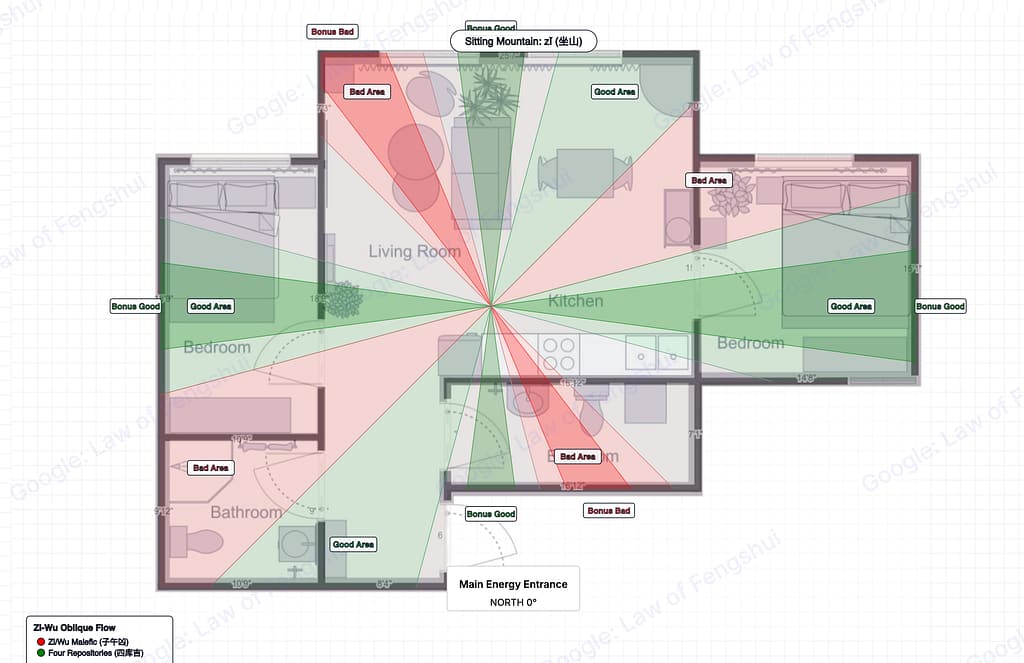
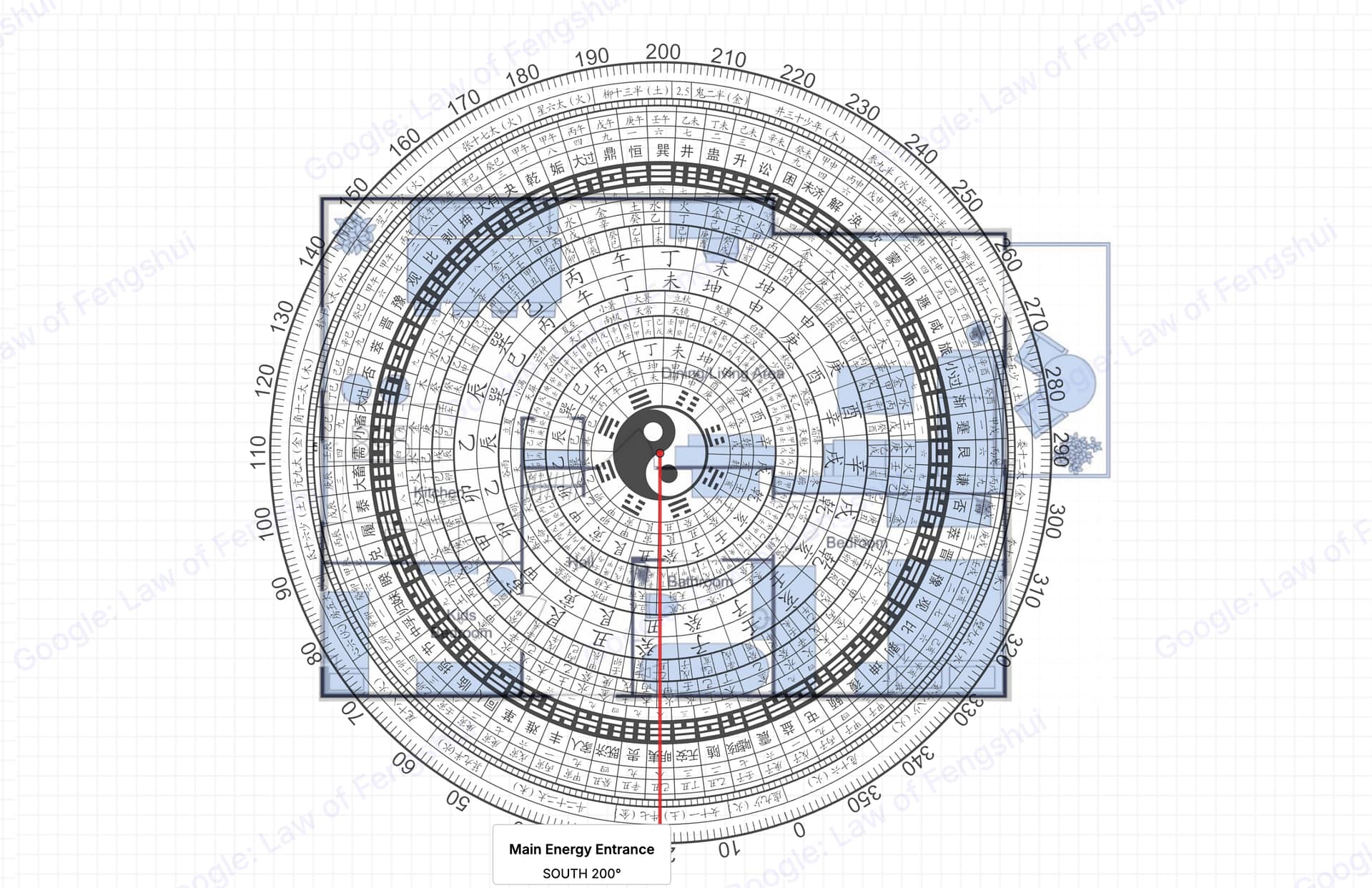
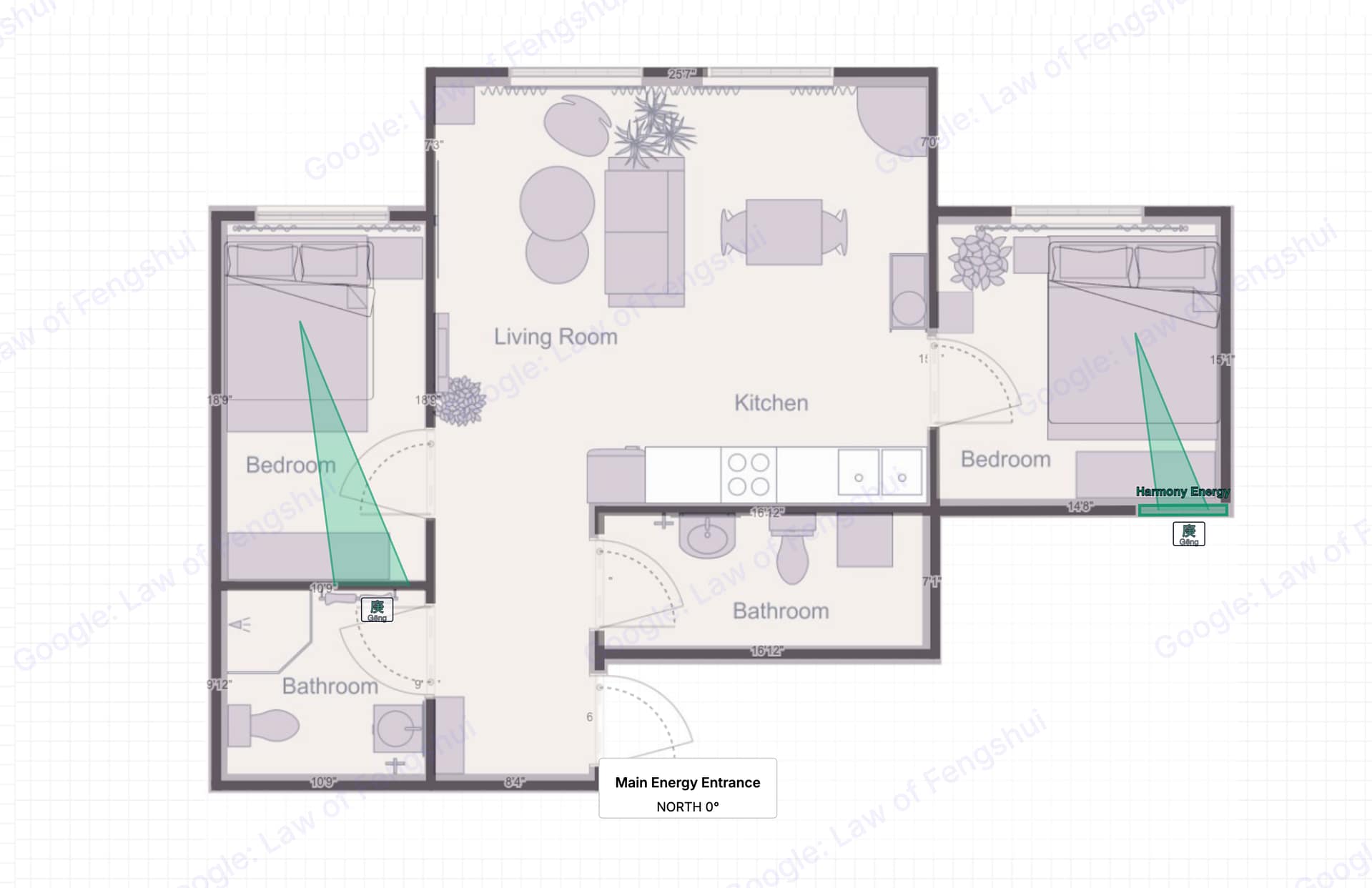
He Chong and Zi-Wu combined overlay. Green sectors mark harmony zones. Red sectors mark clash zones. The left bedroom (west) and right bedroom (east) fall in different energy zones depending on which resident’s zodiac is active.
Feng shui bed placement is the practice of positioning a bed in the best room and the best compass direction based on classical feng shui calculations. The feng shui bed rules most people encounter online involve the commanding position (can you see the door from bed?), avoiding the “coffin position” (feet pointing at the door), and generic cardinal direction advice like “face east for health.”
Those rules aren’t wrong. But they’re incomplete. They apply the same way to every person in every building. Classical feng shui bed placement starts with the building’s compass data and the resident’s birth information, then runs two systems that produce personalized, building-specific answers.
The two systems:
Layer 1 – He Chong (合冲): Determines which room in your home is best for your bed. This layer maps your Chinese zodiac’s Earthly Branch against 12 compass sectors using four relationship types: Triads (San He), Hexads (Liu He), Six Harms (Liu Hai), and Six Clashes (Liu Chong). Sectors that harmonize with your zodiac branch support rest and recovery. Sectors that clash work against you.
Layer 2 – Na Jia Li (納甲理): Determines which direction your bed should face once you’ve picked the room. This layer maps the headboard’s compass direction to one of 24 Mountains, assigns it to a trigram group, and identifies the best-use compass sectors for that trigram. The best-use sectors are where your headboard direction draws the most support.
Layer 1 is personalized. Different people get different rooms. Layer 2 is building-specific. The headboard’s compass position relative to the building determines the best direction.
The He Chong system doesn’t care about room size, natural light, or closet space. It cares about where your zodiac branch sits on the compass and which sectors harmonize with it.
Nicole was born in 1998. Tiger zodiac. Her Earthly Branch is Yin (寅). In the He Chong system, Tiger harmonizes with three branches through the San He Fire Triad: Horse (Wu, South), Dog (Xu, WNW), and the Tiger’s own position (ENE). Tiger also harmonizes through the Liu He Hexad with Pig (Hai, NNW).
Ryan was born in 1992. Monkey zodiac. His Earthly Branch is Shen (申). Monkey harmonizes through the San He Water Triad with Rat (Zi, North) and Dragon (Chen, ESE). Through the Liu He Hexad, Monkey harmonizes with Snake (Si, SSE).
Tiger and Monkey are also a direct Six Clash pair (Yin-Shen). Wood vs Metal. “Strong” intensity. This is the most severe conflict type in the He Chong system. When two residents carry a Six Clash, their energy zones pull in opposite directions.
In this San Diego condo, the left bedroom sits in the western sector. Nicole’s Tiger harmonizes with Dog (WNW). Her harmony energy covers the west side. Ryan’s Monkey has no harmony branch in the west. For Ryan, the right bedroom in the eastern sector is better. His Monkey harmonizes with Dragon (ESE) and Snake (SSE), both pulling toward the east side of the building.
Same apartment. Opposite bedrooms. If Nicole and Ryan shared a bedroom, one of them would be sleeping in a clash zone.
This is the core feng shui bed placement for couples problem. Two people sharing a home need different compass sectors. The He Chong chart doesn’t just pick the best room — it reveals whether a couple’s zodiac branches are compatible enough to share one.
Here’s the He Chong harmony map for all 12 zodiac signs. Each row shows the Earthly Branch, the zodiac animal, and the compass sectors where harmony energy is strongest.
| Zodiac | San He Triad | Liu He Hexad |
|---|---|---|
| Rat | Monkey, Dragon (Water) | Ox |
| Ox | Snake, Rooster (Metal) | Rat |
| Tiger | Horse, Dog (Fire) | Pig |
| Rabbit | Pig, Sheep (Wood) | Dog |
| Dragon | Rat, Monkey (Water) | Rooster |
| Snake | Rooster, Ox (Metal) | Monkey |
| Horse | Tiger, Dog (Fire) | Sheep |
| Sheep | Rabbit, Pig (Wood) | Horse |
| Monkey | Rat, Dragon (Water) | Snake |
| Rooster | Snake, Ox (Metal) | Dragon |
| Dog | Tiger, Horse (Fire) | Rabbit |
| Pig | Rabbit, Sheep (Wood) | Tiger |
This chart replaces the single Kua number that most feng shui bed direction charts use. Instead of one “favorable direction,” the He Chong system gives you a map of multiple harmony sectors based on four types of zodiac relationships. The sectors where Triads and Hexads overlap are the strongest placement zones.
For feng shui bed placement in 2026, the chart above is a starting point. The next step is matching these sectors to actual rooms on your floor plan.
In the 2026 Year of the Fire Snake, the Snake branch (Si 巳) sits in the SSE sector. If your zodiac has a Six Clash with Snake (Pig, Hai 亥), avoid beds in the SSE sector this year. The He Chong room selection chart above remains valid year to year, but annual influences like the Grand Duke (Tai Sui) and Year Breaker add temporary overlays worth checking.
Curious which bedroom is the best fit for you?
Our sample report runs He Chong and Na Jia Li on a real property so you can see how room selection and bed direction work together.
Once you’ve picked the room, the second layer kicks in. Na Jia Li determines the best feng shui bed facing direction based on where the headboard points on the compass.
Here’s how it works. The headboard direction maps to one of the 24 Mountains (each 15 degrees wide). That Mountain belongs to one of 8 trigram groups. Each trigram group has specific “best-use” Mountains where the headboard draws the most support.
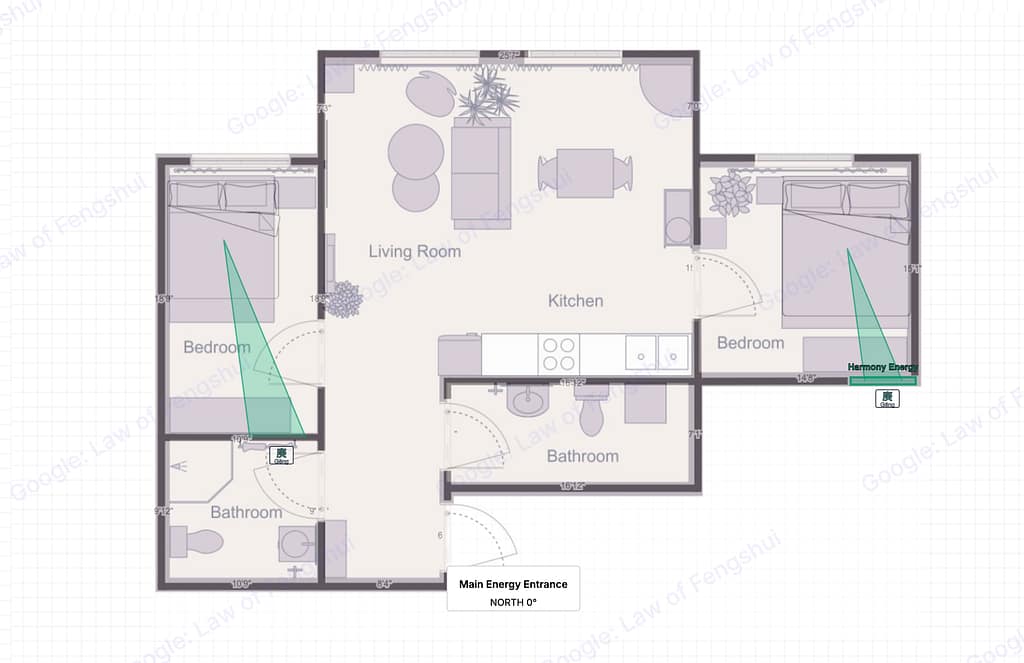
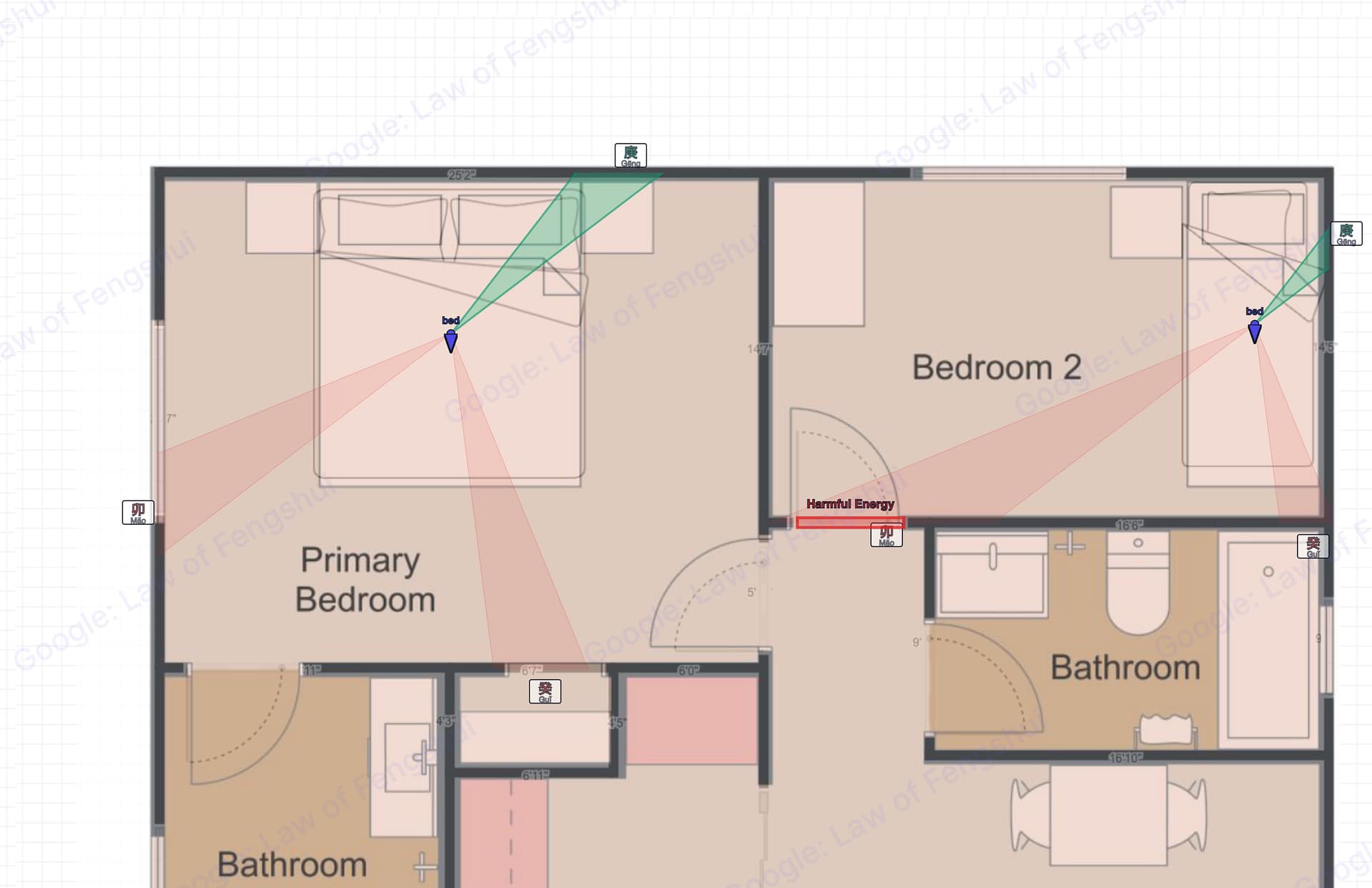
Na Jia Li overlay showing best-use direction sectors (green fans) for each bed. The green sectors indicate where the headboard’s trigram group draws the strongest support energy.
The 8 trigram groups and their best-use directions:
| Trigram | Chinese | Element |
|---|---|---|
| Qian | 乾 | Wood, Water |
| Kun | 坤 | Wood, Water |
| Gen | 艮 | Fire |
| Dui | 兑 | Fire |
| Kan | 坎 | Earth |
| Li | 离 | Earth |
| Zhen | 震 | Metal |
| Xun | 巽 | Metal |
This isn’t about “face east for health.” It’s about the specific 15-degree sector your headboard points toward and which trigram that sector activates.
For Nicole’s bed in the left (west) bedroom, the headboard direction maps to a specific Mountain. That Mountain’s trigram determines which best-use sectors light up green on the overlay. Rotate the bed 15 degrees and the trigram might change, which changes the best-use map entirely.
This is the most searched question in the feng shui bed placement space. And the honest answer: it depends on your building and your birth data.
Feng shui bed facing south: In this San Diego case study, the building faces south (Wu 午). For a bed in the western bedroom with a headboard pointing south, the Mountain is Wu (午), which belongs to the Li (离) trigram. Li’s best-use Mountain is Ji (己, Earth). So a south-facing headboard here isn’t automatically good or bad. It depends on whether Ji’s sector aligns with a favorable zone in the room.
Feng shui bed facing north: The building sits north (Ren 壬). A headboard pointing north would map to Ren (壬) or Zi (子) depending on the exact degree. Ren belongs to the Qian (乾) trigram. Zi belongs to Kan (坎). Different trigrams, different best-use sectors. Five degrees of compass difference can change the entire calculation.
Feng shui bed facing east: East covers three Mountains: Jia (甲), Mao (卯), and Yi (乙). Jia belongs to Qian. Mao belongs to Gen. Yi belongs to Kun. Three trigrams in one cardinal direction. “Face east” isn’t specific enough.
Feng shui bed facing west: West also covers three Mountains: Geng (庚), You (酉), and Xin (辛). Geng belongs to Zhen. You belongs to Dui. Xin belongs to Xun. Three different trigram groups with three different best-use maps.
This is why generic cardinal direction advice falls short. The 24 Mountains divide each cardinal direction into three 15-degree sectors, and each sector maps to a different trigram with different best-use recommendations. “Face south” could mean three different trigram assignments depending on which 15-degree slice the headboard actually points toward.
Should you put a feng shui bed under a window? The classical position says no. A bed against a window places the headboard against an opening, which means the solid backing that supports stable energy isn’t there. In environmental psychology terms, prospect-refuge theory says we sleep better with a solid wall behind our heads and a clear sightline toward the room’s entrance.
But here’s the tension. Sometimes the best compass sector for your headboard is the wall with the window. The He Chong system might say the west bedroom is best for your zodiac. The Na Jia Li system might say the headboard should point west-northwest. And the only west-northwest wall in that bedroom has a window.
Practical solution: if the compass calculation points to a window wall, keep the bed there but add a solid headboard that rises above the window sill. A high headboard or a heavy piece of wall art above the headboard creates the symbolic backing that the classical system calls for. The compass direction takes priority. The physical remedy handles the window concern.
Feng shui bed placement near a window isn’t a dealbreaker. The compass direction matters more than the window. But when you have options, a solid wall behind the headboard is always the stronger setup.
The feng shui bed facing door question is one of the oldest in the practice. The “coffin position” or “death position” places the bed with feet pointing directly at the bedroom door. In both classical feng shui and modern environmental psychology, this is considered unfavorable. The reasoning from the classical side: energy rushes through the door opening and hits the sleeper directly. The environmental psychology side: studies show people sleep with higher cortisol levels when their feet face the door.
The commanding position for a bed places you where you can see the door without being directly in line with it. Diagonal from the door, back against a solid wall, clear sightline. This is the physical positioning rule.
But the commanding position is Layer 0. The physical baseline. Layers 1 and 2 (He Chong and Na Jia Li) add compass-level precision on top of it. You want all three aligned: the commanding position for the physical setup, He Chong for the right room, and Na Jia Li for the right headboard direction.
When they conflict, here’s the priority order: avoid the coffin position first (Layer 0), honor the He Chong room selection second (Layer 1), optimize the Na Jia Li headboard direction third (Layer 2). You can adjust a headboard angle by a few degrees. You can’t easily fix sleeping in the wrong room.
The feng shui bed facing door solution is simple: don’t place the bed directly in line with the door. Then let He Chong and Na Jia Li handle the rest.
Want to see the two-layer bed placement system on a real floor plan?
Our sample report maps zodiac harmony sectors and headboard direction analysis on an actual property for two different residents.
Two of the eight Na Jia Li trigram groups are specifically flagged for wealth energy:
Both Zhen and Xun draw their best-use energy from Metal Mountains. In Five Element theory, this represents structured accumulation. Metal energy supports disciplined wealth building, not windfall luck.
But this is Layer 2 only. For feng shui bed placement for wealth, Layer 1 still matters. If your He Chong analysis puts you in a clash-zone bedroom, the Na Jia Li wealth direction won’t fully compensate. You need the room-level energy working for you before the direction-level energy kicks in.
This is also different from the Ba Gua “southeast wealth corner” that most guides reference. The Ba Gua wealth corner is a fixed sector. Na Jia Li wealth directions change based on where the headboard actually points. Both systems can work together, but Na Jia Li adds a layer of building-specific precision that the Ba Gua map doesn’t.
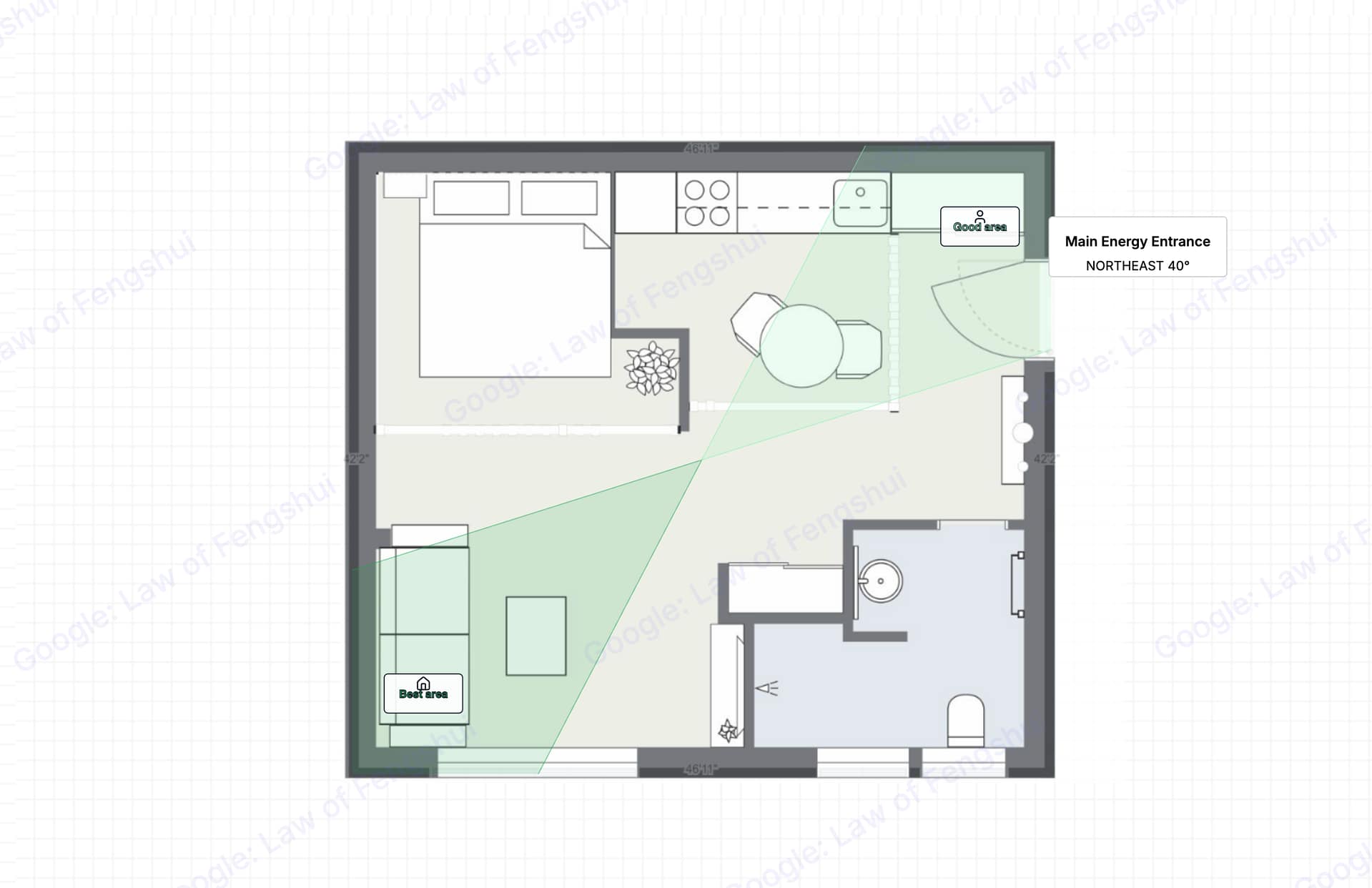
For the Zi-Wu fortune spots visible on the first overlay image, the green “Bonus Good” and “Good Area” labels show where the building’s own fortune zones land. When a bed sits inside a Zi-Wu fortune zone AND the headboard maps to a Zhen or Xun trigram, you get the strongest wealth-supporting configuration.
Small rooms limit your options. You might have one wall for the headboard, no room to angle the bed, and the door might be close enough that every position feels like the coffin position. Feng shui bed placement in a small room becomes an exercise in prioritization.
Here’s the order for small rooms:
A feng shui bed in the corner is fine. Classical feng shui doesn’t penalize corner placement the way some Western feng shui guides do. The compass direction of the headboard is what Na Jia Li evaluates, not whether the bed touches one wall or two. Corner beds are common in small rooms, and the energy reading stays the same.
Bed height also matters for energy flow underneath. Classical feng shui principles recommend space under the bed for air circulation. Platform beds that sit flat on the floor block this circulation. In a small room, a raised bed frame with clearance underneath is preferred over a low platform, even if it makes the room feel taller.
If you’ve searched “feng shui bed placement” before, you’ve probably encountered the Kua number. You add digits of your birth year, reduce to a single number, and get four favorable directions and four unfavorable ones. Simple. Fast. Universal.
The He Chong system works differently. Instead of reducing your birth year to one number, it maps your full zodiac branch (one of 12 Earthly Branches) against four relationship types across 12 compass sectors. The Kua number gives you 8 directions (4 good, 4 bad). He Chong gives you a gradient across 12 sectors with multiple relationship layers.
The biggest difference: Kua number is the same for everyone born in the same year. He Chong uses the same zodiac branch for everyone born in the same year, but the relationship analysis against 12 sectors is richer. The Kua system says “east is good for you.” He Chong says “east-southeast is a Triad harmony, east-northeast is neutral, and east is a Hexad harmony.” Three different readings within the same cardinal direction.
Then there’s Layer 2. Kua number doesn’t have a furniture-level system. He Chong combines with Na Jia Li to add headboard direction analysis. The two-layer approach is what makes classical feng shui furniture placement different from the single-number method.
Neither system is “wrong.” The Kua number is a useful starting point if you want quick guidance. But for the precision that classical feng shui bed placement calls for, the two-layer approach covers ground that a single number can’t.
Curious what 15+ classical feng shui systems reveal about a real home?
Our sample report shows every overlay on an actual floor plan so you can see the difference between classical analysis and generic advice.
There’s no universal answer. Classical feng shui bed placement uses two layers: He Chong maps your zodiac to compass sectors for room selection, and Na Jia Li maps the headboard’s 24-Mountain position to a trigram for direction optimization. “Face east” or “face south” oversimplifies the calculation. The right direction depends on your birth year, the building’s compass orientation, and the exact degree the headboard points toward.
Yes, in both classical feng shui and environmental psychology research. The “coffin position” places your feet directly in line with the bedroom door. Studies show increased cortisol levels in this setup. The fix: position the bed diagonally so you can see the door without being directly aligned. The commanding position puts your back against a solid wall with a clear sightline to the door.
Yes. Nicole (Tiger) and Ryan (Monkey) in this case study carry a Six Clash. Their harmony sectors point to opposite sides of the apartment. In a shared home, He Chong analysis often shows that each resident has a different optimal bedroom based on their zodiac branch. This is one of the biggest gaps in standard feng shui bed placement advice, which assumes one answer fits everyone in the household.
He Chong room selection is based on your zodiac branch, which doesn’t change. Na Jia Li headboard direction is based on the building and the bed’s compass position, which also stays constant. Annual flying stars can add temporary influences, but the two-layer base calculation stays the same year to year. The feng shui bed direction chart above works for 2026 and beyond.
The Ba Gua southeast sector is traditionally associated with wealth. But Na Jia Li identifies specific trigram-based wealth directions (Zhen and Xun) that depend on where the headboard actually points. The Zi-Wu system adds four fortune spots calculated from the building’s compass data. The southeast isn’t automatically the best wealth position for every building.
Classical feng shui prefers a solid wall behind the headboard. A window behind the bed means the energy backing isn’t fully supported. If the best compass direction puts your headboard against a window, use a solid, tall headboard to create a symbolic backing. The compass direction takes priority over the window concern.
Yes. Classical feng shui recommends clearance under the bed for energy circulation. Platform beds that sit directly on the floor restrict airflow underneath. A bed frame with visible space under the bed supports better energy movement. In small rooms, this clearance also helps the room feel more open.
Kua number reduces your birth year to a single digit and gives 4 favorable plus 4 unfavorable directions. He Chong maps your zodiac’s Earthly Branch against 12 sectors using four relationship types (Triads, Hexads, Harms, Clashes). He Chong is more granular. And when paired with Na Jia Li for headboard direction, the two-layer system covers both room selection and furniture-level placement in a way the Kua number can’t.
Sometimes. If the room is wrong (Layer 1), moving to a different room is the strongest fix. If the direction is wrong (Layer 2), rotating the headboard by even 15 degrees can shift the Mountain assignment to a different trigram. Small rotations, angled headboards, or bed risers that create a slight turn are all ways to adjust Na Jia Li without a major rearrangement.
Yes. Apartments use the building’s compass data the same way houses do. The main energy entrance direction determines the compass reference. He Chong maps zodiac sectors the same way regardless of whether you own or rent. Na Jia Li reads the headboard direction the same way in a 600 sq ft apartment as in a 3,000 sq ft house. The case study in this article is a 2-bedroom condo.
Most classical practitioners say yes. A mirror facing the bed reflects energy back at the sleeper, which can disrupt rest. In environmental psychology terms, movement caught in peripheral vision during sleep triggers alertness. The simple fix: cover the mirror at night or reposition it so the reflective surface doesn’t face the bed directly. This is a physical placement rule, separate from the two-layer compass analysis.
Classical feng shui recommends airflow under the bed for energy circulation. Heavy storage blocks this flow. If you must store items underneath, keep them organized, clean, and avoid emotional items (old letters, photos of ex-partners). Platform beds that sit flat on the floor have the same issue — they restrict the space where energy moves around the sleeper.
Run He Chong for both people. If their harmony sectors overlap, they can share a bedroom comfortably. If they carry a Six Clash (like the Tiger-Monkey pair in this case study), their optimal rooms are in opposite compass sectors. Sharing a bedroom means one person sleeps in a clash zone. The compromise: choose the room that harmonizes with the person who has more health or sleep concerns, and optimize the headboard direction via Na Jia Li for the other.