Address
304 North Cardinal St.
Dorchester Center, MA 02124
Work Hours
Monday to Friday: 7AM - 7PM
Weekend: 10AM - 5PM
Address
304 North Cardinal St.
Dorchester Center, MA 02124
Work Hours
Monday to Friday: 7AM - 7PM
Weekend: 10AM - 5PM

Most feng shui content focuses on what to put where – crystals in the wealth corner, mirrors facing the door, plants in the career zone. But classical feng shui starts with something more fundamental: which compass sector of your building should you avoid disturbing at all costs?
Every building sits on one of 24 compass mountains. Each mountain has one fixed sector called Jie Sha (劫煞), which translates to Robbery Star. Environmental disturbance in that sector – a busy road, construction, a large tree, even a water fountain – triggers wealth loss, accidents, and legal disputes.
The other 23 sectors? They don’t carry this specific risk.
The robbery sector is permanent. It doesn’t rotate annually like Flying Star afflictions. It doesn’t depend on who lives in the building or what year it is. One sitting mountain, one robbery sector, forever.
I ran this analysis on a 3-bedroom house in San Francisco to see how it plays out on a real floor plan and its surrounding environment.
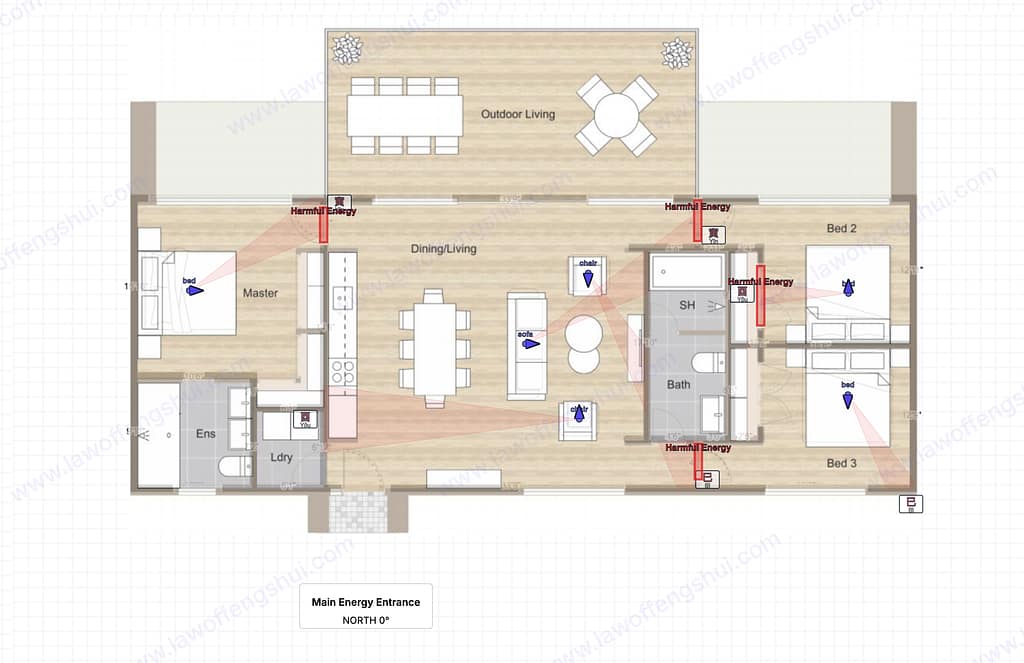
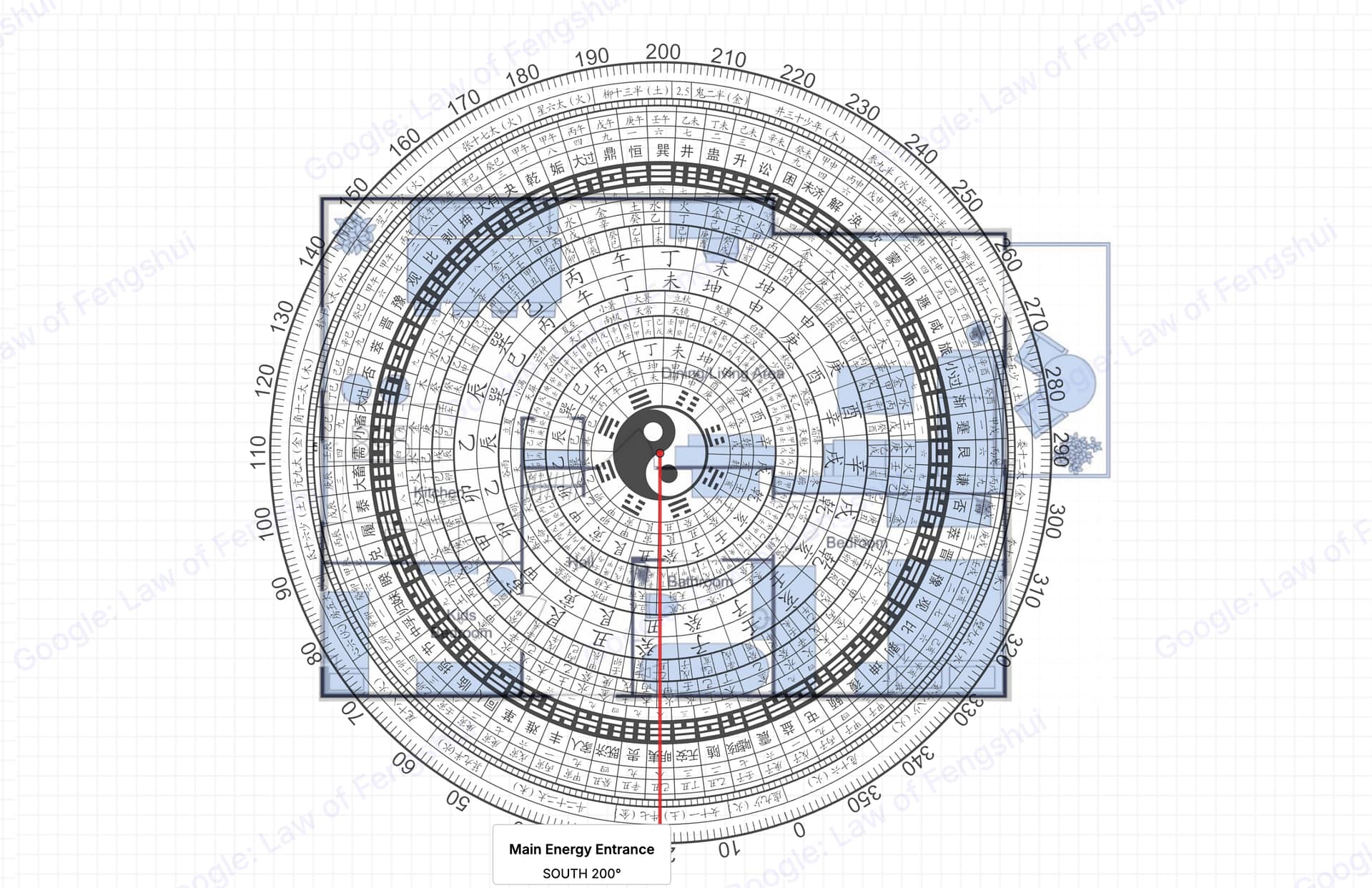
The calculation is straightforward. You measure the building’s sitting direction on a Luo Pan (feng shui compass) to determine which of the 24 mountains it sits on. Then you look up the corresponding Jie Sha sector from a fixed table.
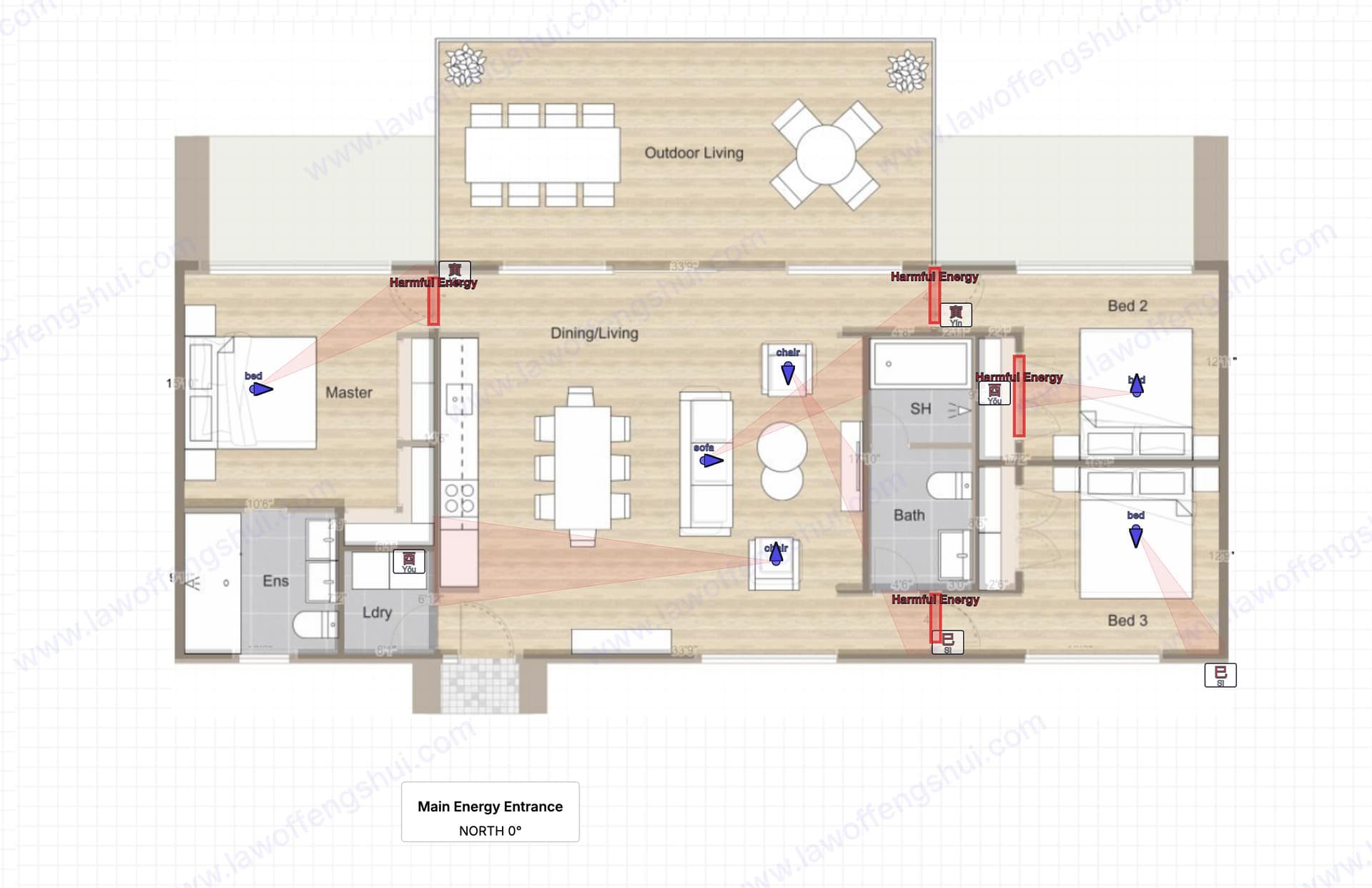
This property at 525 Arkansas Street faces west (You/酉, ~270 degrees). The sitting mountain is Mao (卯, East). The Jie Sha correspondence for Mao is Ding (丁), which falls at 187.5 to 202.5 degrees – south-southwest.
That’s a 15-degree zone. Not a quadrant, not a vague “southern area.” Fifteen degrees of precision. A few degrees of measurement error can shift the sitting mountain and give you the wrong Jie Sha sector entirely. This is why professional feng shui practitioners use a Luo Pan rather than a phone compass.
This house has a split-bedroom design. The master bedroom sits on the left wing with its own ensuite bathroom and the laundry room. The two guest bedrooms (Bed 2 and Bed 3) sit on the right wing, sharing a bathroom between them. A large open dining and living area separates the two wings.
The Jie Sha overlay mapped the Ding sector onto the floor plan. The result: the entire right wing is flagged with “Harmful Energy” markers. Bed 2, the shared bathroom, and Bed 3 all fall within the robbery sector. The master bedroom on the left wing is completely clear.
Same building. Opposite wings. Opposite result.
If children sleep in either guest bedroom, they sleep in the robbery zone every night. If it’s a guest room used occasionally, the exposure is limited. Practical severity depends on how much time someone spends in the flagged sector – a bedroom matters more than a storage closet.
The outerview analysis looked at the property’s immediate surroundings. Two trees near the building were assessed against the Jie Sha sector.
Tall Tree 1 sits in the Ding direction (south-southwest of the property). Flagged.
Tall Tree 2 sits in a different compass direction. Clear.
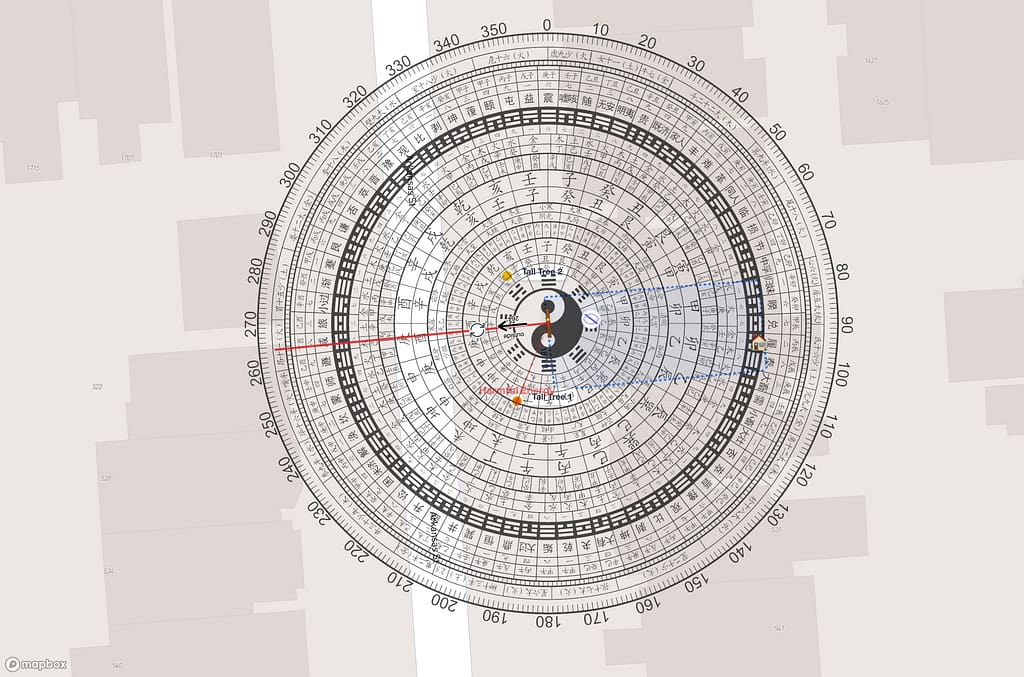
A tree sounds like the last thing that would trigger bad feng shui. But the core activation principle of Jie Sha is: 動則應,靜則不應. Movement triggers. Stillness does not.
Trees generate movement. Wind through branches, leaves rustling, seasonal growth – all qualify as activation. A quiet stone wall in the same sector? No activation. A tree that sways every time the breeze picks up? That counts.
This is the distinction most people miss. The robbery sector isn’t inherently dangerous. It becomes dangerous when something in that direction moves, breaks, or exerts pressure. A freeway is maximum activation (movement + pressure + piercing). A tree is moderate activation (movement). An empty lot is zero activation.
Want to see where the Robbery Star lands on a real floor plan?
Our sample report runs Jie Sha scanning on an actual property and shows which sectors carry loss or conflict energy.
Classical texts describe three categories of Jie Sha consequences:
Wealth drain (財損): Financial leakage, investment failures, penalty payments, ongoing erosion of savings. Not a single dramatic loss, but a pattern where money flows out faster than it flows in.
Physical harm (人傷): Accidents, chronic illness, limb injuries, fertility difficulties. The texts specifically reference physical injuries and bodily harm, not vague “health concerns.”
Disputes (訴訟): Neighbor conflicts, contract disputes, legal troubles, career blockages. Social and professional relationships deteriorate.
The speed of manifestation depends on the severity of the activation. If the main door faces the Jie Sha sector, effects are rapid. If a road or drainage flows directly from that direction toward the property, activation accelerates. A single tree is a slower, lower-intensity trigger compared to a highway on-ramp.
This property’s energy score came back at 43/100 (Fair), with the financial category at -25. That negative financial reading aligns with the Jie Sha prediction of wealth drain when the sector is active.
If you’ve searched for feng shui directions to avoid this year, you’ve probably seen the same three results everywhere: the San Sha (三煞) are in the North, the Five Yellow is in the South, and the Grand Duke (Tai Sui) sits in the South for the Horse year. These are annual afflictions. They move every January.
But nobody mentions the direction that doesn’t move.
Your building’s Jie Sha sector was the same in 2020, is the same now in 2026, and will be the same in 2040. It doesn’t care what year it is, what zodiac animal rules the year, or what Flying Star chart is active. It’s a function of the building’s compass bearing, period. And in the Fire Horse year (2026), where intensified Fire energy amplifies environmental disturbance, an active Jie Sha sector may respond more aggressively than in a quieter year.
The practical difference: your San Sha cure needs to be repositioned every January. Your Jie Sha sector needs to be addressed once and managed permanently.
Curious which sectors in your home carry robbery energy?
Our sample report maps the Jie Sha destructive patterns across a real floor plan based on the property’s sitting direction.
Jie Sha vs. Flying Stars: Flying Stars rotate annually. The Five Yellow affliction moves to a different sector each year, and annual cures change accordingly. Jie Sha never moves. It’s fixed to the sitting mountain for the life of the building.
Jie Sha vs. Ba Sha Huang Quan (Yellow Spring): Both are taboo sector systems, but they use different inputs. Yellow Spring involves the relationship between sitting direction, facing direction, and water flow. Jie Sha uses only the sitting mountain – nothing else.
Jie Sha vs. Kua Numbers: Kua numbers are person-specific. Your birth year determines your favorable and unfavorable directions. Jie Sha is building-specific. It doesn’t care who lives there.
Jie Sha vs. San Sha (三煞): San Sha occupies a broader 90-degree zone and rotates every year based on the zodiac cycle. In 2026, it’s in the North. In 2027, it moves. Jie Sha occupies a narrow 15-degree zone and never rotates. Both can be checked independently, and a property can have both a San Sha concern and a Jie Sha concern simultaneously.
The simplicity is the point. One measurement (sitting mountain), one lookup (correspondence table), one answer (robbery sector location). No complex calculations, no annual adjustments, no resident-specific variables. That makes it one of the fastest checks a practitioner can run, and one of the first things that should be checked before evaluating a property.
If your building has an active Jie Sha sector, the remediation priorities follow a clear hierarchy:
1. Avoidance (most effective). Relocate the main door to miss the Jie Sha sector. Adjust drainage so outflow doesn’t run through the sector. In new construction or site selection, eliminate properties with major roads or bridges in the robbery direction.
2. Form buffering. When avoidance isn’t possible, add physical barriers between the property and the activating feature. Vestibules, interior screens, entrance halls that bend the qi path. Hedges, boundary walls, or landscaping that screens sharp forms. Curved paths instead of direct sightlines.
3. Professional micro-adjustment. A qualified practitioner can sometimes tweak the building’s axis by 2-3 degrees so doors and water routes miss the Jie Sha sector. This requires on-site Luo Pan measurement at fenjin precision and is specialized lineage-level work.
For this San Francisco property, the practical recommendation is straightforward: avoid using the right-wing bedrooms as primary sleeping quarters if possible. The master bedroom is the safe option. If the guest bedrooms must be used regularly, form buffering (screens, curtain placement, reducing movement-generating items in those rooms) is the next step.
Curious what 15+ classical feng shui systems reveal about a real home?
Our sample report shows every overlay on an actual floor plan so you can see the difference between classical analysis and generic advice.
What is Jie Sha in feng shui? Jie Sha (劫煞) is the Robbery Star – a classical feng shui system that identifies one specific 15-degree compass sector in every building where environmental disturbance triggers negative effects including financial loss, physical harm, and legal disputes. It’s determined by the building’s sitting mountain on the 24-mountain compass and never changes.
Is bad feng shui from Jie Sha permanent? The robbery sector itself is permanent – it’s fixed to the building’s sitting direction for the life of the structure. But the effects only activate when there’s disturbance (movement, construction, sharp features) in that sector. A quiet robbery sector has no negative impact.
Can a tree cause bad feng shui? In the Jie Sha system, yes – if the tree sits in the building’s robbery sector. Trees generate movement through wind, which counts as an activation trigger. The principle is 動則應,靜則不應 (movement triggers, stillness does not). A tree in any other compass sector is not a Jie Sha concern.
How is Jie Sha different from Flying Stars? Flying Stars rotate annually – the Five Yellow and other afflictions move to different sectors each year. Jie Sha is static. It’s determined once by the sitting mountain and never changes. They’re separate systems that can be checked independently.
What should I check first – Jie Sha or Flying Stars? Jie Sha is faster to check (one measurement, one table lookup) and identifies a permanent risk. Flying Stars require knowing the construction year and facing direction, and the results change annually. Many practitioners check Jie Sha first as a baseline because it’s the simplest, most permanent taboo sector assessment.
What feng shui directions should I avoid in 2026? In 2026 (Year of the Fire Horse), the annual afflictions are: San Sha (三煞) in the North, Five Yellow in the South, Grand Duke (Tai Sui) in the South. These move every year. But your building also has a permanent Jie Sha sector that doesn’t change yearly. Check both: the annual directions AND your building-specific robbery sector.
How do I know if my house has bad feng shui? One of the fastest checks is identifying your building’s Jie Sha sector. Measure the sitting direction with a compass, find your sitting mountain on the 24 Mountains, and look up the corresponding robbery sector. Then check what environmental features (roads, trees, construction) sit in that direction. If there’s active disturbance in your robbery sector, that’s a permanent feng shui concern worth addressing.