Address
304 North Cardinal St.
Dorchester Center, MA 02124
Work Hours
Monday to Friday: 7AM - 7PM
Weekend: 10AM - 5PM
Address
304 North Cardinal St.
Dorchester Center, MA 02124
Work Hours
Monday to Friday: 7AM - 7PM
Weekend: 10AM - 5PM

There’s a check in classical feng shui that practitioners are supposed to run before anything else. Before bedroom selection. Before furniture placement. Before any of the popular feng shui rules about mirror positions or color choices. It’s called Ba Sha Huang Quan (八煞黃泉) – the Yellow Spring taboo – and most homeowners have never heard of it.
The concept is actually straightforward: given your property’s feng shui compass sitting direction, one specific compass sector is absolutely forbidden for water, drainage, roads, and your main entrance. The formula is encoded in a classical verse that practitioners have memorized for centuries. If your front door opens toward that forbidden sector, you’re looking at what the texts consider one of the worst possible bad feng shui configurations.
I ran this check on a real property in La Jolla, California. The formula flagged one surrounding object in the forbidden direction. Here’s exactly what it found.
Most bad feng shui advice focuses on interior choices. Don’t put a mirror facing the bed. Don’t sleep under a beam. Those matter, but they’re secondary. The Yellow Spring formula addresses something more fundamental: the relationship between your property’s compass orientation and the direction energy enters the home.
In classical feng shui principles, the front door is treated as a “water mouth” (水口). It’s not a metaphor. The door is the primary channel through which qi (spatial energy) enters the home. Every time the door opens, energy from the surrounding environment flows in. If that energy comes from a direction the feng shui compass formula identifies as forbidden, the classical texts describe rapid, direct effects: financial leakage, sudden losses, illness, accidents, and legal friction.
The verse that encodes the feng shui rules: “Geng Ding at Kun is Yellow Spring; Yi Bing at Xun; Jia Gui at Gen; Xin Ren at Qian.” Each line maps a sitting direction (determined by the feng shui compass) to one forbidden sector. Eight pairings total. Deterministic. Given your compass reading, the forbidden sector is fixed.
Here are all eight Yellow Spring pairings based on classical feng shui principles. The mechanism is Five Elements restraint – the forbidden sector’s element suppresses your sitting direction’s element:
The formula is universal. Every property has exactly one Yellow Spring sector based on its feng shui compass sitting direction. The question is whether anything important sits in that sector.
I ran the Ba Sha Huang Quan check on a property in the La Jolla neighborhood of San Diego, California. The property faces northeast (艮 Gen, Earth) and sits southwest (坤 Kun, Earth). Configuration: 坤艮. Na Jia Li Trigram Group: Kun.
For Kun sitting, the feng shui compass formula says: Mao (卯), due east at approximately 90 degrees, is the Yellow Spring sector. The classical mnemonic for this pairing is “Kun rabbit” (坤兔) – Kun Earth is restrained by Mao Wood. Wood controls Earth.
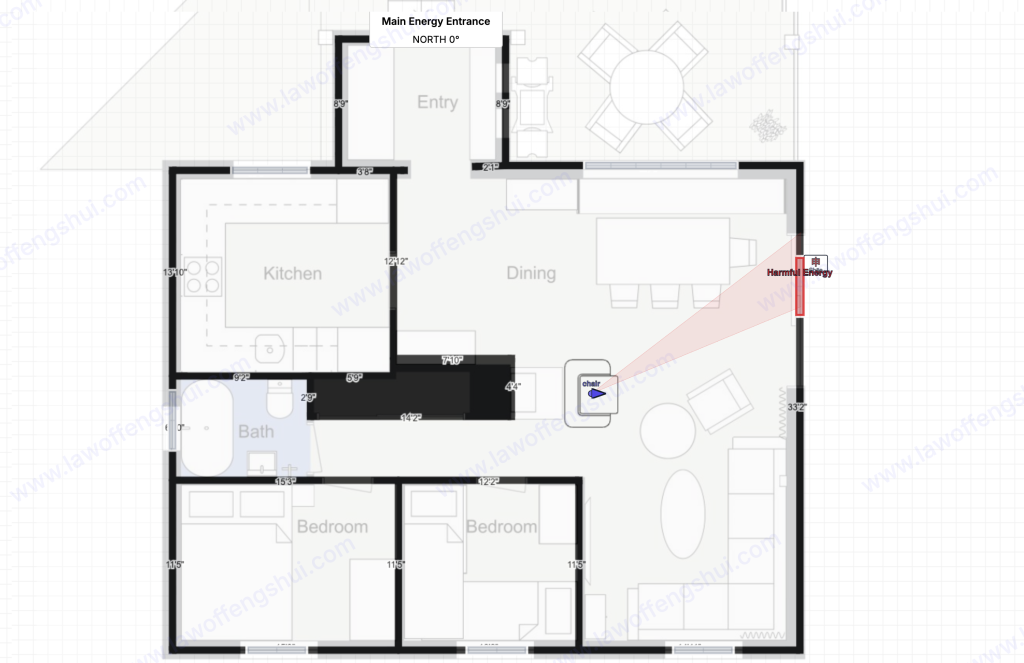
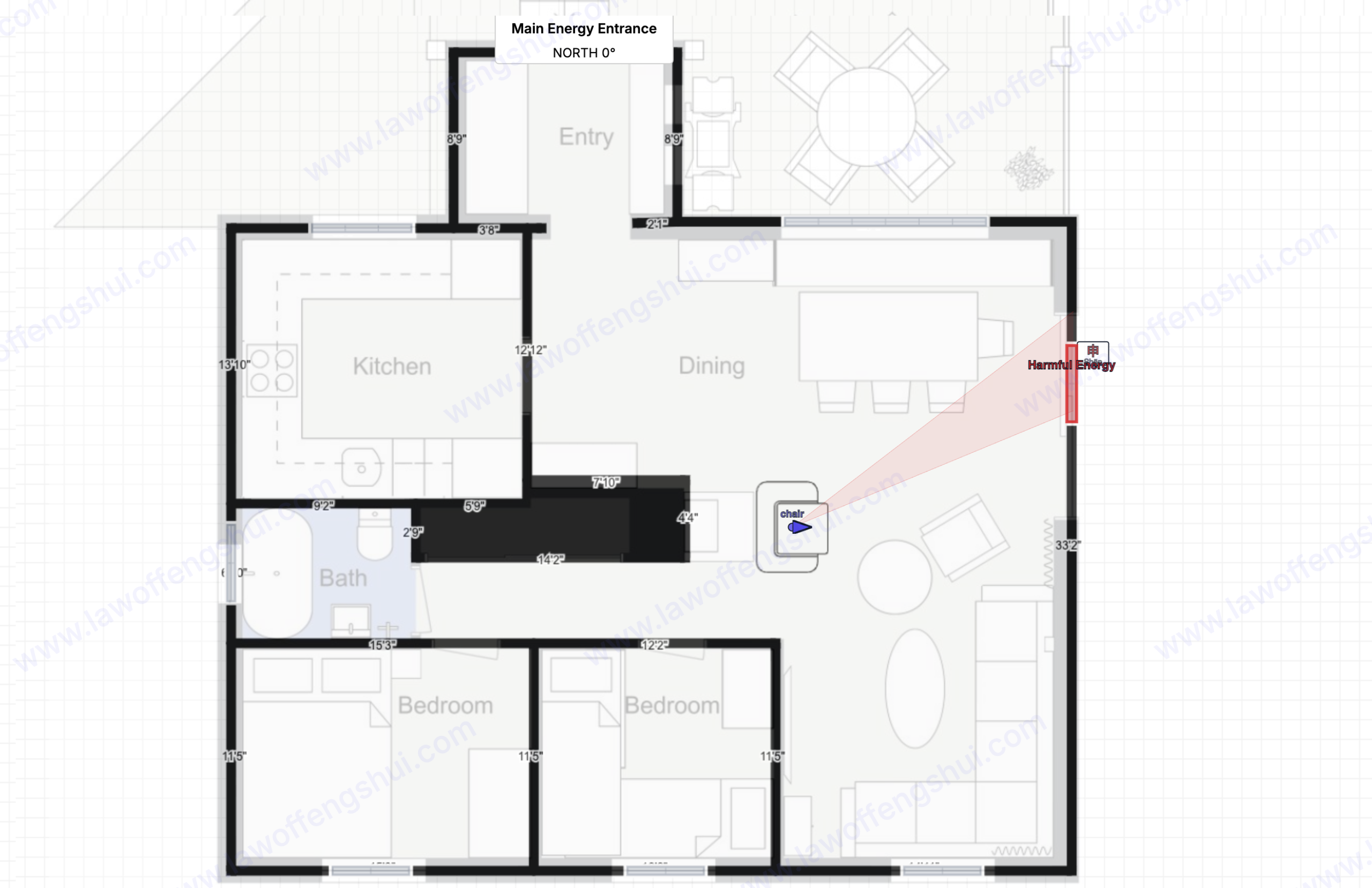
On the innerview overlay, the east portion of the floor plan lights up in red. The forbidden zone cuts across the dining area toward the east wall. There’s a chair placed right in the harmful energy path. The tool’s advice: “Avoid placing doors or windows in this sector. Do not position movement-generating items (fish tanks, water fountains, fans) or inauspicious items (trash bins) here.”
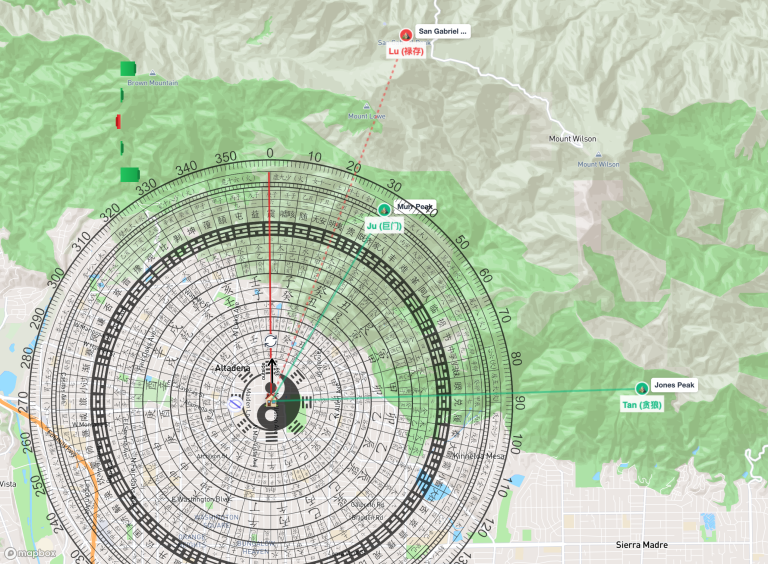
The outerview analysis scanned surrounding objects and checked them against the Yellow Spring formula. Result: 1 object in Ba Sha (harmful water) direction out of 1 analyzed.
The object: a tree to the east of the property, sitting directly in the forbidden Mao (卯) sector.
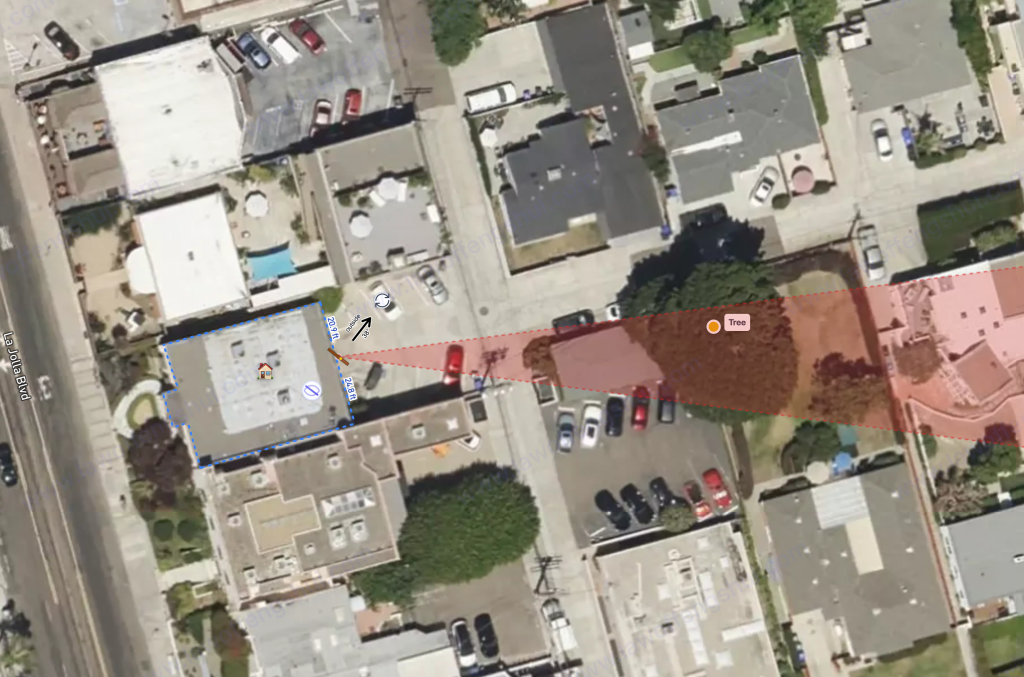
The report states it plainly: “Tree – Forbidden water direction: 卯 (Mao).”
A tree isn’t a water feature or a road. But in the classical framework, anything that generates qi movement in the forbidden sector contributes to the violation. The key isn’t the tree itself. The key is that the forbidden sector extends east from this property, and any significant feature in that direction gets evaluated.
One of the most common feng shui mistakes in modern application is focusing only on visible water. The classical formula applies to “virtual water” – roads, driveways, traffic corridors, pedestrian paths, and yes, significant landscape features like large trees. A main road approaching your property from the Yellow Spring sector creates the same violation as a water channel from that direction.
This means the bad feng shui check extends beyond your front door. A driveway curving in from the forbidden direction. A busy road running past the property on the east side. Drainage flowing toward the forbidden sector. All relevant.
The classical texts are specific about the effects:
The distinguishing characteristic: speed. Unlike other bad feng shui configurations that build gradually, the Yellow Spring violation is described as producing rapid onset effects. The classical verse ends with “ruin comes in one day” (一旦招凶禍). The tradition treats this as a priority-one issue.
If you find that your feng shui front door, road, or surrounding features fall in the forbidden sector, the feng shui rules for resolution follow a strict priority:
Priority 1 – Avoidance (most effective): Relocate or reorient the main door away from the Yellow Spring sector. In site selection, eliminate properties where the main road approach falls in the forbidden sector.
Priority 2 – Qi rerouting: Add a vestibule, interior screen, or curved entry path that redirects energy flow. Convert a direct approach into a meandering one. Form-based remedies take priority over symbolic cures.
Priority 3 – Professional recalibration: A practitioner with a precision luopan can micro-adjust the sitting/facing angle by 2-3 degrees to shift the door out of the violation range. Not a DIY fix.
The most serious bad feng shui for a front door is the Ba Sha Huang Quan (Yellow Spring taboo) violation. This occurs when your main entrance opens toward the one compass sector that the classical feng shui formula identifies as forbidden for your property’s sitting direction. This La Jolla property sits southwest (Kun), making the east (Mao) sector forbidden. The door is treated as a “water mouth” in feng shui principles. A door in the Yellow Spring sector is considered a top-tier violation.
Your property’s feng shui compass sitting direction determines which compass sectors are favorable and which are forbidden. The Ba Sha Huang Quan formula maps your sitting direction to one specific forbidden sector. This property faces northeast (Gen) and sits southwest (Kun), which means east (Mao) is its Yellow Spring. Two homes on the same street facing different directions have completely different forbidden sectors.
The biggest feng shui mistake is never checking the front door’s compass direction against the Yellow Spring formula. Most homeowners focus on interior feng shui rules like bedroom placement, mirror positions, and furniture arrangement. Those matter, but the Ba Sha Huang Quan check should come first. If your front door or a major surrounding feature violates the Yellow Spring formula, the positive effects of interior arrangements are significantly diminished.
Yes. While the Yellow Spring taboo primarily targets the main entrance, water, and external features, a bad feng shui bedroom that overlaps with the forbidden sector compounds the issue. In the La Jolla property, the forbidden Mao sector cuts across the dining area rather than the bedrooms, but if a bedroom were in that zone, spending 6-8 hours nightly in the forbidden sector would be a significant concern.
Classical feng shui rules follow a priority hierarchy. The Ba Sha Huang Quan (Yellow Spring) check comes first, along with other directional taboo assessments. Next, the sitting/facing relationship with surrounding landforms. Then, internal layout: bedroom placement, kitchen position, door/window configuration. Popular feng shui rules about colors, plants, and decorative objects are useful but rank lower.