Address
304 North Cardinal St.
Dorchester Center, MA 02124
Work Hours
Monday to Friday: 7AM - 7PM
Weekend: 10AM - 5PM
Address
304 North Cardinal St.
Dorchester Center, MA 02124
Work Hours
Monday to Friday: 7AM - 7PM
Weekend: 10AM - 5PM

You bought the tutoring package. You set up the desk lamp, the ergonomic chair, the noise-canceling headphones. You even negotiated screen time limits. But where in the apartment your kid actually sits down to study? That part was decided by whichever bedroom had room for a desk.
Classical feng shui has a system dedicated entirely to academic success. It’s called Wenchang (文昌), the “Literary Star,” and it does something most generic feng shui room layout guides never mention: it calculates the optimal study position two ways, and the two calculations often disagree.
Most feng shui desk placement guides stop at the commanding position or your Kua number. Those are useful layers. But they don’t address the academic-specific system that classical feng shui built for exactly this purpose.
I ran a Wenchang analysis on a 2BR apartment in La Jolla, California, for a mother and her teenage daughter. The building’s academic star pointed East. The teenager’s personal star pointed West. Same apartment, opposite study zones.
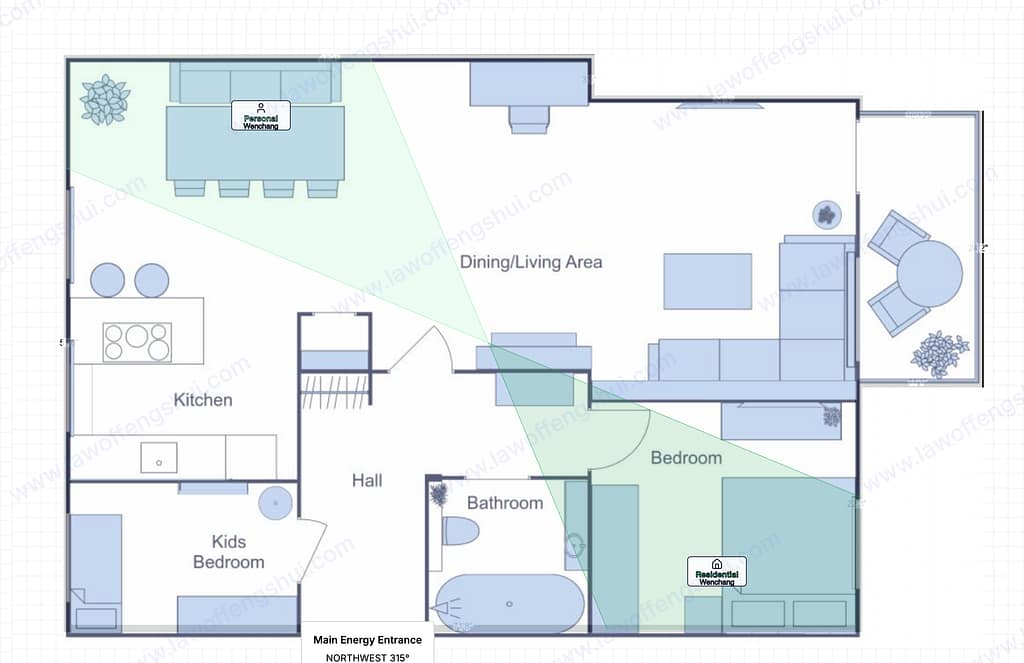
Wenchang (文昌) translates to “Literary Star” or “Star of Academic Success.” In classical feng shui, it’s the system dedicated to intellectual achievement, academic focus, and examination success. While most feng shui office advice focuses on desk direction or room choice, Wenchang goes further. It identifies the specific compass sector of a building where academic energy concentrates.
There are two independent Wenchang calculations:
Residential Wenchang (住宅文昌位): Calculated from the building’s sitting direction using the Eight Mansions (八宅) system. This position is fixed for the building. It doesn’t change based on who lives there. If the building sits on Qian (Northwest), the Residential Wenchang is East. If it sits on Kan (North), the Wenchang is Northeast. Every sitting direction maps to a specific academic sector.
Personal Destiny Wenchang (个人文昌位): Calculated from the person’s birth year. Specifically, the Heavenly Stem (天干) associated with that year determines the personal Wenchang direction. This position is individual and stays constant for the person’s entire life. A person born in 2009 (Heavenly Stem Ji 己) has their Personal Wenchang in the West. A person born in 1983 (Heavenly Stem Gui 癸) has theirs in the East.
When the Residential and Personal Wenchang positions align, that overlap zone is the strongest possible study position. When they disagree, you have a choice: follow the building’s star, follow the personal star, or find a spot that serves both.
This is the biggest misconception in feng shui desk placement advice online. Most guides give a single “best direction” for a study desk, usually the southeast or a direction based on the Kua number. That treats every person in the building as if they share the same optimal study position.
Wenchang shows why that doesn’t work. The building’s academic star is shared. But the personal star depends on the individual. Two siblings born in different years have different Personal Wenchang directions. A parent and child almost certainly have different ones.
The feng shui desk placement conversation usually stops at “face the door” (the commanding position) or “face your good direction” (Kua number). Wenchang adds a layer: which room are you in? Is the room itself in the academic energy zone for your specific birth year?
You can have a desk that faces the right direction in a room that’s in the wrong sector. The commanding position addresses furniture-level placement. Wenchang addresses room-level positioning. Both matter.
If you search “what direction should a study desk face feng shui,” you’ll get answers like “face east for growth” or “face your Kua number’s best direction.” Those aren’t wrong. But they skip the most important question: which room is the desk in?
Wenchang answers the room-level question that desk direction advice ignores. You can face east from a desk in the bathroom and it won’t help. The feng shui desk placement conversation needs two layers: first, is the desk in the correct compass sector of the building? Second, does the desk face a supportive direction within that sector?
The Residential Wenchang tells you which room. The Personal Wenchang tells you whether that room works for the specific person. The commanding position tells you how to orient the desk once you’re in the right room. Skip the first layer and the other two layers are working without a foundation.
A 2019 study in the Journal of Environmental Psychology linked study-space personalization to increased academic motivation. Wenchang is the classical system that personalizes by compass sector and birth year. Most feng shui home office advice treats every person identically. This system doesn’t.
Want to see where your child’s best study spot lands on a real floor plan?
Our sample report calculates the personal Wenchang position from birth year and maps it onto an actual property.
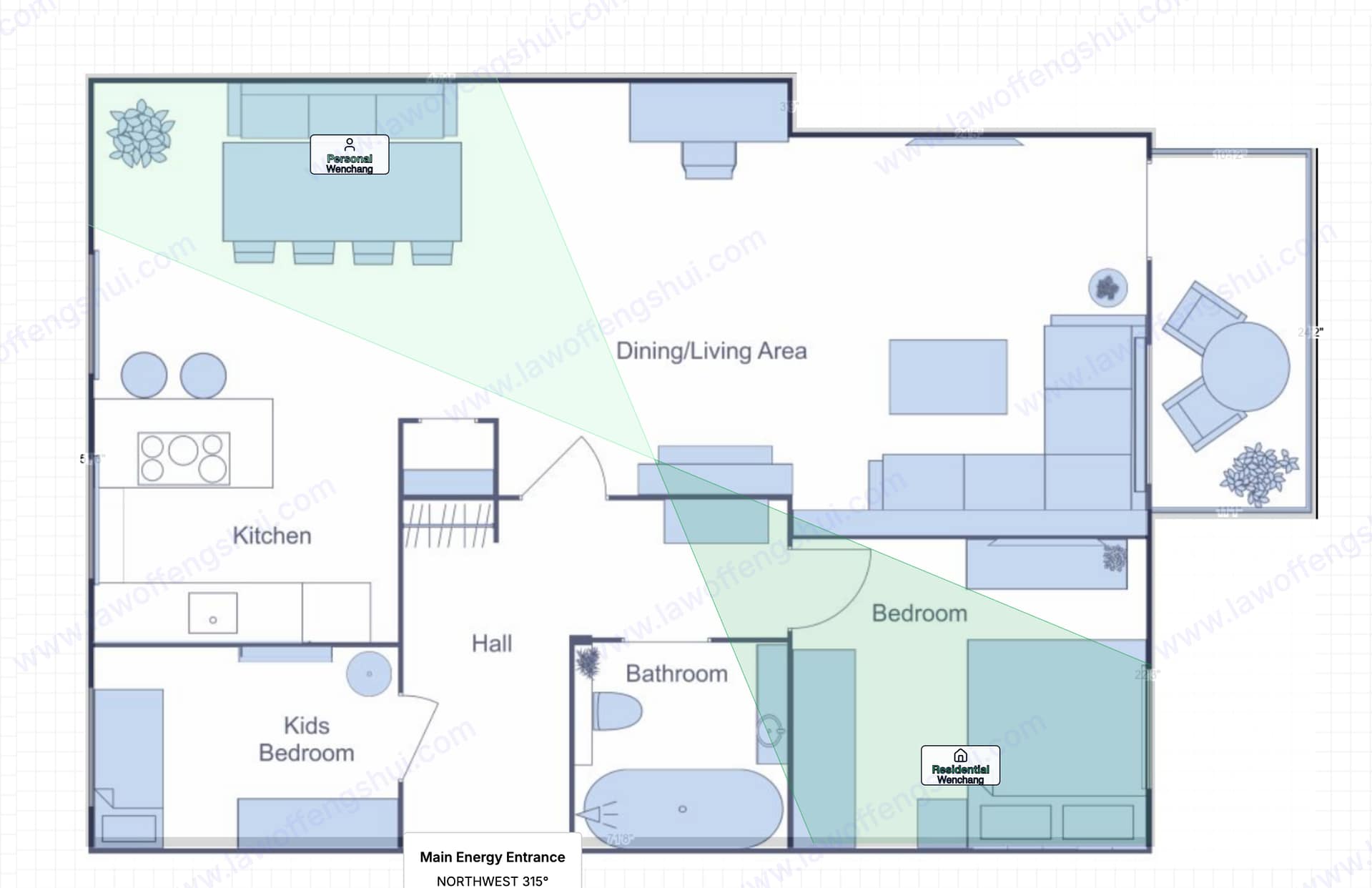
The property is a 2BR apartment in La Jolla, California, approximately 851 square feet. Layout: Kids Bedroom (bottom-left), Bathroom (center-bottom), Bedroom (bottom-right), Kitchen (left), open Dining/Living Area (center-right), Hall (center), and a balcony (upper-right).
Sitting direction: Qian 乾 (Northwest, approximately 315 degrees). Main Energy Entrance at NORTHWEST 315 degrees.
Using the Eight Mansions mapping: Qian sitting -> Residential Wenchang position is East. The eastern sector of the apartment maps primarily to the Bedroom area (lower-right on the floor plan) and part of the Dining/Living Area.
Two residents were analyzed:
Maya, age 17 (born 2009). High school junior preparing for SATs. Birth year ends in 9 -> Heavenly Stem Ji (己) -> Personal Wenchang = West. Her personal academic star points to the western sector, mapping to the Kitchen/Dining area on the upper-left side of the floor plan.
Sarah, Maya’s mother (born 1983). Works from home occasionally. Birth year ends in 3 -> Heavenly Stem Gui (癸) -> Personal Wenchang = East. Her personal star matches the Residential Wenchang exactly.
The Wenchang overlay for Maya shows the split clearly. The Personal Wenchang icon (with a person symbol) sits near the Kitchen/Dining area in the upper-left of the floor plan. The Residential Wenchang icon (with a house symbol) sits near the Bedroom in the lower-right. These are on opposite sides of the apartment.
Maya’s desk is presumably in the Kids Bedroom (bottom-left). That’s neither in her Personal Wenchang zone (Kitchen/West) nor in the Residential Wenchang zone (Bedroom/East). She’s studying in a non-Wenchang area.
The Best Study Area overlay for Sarah tells a different story. Both the dark green (Residential) zone and the light green (Personal) zone converge on the right/lower-right area of the apartment, covering the Bedroom and part of the Dining/Living Area. A “Best Area” label appears near the Bedroom where both zones overlap.
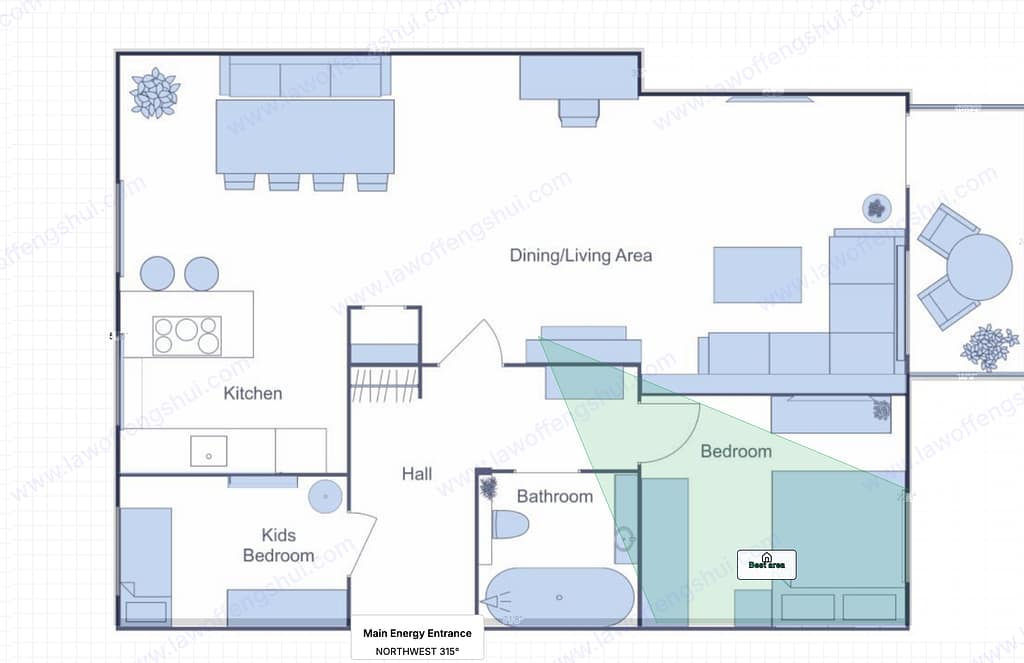
Same apartment. Mother and daughter. The building’s academic energy works for Sarah. Both her personal star and the building’s star agree: study near the Bedroom/East sector. For Maya, the two systems point to opposite sides of the home. The teenager who needs the academic support most doesn’t have alignment.
The practical application of Wenchang doesn’t require a bedroom swap. It’s about where in the entire apartment the desk goes.
Step 1: Find the Residential Wenchang. Determine the building’s sitting direction using a compass. Use the Eight Mansions mapping table above. This gives you the building’s fixed academic zone.
Step 2: Find the Personal Wenchang. Take the student’s birth year. Look at the last digit. Use the Heavenly Stem mapping table. This gives you their personal academic zone.
Step 3: Check for overlap. If both positions point to the same compass sector, that’s the optimal study zone. Set up the desk there.
Step 4: If they disagree, prioritize the Residential Wenchang as the primary option (it’s considered the stronger influence in Eight Mansions theory). But if that zone falls in a kitchen, bathroom, or other unsuitable room, the Personal Wenchang becomes the practical choice.
Step 5: Optimize the spot. Place the desk in the Wenchang sector. Good lighting. Minimal clutter. Books and study materials in the area. The commanding position still applies: the student should see the room entrance from the desk if possible.
For Maya, the practical fix is a small study nook on the western side of the apartment, near where her Personal Wenchang lands. Even a fold-up desk in the Dining area could put her in her personal academic zone. The Wenchang position isn’t about having a dedicated study room. It’s about which compass sector of the home supports focus for that specific person.
The question of whether physical environment affects cognitive performance has research behind it. While no controlled study has isolated Wenchang positions specifically, the broader field of environmental psychology supports the principle that spatial configuration affects focus.
Harvard’s Center for Health and the Global Environment found roughly 12% productivity improvements linked to natural light access and exterior views. Princeton’s Neuroscience Institute demonstrated that visual clutter competes for attention and measurably reduces cognitive processing capacity. Research published in Building and Environment journal found that spatial positioning within a room affects cognitive performance by up to 15%, with desk location relative to walls, windows, and entry points all measurably influencing focus duration. A comparative analysis published in IJASRE found 57% of classical feng shui Form School recommendations align with peer-reviewed environmental psychology research.
The feng shui wealth corner uses a different calculation (Zi-Wu Oblique Flow) to find prosperity zones. Wenchang uses Eight Mansions to find academic zones. Both systems share a core principle: specific compass sectors serve specific functions, and which sector you occupy matters.
Whether Wenchang’s academic benefit comes from the classical explanation (positioning within the Literary Star’s compass zone amplifies intellectual focus) or from environmental factors that correlate with those positions (natural light patterns, noise levels, air circulation), the practical recommendation remains the same: study in the Wenchang sector.
Curious how Wenchang analysis finds the best desk position for each person?
Our sample report runs Wenchang for two residents and shows how their best study spots differ on the same floor plan.
This is common and it’s the main reason Personal Wenchang exists as a backup system. If the Residential Wenchang maps to a bathroom, kitchen, or storage closet, you can’t study there. The Personal Wenchang offers an alternative compass sector.
In cases where both the Residential and Personal Wenchang fall in unsuitable rooms, classical feng shui offers a third option: Wenchang enhancement. Place study-related items (books, calligraphy, a small desk) in the closest accessible area to the Wenchang sector, even if it’s not the exact center of the zone. The edges of the sector still carry some academic energy influence.
The worst scenario for any feng shui home office or study setup is studying in a compass sector that carries negative energy in the building’s chart. For example, if Maya continued studying in the Kids Bedroom and that sector happened to fall in a bad feng shui zone from a different overlay system, the study environment would be doubly undermined. Wenchang is one layer in a multi-layer analysis.
If you’ve looked into feng shui study advice before, you’ve probably encountered Kua numbers. The Kua system (also from Eight Mansions) assigns each person to an East Group or West Group and recommends four favorable and four unfavorable directions.
Wenchang is more specific. Instead of giving you a group of four “good” directions, it identifies a single compass sector dedicated to academic success. The Kua number might say “East Group, favorable directions are North, South, East, Southeast.” Wenchang says “your academic star is in the East, specifically.” It’s the difference between “somewhere in the right half of the city” and “this specific address.”
The Residential Wenchang adds another dimension that Kua numbers don’t have. The building itself has a fixed academic zone that’s independent of who lives there. The feng shui kitchen is evaluated the same way – certain compass sectors are better for certain room functions, regardless of the occupants.
Two kids in the same apartment can have different Personal Wenchang directions but share the same Residential Wenchang. A family of four might have four different Personal Wenchang positions. That’s why “study facing Southeast” is incomplete feng shui home office advice. Which family member? Based on what calculation?
The annual Flying Star #4, the education star, lands in the Northeast for 2026. If your building’s Residential Wenchang doesn’t point to the Northeast, the annual academic energy and the building’s fixed academic energy are in different sectors. That’s already one layer of misalignment most families don’t know about.
Add the Fire Horse year on top of that. 2026’s chart has zero Water element. Fire without Water means speed without cooling, intensity without patience. For students, that translates to shorter attention spans, higher test anxiety, and more difficulty sitting still with difficult material. The feng shui room layout question becomes more urgent when the year’s energy is actively working against sustained focus.
Research published in Building and Environment journal found that spatial positioning within a room affects cognitive performance by up to 15%. In a year that already pressures focus, getting the spatial foundation right is the minimum viable intervention. The desk lamp and ergonomic chair help. But they don’t address which compass sector the student is sitting in.
2026 is the Year of the Fire Horse. The annual chart has zero Water element, which creates an environment of speed, intensity, and restlessness. For students, this means focus may be harder to sustain. The pressure to perform is amplified. Distractions hit harder when there’s no Water to cool things down.
The Wenchang position becomes more relevant in a Fire year, not less. If the study environment is already spatially misaligned (desk in a non-Wenchang sector, back to the door, cluttered surroundings), the Fire year’s intensity compounds the disadvantage. Stabilizing the study environment is the first step before adding academic interventions.
For Maya specifically, a Fire Horse year amplifies the urgency of SAT preparation while reducing the environmental support for sustained focus. Moving her desk to her Personal Wenchang sector (West) gives her spatial foundation that works with her personal chart rather than against it.
Curious what 15+ classical feng shui systems reveal about a real home?
Our sample report shows every overlay on an actual floor plan so you can see the difference between classical analysis and generic advice.
What is Wenchang in feng shui? Wenchang (文昌) is the “Literary Star” in classical feng shui, a system dedicated to academic success and intellectual focus. It identifies the compass sector of a building where academic energy concentrates. There are two calculations: Residential Wenchang (based on the building’s sitting direction, shared by all occupants) and Personal Destiny Wenchang (based on an individual’s birth year, unique per person). The ideal study spot is where both positions overlap.
How do I find my Wenchang position? For Residential Wenchang, determine your building’s sitting direction (opposite of facing) and use the Eight Mansions mapping. For Personal Wenchang, take the last digit of your birth year to find your Heavenly Stem, then map it to a compass direction. For example, birth years ending in 9 (Stem Ji) map to West, years ending in 3 (Stem Gui) map to East.
Does the feng shui home office position change based on who’s using it? Yes. The Residential Wenchang stays the same for the building, but each person’s Personal Wenchang depends on their birth year. Two people in the same apartment can have different optimal study zones. This is why generic “study in the southeast corner” advice is incomplete – it ignores the personal calculation.
Is Wenchang the same as Kua number directions? No. Kua numbers assign you to an East or West Group with four favorable directions. Wenchang identifies a single compass sector for academic success. Wenchang is more specific: instead of “your good directions are North, South, East, Southeast,” Wenchang says “your academic star is specifically in the East.” Additionally, Residential Wenchang evaluates the building independently.
What if my Wenchang position falls in the bathroom or kitchen? Use the Personal Wenchang as a backup. If both positions fall in unsuitable rooms, place study-related items (desk, books, good lighting) as close to the Wenchang sector boundary as possible. The edges of the zone still carry some academic energy influence. Avoid studying in a compass sector that carries negative energy from other overlay systems.
Can Wenchang help with exam performance? Wenchang specifically targets academic focus and examination success in classical feng shui. While no Western controlled study has isolated Wenchang positions, environmental psychology research supports the broader principle that spatial configuration affects cognitive performance. Harvard found 12% productivity improvements from optimized environments. The practical recommendation is the same: study in the Wenchang sector with good lighting and minimal clutter.
Does the feng shui desk placement direction matter inside the Wenchang zone? Yes. Being in the correct Wenchang sector addresses the room-level question. The commanding position addresses the furniture-level question: can the student see the room entrance from the desk without being directly in line with the door? Both layers work together. Right room, right desk position.
How is the Residential Wenchang calculated? Residential Wenchang uses the Eight Mansions system. The building’s sitting direction (opposite of its facing) determines which compass sector holds the academic star. Northwest sitting (Qian) maps to East. North sitting (Kan) maps to Northeast. Each of the eight sitting directions has a unique Wenchang position.
What direction should a child’s study desk face in feng shui? First, confirm the desk is in the correct compass sector (the Wenchang zone for that child’s birth year or the building’s Residential Wenchang). Then apply the commanding position: the child should see the room entrance from the desk without sitting directly in line with the door. Facing East is commonly recommended for growth energy, but the feng shui desk placement that matters most is room-level positioning. A desk facing East in the wrong room is less effective than a desk facing any direction in the correct Wenchang sector.
Does the feng shui study position change every year? The Residential Wenchang (building-based) and Personal Wenchang (birth-year-based) are both fixed. They don’t change annually. However, the annual Flying Star chart adds a temporary layer. In 2026, Flying Star #4 (the education star) sits in the Northeast. If a student’s Wenchang zone happens to overlap with the Northeast, the annual star reinforces it. If not, the annual star and the fixed Wenchang are in different sectors. The fixed Wenchang remains the primary system. The annual star is a secondary consideration, not a replacement.