Address
304 North Cardinal St.
Dorchester Center, MA 02124
Work Hours
Monday to Friday: 7AM - 7PM
Weekend: 10AM - 5PM
Address
304 North Cardinal St.
Dorchester Center, MA 02124
Work Hours
Monday to Friday: 7AM - 7PM
Weekend: 10AM - 5PM

If you’re buying or developing property near hills or mountains, the standard checklist covers views, sun exposure, fire risk, and drainage. Classical feng shui adds something most due diligence reports miss entirely: which peaks are sending favorable energy toward the property and which ones are doing the opposite.
The system that evaluates this is called Mountain Nine Star (山星九星). It’s one of the core landscape analysis tools in the Yang Gong school of classical feng shui, and it maps nine specific star energies onto surrounding peaks, ridgelines, and tall structures based on the property’s compass orientation. I ran this analysis on a real foothill property to show how it works and what it reveals.
Nine stars map to compass sectors around the property. The mapping sequence starts from the sitting palace (the direction the property’s back faces) and follows a fixed traversal path through the eight compass positions. Each star carries a distinct energy profile:
Auspicious stars (peaks and tall structures here benefit the property):
Inauspicious stars (peaks here create problems):
The physical shape of the peak matters too. Each star’s energy is amplified or diminished depending on the mountain’s five-element form:
The star tells you the energy type. The peak’s form tells you the intensity.
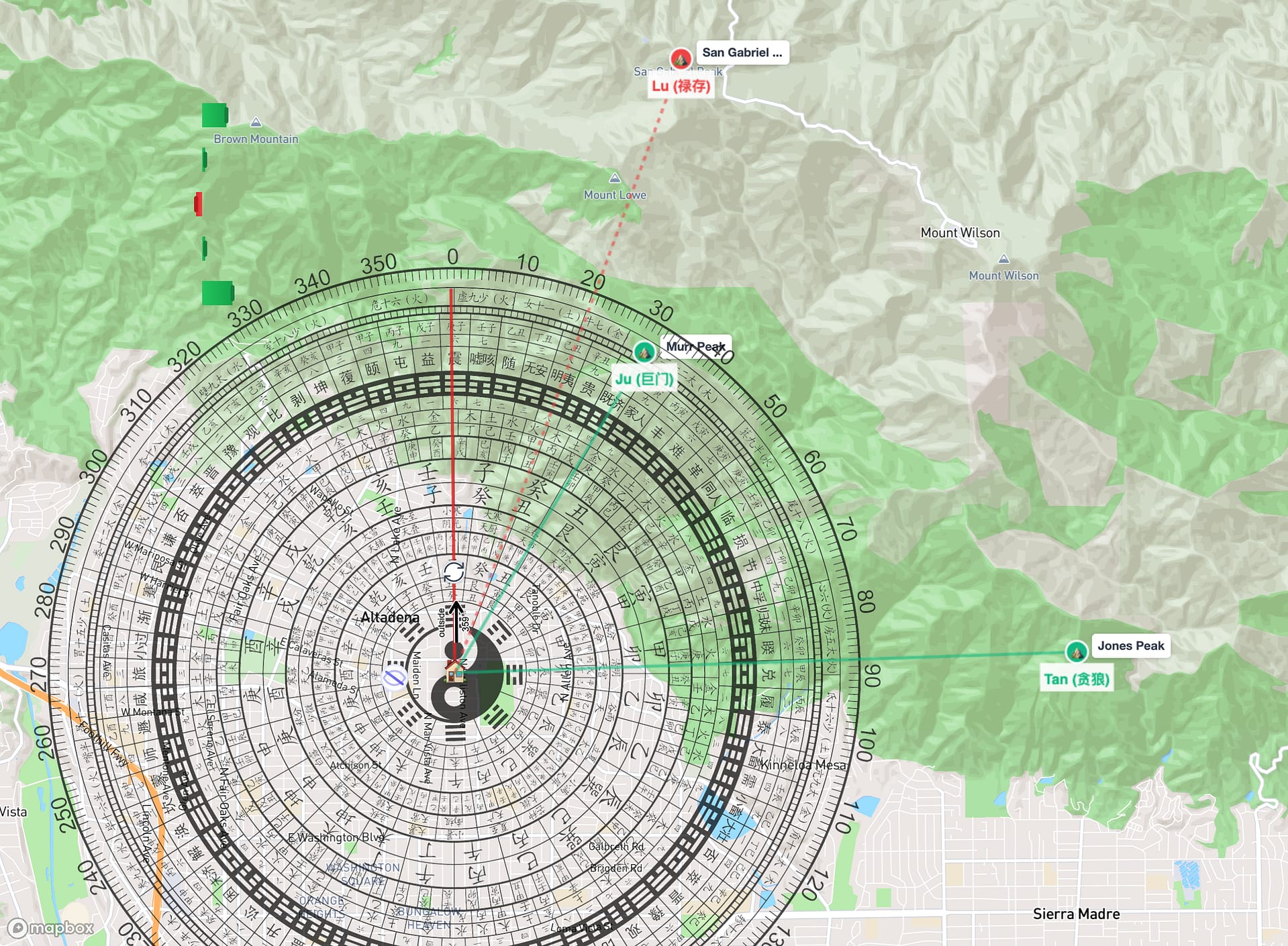
I analyzed a north-facing property in Altadena, California, sitting right at the base of the San Gabriel Mountains. The property faces 子 zǐ (North) and sits on 午 wǔ (South). Three significant peaks showed up in the nine star mountain scan.

Murr Peak landed at the Giant Gate star, one of the strongest auspicious positions in the nine star mountain system. The analysis reads: “wealth accumulation and financial prosperity, status and recognition in society, enhanced when accompanied by protective formations.” Advice: “excellent for business and wealth-building activities.”
Giant Gate energy is about deep, stable wealth. Not flashy gains, but the kind of financial foundation that compounds over time. For a property buyer or developer, having a prominent peak at Giant Gate is the landscape equivalent of a blue-chip holding in your portfolio.
Jones Peak landed at Greedy Wolf, the supreme star for scholarship, creativity, and career reputation. The analysis reads: “scholarly achievement and literary talent, human resources and nobility, elegant and upright energy when peak is well-formed.” Advice: “favorable for academic pursuits and creative endeavors.”
For real estate evaluation, Greedy Wolf on a well-formed peak signals strong career energy for the property’s occupants. Properties with this star on a clean, prominent ridge historically attract professionals, academics, and creative types. It’s the kind of signal that doesn’t show up on a listing sheet but shows up in who ends up living there.
Here’s where the feng shui mountain analysis gets interesting. San Gabriel Peak, the most prominent and iconic peak in the range, landed at Revenue/Accumulation (祿存). The name sounds great. The reality in the nine star system is the opposite.
Revenue/Accumulation signals: “prone to loss and decline, unstable financial situations, requires careful mitigation.” The report includes explicit warnings: “watch for financial losses and instability” and “avoid major investments in this direction.”
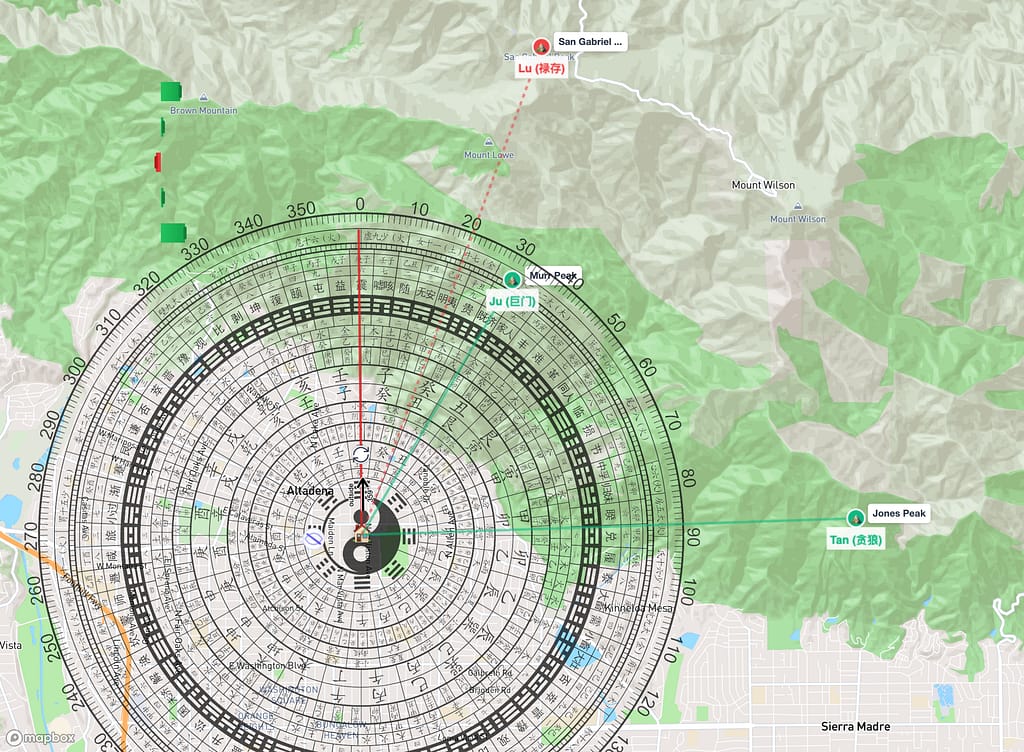
This star is the one most often misunderstood because of its name. “Revenue” sounds like income. In the nine star mountain tradition, it’s associated with money that comes in and leaves faster, medical expenses, and interpersonal friction.
Want to see how mountains and landforms score around a real property?
Our sample report runs Mountain Nine Star analysis on an actual property’s surroundings so you can see which formations help and which hurt.
The nine star mountain analysis scored this Altadena property at 59 out of 100 – “Fair.”
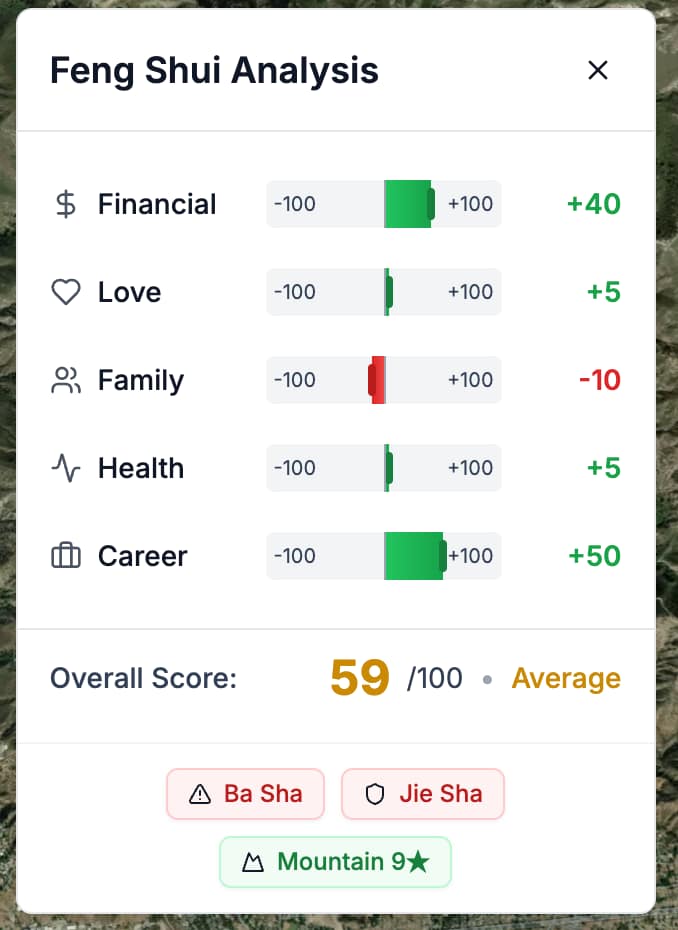
Without that one inauspicious peak, this property would likely score in the “Good” range (70+). But one problematic reading on the most prominent peak in the range pulls the entire assessment down to “Fair.” The scoring system doesn’t smooth things out nicely. It flags the risk.
The standard real estate pitch for foothill properties is “amazing mountain views.” And the views are amazing. But the nine star mountain method adds a layer of property evaluation that most buyers never consider: which specific peaks are visible, what compass bearing they sit at relative to your home, and what star energy they carry.
Two properties on the same street in Altadena, with the same mountain views, can have completely different nine star mountain readings if they face different compass directions. The facing direction determines the star mapping, so rotating a property even 15-20 degrees shifts which star governs which peak.
For developers choosing between two parcels with mountain views, the one where the dominant peak falls at Giant Gate or Greedy Wolf has a measurably different energy profile than the one where it falls at Revenue/Accumulation or Army Breaker.
Curious how the landscape around your home affects its energy?
Our sample report maps mountain and landform energy across a real property with Nine Star overlays that score every surrounding feature.
Nine star mountain analysis isn’t limited to natural peaks. In urban environments, tall buildings, water towers, transmission towers, and elevated structures all function as “virtual mountains.” A glass high-rise in your Army Breaker sector carries the same inauspicious flag as a jagged ridgeline would.
This means the mountain feng shui analysis applies in cities too. A new development going up next door isn’t just affecting your sight lines. The compass bearing of that structure relative to your property determines its star assignment, and that star determines whether the building’s presence is neutral, beneficial, or problematic.
Curious what 15+ classical feng shui systems reveal about a real home?
Our sample report shows every overlay on an actual floor plan so you can see the difference between classical analysis and generic advice.