Address
304 North Cardinal St.
Dorchester Center, MA 02124
Work Hours
Monday to Friday: 7AM - 7PM
Weekend: 10AM - 5PM
Address
304 North Cardinal St.
Dorchester Center, MA 02124
Work Hours
Monday to Friday: 7AM - 7PM
Weekend: 10AM - 5PM

Most people walk through their house every day without knowing that classical feng shui divides it into 8 distinct zones. Each zone is tied to a compass direction, a life area, and a natural element. Career is always North. Wealth is always Southeast. Love is always Southwest. The compass decides where these zones fall in your home, and they don’t move.
This system is called the Ba Gua (八卦), meaning “eight trigrams.” It’s one of the most widely recognized concepts in feng shui, but it’s also one of the most commonly misapplied. I’ll explain how it actually works using a real floor plan analysis.
The Ba Gua divides the space around a building’s center into 8 compass sectors. Each sector corresponds to a trigram from the I Ching and governs a specific aspect of life:
| Direction | Trigram | Life Area | Element |
|---|---|---|---|
| North | Kan (坎) | Career | Water |
| Northeast | Gen (艮) | Knowledge | Earth |
| East | Zhen (震) | Family | Wood |
| Southeast | Xun (巽) | Wealth | Wood |
| South | Li (离) | Fame | Fire |
| Southwest | Kun (坤) | Love | Earth |
| West | Dui (兑) | Children/Creativity | Metal |
| Northwest | Qian (乾) | Helpful People | Metal |
There’s also a 9th zone at the very center of the home called the Tai Chi. It represents overall health and balance. Most practitioners recommend keeping the center of your home open and uncluttered.
The critical point: these sectors are based on actual compass directions, not relative to your front door. This is where classical feng shui differs sharply from the Western BTB (Black Sect Tantric Buddhist) method, which aligns the Ba Gua based on whichever wall your entrance is on. Two completely different maps of the same home. Classical practitioners consider compass direction foundational to how the system functions.
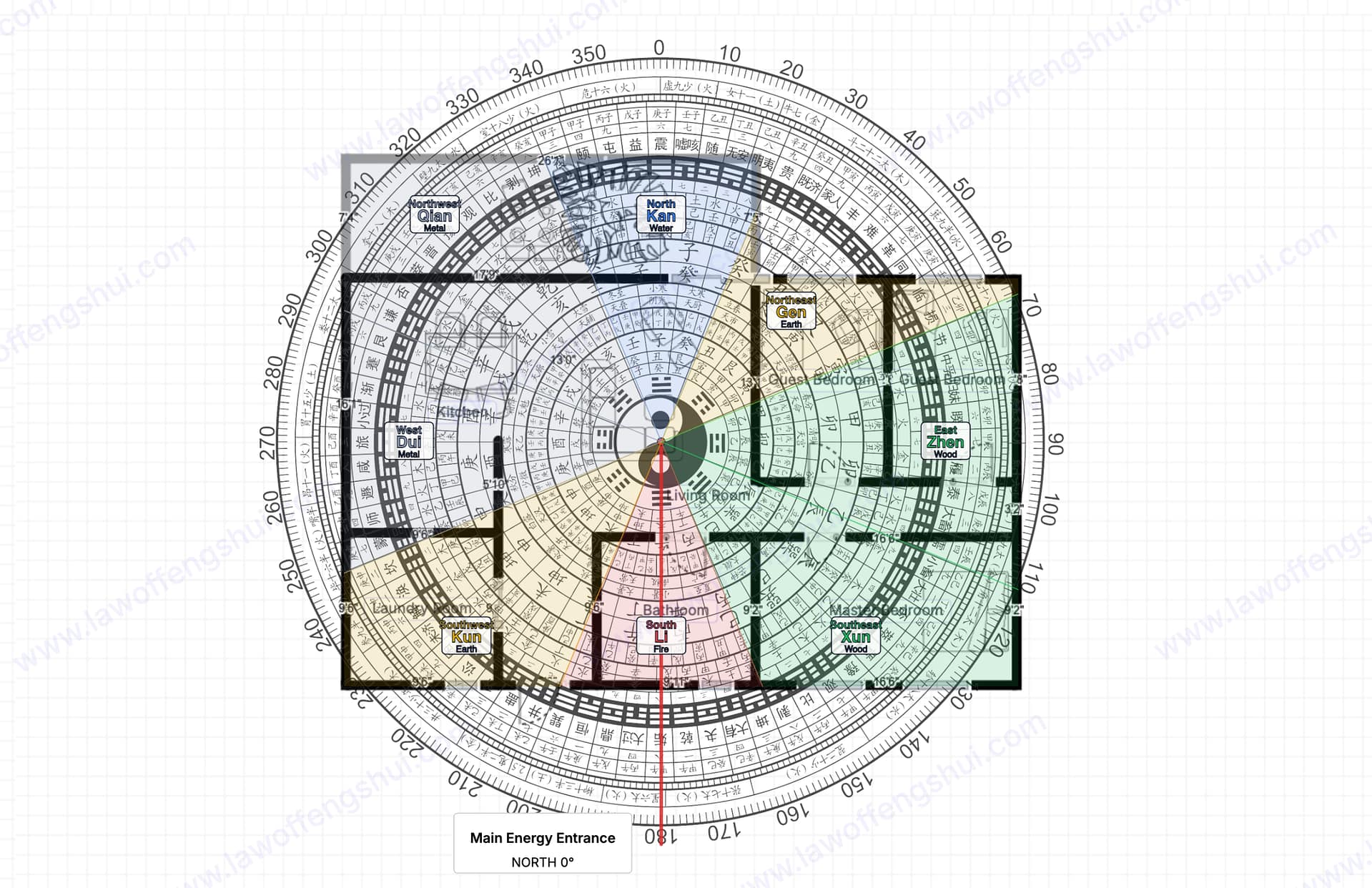
I ran the Ba Gua sector overlay on a 3-bedroom home at 4470 Champlain Way in San Diego, California. The property faces south, with the main entrance on the south wall.
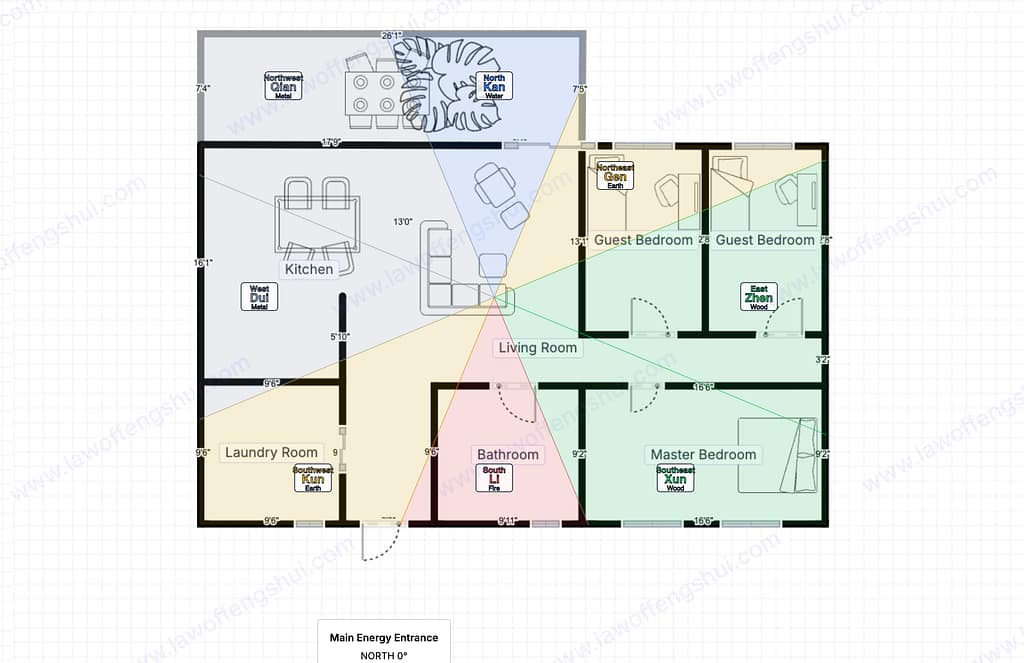
Here’s where each room landed:
The primary bedroom sits squarely in the Wealth zone. In classical feng shui, this is considered excellent placement for a bedroom. You rest and recover in the sector that governs prosperity, abundance, and fortunate opportunities. Wood element enhancements (green tones, plants, wooden furniture) would strengthen this zone further.
Both guest bedrooms fell in the Knowledge sector. If children occupy these rooms, the alignment is particularly good. Knowledge governs wisdom, self-cultivation, and spiritual growth. Earth element additions (warm earth tones, ceramics, low square furniture) support this energy. For a home office or study, you could hardly ask for a better sector.
The main gathering space of the house sits in the Family zone. This is one of those alignments that just works. Family, health, and new beginnings are the themes of the East sector. A living room where the family comes together in the Family zone? That’s natural resonance, not coincidence.
The kitchen landed in the Children and Creativity zone. There’s an interesting dynamic here. Cooking is inherently creative, so the resonance between kitchen activity and the Creativity sector makes intuitive sense. Metal element is the governing force here. White, gray, and metallic accents support this zone.
Not every room lands in its ideal sector. The bathroom fell in the Fame sector (South – Li – Fire). Fame governs your reputation, recognition, and how others perceive you. A bathroom in this sector means water is literally draining out of your reputation zone. It’s not catastrophic, but classical practitioners would flag it.
The laundry room sits in the Love sector (Southwest – Kun – Earth). Your romantic relationships and partnerships zone is… where you sort socks. Again, not a deal-breaker, but if you wanted to strengthen the Love area of your life, the laundry room isn’t contributing positively.
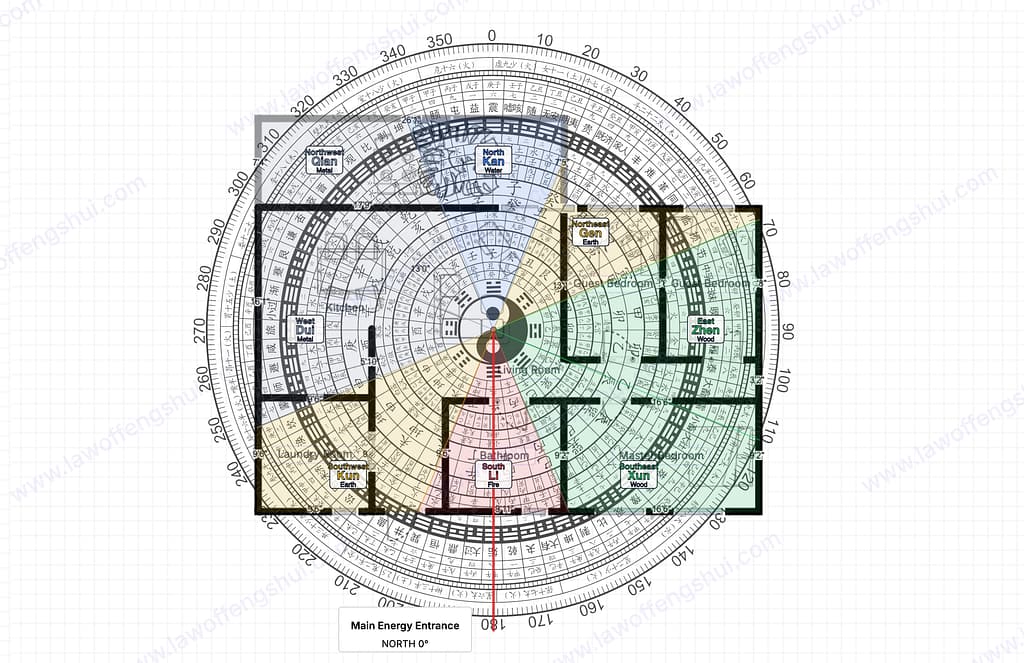
Want to see all 8 energy zones mapped on a real floor plan?
Our sample report runs the full Ba Gua compass overlay on an actual property so you can see where each zone lands room by room.
You can’t move the Ba Gua zones. They’re fixed to compass directions. But you can work with them.
Strengthen a sector with its element. Each of the 8 sectors has a governing element, and you can introduce that element through design choices:
Compensate for problematic placements. A bathroom in the Fame/Fire sector? You can add fire element accents (red towels, bright lighting, warm-toned decor) to counterbalance the draining water energy. A laundry room in the Love sector? Introduce earth element touches (warm yellow walls, a ceramic vase, square storage containers) to reinforce the zone.
Be intentional about room assignments. If you’re moving into a new home or rearranging, knowing which room falls in which sector gives you a framework. Should the home office go in the Career zone or the Knowledge zone? Should the master bedroom be in Wealth or Love? The Ba Gua gives you a structured way to think about this beyond “which room is biggest.”
This is worth emphasizing because it’s the single biggest source of confusion in feng shui.
Classical Ba Gua places sectors based on magnetic compass direction. Career is always North, no matter where your front door is. If your door faces East, Career is still North. If your door faces South, Career is still North.
Western (BTB) Ba Gua aligns the Career sector with your front door, regardless of compass direction. Walk through the door, and Career is beneath your feet. Wealth is the far-left corner. Love is the far-right corner.
Two people analyzing the same house will get completely different maps depending on which method they use. A room that’s in the “Wealth” zone under BTB might be in the “Knowledge” zone under classical. This is why feng shui advice online can seem contradictory. People are using different systems without specifying which one.
Classical practitioners (and this analysis) use the compass method. The reasoning: if compass direction didn’t matter, why would feng shui have developed an entire system of directional analysis over thousands of years?
Curious which energy zone your bedroom falls in?
Our sample report maps Ba Gua sectors across a real floor plan and scores each room against the 8 life areas.
Curious what 15+ classical feng shui systems reveal about a real home?
Our sample report shows every overlay on an actual floor plan so you can see the difference between classical analysis and generic advice.
You need two things: a compass reading for your property’s facing direction, and a floor plan. Take a compass reading at your front door facing outward. Then overlay the 8 Ba Gua sectors onto your floor plan with North at compass North. Whichever sector your bedroom falls in is its governing zone.
Yes. The Ba Gua applies to any enclosed space. For an apartment, use the main entrance as your facing reference and overlay the 8 sectors onto your unit’s floor plan. The compass directions remain the same regardless of which floor you’re on.
No. The zones are fixed to compass directions. You can’t move Southeast to a different part of your house. What you can do is work with the zone by introducing its governing element through design choices, or by being intentional about which activities happen in which rooms.
The Ba Gua is a static map. It shows the same 8 zones every year. Flying Stars (Xuan Kong) adds a time dimension. Stars rotate annually, monthly, and even daily, creating dynamic energy patterns layered on top of the fixed Ba Gua sectors. They’re different systems that work in concert, not alternatives.