Address
304 North Cardinal St.
Dorchester Center, MA 02124
Work Hours
Monday to Friday: 7AM - 7PM
Weekend: 10AM - 5PM
Address
304 North Cardinal St.
Dorchester Center, MA 02124
Work Hours
Monday to Friday: 7AM - 7PM
Weekend: 10AM - 5PM

What is Fengshui, Really?
For over 3,000 years, this Chinese practice has shaped how buildings are oriented, rooms are arranged, and spaces are designed. Today, researchers are discovering why many of these ancient principles align with what environmental psychology tells us about how spaces affect human wellbeing. Here's what you need to know.

The Ancient Art of Harmonizing Space
Fengshui (風水) literally translates to "wind-water" in Chinese: two natural forces that have shaped landscapes and human settlements throughout history. At its core, fengshui is a systematic approach to understanding how the arrangement of space affects the people who inhabit it.
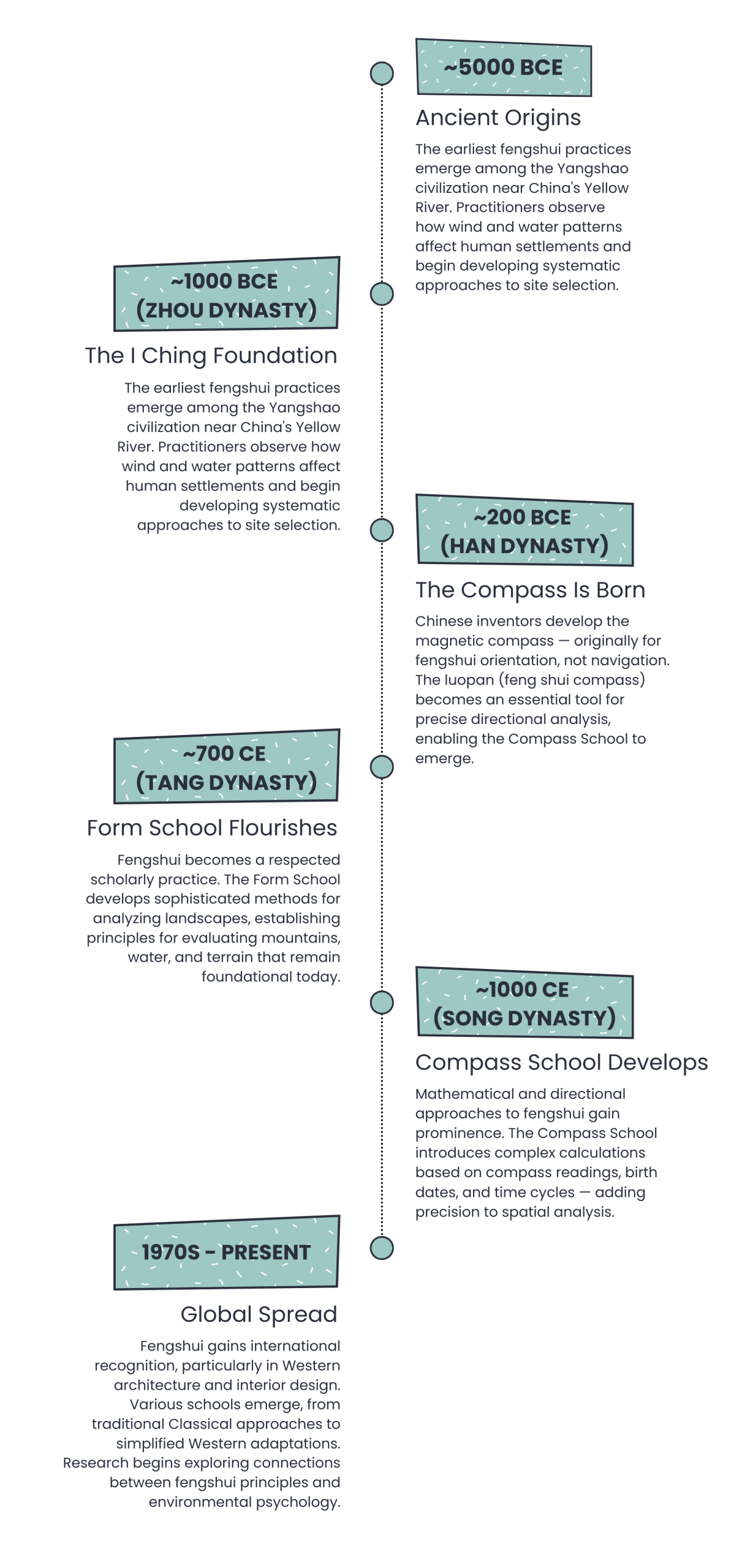
The practice originated approximately 5,000 years ago among the Yangshao civilization near China's Yellow River. Initially used to determine optimal burial sites and building orientations, fengshui evolved into a sophisticated system for analyzing how physical environments influence human health, prosperity, and wellbeing.
Unlike casual interior decorating, fengshui follows specific principles developed and refined over millennia. It considers the orientation of buildings relative to compass directions, the flow of energy through rooms, the relationship between a structure and its surrounding landscape, and the positioning of furniture and objects within spaces.
The Six Foundational Concepts
Qi — The Life Force
Qi (pronounced "chee") is the vital energy believed to flow through all living things and spaces. In practical terms, qi represents the quality of a space — how air circulates, how light enters, how movement flows through rooms. Stagnant qi (blocked pathways, cluttered corners) creates discomfort; flowing qi (clear circulation, balanced proportions) promotes wellbeing. Environmental psychology research confirms that spaces with good air quality and natural circulation support better cognitive function and mood
Yin & Yang — Balance of Opposites
Yin represents passive, soft, dark, and cool energy. Yang represents active, bright, warm, and stimulating energy. Every space needs both. Bedrooms should lean yin (soft textures, muted colors, dim lighting) to support rest. Home offices and kitchens should lean yang (brighter lighting, more angular furniture, energizing colors) to support activity. This principle aligns with modern understanding of how environmental factors affect arousal levels and productivity.
The Five Elements
Wood, Fire, Earth, Metal, and Water represent different qualities of energy. Each element can be introduced through colors, materials, and shapes. Wood (green, rectangular) promotes growth and creativity. Fire (red, triangular) brings passion and visibility. Earth (yellow/brown, square) provides stability. Metal (white/gray, circular) supports logic and precision. Water (black/blue, wavy) encourages wisdom and flow. These elements interact through productive and controlling cycles — a system for balancing spatial energy.
The Bagua — Eight Life Areas
The bagua is an octagonal energy map divided into eight sections, each corresponding to a life area: Career (North), Knowledge (Northeast), Family (East), Wealth (Southeast), Fame (South), Relationships (Southwest), Creativity (West), and Helpful People (Northwest). When overlaid on a floor plan, the bagua reveals which physical spaces influence which aspects of life — providing a framework for intentional design decisions.
The Commanding Position
The commanding position is one of fengshui's most practical principles. It recommends placing key furniture — beds, desks, stoves — where you can see the main entrance without being directly in line with it. Psychologically, this reduces the "fight or flight" response triggered when we can't see who might approach. Research suggests this positioning lowers stress hormones and improves focus, explaining why this ancient recommendation still resonates today.
Form School
Before analyzing interiors, classical fengshui examines the external environment. The Form School evaluates how surrounding landforms, water features, roads, and neighboring buildings affect a property. Protective hills behind a structure, open space in front, and balanced features on either side create what practitioners call an "armchair" formation — optimal conditions for occupant wellbeing. This environmental awareness parallels modern site analysis in architecture and urban planning.
3,000+ Years of Spatial Wisdom
From ancient burial practices to modern design consultations, fengshui has continuously evolved while maintaining its core principles.
Not All Fengshui Is the Same
Form School (Xing Shi Pai)
The oldest approach, originating in southern China's mountainous regions. Form School focuses on the physical landscape — mountains, rivers, terrain shapes, and the natural environment. It evaluates sites using the "Four Celestial Animals" concept: protective mountain (Black Tortoise) behind, open space (Red Phoenix) in front, and balanced formations (Green Dragon and White Tiger) on either side. This school emphasizes what you can see and feel in an environment.
Classical/Traditional Fengshui
Integrates both Form and Compass approaches using actual compass directions and time-based calculations. This rigorous method considers the building's facing direction, construction date, and annual energy shifts. Practitioners typically undergo years of training to master the mathematical and analytical frameworks.
Compass School (Li Qi Pai)
Uses the luopan (fengshui compass) and mathematical calculations based on compass directions and the I Ching. The Compass School adds precision through formulas and directional analysis. Major branches include San He (Three Harmonies), which focuses on water flow and mountain formations, and San Yuan (Three Cycles), which incorporates time periods and includes the popular Flying Stars system.
BTB/Western Fengshui
A simplified adaptation introduced to the West in the 1970s. BTB (Black Sect Tantric Buddhism) aligns the bagua map based on the main entrance rather than compass directions, making it more accessible to beginners. While popular in Western countries, traditional practitioners note that this approach omits directional and temporal calculations central to classical practice.
Common Misconceptions
Lucky objects and charms can change your fengshui.
Objects like money toads, fu dogs, and crystals are decorative items with cultural significance — they don't alter the fundamental energy of a space. Real fengshui focuses on building orientation, room layout, furniture positioning, and environmental factors. As one study noted, objects "cannot do much to the overall feng shui of a property — their purposes are entirely decorative."
"Fengshui brings instant wealth and success."
No spatial arrangement can guarantee financial outcomes. Fengshui can create environments that support focus, reduce stress, and promote wellbeing — conditions that may help you work more effectively toward your goals. But it's not a substitute for effort, skill, and opportunity.
"Fengshui is just about rearranging furniture."
Furniture placement is one small component. Classical fengshui analyzes building orientation, surrounding environment, internal room relationships, directional influences, and temporal factors. The commanding position for beds and desks matters, but it's part of a much larger analytical framework.
"Certain numbers are lucky or unlucky in fengshui."
The avoidance of "4" (which sounds like "death" in Chinese) is cultural superstition, not fengshui principle. Authentic fengshui doesn't assign luck to addresses or phone numbers. This conflation of cultural folklore with systematic spatial analysis has contributed to misconceptions about the practice.
"Mirrors can direct good energy and repel bad energy."
Mirrors have specific uses in fengshui — primarily to expand visual space or redirect views — but they're not "smart" enough to selectively attract or repel different types of energy. The oversimplification of mirror placement has become one of the most common misunderstandings in popular fengshui books.
"You need to believe in fengshui for it to work."
Many fengshui principles operate regardless of belief. Good natural light improves mood whether or not you attribute it to qi flow. Positioning your desk to see the door reduces stress whether or not you call it the commanding position. The practice offers practical spatial optimization — belief is optional.
Modern Applications Across Industries
Real Estate
Real estate professionals use fengshui analysis to understand why certain properties sell quickly while others linger on the market. Environmental factors — T-junctions pointing at entrances, building orientation, surrounding structures — affect how buyers feel during walkthroughs. Agents who can identify and address these factors gain competitive advantage.
Interior Design
Interior designers integrate fengshui principles to create spaces that feel balanced and supportive. Beyond aesthetics, they consider furniture positioning for occupant comfort, color selection for appropriate energy levels, and spatial flow for ease of movement. Fengshui provides a framework for design decisions that goes deeper than visual appeal.
Architecture
Architects increasingly encounter clients requesting fengshui-informed design. Site analysis, building orientation, entrance placement, and room relationships all fall within fengshui's scope — overlapping significantly with architectural concerns. Some firms now integrate fengshui consultation into their design process, particularly for wellness-focused projects.
Commercial Spaces
Businesses apply fengshui to retail stores, restaurants, offices, and hospitality properties. Reception area positioning, desk arrangements for employees, customer flow patterns, and conference room setups all benefit from spatial analysis. The wellness real estate market, valued at over $275 billion globally, increasingly incorporates these principles.
Questions We Hear Most Often
Honest answers to the questions people ask when they're trying to understand fengshui.
Fengshui is not a religion. While it developed within Chinese philosophical traditions that include Taoism and Confucianism, fengshui itself is a systematic approach to spatial analysis. It doesn't require any particular religious belief and has been applied successfully by people of all faiths — and no faith — around the world. Think of it as an ancient environmental science rather than a spiritual practice.
Interior design focuses primarily on aesthetics, functionality, and style preferences. Fengshui adds another layer: analyzing how spatial arrangements affect occupant wellbeing based on principles developed over millennia. An interior designer asks "Does this look good and work well?" A fengshui analysis asks "How will this space make people feel over time?" The two disciplines complement each other.
Yes. Many fengshui recommendations have practical benefits regardless of belief. Positioning furniture to see doorways reduces startle responses. Decluttering improves focus (Princeton research confirms this). Maximizing natural light improves mood. Good circulation improves air quality. You can implement these changes for their evidence-based benefits alone.
Classical fengshui uses actual compass directions and incorporates time-based calculations. Western fengshui (BTB/Black Hat Sect) simplifies the system by aligning the bagua based on the entrance regardless of compass direction. Classical methods are more comprehensive but require more expertise. Western methods are more accessible but omit significant analytical dimensions.
Fengshui can create environmental conditions that support these areas of life. A bedroom optimized for sleep can improve health. A home office positioned for focus can support career advancement. A living space arranged for conversation can nurture relationships. What fengshui cannot do is guarantee outcomes — it creates supportive conditions, not magical results.
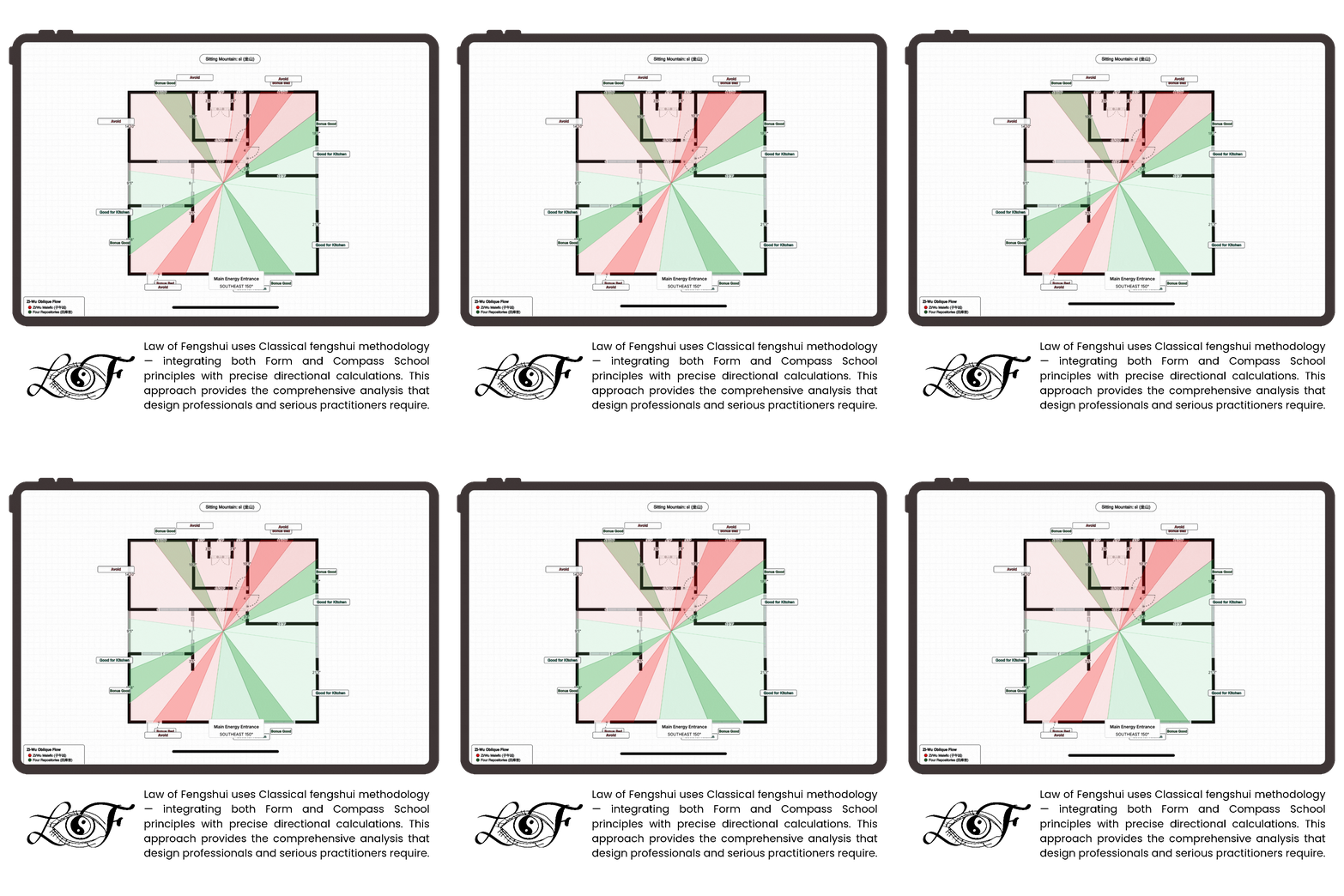
Law of Fengshui automates Classical fengshui analysis using both Form and Compass School methodologies. The system analyzes building surroundings using satellite maps, maps energy zones throughout floor plans, provides furniture placement guidance based on directional calculations, and offers an AI assistant that answers fengshui questions in plain language. It brings practitioner-level analysis to design professionals without requiring years of specialized training.
No. Most fengshui adjustments don't require renovation. Furniture repositioning, decluttering, strategic use of mirrors and plants, and optimized room assignments can all improve a space's fengshui without structural changes. Even renters can implement meaningful improvements using these non-permanent approaches.
Some effects are immediate — repositioning your desk to see the door can reduce stress from the first day. Other changes accumulate gradually as you spend time in the optimized space. Practitioners suggest allowing 27 days to a few months to fully experience the effects of significant changes, though this varies based on the nature and scale of adjustments made.